
From Mendel's Factors to Chromosomes — The Big Leap
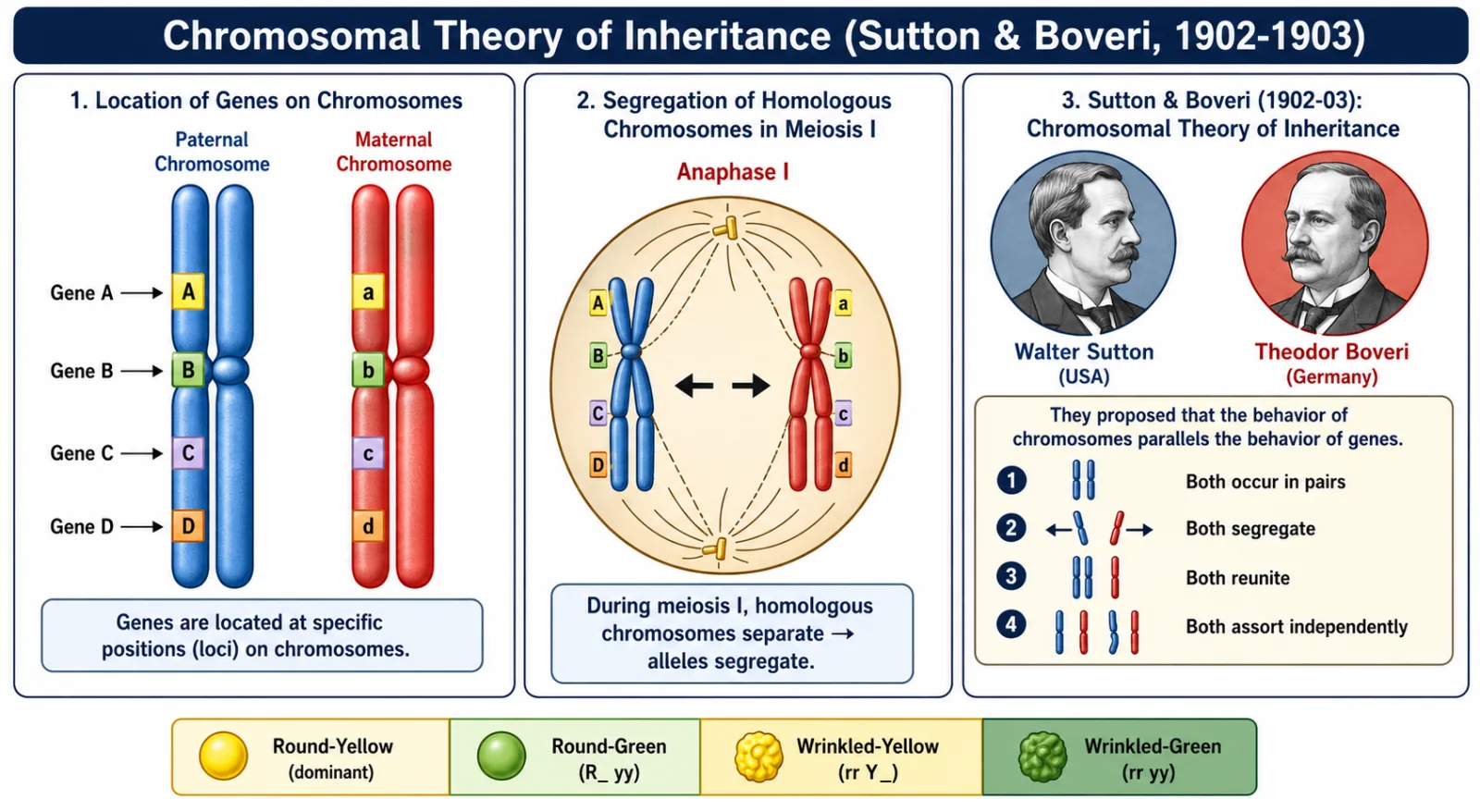
By 1900, Mendel had been rediscovered — de Vries, Correns and von Tschermak independently arrived at the same results and pulled his 1866 paper out of obscurity. (It had been ignored for over three decades: communication was poor, his mathematical approach seemed alien to biologists, and he could give his "factors" no physical identity.) Those "factors" (genes) clearly existed — but no one knew what they physically were or where they lived inside the cell. Were they tiny particles? Invisible droplets? Some abstract mathematical entity?
Meanwhile, microscopy had advanced enormously since Mendel's time. Cell biologists could now see chromosomes condensing and segregating during meiosis with stunning clarity. In 1902, two scientists — independently and on opposite continents — noticed a startling parallel.
The two scientists:
- Walter Sutton (USA) — studied grasshopper sperm formation.
- Theodor Boveri (Germany) — studied sea urchin embryology.
What they realised, almost simultaneously, was this:
Mendel's "factors" behave EXACTLY like chromosomes during meiosis.
This insight became the Chromosomal Theory of Inheritance (1902-1903). It linked the abstract Mendelian factors to the physical chromosomes, kick-starting the modern science of cytogenetics.
The Parallel Behaviour — Why Sutton & Boveri Made the Link
Here's the side-by-side comparison that Sutton drew (and which has been on every NEET / Board paper since):
| Behaviour | Mendel's "Factors" (Genes) | Chromosomes |
|---|---|---|
| Existence in pairs | Genes exist in pairs in a diploid cell (one from each parent) | Chromosomes exist in homologous pairs (one from each parent) |
| Separation during gamete formation | Alleles segregate, with each gamete carrying only one allele of each gene | Homologous chromosomes separate during Meiosis I, each gamete carries only one chromosome of each pair |
| Reunion at fertilisation | The two alleles of a gene unite again in the zygote | The two homologous chromosomes are restored at fertilisation |
| Independent assortment | Alleles of different genes assort independently | Different chromosome pairs assort independently during Meiosis I |
The match was uncanny. If Mendel's factors behave like chromosomes, the simplest explanation is that factors ARE on chromosomes.
The hypothesis (1902-1903):
Genes (Mendel's factors) are physical entities located on chromosomes. Chromosomes serve as the vehicles by which genes are transmitted from parent to offspring.
This was a hypothesis in 1902 — convincing but not proven. It needed experimental confirmation. That came from Thomas Hunt Morgan about a decade later, using fruit flies.
Thomas Hunt Morgan & the Fruit Fly Confirmation
Thomas Hunt Morgan (1866–1945) was an American geneticist working at Columbia University in the early 1900s. He chose Drosophila melanogaster (fruit fly) as his experimental organism — and this choice transformed genetics into a precise experimental science.
Why fruit fly?
- Very fast life cycle: ~2 weeks from egg to adult; multiple generations per year.
- Many offspring: Each female lays hundreds of eggs.
- Easy to maintain: Grows on a simple synthetic medium (banana mash in the early labs). Cheap to keep thousands in milk bottles.
- Small genome: Only 4 pairs of chromosomes (compared to humans' 23 pairs).
- Many visible mutations — eye colour, wing shape, body colour all show inherited variations.
- Distinguishable male and female (males smaller, with darker abdomens, "sex combs" on front legs).
Morgan's key contributions to confirming the Chromosomal Theory:
Discovery of sex-linked inheritance (1910): Morgan found a white-eyed male fruit fly (mutation; wild-type eye colour is red). When he crossed it with normal red-eyed females, the inheritance pattern showed that white eye was inherited in a sex-linked manner — appearing differently in male vs female offspring. This was the FIRST direct evidence that a gene was on a specific chromosome (the X chromosome).
Discovery of linkage and recombination: Morgan and his students (including Sturtevant, Bridges, Muller — all later Nobel laureates) found that some genes do NOT assort independently — they tend to be inherited together. This violated Mendel's third law. They explained it by linkage — when genes are on the same chromosome, they tend to be inherited together (Section 8).
Construction of gene maps: Sturtevant (Morgan's student) used recombination frequencies to construct the first linkage maps — physical maps showing the relative positions of genes on chromosomes (centiMorgan unit).
Morgan received the Nobel Prize in Physiology or Medicine in 1933 for this work — the first geneticist to be so honoured. His "fly room" at Columbia became the most famous laboratory in genetics history.
[NEET fact] Drosophila has only 4 pairs of chromosomes (2n = 8): 3 pairs of autosomes + 1 pair of sex chromosomes. This small genome and short life cycle made it ideal for mapping experiments.
Memory Capsule — Section 7
5 facts to lock in:
Chromosomal Theory of Inheritance (1902-1903): proposed independently by Walter Sutton (USA, grasshopper) and Theodor Boveri (Germany, sea urchin). "Genes are on chromosomes."
The 4 parallels between Mendel's factors and chromosomes: existence in pairs, segregation, reunion at fertilisation, independent assortment. This is what convinced Sutton.
Thomas Hunt Morgan (Columbia University) experimentally confirmed the Chromosomal Theory using Drosophila melanogaster (fruit fly).
Morgan's main contributions: discovery of sex-linked inheritance (white-eyed fruit fly), discovery of linkage and recombination, construction of gene maps. Nobel Prize 1933.
Why Drosophila is ideal: 2-week life cycle, hundreds of offspring per female, easy maintenance, only 4 pairs of chromosomes (2n = 8), many visible mutations, distinguishable males and females.
One question to anchor: "Why is Drosophila ideal for genetic studies?" — recall the 6 reasons.
Solved Examples — Section 7
Q1. State the Chromosomal Theory of Inheritance. Who proposed it and when?
Answer: Genes (Mendel's "factors") lie on chromosomes, which are the physical carriers that transmit heredity from parents to offspring. Walter Sutton (working on grasshopper sperm) and Theodor Boveri (working on sea urchin embryos) proposed it independently around 1902–1903, after noticing that Mendel's factors segregate and assort exactly as chromosomes do in meiosis. Morgan confirmed it experimentally a decade later.
Q2. Describe 3 parallels between Mendel's factors and chromosomes that led Sutton to propose the Chromosomal Theory.
Answer: (1) Both exist in pairs in a diploid cell, one member from each parent; (2) both separate during gamete formation — alleles segregate as homologous chromosomes part in Meiosis I; (3) different pairs assort independently. (A fourth parallel: both are restored at fertilisation.)
Q3. Why is Drosophila melanogaster an ideal organism for genetic studies?
Answer: Its short ~2-week life cycle gives many generations quickly, each female yields hundreds of offspring for solid statistics, and it is cheap to rear on banana medium. It also has only 4 pairs of chromosomes (2n = 8), many visible mutations (eye colour, wing shape, body colour), and easily distinguishable sexes — ideal for controlled crosses.
Q4. Who first discovered sex-linked inheritance and in which organism? Briefly describe the experimental basis.
Answer: Thomas Hunt Morgan, in 1910, using Drosophila. He crossed a mutant white-eyed male with red-eyed females: the F1 were all red-eyed, and the F2 gave a 3 red : 1 white ratio in which every white-eyed fly was male. Since the trait tracked with sex, the eye-colour gene had to sit on the X chromosome — the first proof that a specific gene maps to a specific chromosome.
Q5. What is the chromosome number (2n) of Drosophila melanogaster? Why does this make it suitable for genetic studies?
Answer: 2n = 8 — four pairs (three autosomal pairs plus XX/XY sex chromosomes). So few chromosomes makes it easy to track which gene sits on which chromosome and to do linkage mapping, and the four pairs differ in size under the microscope. (Humans, by contrast, have 2n = 46.)