
How is Sex Determined? Four Major Systems in the Animal Kingdom
In humans, sex is sealed the moment a sperm fertilises an egg. An X-carrying sperm gives a female embryo (XX); a Y-carrying sperm gives a male embryo (XY). But the machinery for deciding male vs female isn't the same everywhere — across the animal kingdom there are 4 major systems, each elegant in its own way.
Why does sex determination matter?
- It governs the production of male and female gametes.
- It sets the inheritance pattern of sex-linked genes (Section 11).
- It has consequences for genetic disorders (haemophilia, for instance, is far more common in males because of X-linkage).
- It is heavily tested in NEET and Board exams.
The 4 systems we'll cover:
- XX-XY system — humans, most mammals, fruit flies.
- XO system — many insects (grasshoppers, true bugs).
- ZW system — birds, snakes, butterflies, some fish.
- Haplo-diploid system — bees, ants, wasps.
Key concept: heterogamety vs homogamety
- The sex that produces two different types of gametes (a human male makes X and Y sperm) is heterogametic.
- The sex that produces only one type of gamete (a human female makes only X eggs) is homogametic.
The Four Major Sex Determination Systems
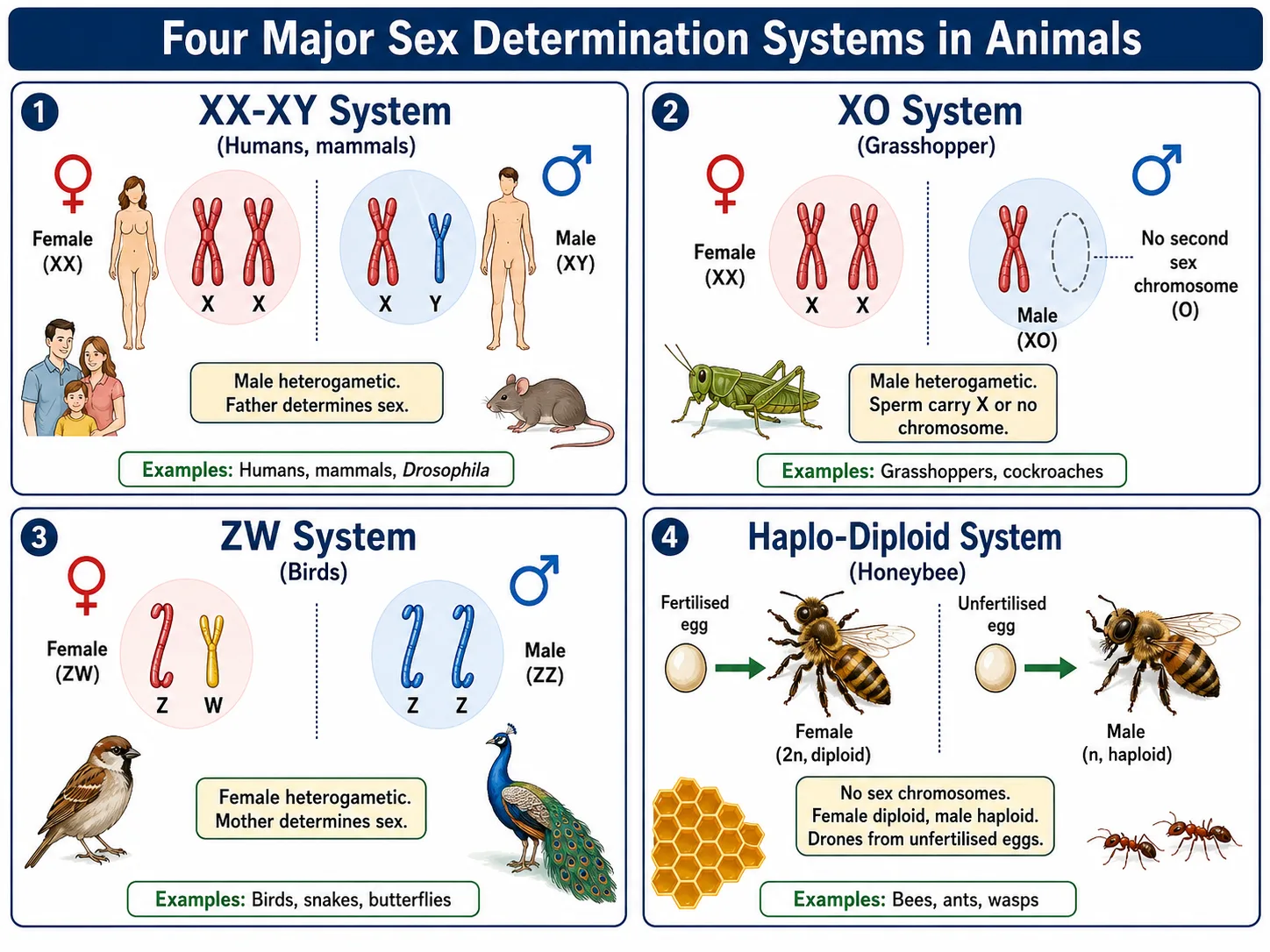
1. XX-XY type (humans, most mammals, fruit fly):
- Female: XX (homogametic — all eggs carry X).
- Male: XY (heterogametic — sperm carry either X or Y).
- The offspring's sex hinges entirely on which sperm fertilises the egg.
If X sperm + X egg → XX (female). If Y sperm + X egg → XY (male).
So the father determines the sex in humans, not the mother — a Board / NEET favourite.
In humans, the Y chromosome carries the SRY gene (Sex-determining Region of Y); its expression triggers male development. Without SRY (or with a defective copy), the embryo develops as female by default.
2. XO type (many insects: grasshoppers, true bugs, cockroaches):
- Female: XX (homogametic — all eggs carry X).
- Male: XO (heterogametic — a single X, no Y; sperm carry either X or nothing).
- Sex depends on whether the fertilising sperm carries an X or no sex chromosome at all.
If X sperm + X egg → XX (female). If "O" sperm + X egg → XO (male).
In XO systems, sex turns on the presence or absence of a single sex chromosome (X), not on an X-vs-Y choice.
3. ZW type (birds, snakes, butterflies, some fish):
The naming is just convention: rather than XY/XX, ornithologists used ZW/ZZ to avoid confusion.
- Female: ZW (heterogametic — eggs carry either Z or W).
- Male: ZZ (homogametic — all sperm carry Z).
- Here the mother determines the sex (the reverse of mammals).
If Z egg + Z sperm → ZZ (male). If W egg + Z sperm → ZW (female).
Note: Z and W are different chromosomes (different sizes and gene content), unlike the matched XX in mammalian females. (Exactly how the Z and W chromosomes set sex in birds is more involved and beyond the syllabus.)
4. Haplo-diploid type (bees, ants, wasps):
This is the most unusual system.
- Female workers and queens are DIPLOID (2n) — they develop from FERTILISED eggs.
- Males (drones) are HAPLOID (n) — they develop from UNFERTILISED eggs (parthenogenesis).
- Sex is set by whether the egg is fertilised, not by any sex chromosome.
If fertilised egg (2n) → female (worker or queen, depending on diet). If unfertilised egg (n) → male (drone).
Why this matters genetically: a male drone has NO father (only a mother — the queen). He is essentially a "swimming sperm cell" with wings, and he produces sperm by mitosis (no meiosis needed — he's already haploid).
[NEET fact] Heterogametic sex:
- Mammals (XY): MALE is heterogametic.
- XO insects: MALE is heterogametic.
- Birds (ZW): FEMALE is heterogametic.
- Bees: not applicable (sex is set by ploidy, not chromosomes).
Sex Determination in Humans — A Closer Look
Humans are XX/XY mammals. Let's get into the molecular and historical detail.
The chromosome count:
- Every human (male or female) has 22 pairs of autosomes + 1 pair of sex chromosomes = 23 pairs = 46 chromosomes.
- Female: 22 autosomal pairs + XX → karyotype 46, XX.
- Male: 22 autosomal pairs + XY → karyotype 46, XY.
How the father determines sex:
The father (XY) makes sperm by meiosis. Each sperm carries either:
- 22 autosomes + X (X-sperm), OR
- 22 autosomes + Y (Y-sperm).
The mother (XX) makes eggs by meiosis, and every egg carries 22 autosomes + X.
At fertilisation:
- X-sperm + X-egg → XX zygote → female.
- Y-sperm + X-egg → XY zygote → male.
The child's sex depends entirely on which sperm reaches the egg first. The mother contributes only X chromosomes; all the variation lies in the father's sperm.
This is biologically and socially important. In many cultures (including parts of India), mothers have been blamed for bearing "only daughters". That blame is scientifically wrong — the father is the parent who can contribute either an X or a Y sperm. The mother always contributes X.
SRY gene — the master switch:
The Y chromosome is short and gene-poor, but it carries one critical gene: SRY (Sex-determining Region of the Y chromosome).
- SRY codes for a transcription factor that switches on the genes driving testis formation in the early embryo.
- Without SRY (or with a defective one), the gonads develop as ovaries by default → female phenotype.
- It was identified only in 1990 — remarkably late, given how pivotal it is.
Discovery of the X chromosome:
In 1891, Hermann Henking spotted an extra-staining body in the sperm of certain insects and called it the "X-element" (X for unknown). Later work confirmed that Henking's X-element was indeed a chromosome tied to sex determination, and it was renamed the X chromosome. Henking (1891) is credited as its foundational discoverer.
Memory Capsule — Section 10
5 facts to lock in:
- Four sex determination systems:
- XX-XY: humans, most mammals, fruit fly. Male heterogametic.
- XO: many insects (grasshoppers). Male heterogametic (no Y).
- ZW: birds, snakes, butterflies. Female heterogametic.
- Haplodiploid: bees, ants, wasps. No sex chromosomes — males haploid, females diploid.
In humans, the FATHER determines the sex — he contributes either X-sperm (→ female) or Y-sperm (→ male). The mother always contributes X.
Human karyotype:
- Female: 46, XX (22 autosome pairs + XX).
- Male: 46, XY (22 autosome pairs + XY).
SRY gene on the Y chromosome triggers testis formation → male development. Without SRY → female by default.
History: X chromosome discovered by Henking (1891), who named it the "X body"; later shown to be a chromosome involved in sex determination.
Two NEET-friendly facts:
- "Male determines sex in humans" — true.
- "Female determines sex in birds" — true (the female is ZW, the heterogametic sex).
Solved Examples — Section 10
Q1. Why is the human male called the heterogametic sex while the female is homogametic?
Answer: The female (XX) makes only one kind of egg, all X-bearing — one gamete type, so homogametic. The male (XY) makes two kinds of sperm, X-bearing and Y-bearing in roughly equal numbers — two gamete types, so heterogametic. Because of this, the sperm decides the offspring's sex: X-sperm × X-egg → XX female, Y-sperm × X-egg → XY male. The mother, contributing only X, cannot influence it.
Q2. Compare the XX-XY, XO, and ZW sex determination systems with one example each.
Answer: In XX-XY and XO the male is heterogametic; in ZW the female is.
| System | Female | Male | Heterogametic sex | Example |
|---|---|---|---|---|
| XX-XY | XX | XY | Male | Humans, mammals, Drosophila |
| XO | XX | XO (one X, no Y) | Male | Grasshoppers, cockroaches |
| ZW | ZW | ZZ | Female | Birds, snakes, butterflies |
In every case the offspring's sex is set by which gamete comes from the heterogametic parent.
Q3. Explain sex determination in honeybees. Why are male bees called drones and how do they arise?
Answer: Honeybees use the haplodiploid system. Females (queens and workers) are diploid (2n = 32) and develop from fertilised eggs; males (drones) are haploid (n = 16) and develop from unfertilised eggs by parthenogenesis. The queen stores sperm from her mating flight and chooses whether to fertilise each egg. A drone therefore has no father, and since he's already haploid he makes sperm by mitosis rather than meiosis. Haplodiploidy is unique to Hymenoptera (bees, ants, wasps).
Q4. A married couple is unable to conceive a male child despite having two daughters. The wife is blamed in the family. Explain scientifically why this blame is wrong.
Answer: In humans the father, not the mother, determines a child's sex. The father (XY) makes 50% X-sperm and 50% Y-sperm; the mother (XX) makes only X-eggs. An X-sperm gives a daughter, a Y-sperm gives a son — so the outcome rides entirely on the father's sperm plus chance (two daughters in a row is about a 1-in-4 result, perfectly common). Blaming the mother is biologically unfounded.
Q5. Where does the gene SRY sit, and what does it do?
Answer: SRY (Sex-determining Region of Y) lies on the short arm of the Y chromosome. It encodes a transcription factor that, in the early embryo, switches on a cascade turning the bipotential gonads into testes, which then make testosterone and drive male development. Without a functional SRY the gonads default to ovaries and the embryo develops as female — hence XY females (Swyer syndrome) when SRY is defective, and XX males when SRY is translocated onto an X. It was discovered in 1990.