
Inheritance of One Gene — The Monohybrid Cross
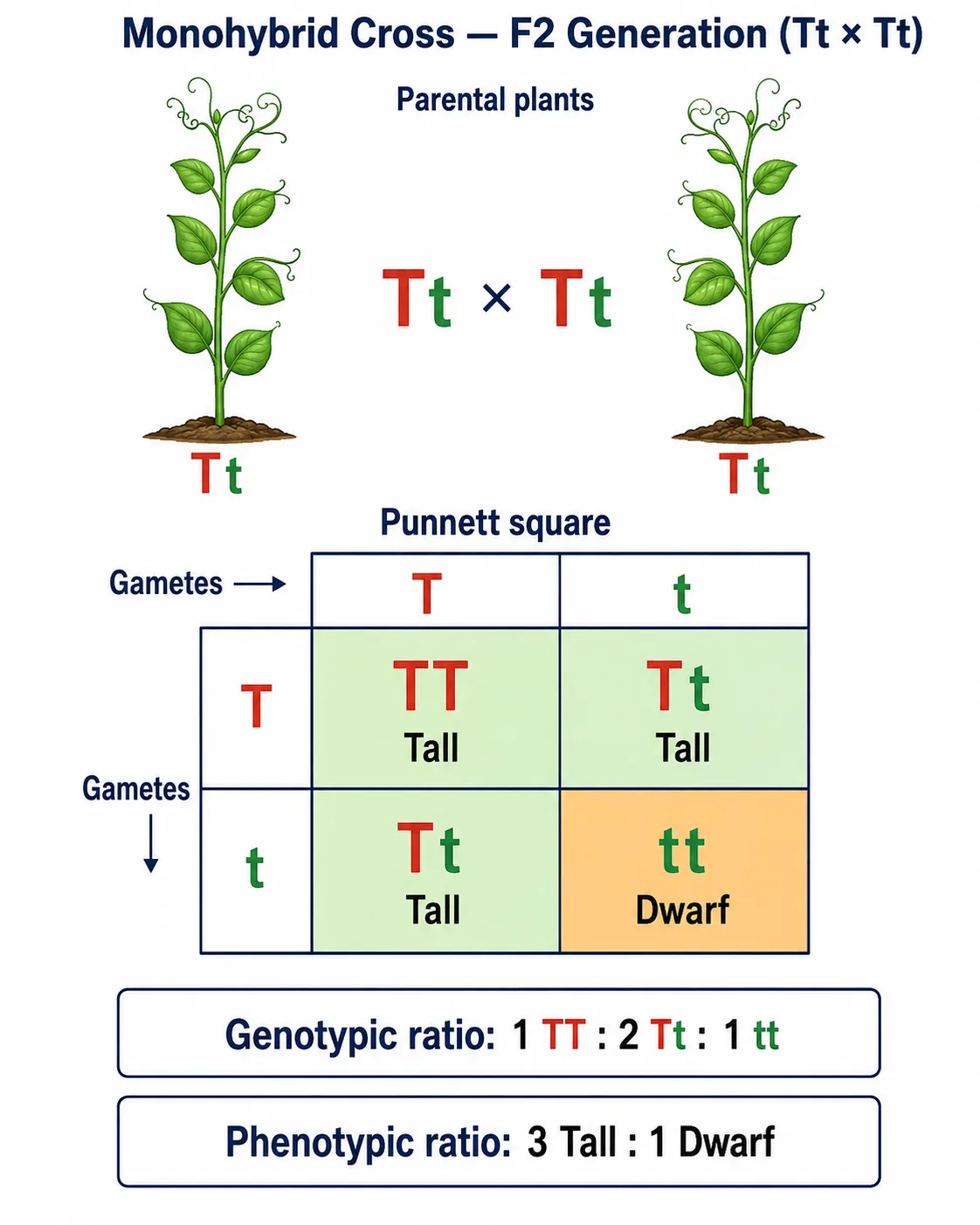
A monohybrid cross is a cross between two parents that differ in just one trait (one pair of contrasting characters). It is the simplest form of genetic cross — and it was the cross Mendel ran first to derive his fundamental laws.
Let's walk through Mendel's classic tall × dwarf cross step by step.
The setup (Parent generation, P):
- Father plant: Tall, true-breeding → genotype TT → produces gametes carrying T (only).
- Mother plant: Dwarf, true-breeding → genotype tt → produces gametes carrying t (only).
F1 generation:
Each F1 offspring receives one allele from each parent: T from father + t from mother = Tt.
- F1 genotype: all Tt (heterozygous) — 100% uniform.
- F1 phenotype: all tall — because T is dominant.
This uniformity in F1 was Mendel's first surprise. The dwarf trait seems to have vanished. But it hasn't.
F2 generation — the key step:
Mendel allowed F1 plants to self-pollinate. Each F1 (Tt) produces gametes T and t in roughly equal proportions (50% T : 50% t).
Punnett square for Tt × Tt:
| T (50%) | t (50%) | |
|---|---|---|
| T (50%) | TT (25%) | Tt (25%) |
| t (50%) | Tt (25%) | tt (25%) |
- F2 genotypic ratio: 1 TT : 2 Tt : 1 tt
- F2 phenotypic ratio: 3 Tall : 1 Dwarf
The dwarf trait reappears in F2 in 1 out of 4 offspring. It was never lost — it was just masked by the dominant T allele in heterozygous Tt individuals.
This 3:1 ratio held for every one of Mendel's 7 traits.
Mendel's Three Laws — Stated Plainly
Based on his monohybrid (and later dihybrid) crosses, Mendel proposed three rules of inheritance.
Law 1 — Law of Dominance:
In a heterozygous individual, one allele (the dominant) masks the expression of the other (the recessive). The dominant allele is expressed in the phenotype, while the recessive allele remains hidden.
Implications:
- In Tt, only T (tall) is expressed. The t (dwarf) is "silent" but present.
- A phenotypically tall plant can be either TT or Tt — phenotype alone doesn't tell you the genotype.
Law 2 — Law of Segregation (the most fundamental):
During gamete formation, the two alleles for a trait segregate from each other so that each gamete carries only one allele. At fertilisation, the two alleles unite again in the zygote.
Implications:
- A Tt parent makes two types of gametes — T and t — in equal proportions.
- Segregation is the molecular reason behind the 3:1 F2 ratio.
- This law has a clear biological basis: it's what happens during meiosis when homologous chromosomes separate (Anaphase I).
Law 3 — Law of Independent Assortment (we'll cover this fully in Section 6 with the dihybrid cross):
When two or more pairs of traits are considered together, the alleles for one trait segregate independently of the alleles for another trait.
Implications:
- A pea plant heterozygous for both height (Tt) and seed colour (Yy) produces 4 gamete types in equal proportions: TY, Ty, tY, ty.
- This law applies only to genes on different chromosomes (or genes far apart on the same chromosome). For linked genes (on the same chromosome, close together), it breaks down — that's Section 8.
[NEET / Board priority] Of the three laws, the Law of Segregation is the most fundamental and most universally applicable. It works for every gene, every species. Dominance has many exceptions (see Section 4). Independent assortment breaks for linked genes.
The Test Cross — How to Find the Genotype
You see a tall pea plant. You can't see its DNA. Is it homozygous (TT) or heterozygous (Tt)? Both look the same.
Mendel solved this with the test cross — crossing the unknown with a homozygous recessive (tt) parent.
Case 1: Unknown = TT (homozygous dominant)
- Cross: TT × tt
- Gametes from TT: all T. Gametes from tt: all t.
- Offspring: all Tt (heterozygous).
- Phenotype: 100% tall (all offspring tall).
Case 2: Unknown = Tt (heterozygous)
- Cross: Tt × tt
- Gametes from Tt: 50% T, 50% t. Gametes from tt: all t.
- Offspring: 50% Tt (tall) + 50% tt (dwarf).
- Phenotype: 1 : 1 (tall : dwarf).
So the test-cross rule:
| Test cross result | Unknown genotype |
|---|---|
| All offspring tall (100%) | Homozygous dominant (TT) |
| 1 tall : 1 dwarf (50:50) | Heterozygous (Tt) |
| All offspring dwarf | Homozygous recessive (tt) |
Why a test cross uses homozygous recessive?
Because the recessive parent (tt) can only contribute t gametes. So the offspring's phenotype reflects entirely what the unknown parent contributed. It "exposes" hidden recessive alleles in the unknown.
[NEET Tip] Test crosses are also called back crosses when the F1 is crossed back to a parent — but technically, a back cross with the recessive parent is the same as a test cross. With the dominant parent, it's just a back cross (and provides less information).
This test-cross logic is used in:
- Mendel's original experiments (he test-crossed F1 to confirm Tt genotype).
- Modern genetics: confirming heterozygotes in pedigree analysis.
- Plant and animal breeding: testing whether a phenotypically dominant individual is homozygous (true-breeding) or heterozygous.
Memory Capsule — Section 3
5 facts to lock in:
- Monohybrid cross ratios:
- F1: 100% heterozygous (Tt), 100% dominant phenotype.
- F2 genotypic ratio: 1 : 2 : 1 (TT : Tt : tt).
- F2 phenotypic ratio: 3 : 1 (dominant : recessive).
- Three Mendelian laws:
- Dominance: dominant allele masks recessive in heterozygote.
- Segregation (fundamental): two alleles separate into different gametes during meiosis.
- Independent Assortment: alleles of different genes segregate independently (for unlinked genes).
Law of Segregation is the most universal of Mendel's laws — it has no known exceptions and is mechanistically the most clearly understood (it's just meiosis).
Test cross = cross with homozygous recessive (tt). Results:
- 100% dominant phenotype → unknown is TT.
- 1:1 ratio → unknown is Tt.
- Punnett square = the diagrammatic tool used to calculate offspring genotype/phenotype ratios. Memorise the 2×2 (monohybrid) and 4×4 (dihybrid, Section 6) layouts.
One number to remember: 3 : 1 — the F2 phenotypic monohybrid ratio.
Solved Examples — Section 3
Q1. In pea plants, T (tall) is dominant over t (dwarf). What is the result of a cross between two heterozygous tall plants?
Answer: Genotypic ratio 1 TT : 2 Tt : 1 tt, phenotypic ratio 3 Tall : 1 Dwarf — the classic F2 outcome of any Tt × Tt cross.
| T | t | |
|---|---|---|
| T | TT | Tt |
| t | Tt | tt |
Q2. A tall pea plant is crossed with a dwarf pea plant. All offspring are tall. What does this tell you about the genotype of the tall parent?
Answer: The tall parent is homozygous dominant (TT). The dwarf parent can only be tt, so if the tall parent had been Tt we'd see a 1 tall : 1 dwarf split; getting all tall means it carried no hidden t allele.
Q3. State Mendel's Law of Segregation and explain its biological basis.
Answer: The two alleles of a gene separate during gamete formation so that each gamete carries only one, and they reunite at fertilisation. The physical basis is meiosis: at Anaphase I the homologous chromosomes (carrying the two alleles) move to opposite poles, so a Tt plant ends up with half T and half t gametes.
Q4. What is a test cross? Why is the recessive parent used?
Answer: A test cross mates an individual of unknown genotype (dominant phenotype) with a homozygous recessive (tt). Since tt contributes only t, the offspring phenotypes reveal the unknown directly: all dominant means it was TT, a 1 : 1 split means it was Tt.
Q5. A heterozygous round-seeded pea plant (Rr) is crossed with a wrinkled-seeded plant (rr). What is the expected phenotypic ratio of the offspring?
Answer: 1 Round : 1 Wrinkled. This is a test cross — half the Rr gametes carry R and half carry r, while rr gives only r, so the offspring come out 50% Rr (round) and 50% rr (wrinkled).
Q6. Why is the Law of Dominance subject to exceptions, while the Law of Segregation holds universally?
Answer: Dominance is a phenotypic outcome that depends on the gene product, so it breaks down in cases like incomplete dominance (red × white snapdragon → pink) and codominance (I^A and I^B in ABO blood groups). Segregation just describes homologous chromosomes separating in meiosis, which happens in every sexually reproducing organism — so it has essentially no exceptions for nuclear genes.