
Inheritance of Two Genes — Welcome to the Dihybrid Cross
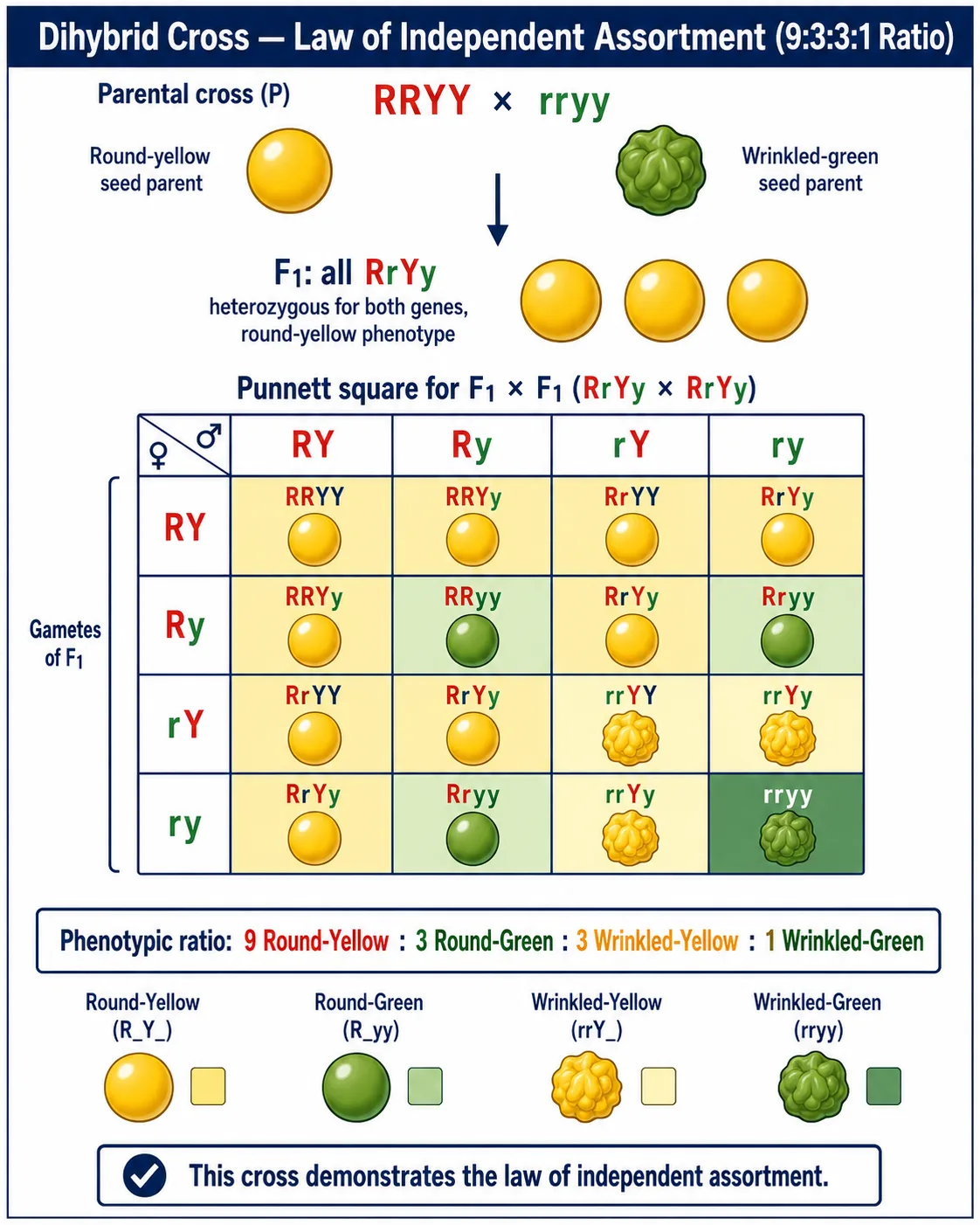
So far we've tracked one gene at a time (monohybrid crosses). What happens when we follow two genes simultaneously? Mendel asked this question with a brilliant experiment using pea seed traits.
A dihybrid cross = a cross between two parents differing in two pairs of contrasting traits simultaneously.
Mendel's setup:
- Parent 1: Round, Yellow seeds (RRYY — homozygous dominant for both).
- Parent 2: Wrinkled, Green seeds (rryy — homozygous recessive for both).
F1 generation:
- Each F1 plant gets one R + one r (heterozygous for shape) and one Y + one y (heterozygous for colour).
- F1 genotype: RrYy (heterozygous for both genes — dihybrid).
- F1 phenotype: all Round, Yellow (since both R and Y are dominant).
F2 generation — the key result:
F1 (RrYy) self-pollinates. The four gamete types produced by F1 are:
- RY, Ry, rY, ry (each in equal proportion: 1/4 each).
The 4×4 Punnett square gives 16 combinations:
| RY | Ry | rY | ry | |
|---|---|---|---|---|
| RY | RRYY | RRYy | RrYY | RrYy |
| Ry | RRYy | RRyy | RrYy | Rryy |
| rY | RrYY | RrYy | rrYY | rrYy |
| ry | RrYy | Rryy | rrYy | rryy |
F2 phenotypic ratio: 9 Round-Yellow : 3 Round-Green : 3 Wrinkled-Yellow : 1 Wrinkled-Green.
This 9 : 3 : 3 : 1 ratio is the signature of a Mendelian dihybrid cross.
[Memory aid] Notice the breakdown:
- 9 = both dominant
- 3 = first dominant, second recessive
- 3 = first recessive, second dominant
- 1 = both recessive
Mendel's Law of Independent Assortment
The 9 : 3 : 3 : 1 ratio led Mendel to his Third Law:
Law of Independent Assortment: When two or more pairs of traits are considered simultaneously in a cross, the alleles for each trait segregate (assort) into gametes INDEPENDENTLY of the alleles for the other trait.
What this means practically:
- In a Yy parent, the alleles Y and y separate during gamete formation → some gametes carry Y, others y.
- In a Rr parent, R and r separate similarly.
- These two segregations happen independently — knowing whether a gamete carries R doesn't tell you whether it carries Y or y.
- All 4 gamete combinations (RY, Ry, rY, ry) are produced in equal proportions (1/4 each).
The 9 : 3 : 3 : 1 ratio decoded:
If you treat the two genes independently:
- Round : Wrinkled = 3 : 1 (one Mendelian 3:1 ratio for shape).
- Yellow : Green = 3 : 1 (another Mendelian 3:1 ratio for colour).
- Combining them (probability multiplication): 3R × 3Y = 9 (both dominant), 3R × 1g = 3 (round-green), 1r × 3Y = 3 (wrinkled-yellow), 1r × 1g = 1 (both recessive).
So 9 : 3 : 3 : 1 is just (3:1) × (3:1) — the product of two independent monohybrid ratios.
The mechanistic basis: Meiosis I again.
Why does independent assortment work?
- The genes for shape (R) and colour (Y) in pea are on different chromosomes.
- During Meiosis I, homologous chromosome pairs separate randomly into different daughter cells.
- Each gamete therefore gets a random combination — R or r is independent of Y or y.
[Critical caveat] The Law of Independent Assortment breaks down when two genes are on the SAME chromosome (linked genes — see Section 8). In that case, the alleles tend to stay together, giving non-random combinations.
Dihybrid Test Cross & Common Variants
Dihybrid test cross: A dihybrid F1 (RrYy) is crossed with a homozygous recessive (rryy).
- Gametes from RrYy: RY, Ry, rY, ry (each 1/4).
- Gametes from rryy: all ry.
- Offspring:
| Gamete | Result genotype | Phenotype |
|---|---|---|
| RY × ry | RrYy | Round, Yellow |
| Ry × ry | Rryy | Round, Green |
| rY × ry | rrYy | Wrinkled, Yellow |
| ry × ry | rryy | Wrinkled, Green |
Phenotypic ratio: 1 : 1 : 1 : 1.
This 1:1:1:1 in a dihybrid test cross is the signature of independent assortment. If the genes were linked, the ratio would be skewed (more "parental" combinations than recombinants).
Variant — incomplete dominance in a dihybrid cross:
If one or both genes show incomplete dominance, the 9:3:3:1 ratio changes. Hypothetical example: if BOTH genes in a dihybrid cross showed incomplete dominance → F2 would be 1:2:1:2:4:2:1:2:1 (9 distinct phenotypes from 9 genotypes).
Quick calculations using probability (without drawing full Punnett):
For any complex cross with multiple genes, use:
- Probability of a specific phenotype = product of the probabilities for each individual gene.
Example: In RrYy × RrYy, what fraction of offspring are RoundGreen?
- Probability of Round (R_) = 3/4.
- Probability of Green (yy) = 1/4.
- Probability of Round AND Green = 3/4 × 1/4 = 3/16. ✓
This shortcut is faster than full Punnett squares for big problems.
[Pro tip] For an n-gene cross (each parent heterozygous for n genes), the number of distinct F2 phenotypes is (assuming complete dominance), and the number of F2 phenotypic classes is also . For n=2: 4 phenotypes. For n=3 (trihybrid): 8 phenotypes (27:9:9:9:3:3:3:1 ratio).
Memory Capsule — Section 6
5 facts to lock in:
Dihybrid cross F2 ratio = 9 : 3 : 3 : 1 (phenotypic, when both genes show complete dominance).
Law of Independent Assortment: alleles of different genes segregate independently during gamete formation. Applies to unlinked genes (on different chromosomes).
9 : 3 : 3 : 1 = (3:1) × (3:1) — two independent monohybrid ratios multiplied together.
Dihybrid test cross = RrYy × rryy → 1 : 1 : 1 : 1 (signature of independent assortment; reveals linkage if disrupted).
Mechanistic basis: Independent assortment works because homologous chromosomes separate randomly during Meiosis I. Breaks down for genes on the same chromosome (linkage — Section 8).
Numbers to remember: 9 : 3 : 3 : 1 (dihybrid F2 phenotypic), 1 : 1 : 1 : 1 (dihybrid test cross).
Solved Examples — Section 6
Q1. Round-Yellow seeded pea (RRYY) is crossed with wrinkled-green seeded pea (rryy). What is the F1 phenotype, and what F2 phenotypic ratio is expected on self-pollination of F1?
Answer: F1 is all Round-Yellow (RrYy), and selfing gives the classic 9 : 3 : 3 : 1 — 9 Round-Yellow : 3 Round-Green : 3 Wrinkled-Yellow : 1 Wrinkled-Green. That ratio is simply (3:1) × (3:1), two independent monohybrid ratios multiplied.
Q2. State the Law of Independent Assortment. What is its biological basis?
Answer: Alleles of different genes segregate into gametes independently of one another — how one pair separates says nothing about how another does. The basis is meiosis: homologous pairs line up and separate at random in Meiosis I, so for genes on different chromosomes a YyRr individual makes YR, Yr, yR and yr gametes in equal numbers. The law holds only for unlinked genes.
Q3. A dihybrid heterozygote (RrYy) is test-crossed with a homozygous recessive (rryy). What are the expected genotypic and phenotypic ratios?
Answer: 1 : 1 : 1 : 1 — Round-Yellow : Round-Green : Wrinkled-Yellow : Wrinkled-Green. The RrYy parent gives four equal gamete types and the rryy parent gives only ry, so each class appears equally. This clean 1:1:1:1 is the signature of independent assortment; linked genes would skew it toward parental types.
Q4. In a RrYy × RrYy cross, what is the probability of an offspring being homozygous recessive for both traits (rryy)?
Answer: 1/16. Multiply the single-gene probabilities: P(rr) = 1/4 and P(yy) = 1/4, so 1/4 × 1/4 = 1/16 — the "1" at the tail of 9:3:3:1.
Q5. What is the probability of getting a Round-Green seed (Rryy or RRyy) from a RrYy × RrYy cross?
Answer: 3/16. P(Round) = 3/4 and P(Green, yy) = 1/4, so 3/4 × 1/4 = 3/16 — matching the "3 Round-Green" out of 16 in the 9:3:3:1 ratio.
Q6. In a trihybrid cross (AaBbCc × AaBbCc), how many distinct phenotypes appear in F2 (assuming complete dominance for all 3 genes)?
Answer: 8 phenotypes (2^n with n = 3), in the ratio 27 : 9 : 9 : 9 : 3 : 3 : 3 : 1, which is just (3:1)³. The classes sum to 64 = 4³, the full F2 count.