
Beyond Single Genes — Polygenic Inheritance
Mendel's traits were neat and discrete — pea seeds were either round OR wrinkled, flowers were violet OR white, no middle ground. But look around: human height, skin colour, weight, intelligence, blood pressure — these vary smoothly across a huge range. Nobody is simply "tall" or "short"; there are endless gradations.
That continuous variation is the signature of polygenic inheritance.
Definition:
Polygenic inheritance = the inheritance of a trait controlled by three or more genes, each contributing a small additive effect to the final phenotype.
Key features:
- Many genes contribute, each with a small effect.
- The genes act additively — each "dominant" allele adds a unit of effect, no matter which gene it belongs to.
- The trait shows continuous variation in a population — not discrete categories.
- The spread of phenotypes usually follows a bell-shaped (normal) curve.
- Environment also weighs in (nutrition affects height; sun exposure affects skin tone).
The classic example: human skin colour.
The genetics of skin colour is usually taught with a simplified 3-gene additive model (genes A, B, C; dominant alleles → darker pigmentation). In reality 10+ genes contribute, but the 3-gene model is the canonical one for Board/NEET. (Historically attributed to Davenport, 1913.)
The 3-gene additive model (simplified):
- 3 genes: A/a, B/b, C/c. Each capital allele adds one "dose" of pigment.
- A maximally dark person (AABBCC): 6 dominant alleles → maximum pigmentation.
- A maximally light person (aabbcc): 0 dominant alleles → no pigmentation.
- Everything in between → intermediate shades.
If both parents are heterozygous (AaBbCc × AaBbCc), the offspring fall into a bell-shaped distribution of skin colour from very light to very dark, with most clustered in the middle.
The phenotype = the SUM of dominant alleles + environmental modulation. That's why identical twins (same genotype) can still look slightly different — environment makes a genuine contribution.
Polygenic Inheritance — The Skin Colour Example in Detail
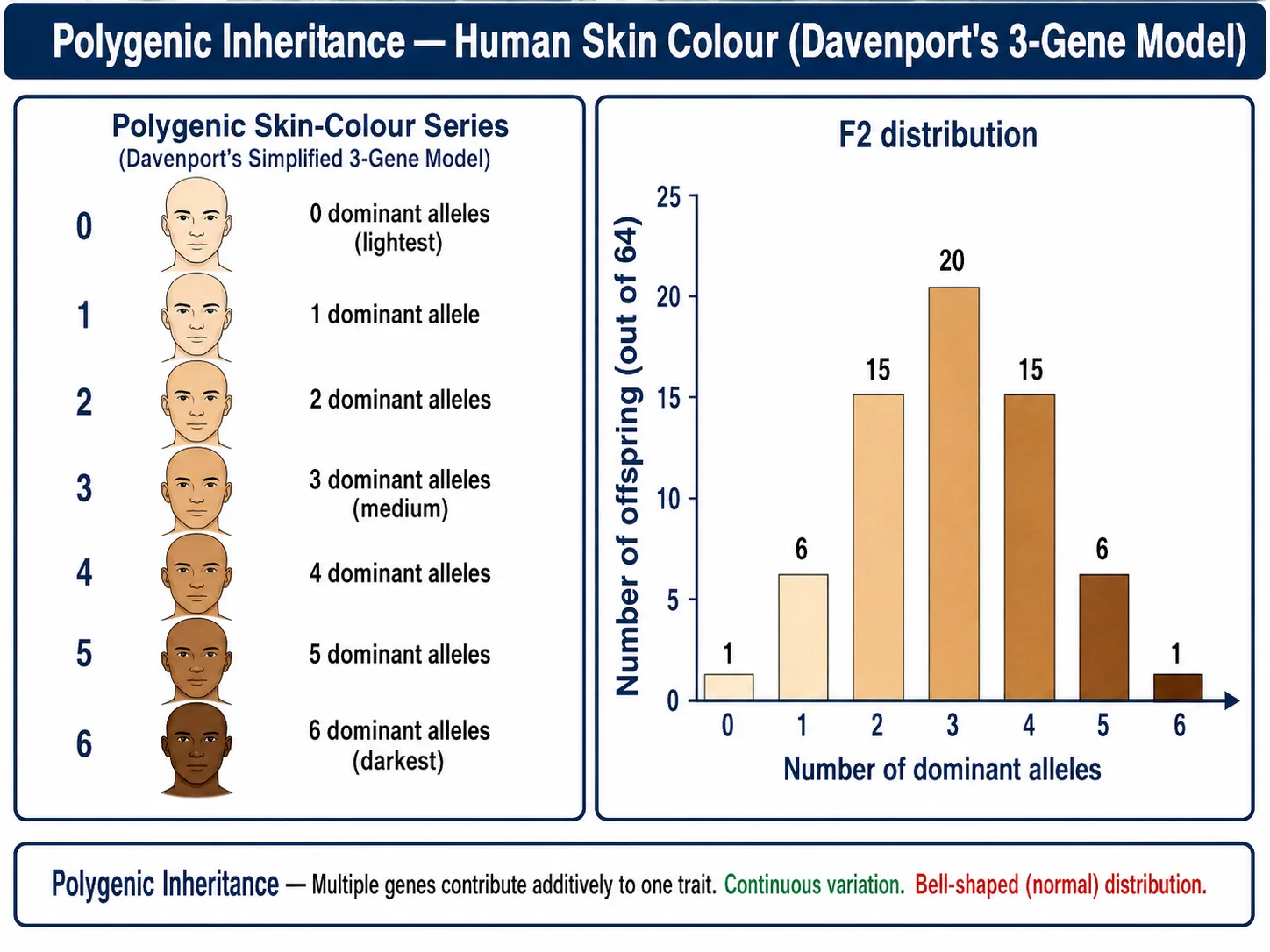
Let's work through the simplified 3-gene polygenic model.
Parents: Father AaBbCc × Mother AaBbCc (both heterozygous for 3 genes).
Each gene contributes about 1/3 of the total skin colour effect. Each dominant allele adds 1 "shade unit"; each recessive allele adds 0.
Total possible "shade scores" (range): 0 to 6.
- 6 = darkest (AABBCC).
- 0 = lightest (aabbcc).
Calculation: how many offspring fall into each shade category?
The number of "dominant alleles" in an offspring follows a binomial distribution:
- Each gene contributes 0, 1, or 2 dominant alleles.
- For each gene: P(0 dominant) = 1/4 (aa); P(1) = 1/2 (Aa); P(2) = 1/4 (AA).
- Across 3 genes, the total number of dominant alleles is the sum.
Out of every 64 children (4 × 4 × 4 combinations):
| Number of dominant alleles | Number of offspring (out of 64) |
|---|---|
| 0 (lightest) | 1 |
| 1 | 6 |
| 2 | 15 |
| 3 (medium) | 20 |
| 4 | 15 |
| 5 | 6 |
| 6 (darkest) | 1 |
Distribution: Bell-shaped, peaking in the middle (3 dominant alleles = medium skin tone), with rare extremes (very light or very dark).
Why does this matter?
- Even when both parents are intermediate (Aa Bb Cc), the children span every shade — which is exactly why polygenic traits don't follow neat Mendelian ratios.
- The smooth bell-shaped distribution hides the discrete Mendelian segregation underneath.
- Environment (UV exposure, diet) shifts the whole distribution.
Other examples of polygenic inheritance:
| Trait | Genes contributing |
|---|---|
| Human height | ~50+ genes |
| Eye colour (continuous shades) | ~10+ genes |
| Skin pigmentation | ~10+ genes (Davenport's 3-gene model simplified) |
| Crop yield (corn, wheat) | many genes |
| Blood pressure | multiple genes |
| Birth weight | multiple genes |
[Cross-link] Polygenic inheritance + environment = quantitative genetics, the framework used in agriculture (selecting for crop yield) and medicine (predicting risk of complex diseases like diabetes and heart disease).
[Critical insight] When NEET asks "Which trait shows polygenic inheritance?" — the answer is always one with CONTINUOUS variation: skin colour, height, weight, NOT eye-colour categories or blood group.
Pleiotropy — One Gene Affecting Many Traits
Pleiotropy is the mirror image of polygenic inheritance:
- Polygenic: Many genes → one trait.
- Pleiotropy: One gene → many traits.
Definition:
Pleiotropy = a single gene affects multiple, seemingly unrelated phenotypic traits.
The classic examples:
1. Sickle-cell anaemia (autosomal recessive):
A single mutation in the beta-globin gene (HbA → HbS) at codon 6 causes:
- Abnormal haemoglobin (HbS) → RBCs sickle under low oxygen.
- Anaemia (the fragile sickle RBCs break down early).
- Vaso-occlusive crises (sickle cells block small blood vessels).
- Joint pain and organ damage (kidney, spleen, brain).
- Protection against malaria (heterozygote advantage — sickle cells are less hospitable to the malarial parasite).
So one gene shapes many phenotypes — RBC shape, anaemia, malaria resistance, organ damage, joint pain.
2. Phenylketonuria (PKU, autosomal recessive):
The PKU gene encodes phenylalanine hydroxylase (PAH). When it's defective:
- Phenylalanine builds up → toxic to the brain → intellectual disability.
- Reduced melanin production → lighter skin, hair, and eye colour.
- Musty body odour (from phenylketones excreted in sweat and urine).
- Higher risk of eczema and other skin problems.
One mutation → multiple unrelated symptoms.
3. The pea starch gene (NCERT's plant example):
In pea, a single gene (B/b) controls starch synthesis — and through it, TWO phenotypes at once:
- BB plants make large starch grains and their seeds are round.
- bb plants make small starch grains and their seeds are wrinkled.
- Bb seeds are round, but their starch grains are intermediate in size.
One gene → two characters (seed shape AND starch-grain size). NCERT's bonus insight: whether B "is dominant" depends on which phenotype you score — complete dominance for seed shape, incomplete dominance for grain size.
4. Marfan syndrome (autosomal dominant):
A mutation in the fibrillin gene weakens connective tissue. Symptoms include:
- Tall, thin build with long limbs.
- Long fingers and toes (arachnodactyly).
- Weakened heart valves and risk of aortic dissection.
- Lens dislocation (vision problems).
Why does pleiotropy happen?
Many genes encode proteins used across several body systems. A defect in one such protein hits every system that relies on it. Fibrillin, for instance, is found in many connective tissues (skin, eye lens, heart valves, bones) → a mutation throws all of them off at once.
[NEET trap] Don't confuse pleiotropy (one gene, many traits) with polygenic inheritance (many genes, one trait). They're opposites.
Memory Capsule — Section 9
5 facts to lock in:
Polygenic inheritance = MANY genes contribute to ONE trait. Each gene adds a small additive effect. Shows continuous variation + bell-shaped distribution.
Classic polygenic examples: human skin colour (Davenport's 3-gene model), height, weight, intelligence, blood pressure, crop yield.
Pleiotropy = ONE gene affects MANY traits. Opposite of polygenic inheritance.
Classic pleiotropy examples: sickle-cell anaemia (anaemia + organ damage + malaria resistance), PKU (brain + skin + hair + odour), Marfan syndrome (heart + skeleton + eyes), the pea starch gene (seed shape + starch-grain size).
Why distinguish?
- Polygenic → continuous trait, bell curve, many genes.
- Pleiotropy → one mutation affects multiple "unrelated" traits because the protein is used in multiple body systems.
Quick test: "Multiple genes → one trait" = polygenic. "One gene → multiple traits" = pleiotropy. Don't mix them up.
Solved Examples — Section 9
Q1. Define polygenic inheritance. Give one example.
Answer: Polygenic inheritance is a trait controlled by three or more genes, each adding a small additive effect to the phenotype. Because many genes contribute, the trait shows continuous variation and a bell-shaped distribution in a population, with environment modulating it further. The classic example is human skin colour (3–4 main genes in Davenport's model, 10+ in reality); height, weight, blood pressure and crop yield are others.
Q2. Differentiate between polygenic inheritance and pleiotropy.
Answer: They run in opposite directions — polygenic is MANY genes → ONE trait, pleiotropy is ONE gene → MANY traits.
| Feature | Polygenic Inheritance | Pleiotropy |
|---|---|---|
| Genes → traits | Many genes → one trait | One gene → many traits |
| Phenotype | Bell-shaped, continuous | Multiple, often unrelated effects |
| Example | Skin colour, height, weight | Sickle-cell anaemia, PKU, Marfan |
| Why | Gene products add up for one trait | One product is used by many systems |
Memory trick: polygenic = MANY-to-ONE, pleiotropy = ONE-to-MANY.
Q3. In Davenport's polygenic model for skin colour (3 genes, AaBbCc × AaBbCc), how many offspring out of 64 are expected to have ALL recessive alleles (lightest skin)?
Answer: 1 out of 64. Each gene has a 1/4 chance of being homozygous recessive, so for all three together it's 1/4 × 1/4 × 1/4 = 1/64 (aabbcc). The all-dominant darkest type (AABBCC) is just as rare at 1/64, while the medium class (3 dominant alleles) is the most common at 20/64 — hence the bell shape.
Q4. Sickle-cell anaemia is given as an example of pleiotropy. Justify this with specific phenotypic effects.
Answer: A single point mutation in the beta-globin gene (GAG → GTG, Glu → Val at codon 6) ripples out into several traits: abnormal haemoglobin (HbS), sickle-shaped RBCs under low oxygen, anaemia from the fragile cells breaking down, vaso-occlusive crises and organ damage when rigid cells block vessels, and partial malaria resistance in heterozygotes. One mutation → many unrelated effects = pleiotropy.
Q5. A human trait shows a smooth bell-shaped distribution from very small to very large values, with most individuals in the middle. What kind of inheritance does this suggest?
Answer: Polygenic inheritance. Many genes each adding small additive effects produce a binomial-like spread that approximates a normal (bell) curve. Single-gene Mendelian traits instead give discrete phenotypic classes (like a clean 3:1), never a smooth continuum. Height, weight, blood pressure, IQ and skin pigmentation are all bell-shaped, polygenic traits.