
Multiple Alleles — More Than Two Versions of a Gene
In Mendel's pea experiments, every trait had just two alleles — T (tall) and t (dwarf), R (round) and r (wrinkled), and so on. But in real populations, a single gene can have more than two alternative forms — what we call multiple alleles.
Key definition:
Multiple alleles = more than two alleles of the same gene existing in a population. However, in any one diploid individual, only TWO of these alleles are present (one inherited from each parent).
Important nuance:
- The gene has multiple alleles in the population as a whole.
- An individual still carries only two of these alleles (since they are diploid — one copy of the gene on each homologous chromosome).
- Different individuals carry different combinations of two alleles from the available pool.
The most famous and most-tested example of multiple alleles is the ABO blood group system in humans.
[Why this matters] Multiple alleles increase genetic diversity in populations. They also complicate dominance relationships — sometimes one allele dominates another, sometimes two alleles are codominant. The ABO system illustrates BOTH at once.
The ABO Blood Group System — Three Alleles, Four Phenotypes
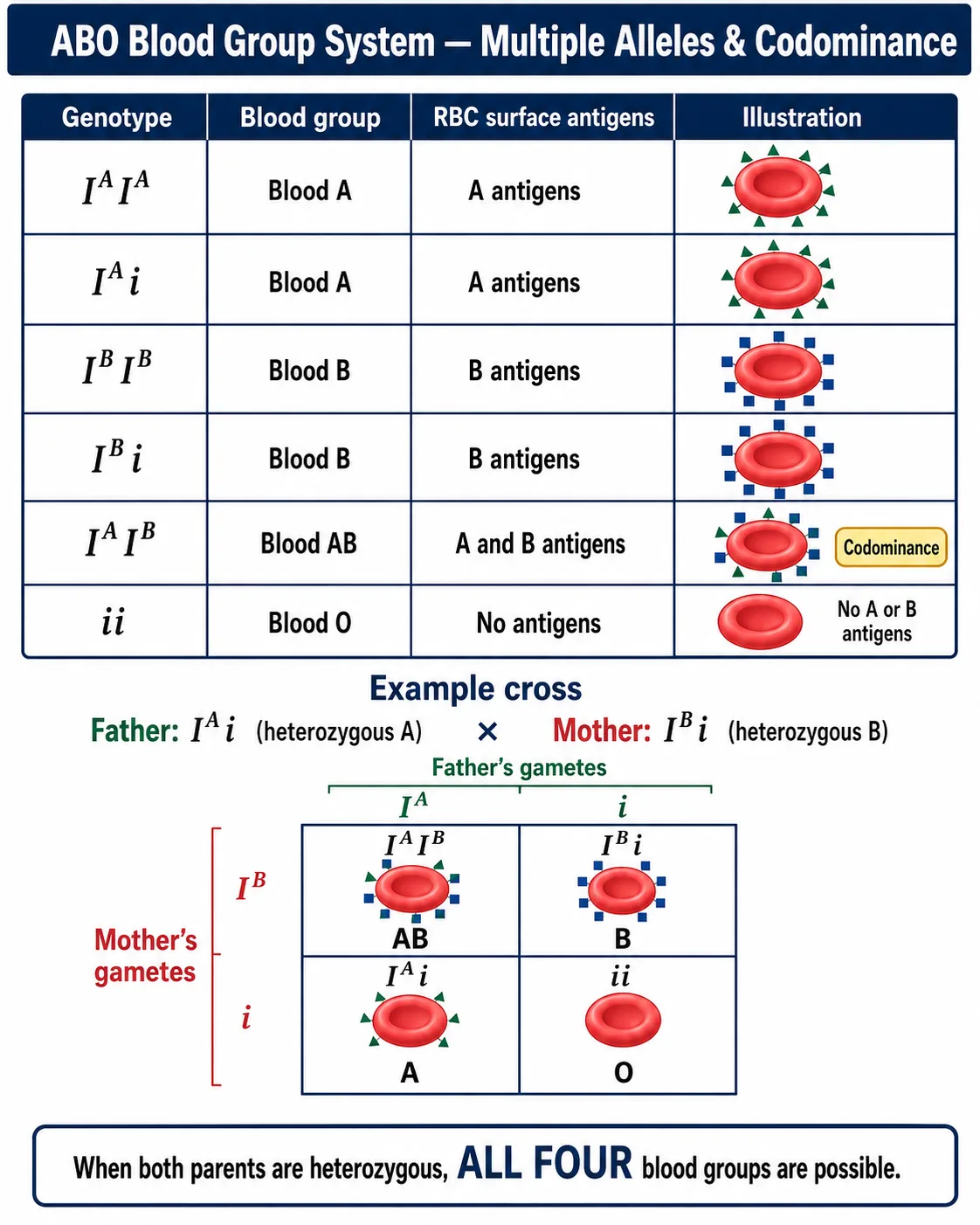
The ABO blood group is controlled by a single gene I (sometimes called ABO gene) on chromosome 9. This gene has three alleles in the human population:
| Allele | Gene product | Antigen on RBC |
|---|---|---|
| I^A | Functional enzyme that adds N-acetylgalactosamine | A antigen |
| I^B | Functional enzyme that adds galactose | B antigen |
| i | Non-functional enzyme | No antigen (just the basic H substance) |
Dominance relationships:
- I^A and I^B are CODOMINANT with each other. Both make functional enzymes, so when both are present (I^A I^B), both A and B antigens appear on the RBC surface.
- Both I^A and I^B are DOMINANT over i. The allele i makes a non-functional enzyme, so it produces no antigen. It is recessive to both I^A and I^B.
The 6 possible genotypes and 4 phenotypes:
| Genotype | Phenotype (Blood Group) | Antigens on RBCs | Antibodies in Plasma |
|---|---|---|---|
| I^A I^A | A | A | Anti-B |
| I^A i | A | A | Anti-B |
| I^B I^B | B | B | Anti-A |
| I^B i | B | B | Anti-A |
| I^A I^B | AB | Both A and B | None |
| ii | O | None | Both Anti-A and Anti-B |
Notice:
- 6 genotypes collapse into 4 phenotypes (because I^A I^A and I^A i both look like A; I^B I^B and I^B i both look like B).
- AB is the universal recipient (no antibodies → can receive any blood).
- O is the universal donor (no antigens → can give to anyone).
[NEET high-yield] The ABO system illustrates two genetic principles at once: (1) multiple alleles (3 alleles in the population), and (2) codominance (I^A and I^B both expressed in I^A I^B heterozygote). This dual answer is what NEET often expects.
Predicting Blood Groups in Crosses — A Critical Skill
Predicting children's blood groups from parents' blood groups is a classic Board and NEET problem. The trick: when a parent has blood group A or B, you don't know if they are homozygous or heterozygous. You must consider both possibilities.
Example 1: Father AB × Mother O
- Father I^A I^B (only one possible genotype for AB).
- Mother ii (only one possible genotype for O).
- Father's gametes: 1/2 I^A, 1/2 I^B.
- Mother's gametes: all i.
- Children: 1/2 I^A i (A) + 1/2 I^B i (B).
- Possible blood groups: A and B only. NEVER AB or O.
An AB father and an O mother can never have an AB or O child — a favourite exam trap. (Do not confuse this with the "Bombay phenotype", a rare condition outside NCERT.)
Example 2: Father A (I^A i) × Mother B (I^B i) — both heterozygous
- Punnett:
| I^B | i | |
|---|---|---|
| I^A | I^A I^B (AB) | I^A i (A) |
| i | I^B i (B) | ii (O) |
- All 4 blood groups possible: 1 A : 1 B : 1 AB : 1 O.
This is the case where ALL FOUR blood groups can appear in children — used in genetic counselling, paternity disputes, and Board questions.
Example 3: Father A (I^A I^A) × Mother A (I^A i)
- Father's gametes: all I^A.
- Mother's gametes: 1/2 I^A, 1/2 i.
- Children: 1/2 I^A I^A (A) + 1/2 I^A i (A).
- All children are A. No other group possible.
Quick rules:
- A child of blood group O must have received i from BOTH parents → both parents must carry at least one i allele (cannot be I^A I^A, I^B I^B, or I^A I^B).
- A child of blood group AB must have received I^A from one parent and I^B from the other → one parent must carry I^A and the other must carry I^B.
- Two parents both of blood group O can only have O children.
[Forensic / Legal use] Blood group analysis was historically the first genetic tool for paternity testing. It can exclude a suspect (e.g., an O father cannot have an AB child) but cannot conclusively prove paternity by itself.
Rh Blood Group System — A Quick Look
Besides ABO, the Rh (Rhesus) blood group system is the second most important blood typing system, also relevant for transfusions and pregnancy.
Genetics:
- A single dominant allele D (Rh+ or Rh-positive) is responsible for the Rh antigen.
- The recessive allele d (Rh-) means no Rh antigen.
- Genotypes: DD or Dd = Rh-positive; dd = Rh-negative.
Why Rh matters:
Rh incompatibility in transfusion:
- A Rh-negative person, if given Rh-positive blood, will develop anti-Rh antibodies over time.
- On the second exposure, severe immune reaction → can be fatal.
Rh incompatibility in pregnancy (Erythroblastosis foetalis / Haemolytic disease of the newborn):
- If a Rh-negative mother carries a Rh-positive foetus (inherited D allele from father):
- The first pregnancy is usually safe (the placenta normally blocks cell mixing).
- At delivery, foetal Rh+ blood can leak into mother's circulation → mother produces anti-Rh antibodies.
- In the SECOND Rh+ pregnancy, these maternal antibodies cross the placenta and attack foetal RBCs → severe foetal anaemia (erythroblastosis foetalis).
Prevention: RhoGAM (anti-Rh immunoglobulin) is given to Rh-negative mothers within 72 hours of delivery (or after miscarriage/abortion) to neutralise foetal Rh+ cells before mother's immune system reacts. Modern obstetric practice has nearly eliminated this condition.
Complete blood typing combines ABO and Rh: e.g., a person is "B-positive" if their RBCs carry both the B antigen and the Rh antigen. In India, groups O and B are the most common and AB the least common; Rh-negative is far rarer than Rh-positive (exact frequencies vary by region).
[Indian context] ~94% of Indians are Rh-positive; only ~6% are Rh-negative. The relatively low Rh-negative frequency means Rh-incompatibility pregnancies are less common in India than in Europe (~15% Rh-).
Memory Capsule — Section 5
5 facts to lock in:
Multiple alleles = more than 2 alleles for one gene in a population. An individual still carries only 2 (diploid).
ABO genetics:
- Gene: I on chromosome 9.
- Alleles: I^A, I^B, i (three).
- I^A & I^B = codominant; both dominant over i.
- 6 genotypes → 4 phenotypes (A, B, AB, O).
Universal donor = O (ii); universal recipient = AB (I^A I^B).
NEET trap: ABO system illustrates BOTH multiple alleles AND codominance. The full answer is "multiple alleles + codominance" — not just one.
Rh system: D (Rh+) dominant over d (Rh−). Erythroblastosis foetalis = haemolytic disease of newborn when Rh− mother carries Rh+ foetus (second pregnancy onwards). Prevention: anti-Rh injection within 72h of delivery.
One key cross: I^A i × I^B i → ALL FOUR blood groups possible (1A : 1B : 1AB : 1O).
Solved Examples — Section 5
Q1. A man of blood group AB marries a woman of blood group O. Can they have a child of blood group O? Explain.
Answer: No. An O child must be ii, needing an i allele from each parent, but the AB father (I^A I^B) carries no i. His children get either I^A or I^B, paired with the mother's i, so they are blood group A or B only.
Q2. Why is the ABO blood group system considered an example of both codominance and multiple alleles?
Answer: Multiple alleles because the I gene exists in three forms in the population (I^A, I^B, i), though any one person carries only two. Codominance because in an I^A I^B individual both alleles are fully expressed — both A and B antigens sit on the same red cell, with neither masking the other.
Q3. A father has blood group A and a mother has blood group B. Their child has blood group O. Determine the genotypes of all three.
Answer: The O child is ii, so each parent passed an i. The father is therefore I^A i (heterozygous A) and the mother I^B i (heterozygous B). Two such carriers can produce children of all four blood groups.
Q4. Explain erythroblastosis foetalis and how it is prevented.
Answer: It is the destruction of a Rh-positive foetus's red cells by maternal anti-Rh antibodies, usually in a second or later pregnancy of a Rh-negative mother. She is first sensitised when foetal Rh+ blood leaks into her circulation at delivery; in the next Rh+ pregnancy her antibodies cross the placenta and cause foetal anaemia and jaundice. Prevention is an anti-Rh immunoglobulin (RhoGAM) injection within 72 hours of delivery, miscarriage or abortion, which clears the foetal cells before she can react.
Q5. Why can blood group O be transfused into any blood type recipient (universal donor)?
Answer: O red cells (ii) carry neither A nor B antigen, so a recipient's anti-A or anti-B antibodies have nothing to attack — the cells can go to A, B, AB or O recipients. (AB is the universal recipient instead, because its plasma has no anti-A or anti-B antibodies.)