
When Mendel's Laws Don't Quite Work — The Deviations
Mendel got beautiful 3 : 1 ratios because in pea, dominance is complete — the heterozygote (Tt) looks exactly like the homozygous dominant (TT). When other plants and animals were studied after Mendel's rediscovery in 1900, scientists found that complete dominance is not a universal rule — many traits show other patterns.
This section covers the two most important deviations:
- Incomplete dominance — the heterozygote shows an intermediate phenotype.
- Codominance — both alleles are equally expressed in the heterozygote.
A third deviation (multiple alleles, including the ABO blood group system) is covered in detail in Section 5.
[Big idea] Why do deviations exist? At the molecular level, dominance depends on what kind of gene product each allele makes. If one allele makes a fully functional protein and the other makes a non-functional protein, the functional one dominates (Mendel's case). If both alleles make different functional proteins (codominance), or if one is half-functional (incomplete dominance), the phenotypes blend or co-express.
Incomplete Dominance — The Pink Snapdragon Story
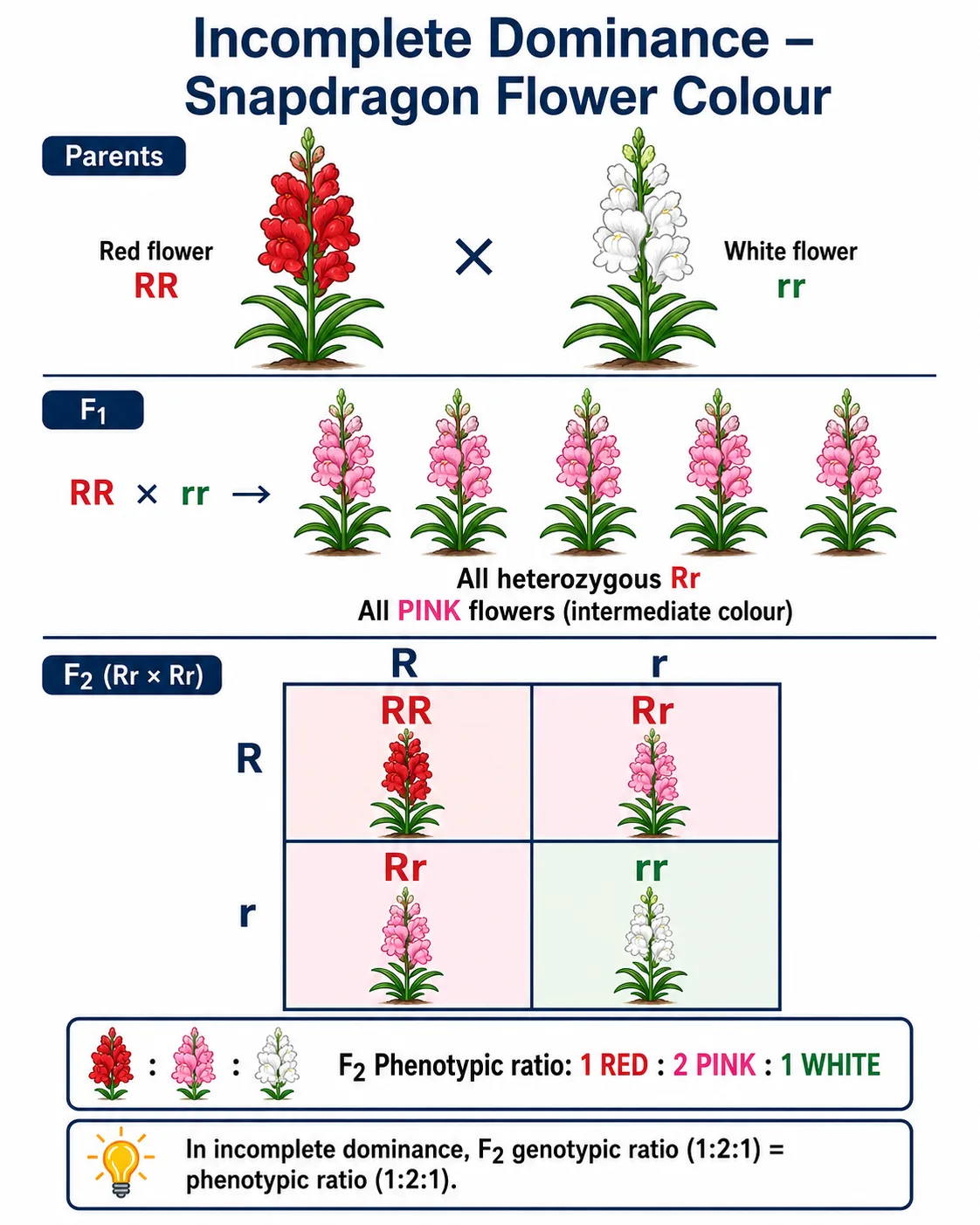
In incomplete dominance, the heterozygote shows a phenotype that is intermediate between the two homozygous parents — as if the dominant allele were only half-effective.
Classic example: Flower colour in snapdragon (Antirrhinum majus)
- Homozygous red parent (RR) × Homozygous white parent (rr) → F1 all pink (Rr)
- F1 pink × F1 pink (Rr × Rr) → F2:
- 1 RR (red) : 2 Rr (pink) : 1 rr (white)
- Phenotypic ratio: 1 red : 2 pink : 1 white
Note the difference from complete dominance:
- Genotypic ratio is the same (1 : 2 : 1) — Mendel's segregation still works.
- Phenotypic ratio differs (1 : 2 : 1 instead of 3 : 1) — because the heterozygote (Rr) has its own distinct phenotype.
Other examples:
- 4 o'clock plant (Mirabilis jalapa) — red × white flowers → pink.
- (Shorthorn cattle roan — red × white → red-and-white patched — is really codominance, covered below.)
- Chicken plumage — black × splashed white → blue Andalusian.
Molecular explanation:
- The "red" allele (R) makes a fully functional enzyme that produces red pigment.
- The "white" allele (r) makes a non-functional enzyme (or no enzyme at all).
- In Rr, only half the normal enzyme dosage is produced → half the normal pigment → pink (a lighter shade of red, not white).
- In RR, full enzyme dosage → fully red.
- In rr, no enzyme → no pigment → white.
This is called gene dosage dependence — phenotype scales with how much functional gene product is made.
[NEET key fact] In incomplete dominance, the F2 phenotypic ratio equals the F2 genotypic ratio (1 : 2 : 1) — because every genotype has a distinguishable phenotype. This is a giveaway for incomplete dominance in NEET MCQs.
Codominance — When Both Alleles Show
In codominance, both alleles in a heterozygote are fully and independently expressed — neither is masked, and neither is intermediate. The heterozygote shows both parental traits simultaneously.
Classic example: ABO blood group system in humans (we'll explore this fully in Section 5)
- The I^A allele produces antigen A on red blood cell surfaces.
- The I^B allele produces antigen B on red blood cell surfaces.
- A person with I^A I^B genotype has both A and B antigens on the same red blood cell — this is the AB blood group.
- Neither allele dominates over the other; both produce their distinct gene products.
Other examples:
- MN blood group system in humans: M and N alleles (genotypes MM, MN, NN). Heterozygote MN shows both M and N antigens — codominance.
- Roan cattle (some interpret this way): R^R × R^W → heterozygote shows both red and white hairs intermixed (rather than blended pink as in some interpretations).
- Sickle-cell heterozygotes (HbS/HbA): both forms of haemoglobin produced — A is functional, S is sickle-prone. Heterozygotes are mostly healthy but have sickle-cell trait. This is sometimes classified as codominance.
Molecular explanation:
In codominance, both alleles produce distinct, functional gene products that can both be present and detected:
- I^A makes a functional glycosyl transferase that adds N-acetyl-galactosamine to RBC surface → A antigen.
- I^B makes a different glycosyl transferase that adds galactose to RBC surface → B antigen.
- Heterozygote (I^A I^B) has both enzymes, so both antigens appear on the RBC surface.
The phenotypic ratio in a heterozygous cross (e.g., I^A I^B × I^A I^B):
- 1 I^A I^A (A) : 2 I^A I^B (AB) : 1 I^B I^B (B)
- Phenotypic ratio: 1 A : 2 AB : 1 B — like incomplete dominance, the heterozygote has its own distinct phenotype.
[Memory trick] Incomplete dominance = blending (pink). Codominance = both visible separately (AB blood = both A and B antigens). Both deviate from the 3:1 ratio and give 1:2:1 instead.
Incomplete Dominance vs Codominance — The Key Distinction
These two are often confused. Here is the cleanest way to think about them:
| Feature | Incomplete Dominance | Codominance |
|---|---|---|
| Heterozygote phenotype | Intermediate (blend) | Both parental phenotypes visible simultaneously |
| Example | Pink snapdragon (red × white) | AB blood group (A × B) |
| Allele expression at molecular level | Each allele produces a different amount of the same gene product (or one makes none) | Both alleles produce different functional gene products |
| Phenotype of heterozygote | Looks like a mixture (1 colour, intermediate) | Looks like both, side by side |
| F2 phenotypic ratio | 1 : 2 : 1 | 1 : 2 : 1 (but the "2" is a unique blend like pink) |
The simplest test:
- If the heterozygote looks like a NEW intermediate color/trait → Incomplete dominance.
- If the heterozygote shows BOTH parental traits at once, distinctly → Codominance.
Real-life mnemonic:
- Mix red paint + white paint → pink (one new colour). That's incomplete dominance.
- Mix red marbles + white marbles in a bowl → you still see distinct red and white marbles. That's codominance.
[NEET high-yield trap] A common NEET question: "In ABO blood groups, the genetic phenomenon is…" — the answer is codominance + multiple alleles (both, because I^A and I^B are codominant, AND there are 3 alleles total: I^A, I^B, i). Don't confuse with "incomplete dominance."
Memory Capsule — Section 4
5 facts to lock in:
Incomplete dominance: Heterozygote shows intermediate phenotype. Example: snapdragon (red × white → pink F1). F2 = 1 red : 2 pink : 1 white.
Codominance: Heterozygote shows both alleles fully expressed. Example: ABO blood groups (A × B → AB). F2 from heterozygote × heterozygote = 1 A : 2 AB : 1 B (if I^A I^B × I^A I^B).
In both deviations, F2 phenotypic ratio = 1 : 2 : 1 — equal to the genotypic ratio (because every genotype has a distinct phenotype).
Molecular basis:
- Incomplete dominance = partial expression (one allele makes less product, or none).
- Codominance = both alleles fully functional, producing different products.
- Examples to memorise:
- Incomplete dominance: snapdragon, Mirabilis jalapa.
- Codominance: ABO blood groups, MN blood groups.
Why this matters: Mendel's "Law of Dominance" is NOT universal. Recognising deviations is key to interpreting modern genetic data.
Solved Examples — Section 4
Q1. In snapdragon, R = red and r = white are alleles showing incomplete dominance. RR × rr cross gives F1 pink. Self-pollination of F1 produces what genotypic and phenotypic ratios in F2?
Answer: 1 red : 2 pink : 1 white (1 : 2 : 1). Self-pollinating the pink F1 (Rr × Rr) gives 1 RR : 2 Rr : 1 rr, and since the heterozygote is pink, the genotypic and phenotypic ratios are identical — the diagnostic feature of incomplete dominance.
Q2. A man with blood group A marries a woman with blood group B. What are the possible blood groups of their children?
Answer: Potentially all four — A, B, AB and O. A father (I^A I^A or I^A i) and a B mother (I^B I^B or I^B i) may each carry a hidden i. Only when both are heterozygous (I^A i × I^B i) do all four groups appear, in a 1 AB : 1 A : 1 B : 1 O ratio:
| I^B | i | |
|---|---|---|
| I^A | I^A I^B (AB) | I^A i (A) |
| i | I^B i (B) | ii (O) |
Q3. Differentiate between incomplete dominance and codominance with one example each.
Answer: In incomplete dominance the heterozygote is an intermediate blend (snapdragon Rr is pink); in codominance both alleles show fully and separately (I^A I^B blood is AB, with both A and B antigens). Both deviate from 3:1 and give a 1:2:1 F2 ratio — the difference is whether the heterozygote looks like a new in-between trait or like both parental traits at once.
Q4. Why is the heterozygote in incomplete dominance phenotypically different from the homozygous dominant?
Answer: It is a gene-dosage effect. In Rr only one allele makes pigment, so the plant gets about half the normal pigment and looks pink rather than fully red. In complete dominance one functional copy already makes enough product, so the heterozygote matches the homozygous dominant.
Q5. In a population of cattle, red and white coat colours are codominant. A heterozygous roan (red-and-white spotted) cattle is crossed with another roan. What is the expected phenotypic ratio of the offspring?
Answer: 1 red : 2 roan : 1 white. Roan × roan is Rr × Rr, giving 1 RR (red) : 2 Rr (roan) : 1 rr (white) — the same 1:2:1 genotype logic as snapdragon — but roan shows BOTH colours side by side (codominance), not a blend.