
Why Pea Plant? Mendel's Brilliant Experimental Choice
In 1856, when Gregor Mendel began his experiments in the monastery garden at Brno, he had no DNA, no microscopes powerful enough to see chromosomes during meiosis, and no inkling of genes. What he had was a sharp mind and the willingness to count tens of thousands of plants — something no one had done before with such rigour.
His genius was in choosing the right experimental organism: Pisum sativum — the garden pea.
Why pea? Mendel listed several reasons:
- Easily cultivated — fast growing, robust, easy to maintain in a monastery garden.
- Short life cycle — a cross yields scorable results within a single growing season.
- Many true-breeding (pure-line) varieties available — important for reliable parents.
- Many contrasting traits — easy to distinguish "tall vs dwarf" or "yellow vs green" without ambiguity.
- Self-pollinating in nature, but easily cross-pollinated by hand (he could control fertilisation).
- Pure lines could be maintained for years — letting him cross known genotypes with confidence.
He chose 7 well-defined traits, each with two contrasting forms — using 14 true-breeding pea plant varieties (one for each end of each contrasting trait pair). Each trait was discrete (no intermediate forms), inherited as a unit, and easily counted.
The Seven Traits Mendel Studied
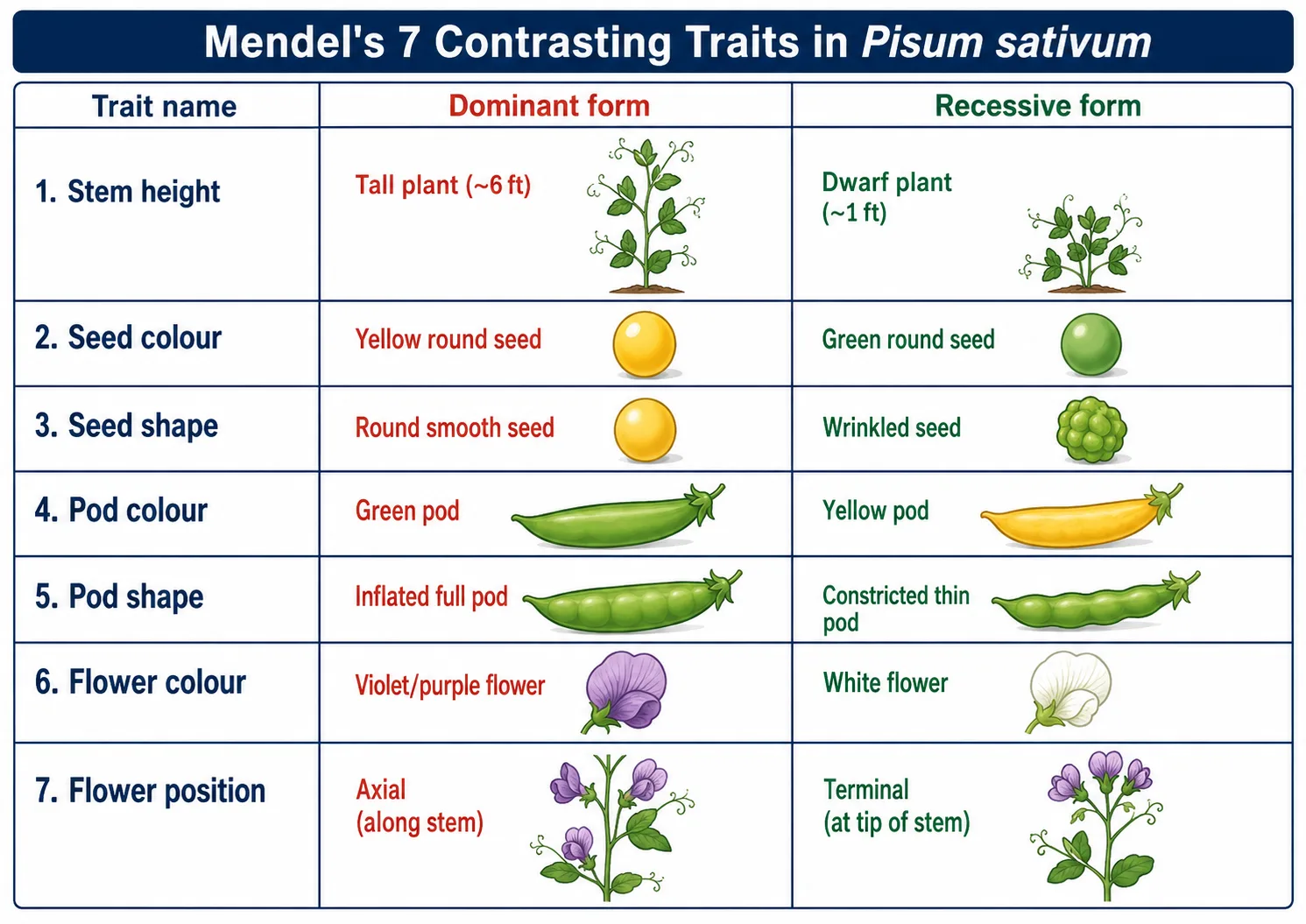
These are the 7 pairs of contrasting traits Mendel tracked through F1 and F2. Memorise this table — NEET asks at least one question on it almost every year:
| Character (trait) | Dominant form | Recessive form |
|---|---|---|
| 1. Stem height | Tall | Dwarf |
| 2. Seed colour | Yellow | Green |
| 3. Seed shape | Round | Wrinkled |
| 4. Pod colour | Green | Yellow |
| 5. Pod shape | Inflated (full) | Constricted |
| 6. Flower colour | Violet (purple) | White |
| 7. Flower position | Axial (along stem) | Terminal (at tip) |
Key observations:
- For every trait, when Mendel crossed a homozygous dominant parent with a homozygous recessive parent, ALL F1 offspring showed the dominant phenotype (no blending, no intermediate). For example: tall × dwarf → all F1 tall.
- When F1 self-pollinated, F2 showed both forms in approximately 3 : 1 ratio (dominant : recessive). The recessive trait reappeared in F2 — it hadn't been lost or blended, just masked.
[NEET Trap] Notice the inconsistency in pod and seed colour: for seed, yellow is dominant; for pod, green is dominant. Don't confuse them.
[Memory Aid] Mnemonic for Mendel's 7 traits: Seed colour, Seed shape, Flower colour, Flower position, Pod colour, Pod shape, Stem height. (SSFFPPS — "Six Sisters Five Flowers Plus Plus Seven".)
Mendel's Experimental Setup — How He Did It
Mendel's experimental rigour was unprecedented. Here's what he did:
Step 1 — Maintain pure (true-breeding) lines.
- He grew each variety in isolation for several generations until each line bred true (every offspring showed the same trait). This ensured his parents were homozygous (TT or tt — though Mendel didn't use that notation).
Step 2 — Control pollination by hand.
For a controlled cross (e.g., tall × dwarf):
- Emasculation: Mendel removed the anthers (male parts) of the flowers of the mother plant before pollen matured — this prevented self-pollination.
- Hand-pollination: He then dusted pollen from the chosen father plant onto the stigma of the mother plant.
- Bagging: He covered the pollinated flowers with bags to prevent any unwanted pollen from reaching them.
Step 3 — Collect and count seeds.
The resulting seeds were planted, grown to maturity, and their phenotypes were carefully recorded for thousands of plants.
Step 4 — Statistical analysis (the truly revolutionary part).
Mendel did not just observe — he counted large samples and looked for ratios. This statistical, quantitative approach was almost unheard of in 19th-century biology and is what made his discoveries durable.
Some of his actual data (for monohybrid crosses):
| Cross | F2 dominant : recessive | Ratio |
|---|---|---|
| Tall × dwarf | 787 tall : 277 dwarf | 2.84 : 1 |
| Round × wrinkled (seeds) | 5474 round : 1850 wrinkled | 2.96 : 1 |
| Yellow × green (seeds) | 6022 yellow : 2001 green | 3.01 : 1 |
The F2 ratios consistently approached 3 : 1. This was no accident — it was a law.
Why Mendel succeeded where others failed:
- Right organism (pea, with discrete traits).
- True-breeding parents (no contamination from past generations).
- Controlled pollination (no unknown crosses).
- Statistical analysis (large sample size + ratios, not just "look").
- Patience — he ran experiments for 7 years (1856–1863) before publishing in 1866.
Mendel's Legacy — Forgotten and Rediscovered
Mendel read his paper in 1865 (its proceedings printed in 1866). The proceedings of the Brno Natural History Society appeared in 1866 in Verhandlungen des naturforschenden Vereines in Brünn (Proceedings of the Natural History Society of Brno).
And then… silence for 34 years.
Why was his work ignored?
- Obscure journal. Brno was a peripheral city; the proceedings reached very few scientific readers.
- Ahead of his time. Mendel's concept of discrete, particulate units of inheritance (today's "genes") was foreign to a scientific community wedded to blending inheritance.
- Statistical reasoning in biology was unfamiliar — many biologists were not trained to think in terms of ratios.
- He communicated only with one major scientist (Carl Nägeli) who failed to grasp the importance of the work and even pushed Mendel to test crosses in Hieracium (hawkweed), where Mendel got confusing results (we now know hawkweed reproduces apomictically).
Mendel died in 1884, having largely abandoned his genetic work and devoted his time to administrative duties as abbot of the monastery.
Rediscovery in 1900:
Three scientists independently rediscovered Mendel's laws in 1900:
- Hugo de Vries (Netherlands)
- Carl Correns (Germany)
- Erich von Tschermak (Austria)
Each had been working on inheritance in their own experimental organisms, and each came upon Mendel's 1866 paper while doing literature review. Tellingly, each gave full credit to Mendel and named the laws after him.
By 1900, microscopy had advanced enough to see chromosomes during meiosis. The next few years would link Mendel's "factors" to chromosomes (the Chromosomal Theory — Section 7). The science Mendel had founded suddenly exploded into the field we now call genetics.
Memory Capsule — Section 2
4 facts to lock in:
Why pea? 5 reasons: easy cultivation, short life cycle, pure-line availability, contrasting traits, controllable pollination (self by default, can be hand-pollinated).
7 traits, paired as dominant : recessive. The pod-vs-seed colour trap: seed yellow dominant; pod green dominant.
The experimental rigour: emasculation + hand-pollination + bagging + large sample counting. This statistical approach was Mendel's greatest innovation.
The story: 1856 start, 1866 publication, 1884 death, 1900 rediscovery (de Vries, Correns, Tschermak). 34 years of obscurity.
One number to remember: 3 : 1 — the F2 ratio of dominant : recessive in every monohybrid cross.
[Cross-check] Whenever a question asks for "Mendel's 7 traits", recall the SSFFPPS mnemonic: Seed colour/shape, Flower colour/position, Pod colour/shape, Stem height.
Solved Examples — Section 2
Q1. Why did Mendel choose pea (Pisum sativum) for his genetic experiments? List any four reasons.
Answer: Any four of: easy to cultivate, short generation time, many true-breeding varieties, several sharply contrasting traits, naturally self-pollinated (so pure lines maintain themselves), and easily cross-pollinated by hand for controlled crosses. Together these let him set up clean crosses and follow traits reliably across generations.
Q2. Name the 7 pairs of contrasting traits Mendel studied in pea plants.
Answer: The seven dominant : recessive pairs are listed below — a frequent 2- or 3-mark recall question, so the table is worth memorising.
| # | Trait | Dominant | Recessive |
|---|---|---|---|
| 1 | Stem height | Tall | Dwarf |
| 2 | Seed colour | Yellow | Green |
| 3 | Seed shape | Round | Wrinkled |
| 4 | Pod colour | Green | Yellow |
| 5 | Pod shape | Inflated | Constricted |
| 6 | Flower colour | Violet | White |
| 7 | Flower position | Axial | Terminal |
Q3. Explain the technique of emasculation and why it is necessary in Mendel's experiments.
Answer: Emasculation is the removal of a flower's anthers before its pollen matures. Pea normally self-pollinates, so to cross two chosen plants the mother flower must be stopped from fertilising itself first; Mendel then dusted on pollen from the father plant by hand and bagged the flower to keep out stray pollen.
Q4. In Mendel's monohybrid cross of tall × dwarf, why did the dwarf trait reappear in F2 even though it disappeared in F1?
Answer: Because the dwarf allele was never lost — only masked. F1 is all Tt, tall because T is dominant, but selfing (Tt × Tt) gives 1 TT : 2 Tt : 1 tt, and the 1-in-4 tt plants are dwarf again. This reappearance was Mendel's strongest evidence against blending inheritance: factors stay intact across generations.
Q5. Mendel's work was published in 1866 but ignored for 34 years. Name the three scientists who independently rediscovered Mendel's laws in 1900.
Answer: Hugo de Vries (Netherlands), Carl Correns (Germany), and Erich von Tschermak (Austria). Each came across Mendel's 1866 paper while reviewing the literature and credited him — making 1900 the year genetics took off as a science.