
When Genes Travel Together — Linkage
Mendel's Law of Independent Assortment says alleles of different genes assort independently. But there's a catch he never ran into: this only holds when the genes sit on different chromosomes (or very far apart on the same one).
So what happens when two genes are on the same chromosome, close together? They tend to be inherited together — and that is what we call linkage.
Morgan's lab stumbled onto this while running dihybrid crosses in Drosophila. The F2 ratios refused to come out as the textbook 9:3:3:1. They were lopsided — too many "parental" combinations, too few "recombinant" ones.
The simple picture:
Picture two genes (A and B) on the SAME chromosome:
- Parent 1: AB / AB (both genes on one chromosome).
- Parent 2: ab / ab (both on the other homologue).
- F1: AB / ab (heterozygous — A and B together on one chromosome, a and b on the other).
When F1 makes gametes:
- IF the genes assorted independently: four gamete types in equal proportions (AB, Ab, aB, ab — 25% each).
- IF the genes are perfectly linked (no recombination): only two gamete types (AB and ab — 50% each).
- IN REALITY: mostly AB and ab (parental), plus a smaller slice of Ab and aB (recombinant), thanks to crossing over.
Definition of linkage:
Linkage = the tendency of two or more genes located close together on the SAME chromosome to be inherited together (rather than assorting independently).
The genes that broke Mendel's law: Morgan's group tracked several Drosophila genes at once and found that many pairs travelled together. This was the first crack in Mendel's third law — and it pointed straight at a physical truth: genes occupy specific positions on chromosomes.
Recombination — Breaking Up the Linkage
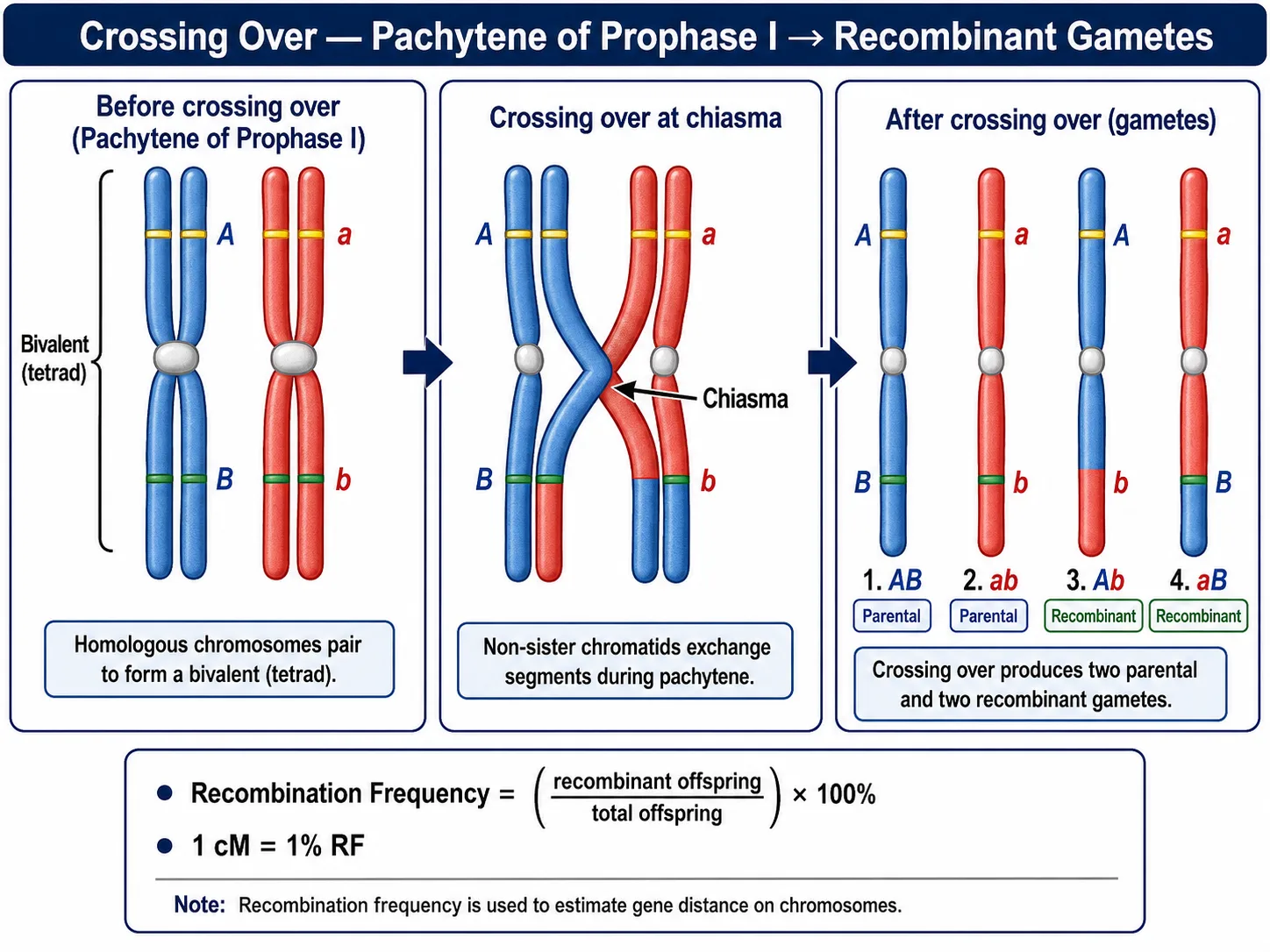
If linked genes always stuck together, we'd never see the recombinant types (Ab, aB). But we do — just at low frequencies. The reason is crossing over during meiosis.
Crossing over = exchange of segments between non-sister chromatids of homologous chromosomes during Prophase I of meiosis (specifically at the pachytene stage).
The mechanism step by step:
- In Prophase I, homologous chromosomes pair up to form a bivalent (or tetrad — all 4 chromatids visible).
- At the pachytene stage, non-sister chromatids exchange segments (crossing over) at random points along the bivalents; the X-shaped chiasmata marking these points become visible later, at diplotene.
- At each crossover site, equal segments of DNA are broken and re-joined between the two non-sister chromatids.
- Once meiosis finishes, gametes carrying recombinant chromosomes (Ab or aB instead of AB or ab) are produced.
Recombination frequency (RF) — the rate at which recombinant gametes turn up:
- RF = 0% → genes are perfectly linked, no recombination (extremely close together, and very rare in nature).
- RF = 50% → genes assort essentially independently (very far apart, or on different chromosomes — either way they behave as "unlinked").
- RF between 0% and 50% → genes are linked but show some recombination; the higher the RF, the farther apart the genes.
The genius insight (Sturtevant, 1913):
Alfred Sturtevant, one of Morgan's students, realised recombination frequency could be used to map where genes actually sit on a chromosome:
The frequency of recombination between two genes is roughly proportional to the physical distance between them on the chromosome.
He proposed the centiMorgan (cM) unit (also called a "map unit"):
- 1 cM = 1% recombination frequency.
So two genes showing 10% recombination are 10 cM apart. This is how the first genetic linkage maps were built — purely from breeding data, decades before anyone could sequence DNA.
[NEET / Board fact] The maximum recombination frequency is 50% — even for genes far apart on the same chromosome, RF caps at 50%. Beyond that, you simply can't tell linkage from independent assortment.
Morgan's Drosophila Linkage Experiments
Let's walk through one of Morgan's classic experiments to see linkage in action.
Setup: Cross 1 — yellow body (y) and white eye (w), both X-linked recessive in Drosophila. The cross: yellow-bodied, white-eyed females × brown-bodied (wild-type), red-eyed (wild-type) males.
- Both genes sit on the X chromosome. The mutant female carries y and w on both of her X's; the wild-type male carries y⁺ and w⁺ on his single X.
- F1: all daughters are heterozygous (y⁺y w⁺w) → wild-type carriers; all sons receive their only X from the mutant mother → yellow-bodied, white-eyed. (The F1 is NOT uniformly wild-type — the classic X-linkage signature.)
- Morgan then intercrossed the F1 flies. If y and w assorted independently, parental and recombinant combinations should turn up in comparable numbers among the F2.
Morgan's actual result:
- Mostly parental types (wild and yellow-white) → the genes are LINKED.
- A small fraction of recombinants (yellow alone, white alone) → some crossing over had occurred.
- Recombination frequency between y and w: about 1.3% → genes roughly 1.3 cM apart.
Cross 2 — white eye (w) and miniature wing (m), also both X-linked.
- Morgan found about 37.2% recombination → w and m are roughly 37.2 cM apart on the X chromosome.
Using these RF values, Sturtevant built the first genetic map:
If y–w = 1.3 cM and w–m = 37.2 cM, then y–m should land near 1.3 + 37.2 = 38.5 cM (or 37.2 − 1.3 = 35.9 cM, depending on the order of the genes). Direct measurement matched the prediction. Genes lie in linear order on chromosomes — like beads on a string.
Why linkage doesn't actually overturn Mendel:
It looks like a contradiction — Mendel said genes assort independently, Morgan said some don't. The resolution: Mendel's law applies only when genes are on different chromosomes. Mendel happened to pick traits that were either on different chromosomes or far enough apart to assort independently. Had he chosen closely linked genes, he'd have seen linkage and might have framed his third law quite differently.
Memory Capsule — Section 8
6 facts to lock in:
Linkage = tendency of genes on the SAME chromosome to be inherited together (violating Mendel's Law of Independent Assortment).
Crossing over = exchange of segments between non-sister chromatids during Prophase I (pachytene) of meiosis → produces recombinant gametes → breaks up linkage.
Recombination frequency (RF) = (number of recombinant offspring / total offspring) × 100%. Maximum value = 50%.
Sturtevant's unit: centiMorgan (cM) = 1% RF. The higher the RF, the farther apart the genes — the basis of the first genetic maps.
Morgan's key cross: yellow body (y) × white eye (w) in Drosophila — both X-linked, only 1.3 cM apart → strongly linked.
Why Mendel didn't see linkage: his traits were either on different chromosomes or far enough apart to assort essentially independently. (Of his 7 traits, about 5 sit on different chromosomes; the rest are well separated.)
Two key numbers: 50% (max RF) and 1 cM = 1% RF.
Solved Examples — Section 8
Q1. Define linkage. Why does it violate Mendel's Law of Independent Assortment?
Answer: Linkage is the tendency of two or more genes that sit close together on the same chromosome to be inherited together instead of assorting independently. Mendel's law needs genes on different chromosomes (which separate independently in meiosis); genes on the same chromosome travel together, so the law breaks down. The violation is only partial — crossing over in Prophase I can still produce recombinants, just at a lower-than-expected rate.
Q2. What is recombination frequency? What is its maximum possible value, and why?
Answer: RF = (recombinant offspring / total offspring) × 100% — the percentage of offspring carrying a non-parental allele combination. Its maximum is 50%. Once genes are on different chromosomes (or so far apart that crossovers are essentially guaranteed between them), half the gametes end up recombinant and half parental, so RF saturates at 50% — the same value you'd get for genuinely unlinked genes.
Q3. Define crossing over and indicate the stage of meiosis at which it occurs.
Answer: Crossing over is the exchange of segments between non-sister chromatids of homologous chromosomes, occurring at the pachytene stage of Prophase I. Homologues pair into a bivalent, chiasmata form at random points, and non-sister chromatids break and swap equal DNA segments — generating recombinant chromosomes. It is the molecular basis of recombination and a major source of genetic variation.
Q4. What is a centiMorgan (cM)? Calculate the map distance between two genes if their recombination frequency is 12%.
Answer: A centiMorgan (map unit) is the distance at which 1% of meiotic products are recombinant, i.e. 1 cM = 1% RF. So an RF of 12% means a map distance of 12 cM. This direct equivalence holds well for low RF values; at large distances, double crossovers undercount the true distance, so refined mapping uses correction factors. The unit was proposed by Alfred Sturtevant in 1913 and named after Morgan.
Q5. Why did Mendel NOT observe linkage in his pea experiments, even though some of his 7 traits are on the same chromosome?
Answer: Mostly luck of the draw. Pea has 7 chromosome pairs, and most of Mendel's chosen traits lie on different chromosomes; the few that share a chromosome are far enough apart that high recombination makes them behave as independent (RF near 50%). His 3:1 and 9:3:3:1 ratios therefore came out clean, hiding any small deviations. Had he picked closely linked genes, his third law would have looked far less universal.
Q6. Two genes A and B in Drosophila show 8% recombination, while genes B and C show 12% recombination. Calculate the map distances and propose a likely gene order.
Answer: A–B = 8 cM and B–C = 12 cM (1 cM per 1% RF). With B in the middle, the order A–B–C gives A–C = 8 + 12 = 20 cM; if instead A and C lie on the same side of B (order C–A–B), A–C = 12 − 8 = 4 cM. To settle it you measure A–C directly: ~20 cM confirms A–B–C, ~4 cM confirms C–A–B. The conventional first guess is the additive linear order, A–B–C — exactly the three-point logic Sturtevant used in 1913.