
Mutations — The Source of New Variation
We've spent a lot of time on how alleles pass from one generation to the next. But step back and ask: where did those alleles come from in the first place? The answer is mutation.
Definition:
A mutation is a heritable change in the DNA sequence (the genotype) of an organism, and it often shows up as a change in the phenotype.
What mutations are like:
- Heritable — if the change happens in germ cells, it passes to the offspring.
- Random in direction — a mutation doesn't happen "for a reason"; it's spontaneous.
- Rare — most genes mutate at rates of roughly 10⁻⁴ to 10⁻⁶ per gene per generation (per base pair of DNA, nearer 10⁻⁹).
- Usually harmful — most mutations disrupt how a gene works.
- The source of variation — without them, evolution would have nothing to work with.
Two broad kinds:
- Point mutations (small-scale) — changes in one or a few DNA bases:
- Substitution (one base swapped for another)
- Insertion (an extra base added)
- Deletion (a base removed)
- Chromosomal aberrations (large-scale) — changes in chromosome number or structure:
- Numerical: aneuploidy (gain or loss of single chromosomes), polyploidy (extra full sets).
- Structural: deletion, duplication, inversion, translocation.
[Why mutations matter] Mutations are the raw material of evolution. Natural selection can only act on the variation they supply — no mutation, no new alleles, and evolution stalls. Most are harmful or neutral, but the rare beneficial one can spread through a population.
Point Mutations — Single-Base Changes
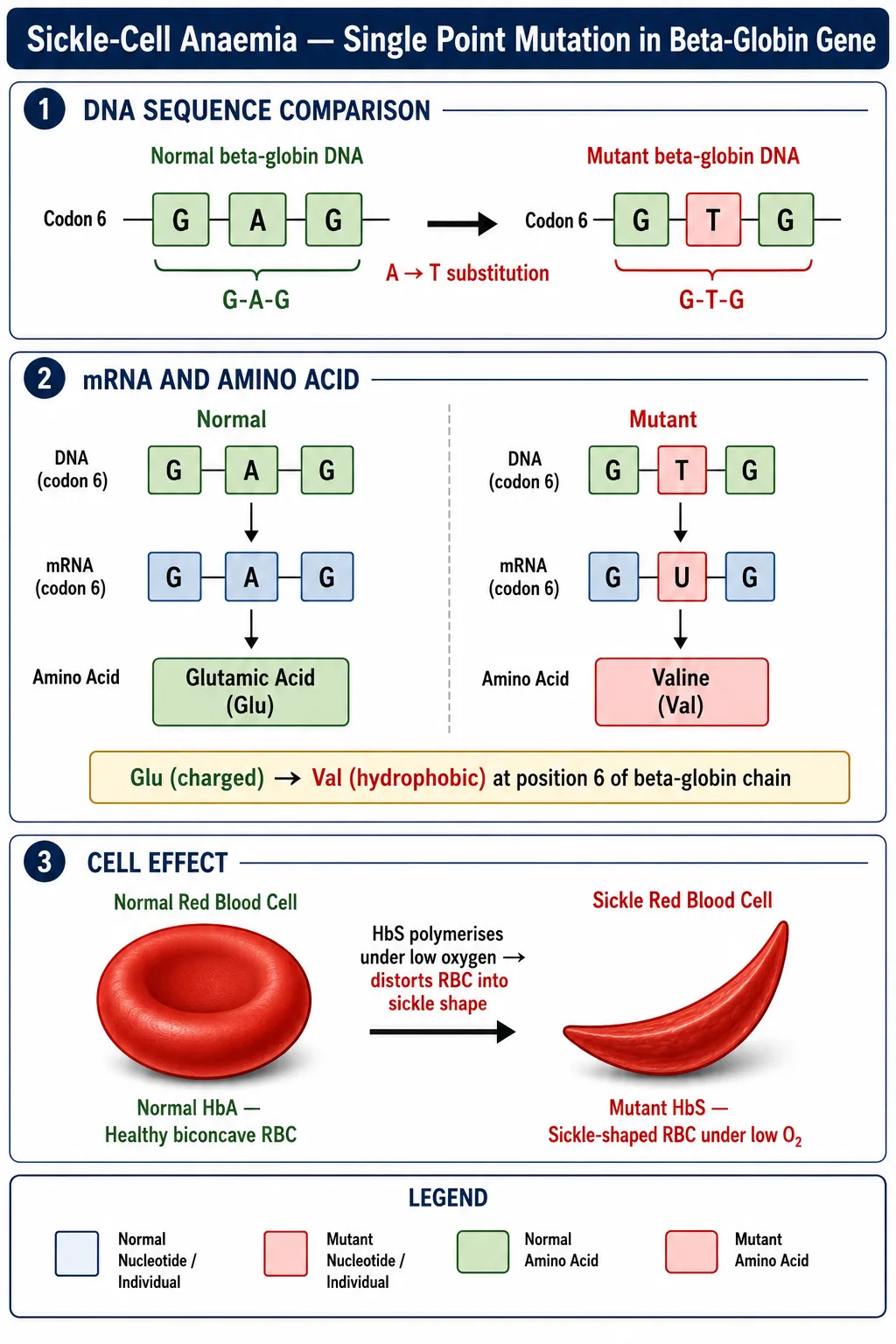
A point mutation is a change in a single nucleotide — or a few adjacent ones — in the DNA sequence.
There are three kinds:
1. Substitution — one base is swapped for another.
- Silent: the swap changes the codon, but thanks to the redundancy of the genetic code the new codon still calls for the same amino acid. The protein is unchanged, so it's usually harmless.
- Missense: the swap changes the codon so it now calls for a different amino acid. The protein carries one altered residue, and the effect ranges from nothing to severe — sickle-cell anaemia is a missense mutation.
- Nonsense: the swap turns a codon into a stop codon, cutting the protein short. Usually severe.
The classic example — sickle-cell anaemia:
A single base substitution in the beta-globin gene at codon 6:
- Normal DNA: G-A-G → glutamate (Glu).
- Mutant DNA: G-T-G → valine (Val).
- So a Val takes the place of a Glu at position 6 of the beta-globin chain. The resulting haemoglobin (HbS) polymerises abnormally when deoxygenated, the red cells sickle, and you get anaemia along with a host of pleiotropic effects.
[NEET Important] Sickle-cell mutation: GAG → GTG in the DNA, Glu → Val at position 6 of beta-globin. The change is in the sixth codon, not the first — that detail comes up again and again.
2. Insertion / Deletion (indel) — frameshift mutations
Insert or delete a base in the middle of a coding sequence and every codon downstream shifts over by one. The whole reading frame is thrown off and every amino acid past that point comes out wrong. That's a frameshift mutation.
- Effect: usually catastrophic — the protein from that point on bears no resemblance to the normal one, and a premature stop codon often crops up, leaving a truncated product.
- Example: a single-base insertion turns ATG-CCG-AAA into ATG-XCC-GAA-A… — every codon after the insertion is reshuffled into a different amino acid.
Why frameshifts hit so hard: they change every downstream amino acid and frequently slip in an early stop codon, so the protein usually ends up non-functional.
[Key insight] Insert or delete 3 bases — or any multiple of 3 — and there's no frameshift; the reading frame survives. You simply add or remove one amino acid. That can still be harmful, but it's nowhere near as drastic as a true frameshift.
What causes point mutations:
- Spontaneous copying errors during DNA replication (~10⁻⁹ per base per generation).
- Chemical mutagens: EMS (ethyl methane sulphonate), nitrous acid, BUdr (5-bromodeoxyuridine).
- Physical mutagens: UV light, X-rays, gamma rays, alpha and beta particles.
- Biological mutagens: transposable elements — the "jumping genes" Barbara McClintock discovered.
Chromosomal Aberrations — Large-Scale Mutations
Chromosomal aberrations affect whole chromosomes or large chunks of them — a far bigger upheaval than a point mutation.
There are two main families.
A. Numerical aberrations (the chromosome number changes):
Aneuploidy — losing or gaining one or a few chromosomes:
- Monosomy (2n − 1) — one chromosome missing. Usually lethal for autosomes; some sex-chromosome cases survive, such as Turner syndrome (45,XO).
- Trisomy (2n + 1) — one extra chromosome. For example:
- Down syndrome (Trisomy 21) — an extra chromosome 21.
- Edwards syndrome (Trisomy 18) — an extra chromosome 18; most cases are lethal.
- Patau syndrome (Trisomy 13) — an extra chromosome 13; most cases are lethal.
- Nullisomy (2n − 2) — both copies of a pair missing. Usually lethal.
The usual cause is non-disjunction during meiosis: the homologous chromosomes fail to separate, so one daughter cell ends up with an extra chromosome and the other with none.
Polyploidy — whole extra sets of chromosomes:
- Triploid (3n) — three sets. Sterile in animals, but common in plants; many edible bananas and watermelons are triploid.
- Tetraploid (4n) — four sets. Common in crop plants like cotton, wheat and sugarcane.
- Polyploidy is rare in animals (mostly some fish and amphibians), but in plants it's a major route to new species and is put to good use in agriculture.
B. Structural aberrations (the shape of a chromosome changes):
| Type | What happens | Example / effect |
|---|---|---|
| Deletion | A segment is lost | Cri-du-chat syndrome (deletion on chromosome 5) |
| Duplication | A segment is repeated | Some leukaemias |
| Inversion | A segment is flipped 180° | Often no obvious effect on the person, but causes meiotic trouble and infertility |
| Translocation | A segment jumps to a different (non-homologous) chromosome | Chronic myeloid leukaemia (the Philadelphia chromosome, a chr 9-22 translocation) |
Structural aberrations arise when chromosomes break — under radiation or chemicals — and then re-join the wrong way.
Cri-du-chat is a good illustration: a deletion in the short arm of chromosome 5, giving affected children a distinctive cat-like cry, developmental delay and intellectual disability.
[Big picture] Numerical changes (aneuploidy) come from meiotic errors — non-disjunction. Structural changes come from break-and-rejoin errors, often triggered by physical or chemical mutagens.
Memory Capsule — Section 12
Six things to lock in:
Mutation = a heritable change in DNA. It's the raw material of evolution.
Point mutations (single-base changes):
- Substitution → silent, missense or nonsense.
- Insertion / deletion (indel) → frameshift mutation, usually catastrophic.
- Sickle-cell: GAG → GTG (Glu → Val) at codon 6 of beta-globin.
- Chromosomal aberrations:
- Numerical = aneuploidy (trisomy 21 = Down) and polyploidy.
- Structural = deletion, duplication, inversion, translocation.
Aneuploidy comes from non-disjunction in meiosis I or II.
Mutagens:
- Physical: UV, X-rays, gamma rays.
- Chemical: EMS, BUdr, nitrous acid.
- Biological: transposable elements (jumping genes — McClintock).
- Most mutations are harmful or neutral, and only a few are beneficial — but those rare beneficial ones are exactly what natural selection acts on to drive evolution.
Two facts the exam loves:
- A frameshift comes from a 1- or 2-base insertion/deletion — not a 3-base one.
- The sickle-cell mutation is a point mutation, missense type, at codon 6 of the beta-globin gene.
Solved Examples — Section 12
Q1. Define mutation. What is the principal source of new genetic variation in a population?
Answer: A mutation is a heritable change in the DNA sequence (genotype) of an organism, often changing the phenotype. Mutation is the ultimate source of new variation — without it no new alleles arise. Recombination and independent assortment only reshuffle existing alleles; mutation alone creates new genetic information.
Q2. What kind of mutation causes sickle-cell anaemia? Describe it precisely.
Answer: A point mutation — a missense substitution in the beta-globin gene. At codon 6 the DNA changes GAG → GTG (mRNA GAG → GUG), so glutamic acid (Glu) is replaced by valine (Val) at position 6 of the β-chain. The resulting HbS polymerises at low oxygen, sickling the red cells.
Q3. What is a frameshift mutation and why is it usually so damaging?
Answer: It's an insertion or deletion of bases in a number that is not a multiple of 3. Since DNA is read in triplets, the reading frame shifts and every codon downstream changes, so the protein is rewritten from that point and a premature stop codon often appears — usually a complete loss of function. A 3-base indel keeps the frame intact and just adds or removes one amino acid, so it's far less drastic (as in the ΔF508 cystic fibrosis deletion).
Q4. Differentiate between aneuploidy and polyploidy.
Answer: Aneuploidy is the gain or loss of one (or a few) chromosomes; polyploidy is the gain of whole extra sets.
| Feature | Aneuploidy | Polyploidy |
|---|---|---|
| Change | One chromosome more or less | One or more complete extra sets |
| Examples | Trisomy 21 (47, +21); Turner (45, XO); Klinefelter (47, XXY) | Triploid (3n), tetraploid (4n), hexaploid (6n) |
| Cause | Non-disjunction in meiosis | Failed cytokinesis or unreduced gametes |
| Occurrence | Plants and animals | Common in plants; rare in animals |
Q5. Name three mutagens with one example of the damage each does.
Answer: UV light (physical) forms thymine dimers; X-rays and gamma rays (physical) break DNA strands and cause chromosomal aberrations; EMS, nitrous acid and BUdr (chemical) modify bases to cause substitutions; and transposable elements (biological — McClintock's jumping genes) insert themselves into genes and disrupt them. Physical mutagens damage DNA directly; chemical ones alter the bases.