
Areas Related to Circles
Areas Related to Circles carries 4 to 6 marks in the board paper (4 in the 2026-27 sample paper, 5 in both 2026 papers and 6 in 2025).
Expect one or two 1-mark MCQs (sector area, arc length, a wheel or a clock hand), often a 2- or 3-mark sum on a sector or a segment, and in recent papers a whole case study on sectors (a brooch, a circular field). There has been no 5-mark question from this chapter, so the case-based questions here are the long practice.
Where marks are usually lost:
- mixing up arc length with sector area ;
- leaving out the two radii (or the diameter) when finding a perimeter;
- taking the triangle in a segment as when the angle is or , not ;
- not converting km or m to cm before dividing, in wheel problems.
Revise in 5 Minutes
Formulas (angle in degrees, radius )
| Formula | |
|---|---|
| Circumference | |
| Area of circle | |
| Length of arc | |
| Area of sector | ( = arc length) |
| Perimeter of sector | arc |
| Area of minor segment | area of sector area of |
| Area of major segment | minor segment |
Triangle in a segment (the only angles in the syllabus)
| Area of | Chord | |
|---|---|---|
| (equilateral) | ||
For : drop ; then and .
Handy facts
- Major sector angle .
- Semicircle perimeter ; quadrant perimeter .
- Minute hand turns a minute; hour hand turns an hour.
- Distance in one turn of a wheel = its circumference; revolutions = distance ÷ circumference (same units).
- Fencing cost given? Circumference = total cost ÷ rate per metre; then find and the area (for a ploughing or levelling cost).
- Radius doubled: circumference , area .
- With , radii 7, 14, 21, 28, 35 give clean answers: circumference 44, 88, 132, 176, 220; area 154, 616, 1386, 2464, 3850.
Traps
- Using (arc) where (area) is needed, or the other way round.
- Leaving out the two radii from a sector's perimeter, or the chord from a segment's perimeter.
- Using for the triangle when the angle is or .
- Giving the radius when the question asks for the diameter.
How to use this page: try each question on paper first, then read the answer. The marks against each step show what an examiner looks for. The 1-mark MCQs and Assertion-Reason questions are in the quiz at the end, together with questions that test how well you understand the chapter; every quiz answer comes with its explanation.
Short Answer Questions (2 and 3 Marks)
Question 1 (2 marks)
The area of a sector of a circle is and its central angle is . Find the radius of the circle. (Use )
Answer.
- — 1 mark
- , so cm — 1 mark
Question 2 (2 marks)
Aarav cycles from his home in Pune to his school, 11 km away, in 25 minutes. The radius of each wheel of his bicycle is 35 cm. How many revolutions does each wheel make per minute? (Use )
Answer.
- Distance in one revolution cm; total distance cm — 1 mark
- Revolutions in 25 minutes, so revolutions per minute — 1 mark
Question 3 (2 marks)
Kavya was asked to find the area of a sector of a circle of radius 6 cm with central angle , in terms of . She wrote:
Area .
Is her answer correct? If not, find the error and the correct area.
Answer.
- Not correct: she used , which gives the arc length ( cm), not the area — 1 mark
- Area — 1 mark
Question 4 (2 marks)
A sector of a circle of radius 9 cm has a central angle of . Find the area of the sector and the length of the major arc, in terms of .
Answer.
- Area — 1 mark
- Major arc: angle , length cm — 1 mark
Question 5 (2 marks)
Ravi says: "In a circle of radius 14 cm, a sector with central angle has an area of . If I keep the angle the same and double the radius, the area of the sector will also double." Check both of his statements. (Use )
Answer.
Model answer:
The first statement is correct. Area of the sector cm², which is about 102.7 cm².
The second statement is wrong. The area of a sector is , so it depends on the square of the radius. If the radius is doubled and the angle stays the same, the area becomes times. With radius 28 cm the area is cm², not .
(It is the arc length that doubles when the radius is doubled.)
Marking scheme:
- Area ; the first statement is correct — 1 mark
- Area depends on : with radius 28 cm the area is , four times, not double; the second statement is wrong — 1 mark
Question 6 (3 marks)
A chord of a circle with centre and radius 42 cm subtends an angle of at . Find the area and the perimeter of the minor segment. (Use and )
Answer.
Model answer:
Area of sector cm². Length of arc cm.
Draw . It bisects and , so . In right triangle : cm and cm. So cm.
Area of cm².
Area of the minor segment cm².
Perimeter of the minor segment = arc + chord cm.
Marking scheme:
- Sector ; arc cm — 1 mark
- : cm, cm, so cm and — 1 mark
- Minor segment ; perimeter cm — 1 mark
Question 7 (3 marks)
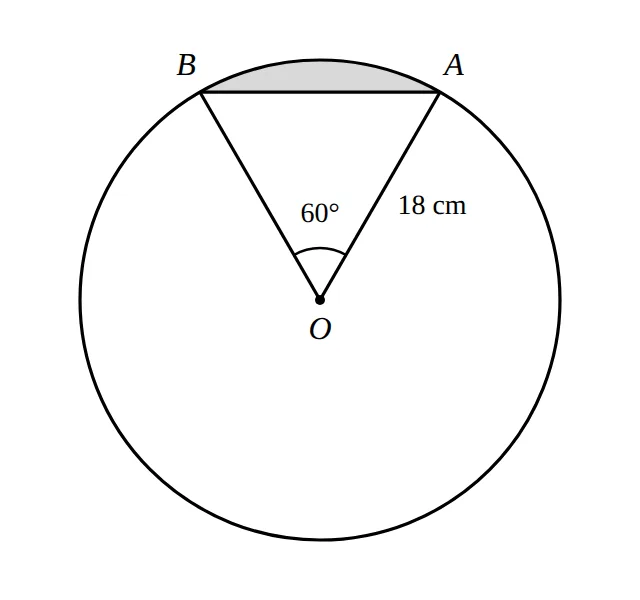
A circular window in a school in Shillong has radius 18 cm. A chord subtends an angle of at the centre , and the part between the chord and the minor arc (shaded in the figure) is made of coloured glass. Find the perimeter and the area of the coloured glass piece, in terms of and .
Answer.
- and , so is equilateral and cm; arc cm — 1 mark
- Perimeter of the glass piece cm — 1 mark
- Area — 1 mark
Question 8 (3 marks)
A round pizza of diameter 28 cm is cut into 8 equal slices by cuts through its centre. Find (i) the area of the top of each slice, (ii) the length of the crust (the curved edge) of each slice, (iii) the perimeter of each slice. (Use )
Answer.
- Each slice is a sector of radius 14 cm and angle ; area — 1 mark
- Crust cm — 1 mark
- Perimeter cm — 1 mark
Question 9 (3 marks)
The area of a sector of a circle is and the length of its arc is 44 cm. Find the radius of the circle, the central angle of the sector, and the perimeter of the corresponding major sector. (Use )
Answer.
- Area with arc : , so cm — 1 mark
- Circumference cm; — 1 mark
- Major arc cm; perimeter of major sector cm — 1 mark
Question 10 (3 marks)
A farmer near Karnal fenced his circular field at ₹ 24 per metre and paid ₹ 5280 in all. Find the radius of the field, its area, and the cost of ploughing it at ₹ 0.50 per m². (Use )
Answer.
- Circumference m; , so m — 1 mark
- Area — 1 mark
- Cost of ploughing ₹ 1925 — 1 mark
Long Answer and Case-Based Questions
Question 11 (4 marks)
Diya's family bought a round wall clock for their new flat in Bhopal. The face of the clock is a circle of radius 21 cm, and its minute hand is 10.5 cm long. The twelve hour marks are equally spaced along the edge of the face. (Use )
(i) Through what angle does the minute hand turn from 4:10 p.m. to 4:50 p.m.? (1 mark)
Answer.
- 40 minutes: — 1 mark
(ii) Find the distance moved by the tip of the minute hand in that time. (1 mark)
Answer.
- cm — 1 mark
(iii) Find the area swept by the minute hand in that time. (2 marks)
Answer.
- Angle , radius 10.5 cm (the minute hand, not the face) — 1 mark
- Area — 1 mark
OR
(iii) Lines drawn from the centre of the face to the twelve hour marks divide the face into 12 equal sectors. Find the area of one such sector and the length of its arc. (2 marks)
Answer.
- Each sector has angle and radius 21 cm; area — 1 mark
- Arc cm — 1 mark
Question 12 (4 marks)
For a craft fair in Kutch, Hetal makes hand fans (pankhas). Each fan is a sector of a circle of radius 28 cm with , fixed to a handle at , as shown in the figure. (Use )
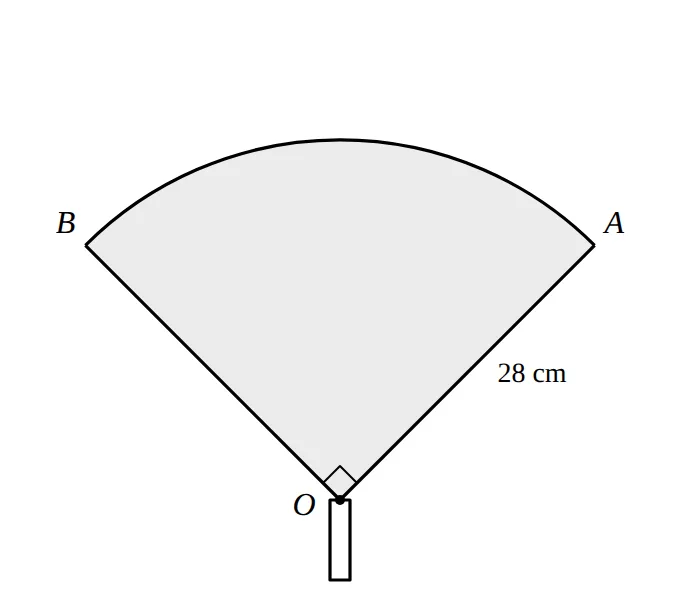
(i) Find the length of the arc of one fan. (1 mark)
Answer.
- cm — 1 mark
(ii) Find the area of cloth used for one fan. (1 mark)
Answer.
- — 1 mark
(iii) A lace is stitched once along the whole boundary of the fan (the arc and the radii and ). Find the length of lace needed for one fan and its cost at ₹ 15 per 10 cm. (2 marks)
Answer.
- Lace cm — 1 mark
- Cost ₹ 150 — 1 mark
OR
(iii) Hetal also makes a small fan: a sector of radius 14 cm with the same angle of . How much less cloth does the small fan need than the big one? (2 marks)
Answer.
- Small fan — 1 mark
- Less cloth (half the radius needs a quarter of the cloth) — 1 mark
Question 13 (4 marks)
A giant wheel at the Dussehra mela in Mysuru has a radius of 14 m. It has 8 cabins fixed at equal distances on its rim, and each cabin is joined to the centre by a spoke, as shown in the figure. and are two neighbouring cabins. (Use )
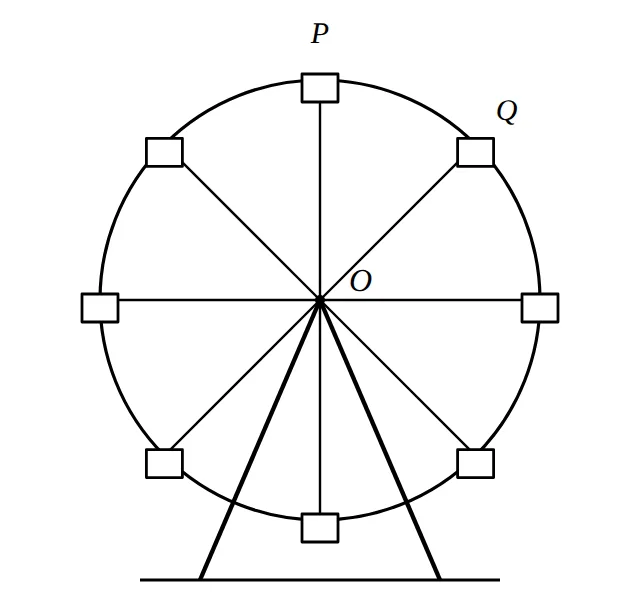
(i) Find , the angle between the spokes of two neighbouring cabins. (1 mark)
Answer.
- — 1 mark
(ii) How far does a cabin travel along the rim in going from the position of to the position of ? (1 mark)
Answer.
- Arc m — 1 mark
(iii) During one ride the wheel makes 5 complete rounds. Find the distance travelled by a cabin during the ride. If a cabin moves at a steady 2.2 m per second, how long does the ride last? (2 marks)
Answer.
- Distance m — 1 mark
- Time seconds, that is, 3 minutes 20 seconds — 1 mark
OR
(iii) Find the area of the sector of the wheel between the spokes of two cabins that have two other cabins between them. (2 marks)
Answer.
- There are 3 gaps between them, so the angle is — 1 mark
- Area — 1 mark
Question 14 (4 marks)
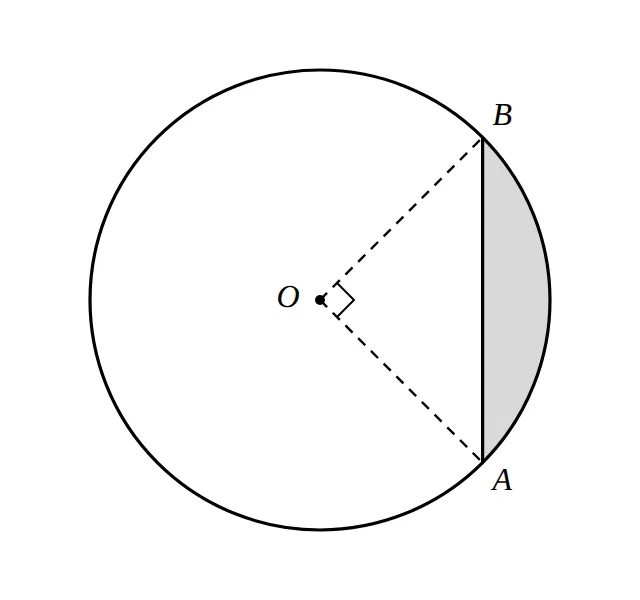
A carpenter in Saharanpur makes a round dining table with a top of radius 70 cm and centre . A part of the top folds down: it is the region cut off by a straight hinge , where the chord subtends a right angle at (shaded in the figure). (Use and )
(i) Find the area of the whole table top. (1 mark)
Answer.
- — 1 mark
(ii) Find the length of the hinge . (1 mark)
Answer.
- cm — 1 mark
(iii) Find the area of the part that folds down. (2 marks)
Answer.
- Quadrant ; — 1 mark
- Folding part (minor segment) — 1 mark
OR
(iii) A metal strip is fixed all round the edge of the folding part (along the arc and along the hinge). Find the length of the strip. (2 marks)
Answer.
- Arc cm — 1 mark
- Strip cm — 1 mark