
Arithmetic Progressions
Arithmetic Progressions carries 4 to 5 marks in the board paper: 4 in the 2026-27 sample paper, and 5 in the 2025 and both 2026 board papers.
The marks usually come as one 1-mark MCQ (the th term, the number of terms, or a term from ) together with either a 3-mark sum problem or a 4-mark case study. An AP case study came in all three real board papers, so the long questions here are case studies and harder 4-mark items. There has been no 5-mark question from this chapter.
Where marks are usually lost:
- writing for the th term, or forgetting the "+ 1" when counting terms;
- taking as positive when the AP is decreasing;
- mixing up (one term) with (the sum of terms);
- keeping a negative or fractional value of after solving the quadratic.
Revise in 5 Minutes
Basics
- Each term after the first is the term before it plus a fixed (the common difference); can be positive, negative or zero.
- , , are consecutive terms of an AP exactly when .
Formulas
| To find | Use |
|---|---|
| th term | |
| th term from the end (last term ) | |
| Number of terms from to | |
| Sum of first terms | |
| A term from the sums |
- If , then . If , then and .
- ; the first odd numbers add up to .
- Three terms: take , , . For an odd number of terms, the middle term is the th.
Derivation of (3 marks): write the sum forwards and backwards and add; each of the pairs is , so .
Standard checks
- Is a term? Only if is a natural number; otherwise "not possible".
- First negative term: solve and take the next natural number.
- "Sum is , find " gives a quadratic: keep only the sensible natural root.
Traps
- is the th term.
- "Between 100 and 200" leaves out 100 and 200.
- "Divisible by both 6 and 8" means multiples of the LCM 24, not of 48.
- "Next 6 terms" are terms 7 to 12, so their sum.
How to use this page: try each question on paper first, then read the answer. The marks against each step show what an examiner looks for. The 1-mark MCQs and Assertion-Reason questions are in the quiz at the end, together with questions that test how well you understand the chapter; every quiz answer comes with its explanation.
Short Answer Questions (2 and 3 Marks)
Question 1 (2 marks)
For the AP 4, 9, 14, …, show that the sum of its 5th to 11th terms is 7 times its 8th term. Explain why the sum of any 7 consecutive terms of an AP is 7 times the middle one.
Answer.
- , , ; sum — 1 mark
- Seven consecutive terms are with middle term ; the terms cancel, so the sum is — 1 mark
Question 2 (2 marks)
The ages, in years, of three sisters are , and , and these ages are in AP. Find and the three ages.
Answer.
- For three terms in AP, twice the middle one equals the sum of the other two: — 1 mark
- , so ; the ages are 4, 10 and 16 years — 1 mark
Question 3 (2 marks)
The 6th term of an AP is and its 10th term is . Find its 15th term.
Answer.
- and give , so and — 1 mark
- — 1 mark
Question 4 (2 marks)
The four angles of a quadrilateral are in AP, and the greatest angle is twice the smallest. Find all four angles.
Answer.
Model answer:
Let the angles, in degrees, be , , and , with the smallest.
The angles of a quadrilateral add up to : .
The greatest angle is twice the smallest: , so .
Putting in the first equation: , so and .
The angles are , , and . (Check: they add up to and .)
Marking scheme:
- Angles , , , : and , so — 1 mark
- gives , ; the angles are , , and — 1 mark
Question 5 (3 marks)
Find the sum of all two-digit numbers which leave a remainder 2 when divided by 3.
Answer.
- The numbers are : an AP with , , — 1 mark
- gives — 1 mark
- — 1 mark
Question 6 (3 marks)
Show that the sum of the first terms of an AP with first term and common difference is .
Answer.
Model answer:
The terms of the AP are . So
…(1)
Writing the same terms in the reverse order,
…(2)
Add (1) and (2) term by term. The first pair gives . The second pair gives . Every pair gives the same total, and there are pairs.
So , that is, .
Since the last term is , this can also be written as .
Marking scheme:
- Write , and the same sum in reverse order — 1 mark
- Adding term by term, each of the pairs gives — 1 mark
- , so — 1 mark
Question 7 (3 marks)
The sum of the first 6 terms of an AP is 57 and the sum of its next 6 terms is 165. Find the AP.
Answer.
Model answer:
The first 6 terms add up to 57: , so …(1)
The "next 6 terms" are the 7th to the 12th terms. So the first 12 terms add up to :
, so …(2)
Subtracting (1) from (2): , so . Then , so .
The AP is . (Check: and .)
Marking scheme:
- , so — 1 mark
- , so — 1 mark
- gives , ; the AP is — 1 mark
Question 8 (3 marks)
Priya was asked to find the 20th term of the AP 12, 8, 4, …. She wrote: , so . Point out her mistake and find the correct 20th term. Also find which term of this AP is .
Answer.
- Mistake: , not 4; the AP is decreasing, so — 1 mark
- — 1 mark
- gives , so is the 29th term — 1 mark
Question 9 (3 marks)
Deepa starts skipping practice with 40 skips on the first day, and every day she does 5 more skips than on the day before. On which day will she do 100 skips for the first time? How many skips will she do in all in the first two weeks?
Answer.
- Daily skips form an AP with , — 1 mark
- gives : the 13th day — 1 mark
- skips — 1 mark
Question 10 (3 marks)
Find the sum of all three-digit numbers which are divisible by both 6 and 8.
Answer.
- Divisible by both 6 and 8 means divisible by their LCM 24 (not 48): — 1 mark
- gives — 1 mark
- — 1 mark
Long Answer and Case-Based Questions
Question 11 (4 marks)
Riya makes rows of triangles with matchsticks, as shown in the figure. One triangle needs 3 matchsticks, a row of two triangles needs 5 and a row of three triangles needs 7. Each new triangle shares one side with the triangle before it.
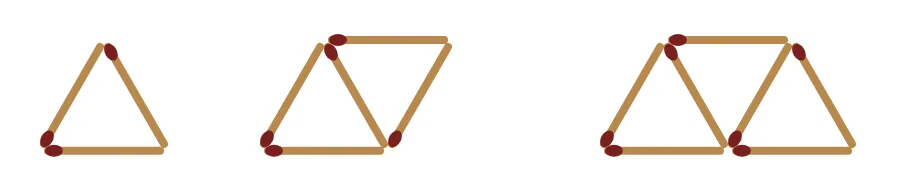
(i) Show that the numbers of matchsticks needed form an AP. Write its first term and common difference. (1 mark)
Answer.
- 3, 5, 7, …: each new triangle adds 2 sticks, so it is an AP with , — 1 mark
(ii) How many matchsticks are needed for a row of 15 triangles? (1 mark)
Answer.
- — 1 mark
(iii) A row of triangles uses exactly 101 matchsticks. How many triangles are there in the row? (2 marks)
Answer.
- — 1 mark
- , so triangles — 1 mark
OR
(iii) Riya makes ten separate rows: one with 1 triangle, one with 2 triangles, and so on up to one with 10 triangles. How many matchsticks does she use in all? (2 marks)
Answer.
- The row of 10 triangles needs sticks — 1 mark
- Total matchsticks — 1 mark
Question 12 (4 marks)
Anu has to read a novel of 570 pages during her holidays. She reads 10 pages on the first day, and every day she reads 4 pages more than on the day before.
(i) How many pages does she read on the 8th day? (1 mark)
Answer.
- pages — 1 mark
(ii) On which day does she read 50 pages? (1 mark)
Answer.
- gives : the 11th day — 1 mark
(iii) In how many days does she finish the novel? (2 marks)
Answer.
- , so — 1 mark
- ; cannot be negative, so she finishes in 15 days — 1 mark
OR
(iii) How many pages has she read by the end of the first week, and how many pages are then left? (2 marks)
Answer.
- pages read — 1 mark
- Pages left — 1 mark
Question 13 (4 marks)
Plastic chairs in a school hall are kept in stacks. A single chair is 80 cm tall, and every chair added to a stack raises its height by 6 cm.
(i) Write the heights, in cm, of stacks of 1, 2, 3 and 4 chairs. Do they form an AP? (1 mark)
Answer.
- 80, 86, 92, 98; yes, it is an AP with common difference 6 — 1 mark
(ii) How tall is a stack of 12 chairs? (1 mark)
Answer.
- cm — 1 mark
(iii) The store-room door is 2 m high, so no stack may be taller than 2 m. At most how many chairs can go in one stack? How many such stacks are needed for 105 chairs? (2 marks)
Answer.
- gives , so at most 21 chairs — 1 mark
- Stacks needed — 1 mark
OR
(iii) A stack is 1.64 m tall. How many chairs are in it? How many more chairs can be added to it before it becomes taller than 2 m? (2 marks)
Answer.
- gives chairs — 1 mark
- A stack can have at most 21 chairs (), so more — 1 mark
Question 14 (4 marks)
During the monsoon, the forest department of a district in Madhya Pradesh runs a tree plantation drive. Volunteers plant 600 saplings in the first week. As the rains ease, they plant 50 fewer saplings every week than in the week before.
(i) Write the first three terms and the common difference of the AP formed by the numbers of saplings planted each week. (1 mark)
Answer.
- 600, 550, 500; — 1 mark
(ii) In which week are fewer than 200 saplings planted for the first time? (1 mark)
Answer.
- gives ; the 9th week has exactly 200, so the 10th week — 1 mark
(iii) After how many weeks does the total number of saplings planted reach 3400? (2 marks)
Answer.
- , so — 1 mark
- ; is rejected because the weekly number would be negative after the 13th week, so 8 weeks — 1 mark
OR
(iii) How many saplings are planted in the 10th week, and how many more are planted in the 3rd week than in the 10th week? (2 marks)
Answer.
- — 1 mark
- more — 1 mark
Question 15 (4 marks)
A school library in Shillong runs a book-donation drive for 12 weeks. It receives 45 books in the first week, and in every week after that it receives 8 books more than in the week before.
(i) How many books does the library receive in the last (12th) week? (1 mark)
Answer.
- — 1 mark
(ii) How many books does it receive in the 3rd week from the end? (1 mark)
Answer.
- Counting back from the last term: — 1 mark
(iii) Find the total number of books received in the 12 weeks. (2 marks)
Answer.
- — 1 mark
- books — 1 mark
OR
(iii) The register shows that exactly 130 books came in one of the weeks. Is this possible? Justify your answer. (2 marks)
Answer.
- gives , so — 1 mark
- is not a natural number, so no week can have exactly 130 books; it is not possible — 1 mark