
Surface Areas and Volumes
Surface Areas and Volumes carries 4 to 6 marks in the board paper (6 in the 2026-27 sample paper, 5 in both 2026 papers and 4 in 2025).
Expect one or two 1-mark MCQs or an Assertion-Reason item (cubes joined end to end, a cone or hemisphere on a cylinder), and a 3-mark or 5-mark sum on a solid made of two shapes: a tent, a toy, a dome-topped room, a shed. The 2026-27 sample paper put a 5-mark question (tent or toy) from this chapter.
Where marks are usually lost:
- adding the hidden faces, where two solids are joined, into the total surface area;
- using the height in place of the slant height for the curved surface of a cone;
- forgetting the in the volume of a cone, or the in a hemisphere;
- mixing units: litres and litre.
Revise in 5 Minutes
Formulas ( radius, height, slant height of a cone; a cuboid is )
| Solid | Curved / lateral surface | Total surface | Volume |
|---|---|---|---|
| Cuboid | |||
| Cube (edge ) | |||
| Cylinder | |||
| Cone | |||
| Sphere | |||
| Hemisphere |
Slant height of a cone: . Useful triples: 3-4-5, 5-12-13, 7-24-25, 6-8-10.
Combined solids (the syllabus has only two solids joined together)
- Volume: add the volumes of the parts; for a hollow or scooped-out part, subtract.
- Surface area: add only the surfaces you can see. The circle or face where two parts meet is hidden.
- Cone on hemisphere (toy): . Cylinder with a cone on top (tent, no floor): .
- A scooped-out hemisphere or cone adds its inner curved surface and removes the circle of the opening.
- A cylinder standing on a cuboid: the covered circle on the cuboid is replaced by the equal top of the cylinder, so just add .
- A hemisphere on top of a cylinder or cone adds to the total height.
- Largest sphere, hemisphere or cone cut from a cube: diameter = edge (a cone's height = edge, a hemisphere's height = half the edge).
- Hollow hemispherical bowl (outer radius , inner ): total surface .
- Volume given, height unknown? Write volume of part 1 + volume of part 2 = given volume and solve for the height.
Units: litres; litre; .
Traps
- Using instead of in .
- Counting hidden faces (two cubes joined: ).
- Taking TSA of a part when only its curved surface shows.
- Forgetting (cone) or (hemisphere).
How to use this page: try each question on paper first, then read the answer. The marks against each step show what an examiner looks for. The 1-mark MCQs and Assertion-Reason questions are in the quiz at the end, together with questions that test how well you understand the chapter; every quiz answer comes with its explanation.
Short Answer Questions (2 and 3 Marks)
Question 1 (2 marks)
A wax crayon is a cylinder of radius 0.7 cm and length 10 cm, with a cone of the same radius and height 2.4 cm at one end. Find the total surface area of the crayon. (Use )
Answer.
- Slant height cm; surface = flat base + curved surface of cylinder + curved surface of cone — 1 mark
- — 1 mark
Question 2 (2 marks)
A toy is a cone of radius 5 cm and height 12 cm mounted on a hemisphere of the same radius. To find its total surface area, Neha wrote:
TSA of toy = TSA of cone + TSA of hemisphere .
Is she right? If not, explain her mistake and find the correct total surface area in terms of .
Answer.
- Not right: the two circular faces where the cone and hemisphere meet ( each) are hidden, so only the curved surfaces count — 1 mark
- cm; TSA — 1 mark
Question 3 (2 marks)
A glass paperweight is a cube of edge 7 cm with a solid cone of base radius 3.5 cm and height 12 cm fixed on the middle of its top face. Find the volume of glass in the paperweight. (Use )
Answer.
- Volume of cube ; volume of cone — 1 mark
- Total volume — 1 mark
Question 4 (2 marks)
Two identical balls, each of radius , are packed in a cylindrical tube so that they touch each other, the curved wall, and both ends of the tube. Show that the balls fill exactly two-thirds of the tube.
Answer.
Model answer:
Each ball touches the wall, so the tube has radius . The two balls sit one on top of the other and touch both ends, so the height of the tube is two diameters, .
Volume of the tube .
Volume of the two balls .
Fraction filled . So the balls fill two-thirds of the tube, and one-third is empty space.
Marking scheme:
- The tube has radius and height , so its volume is — 1 mark
- Balls , and — 1 mark
Question 5 (2 marks)
A cone, a hemisphere and a cylinder stand on equal bases of radius and have the same height. Show that their volumes are in the ratio 1 : 2 : 3.
Answer.
Model answer:
A hemisphere of radius has height . So the cone and the cylinder also have height .
Volume of the cone .
Volume of the hemisphere .
Volume of the cylinder .
Ratio . Multiplying each by gives 1 : 2 : 3.
Marking scheme:
- The height of the hemisphere is , so all three have height — 1 mark
- Volumes: — 1 mark
Question 6 (3 marks)
A science centre in Bhubaneswar has a planetarium hall in the shape of a cylinder of radius 10.5 m and height 8 m, topped by a hemispherical dome of the same radius. Find (i) the volume of air inside the hall, (ii) the area of the curved wall and the dome together, which are to be plastered. (Use )
Answer.
- Cylinder ; dome — 1 mark
- Volume of air — 1 mark
- Area — 1 mark
Question 7 (3 marks)
A cattle shed on a dairy farm is a cuboid 20 m long, 7 m wide and 5 m high, with a roof in the shape of a half-cylinder of diameter 7 m running along its length. Find (i) the volume of air in the shed, (ii) the area of the tin sheet used for the curved roof. (Use )
Answer.
- Cuboid ; half-cylinder (radius 3.5 m, length 20 m) — 1 mark
- Volume of air — 1 mark
- Curved roof — 1 mark
Question 8 (3 marks)
A solid is made of a cylinder of radius 3 cm with a hemisphere of the same radius fixed on one end. The volume of the solid is . Find the height of the cylindrical part, the total height of the solid, and its total surface area in terms of .
Answer.
- Hemisphere ; so — 1 mark
- cm; total height cm — 1 mark
- TSA — 1 mark
Question 9 (3 marks)
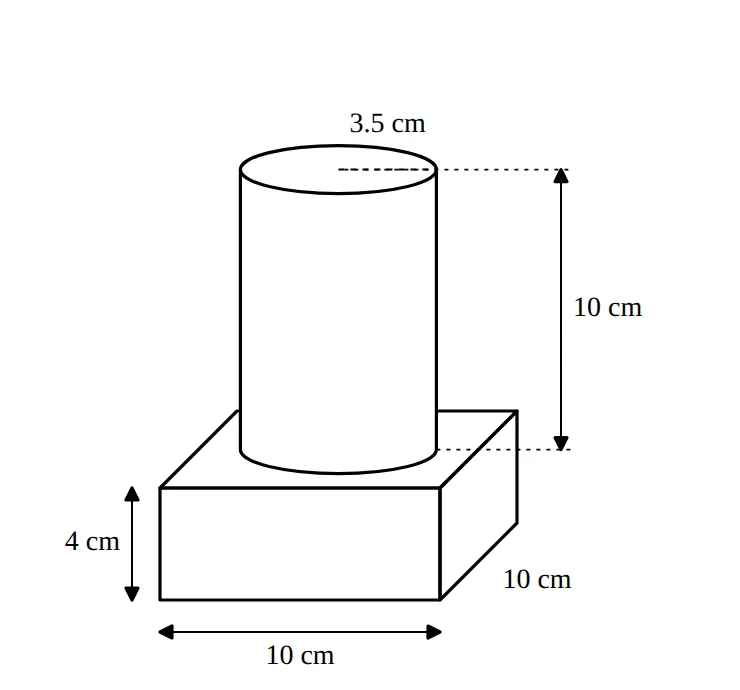
A school trophy is made of a cuboidal base 10 cm long, 10 cm wide and 4 cm high, with a solid cylinder of radius 3.5 cm and height 10 cm standing in the middle of its top face, as shown in the figure. The whole trophy except its bottom face is to be polished. Find the area to be polished and the volume of the trophy. (Use )
Answer.
- Cuboid without bottom ; the circle covered by the cylinder on the top face is replaced by the equal top of the cylinder, so no change — 1 mark
- Add curved surface of cylinder ; area to polish — 1 mark
- Volume — 1 mark
Question 10 (3 marks)
A hemispherical bowl made of steel has an inner radius of 5 cm and an outer radius of 6 cm. Find the total surface area of the bowl (inside, outside and the flat rim at the top), in terms of .
Answer.
- Inner curved surface — 1 mark
- Outer curved surface — 1 mark
- Rim ; total — 1 mark
Long Answer and Case-Based Questions
Question 11 (5 marks)
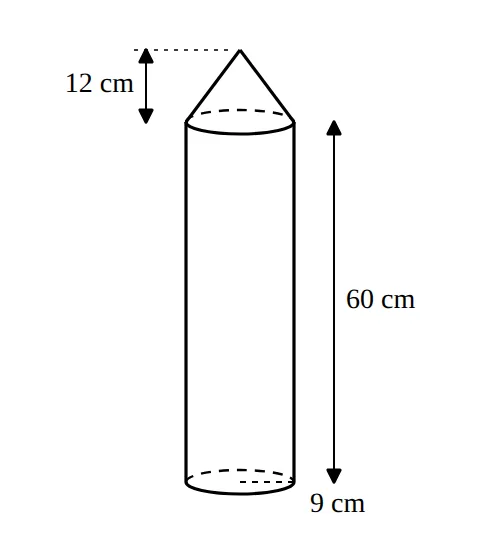
A solid concrete boundary pillar is a cylinder of radius 9 cm and height 60 cm with a cone of the same radius and height 12 cm on top, as shown in the figure. The pillar stands on its base. Find (i) the volume of concrete in the pillar, (ii) the cost of painting all of it except the base at ₹ 10 per 100 cm². (Use )
Answer.
Model answer:
(i) Volume of the cylinder . Volume of the cone .
Volume of concrete cm³.
(ii) The painted surface is the curved surface of the cylinder and the curved surface of the cone. The base is not painted, and the circle where the cone meets the cylinder is hidden.
Slant height cm.
Curved surface of the cylinder . Curved surface of the cone .
Area to be painted cm².
Cost ₹ 381.51.
Marking scheme:
- Volume — 1 mark
- — 1 mark
- cm — 1 mark
- Area to paint — 1 mark
- Cost ₹ 381.51 — 1 mark
OR
A relief-camp tent is a cylinder of radius 6 m and height 5 m, surmounted by a cone of the same radius. The tent encloses 866.64 m³ of air. Find (i) the height of the conical part, (ii) the area of canvas needed for the tent (without the floor), (iii) the cost of the canvas at ₹ 100 per m². (Use )
Answer.
- ; cylinder — 1 mark
- Cone , so m — 2 marks
- m; canvas — 1 mark
- Cost ₹ 37680 — 1 mark
Question 12 (5 marks)
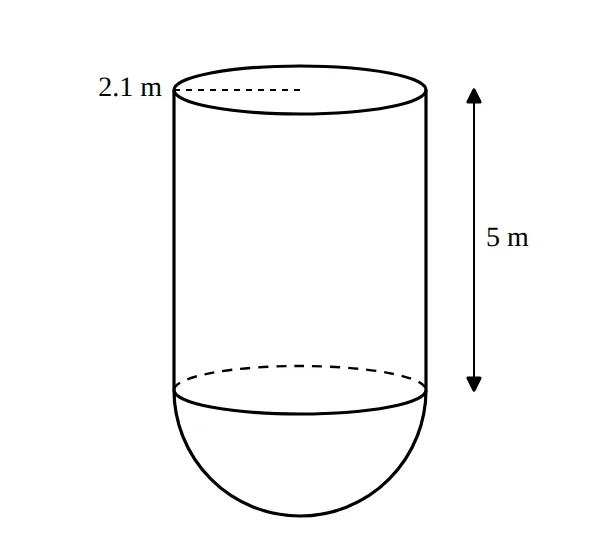
A water tank on the roof of a hostel in Jaipur is a cylinder of radius 2.1 m and height 5 m, closed at the bottom by a hemisphere of the same radius and at the top by a flat circular lid, as shown in the figure. Find (i) how many litres of water the tank can hold, (ii) the cost of painting the whole inner surface of the tank, including the lid, at ₹ 50 per m². (Use )
Answer.
Model answer:
(i) Volume of the cylindrical part m³.
Volume of the hemispherical bottom m³.
Capacity m³. Since litres, the tank holds 88704 litres.
(ii) The inner surface is the curved wall of the cylinder, the curved surface of the hemisphere and the lid.
Curved wall m².
Hemisphere m².
Lid m².
Total m². Cost ₹ 5379.
Marking scheme:
- Volume of cylinder — 1 mark
- Volume of hemisphere — 1 mark
- Capacity litres (as litres) — 1 mark
- Inner surface — 1 mark
- Cost ₹ 5379 — 1 mark
Question 13 (4 marks)
A sports shop in Meerut packs each football of diameter 21 cm in a cubical cardboard box of edge 21 cm, so that the ball just fits inside the box. (Use )
(i) Find the volume of the box. (1 mark)
Answer.
- — 1 mark
(ii) Find the volume of the football. (1 mark)
Answer.
- — 1 mark
(iii) Find the volume of the empty space left in the box, and the fraction of the box that the ball fills. (2 marks)
Answer.
- Empty space — 1 mark
- Fraction — 1 mark
OR
(iii) Find the surface area of the football and the area of cardboard in the box (all six faces). By how much is the cardboard area more than the surface area of the ball? (2 marks)
Answer.
- Ball ; box — 1 mark
- Difference — 1 mark
Question 14 (4 marks)
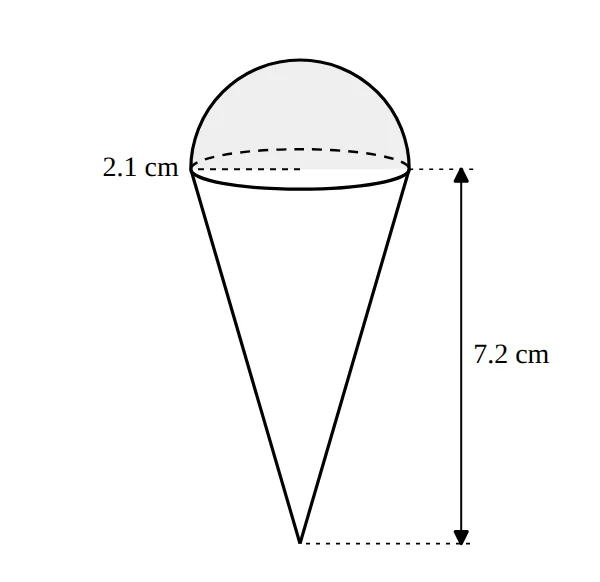
At an ice-cream stall in Kochi, each cone is a wafer cone of radius 2.1 cm and height 7.2 cm, filled completely with ice-cream and topped with a hemisphere of ice-cream of the same radius, as shown in the figure. (Use )
(i) Find the slant height of the wafer cone. (1 mark)
Answer.
- cm — 1 mark
(ii) Find the area of wafer in one cone. (1 mark)
Answer.
- — 1 mark
(iii) Find the total volume of ice-cream in one cone. (2 marks)
Answer.
- Cone ; hemisphere — 1 mark
- Total — 1 mark
OR
(iii) The stall sells 250 such cones in a day. How many litres of ice-cream does it use in a day? (2 marks)
Answer.
- One cone holds — 1 mark
- litres — 1 mark