
Some Applications of Trigonometry
Some Applications of Trigonometry (heights and distances) carries 5 or 6 marks in the board paper: 6 in the 2026-27 sample paper and 5 in the 2025 and both 2026 board papers.
The marks come either as a 5-mark two-triangle problem (sample paper and Feb 2026) or as a 4-mark case study (a lighthouse in 2025, a ladder between two buildings in May 2026), often with a 1-mark MCQ on a shadow, kite or ladder. Written problems use the angles , and , with at most two right triangles in one problem; an MCQ may instead give a ratio, such as a kite string with . A common long question sees the same object from two different heights (from the ground and from a roof or deck).
Where marks are usually lost:
- no figure, or a wrong one (the figure carries a mark in a 5-mark answer);
- measuring the angle of depression from the vertical instead of from the horizontal;
- forgetting to add the observer's eye height or the height of a deck, roof or truck;
- adding distances when the points are on the same side, or subtracting when they are on opposite sides.
Revise in 5 Minutes
Words to know
- Line of sight: the line from the observer's eye to the object.
- Angle of elevation: between the horizontal and the line of sight, for an object above the eye.
- Angle of depression: between the horizontal and the line of sight, for an object below the eye.
- The angle of depression of from equals the angle of elevation of from (alternate angles).
Values you need
Use and when decimals are asked.
Which ratio? Height and horizontal distance: use . A slant length (string, ladder, cable) with height: ; with horizontal distance: .
Ratio given instead of an angle (e.g. ): draw a right triangle with sides 12 and 5, get the hypotenuse 13, then read off or .
Distance from the foot for height : at it is ; at it is ; at it is .
Method for a 5-marker
- Draw the figure: vertical lines for towers, a dashed horizontal line through the eye, angles marked at the right place.
- Mark the unknown as or .
- Write one tan (or sin/cos) equation for each right triangle.
- Solve, rationalise, then put in only at the end.
Patterns
- Walking towards a tower: distances at the two angles differ by the distance walked.
- Two points on opposite sides of a tower: distances add.
- From a window or deck: draw a horizontal line through the eye; the part below it equals the eye's height.
- Same object from the ground and from a height : the two heights found differ by .
Traps
- Angle of depression is drawn from the horizontal at the observer, not from the vertical.
- Add the height of the hand, eye, deck or truck.
- : multiply by , giving .
- Doubling the distance does not halve the angle.
How to use this page: try each question on paper first, then read the answer. The marks against each step show what an examiner looks for. The 1-mark MCQs and Assertion-Reason questions are in the quiz at the end, together with questions that test how well you understand the chapter; every quiz answer comes with its explanation.
Short Answer Questions (2 and 3 Marks)
Question 1 (2 marks)
Riya is flying a kite. She holds the string 1.2 m above the ground. The string is 100 m long and makes an angle of with the horizontal. Assuming the string is straight, find the height of the kite above the ground.
Answer.
- Height of the kite above her hand m — 1 mark
- Height above the ground m — 1 mark
Question 2 (2 marks)
During a storm, a bamboo pole standing vertically on level ground breaks at a point, without separating. The broken part, 8 m long, bends over and its top touches the ground, making an angle of with the ground. Find the height of the pole before it broke. (Use )
Answer.
- Standing part m — 1 mark
- Original height m — 1 mark
Question 3 (2 marks)
From a point on level ground, the angle of elevation of the top of a tower is . Ravi says that from a point on the same line, twice as far from the foot of the tower as , the angle of elevation will be . Is he right? Give a reason.
Answer.
Model answer:
No, Ravi is not right.
Let the height of the tower be . From , , where is the foot, so .
is twice as far, so . The angle of elevation at has .
But , which is not . So the angle at is not . Doubling the distance does not halve the angle. For an angle of , the distance would have to be , which is 3 times .
Marking scheme:
- If the height is , then is from the foot and is ; the angle at has — 1 mark
- , so Ravi is wrong (for the point must be 3 times as far) — 1 mark
Question 4 (2 marks)
A ladder leaning against a vertical wall makes an angle of with the level ground, and its top touches the wall at a height of m. Find the length of the ladder and the distance of its foot from the wall.
Answer.
- , so m — 1 mark
- , so m — 1 mark
Question 5 (3 marks)
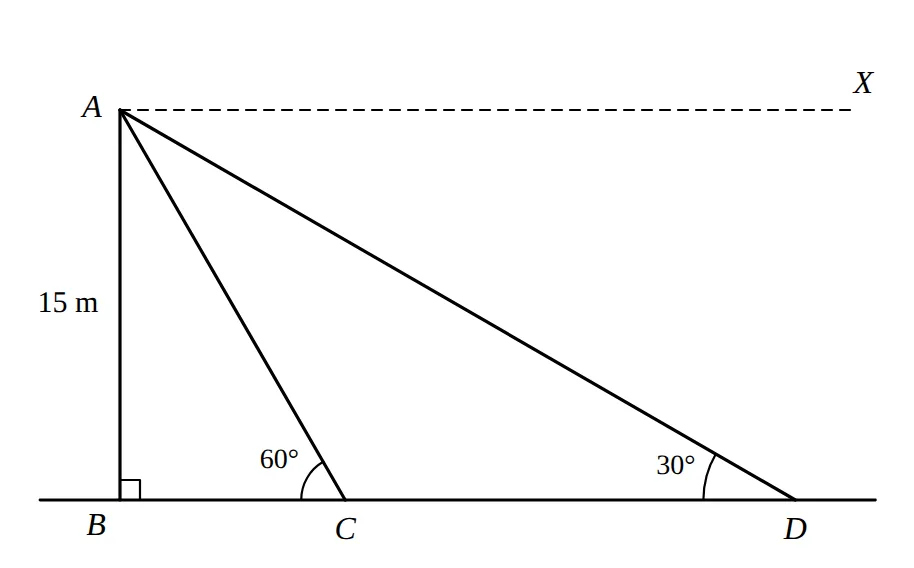
From a window 15 m above the level road, Aman sees a car coming straight towards his house. The angle of depression of the car changes from to . How far did the car travel in this time? (Use )
Answer.
- Let be the window, the foot of the house, and the two positions of the car; and (alternate angles); m — 1 mark
- m — 1 mark
- Distance travelled m — 1 mark
Question 6 (3 marks)
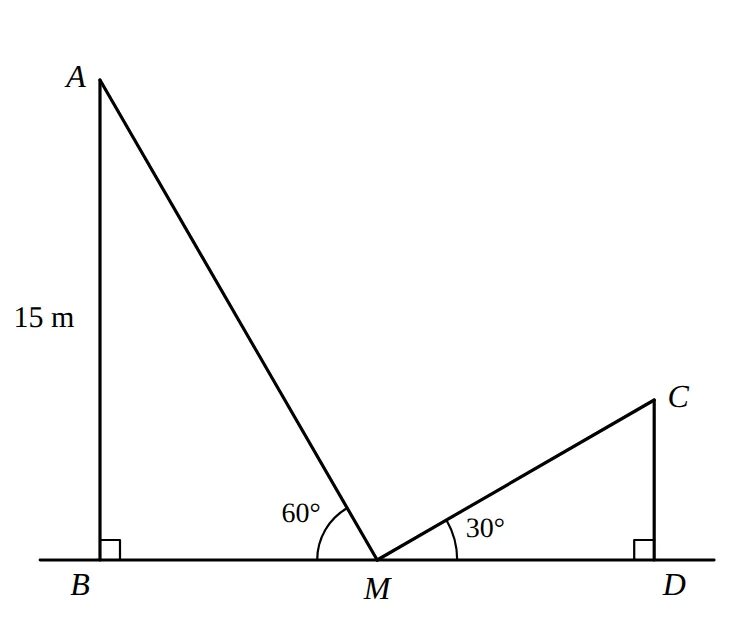
Two vertical poles and stand on opposite sides of a straight road, with their feet and on the road. m. From the midpoint of , the angles of elevation of the tops and are and respectively. Find the width of the road and the height of the pole .
Answer.
- In : , so m — 1 mark
- m — 1 mark
- In : m and m — 1 mark
Question 7 (3 marks)
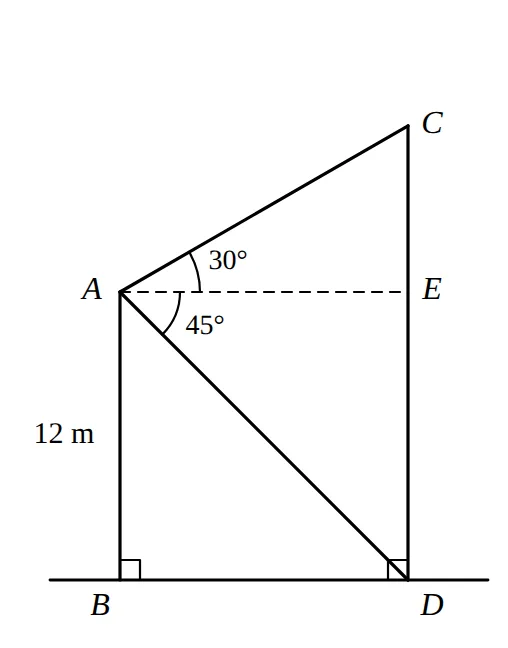
Kavya looks out of her window, 12 m above the level ground. The angle of elevation of the top of the building opposite is and the angle of depression of its foot is . Find the height of the opposite building. (Use )
Answer.
- Let be the window, the foot of Kavya's building (so m), the opposite building and horizontal with on ; from the depression, m — 1 mark
- In : m — 1 mark
- Height m — 1 mark
Question 8 (3 marks)
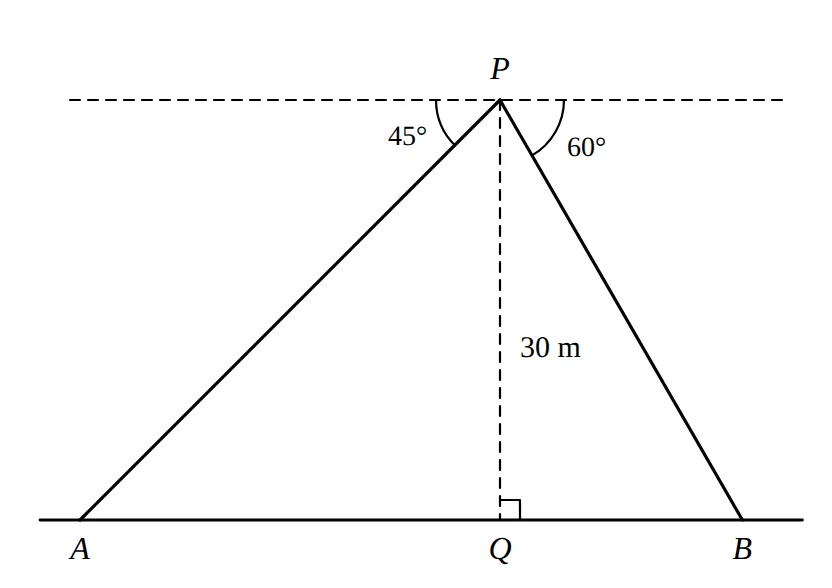
A drone hovers 30 m directly above a point on the ground between the two banks of a river. The angles of depression of the two banks, on opposite sides of the drone and in line with it, are and . Find the width of the river. (Use )
Answer.
- Let the drone be , 30 m above , with banks and ; gives m — 1 mark
- gives m — 1 mark
- Width m — 1 mark
Question 9 (3 marks)
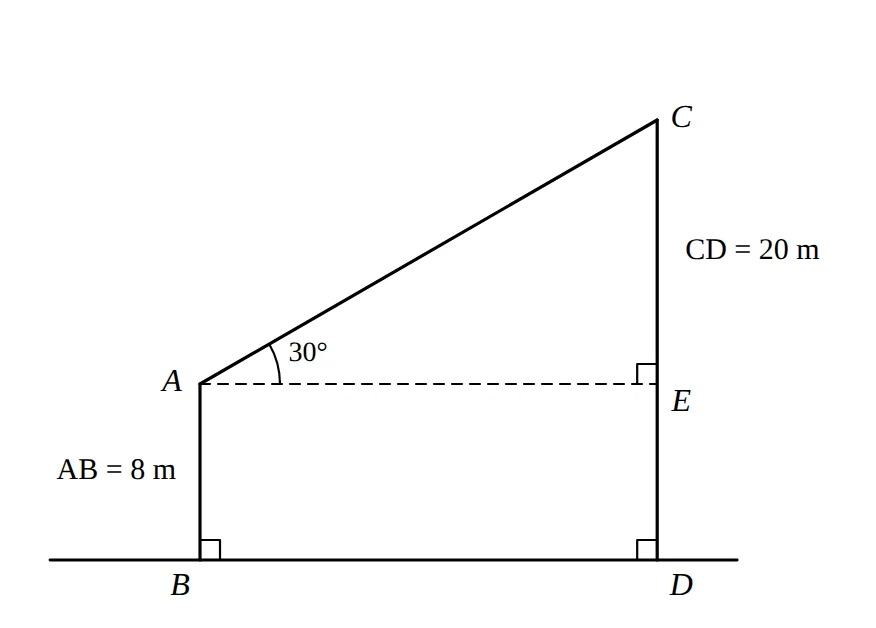
Two vertical poles, 8 m and 20 m high, stand on level ground. A straight wire joins their tops, and the angle of elevation of the top of the taller pole from the top of the shorter pole is . Find the length of the wire and the distance between the poles. (Use )
Answer.
- Let the poles be m and m, and draw meeting at ; then m and m — 1 mark
- In : , so the wire m — 1 mark
- , so m — 1 mark
Long Answer and Case-Based Questions
Question 10 (5 marks)
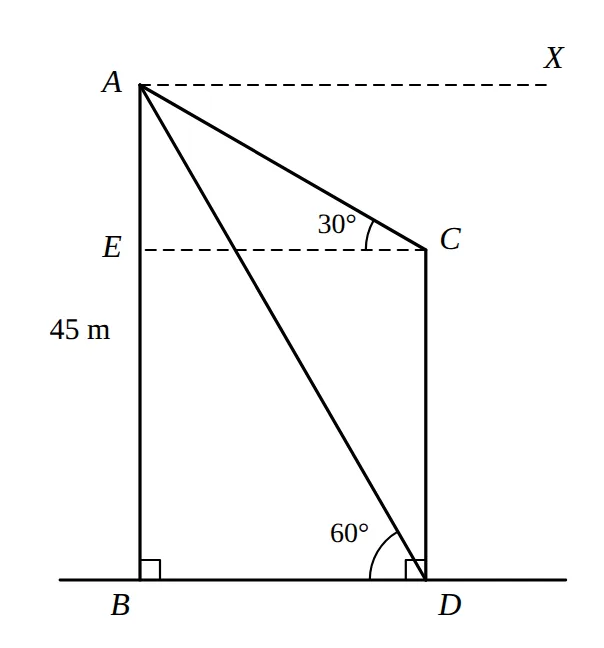
From the top of a 45 m high hotel, the angles of depression of the top and the foot of a temple standing on the same level ground are and respectively. Find the height of the temple and the distance between the hotel and the temple. (Use )
Answer.
Model answer:
Let m be the hotel and the temple. Draw parallel to the ground, meeting at . The angles of depression from are equal to the alternate angles and .
In right : , so and m.
m. In right : , so m.
Height of the temple m.
Distance between the hotel and the temple m.
Marking scheme:
- Correct figure: hotel m, temple , horizontal with on ; , — 1 mark
- In : , so m — 2 marks
- In : m and m — 1 mark
- Height of the temple m; distance between them m — 1 mark
Question 11 (5 marks)
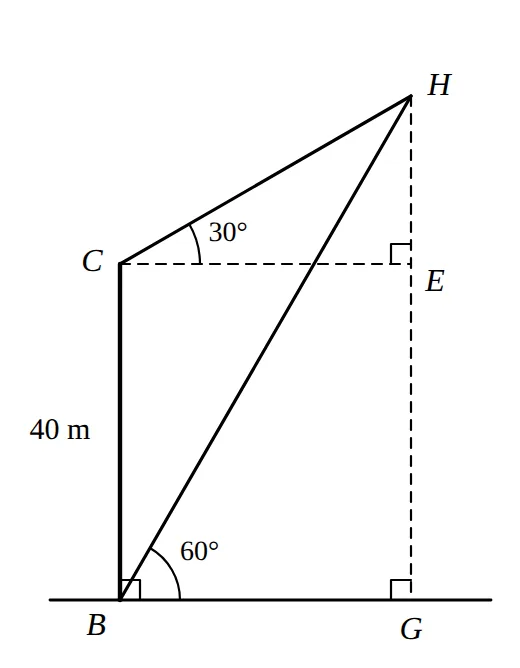
During a flood in Assam, a rescue helicopter hovers in still air. Rahul, standing at the foot of a 40 m high water tower, sees the helicopter at an angle of elevation of . At the same moment Priya, standing on top of the tower, sees it at an angle of elevation of . Find the height of the helicopter above the ground, its horizontal distance from the tower, and its distance from Priya. (Use )
Answer.
Model answer:
Let m be the tower with foot and top . Let the helicopter be at , directly above the point on the ground. Draw horizontal, meeting at . Then m and . Let m.
In right : , so .
In right : , so .
Since : , that is, , so m.
Height of the helicopter m.
Horizontal distance from the tower m.
Distance from Priya: , so m.
Marking scheme:
- Correct figure: tower m ( on the ground), helicopter above the ground point , horizontal with on ; , — 1 mark
- Let ; in : — 1 mark
- In : , and , so — 1 mark
- gives m and m — 1 mark
- Distance from Priya m — 1 mark
Question 12 (5 marks)
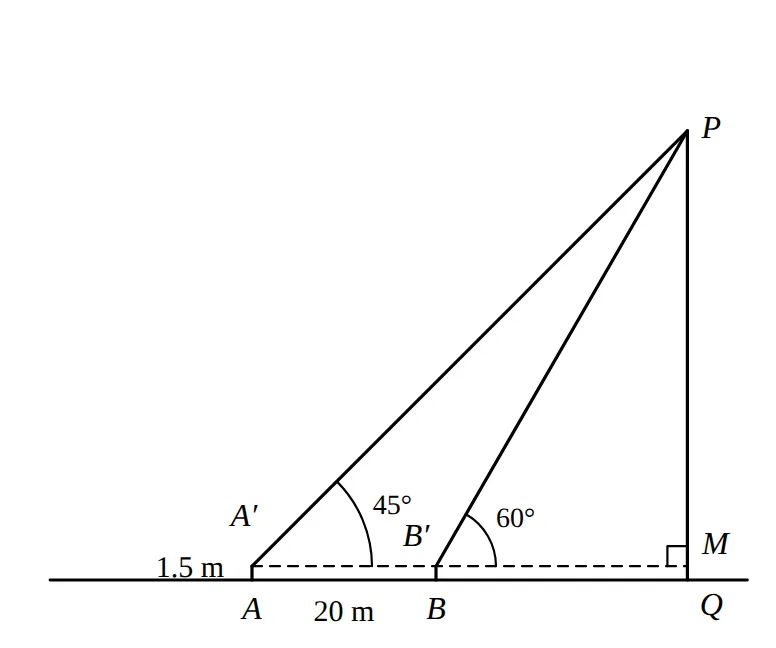
Deepa's eyes are 1.5 m above the level ground. From a point , the angle of elevation of the top of a mobile tower from her eyes is . She walks 20 m straight towards the tower to a point , and the angle of elevation becomes . Find the height of the tower and the distance of from the foot of the tower. (Use )
Answer.
Model answer:
Let be the tower with foot . Let and be Deepa's eye positions, 1.5 m above and . The line is horizontal; produce it to meet at , so m. Let m.
In right : , so .
In right : , so .
: , so and
m.
Height of the tower m.
Distance of from the foot m.
Marking scheme:
- Correct figure: tower , eye positions and 1.5 m above and , produced meets at ; , , m — 1 mark
- Let ; in : (as ); in : — 1 mark
- : , so — 1 mark
- m, so the tower is m high — 1 mark
- Distance of from the foot m — 1 mark
Question 13 (4 marks)
At an adventure camp near Rishikesh, a zipline platform stands 30 m high on level ground. Cable runs straight from the top to a point on the ground and makes an angle of with the ground. A second cable runs from to a point on the other side of the platform and makes an angle of with the ground, as shown in the figure.
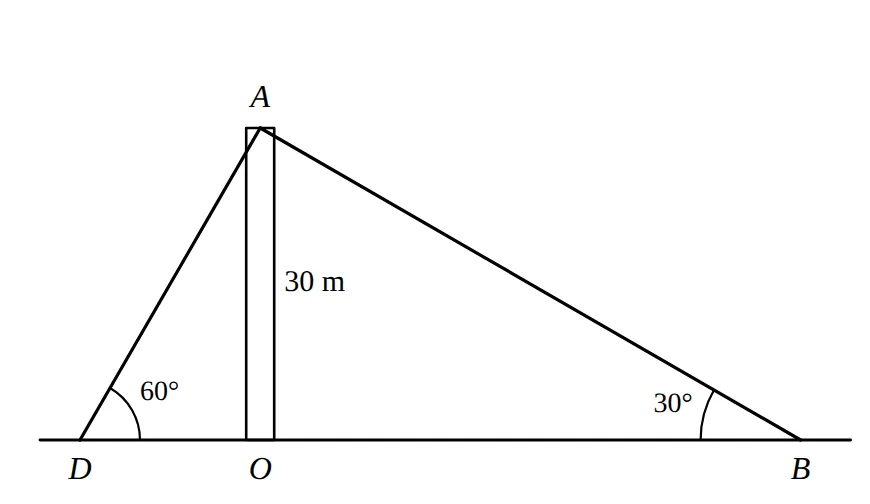
(i) Find the length of the cable . (1 mark)
Answer.
- , so m — 1 mark
(ii) How far is from the foot of the platform? (1 mark)
Answer.
- , so m — 1 mark
(iii) Find the length of the cable and the distance . (Use ) (2 marks)
Answer.
- m — 1 mark
- m; m — 1 mark
OR
(iii) A rider on cable stops at a point that is 20 m from along the cable. How high is above the ground, and how far is it horizontally from the platform? (Use ) (2 marks)
Answer.
- Drop below : m, so the height of is m — 1 mark
- Horizontal distance m — 1 mark
Question 14 (4 marks)
A fire engine reaches a building in Surat. The foot of its ladder is fixed on the truck, 2 m above the ground. The ladder is 20 m long. It is raised to make an angle of with the horizontal, and its top rests against the vertical wall of the building, as shown in the figure.
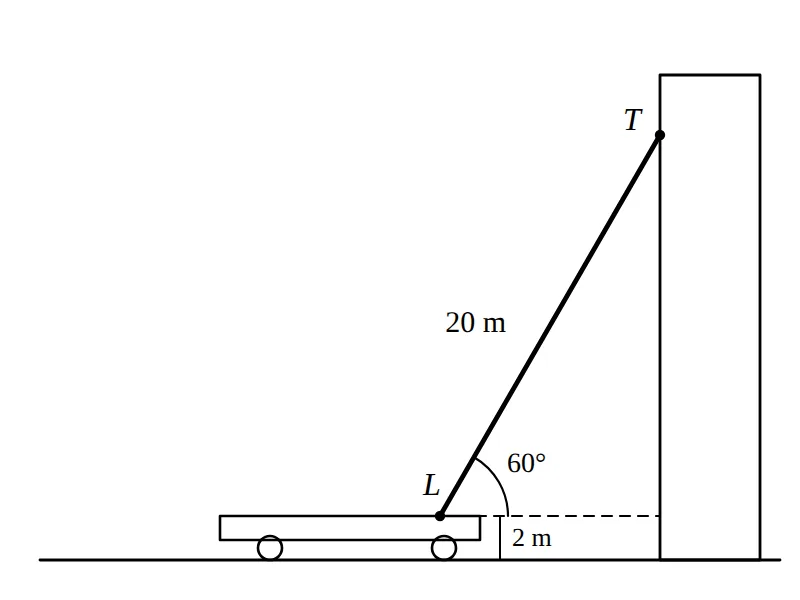
(i) How high above the ground is the top ? (Use ) (1 mark)
Answer.
- m — 1 mark
(ii) What is the horizontal distance of from the wall? (1 mark)
Answer.
- m — 1 mark
(iii) A person is trapped at a window 12 m above the ground. The ladder, with the same length, is lowered to make with the horizontal. Show that its top now reaches the window's height, and find how far back the truck must move so that the top rests on the wall. (Use ) (2 marks)
Answer.
- Height of the top m, which is the window's height — 1 mark
- New horizontal distance m; the truck moves back m — 1 mark
OR
(iii) Suppose the ladder is kept at to the horizontal instead. What length of ladder is needed for its top to reach a window 16 m above the ground? (Use ) (2 marks)
Answer.
- Height to be covered above m, and — 1 mark
- m — 1 mark