Introduction to Trigonometry carries 6 or 7 marks in the board paper: 6 in the 2026-27 sample paper and 7 in the 2025 and both 2026 board papers.
The marks usually come as one or two 1-mark MCQs (a ratio from a given ratio, values at standard angles, a quick simplification), a 2-mark question (evaluate an expression, or find A and B), and a 3-mark identity proof, sometimes set as "find the error in this working". There has been no 5-mark question from this chapter, so the long questions here are case-based and 4-mark items.
Where marks are usually lost:
taking the wrong side as the base or the perpendicular for the angle asked;
using sin2θ+cos2θ=1 when the two angles are different, or writing sin(A+B)=sinA+sinB;
in proofs, cross-multiplying or moving terms across the = sign, or not showing which identity was used;
stopping at 3θ=45∘ instead of finding θ.
Revise in 5 Minutes
Ratios of an acute angle A in a right triangle
sinA
cosA
tanA
perpendicular ÷ hypotenuse
base ÷ hypotenuse
perpendicular ÷ base
cosecA=sinA1, secA=cosA1, cotA=tanA1
tanA=cosAsinA and cotA=sinAcosA
Values to know by heart
0∘
30∘
45∘
60∘
90∘
sin
0
21
21
23
1
cos
1
23
21
21
0
tan
0
31
1
3
not defined
Identities
sin2A+cos2A=1
sec2A−tan2A=1, so (secA−tanA)(secA+tanA)=1
cosec2A−cot2A=1, so (cosecA−cotA)(cosecA+cotA)=1
Quick facts for an acute angle: from 0∘ to 90∘, sinA increases and cosA decreases; both lie between 0 and 1; secA and cosecA are more than 1; tanA can be any positive number.
One ratio given? Draw the right triangle, find the third side by Pythagoras, then read off any ratio.
Proving an identity
Start from the more complicated side. Don't cross-multiply or move terms across =; reducing both sides separately to the same expression is fine.
If stuck, change everything into sin and cos.
Useful algebra: a2+b2=(a+b)2−2ab and a3+b3=(a+b)3−3ab(a+b) with a+b=sin2A+cos2A=1.
End with "= RHS".
Traps
sin(A+B)=sinA+sinB; check with A=B=30∘.
sin260∘+cos230∘ is not 1: the angles differ.
If cos3θ=21, then 3θ=45∘ and θ=15∘.
tanA×cotA=1, not tanA+cotA.
How to use this page: try each question on paper first, then read the answer. The marks against each step show what an examiner looks for. The 1-mark MCQs and Assertion-Reason questions are in the quiz at the end, together with questions that test how well you understand the chapter; every quiz answer comes with its explanation.
Denominator =43+21=45; value =35÷45=34 — 1 mark
Question 2(2 marks)
Find x and y if xtan45∘+ycos60∘=7 and xsin30∘−ysec60∘=−1.
Answer.
Putting in the values: x+2y=7 and 2x−2y=−1, that is, 2x+y=14 and x−4y=−2 — 1 mark
From the first, y=14−2x; then x−56+8x=−2, so x=6 and y=2 — 1 mark
Question 3(2 marks)
Neha was asked to find the value of sin260∘+cos230∘. She wrote: “By the identity sin2θ+cos2θ=1, the value is 1.” Is she right? Find the correct value.
Answer.
Model answer:
No, Neha is not right.
The identity sin2θ+cos2θ=1 is true only when both ratios are of the same angle θ. Here one ratio is of 60∘ and the other is of 30∘, so the identity cannot be used.
Putting in the values: sin60∘=23 and cos30∘=23. So sin260∘+cos230∘=43+43=23.
Marking scheme:
No; the identity holds only when both ratios are of the same angle, and here the angles are 60∘ and 30∘ — 1 mark
sin260∘+cos230∘=43+43=23 — 1 mark
Question 4(2 marks)
If 5sinθ=3, where θ is acute, find the value of secθ+tanθsecθ−tanθ.
Answer.
sinθ=53, base =25−9=4; so secθ=45 and tanθ=43 — 1 mark
Value =45+4345−43=82=41 — 1 mark
Question 5(2 marks)
Prove that tan2A−sin2A=tan2Asin2A.
Answer.
Model answer:
LHS =tan2A−sin2A=cos2Asin2A−sin2A.
Taking sin2A common and using the common denominator cos2A: LHS =cos2Asin2A(1−cos2A).
Since 1−cos2A=sin2A, LHS =cos2Asin2A×sin2A=tan2Asin2A= RHS.
Hence proved.
Marking scheme:
LHS =cos2Asin2A−sin2A=cos2Asin2A(1−cos2A) — 1 mark
=cos2Asin2A×sin2A=tan2Asin2A= RHS — 1 mark
Question 6(3 marks)
In △ABC, right-angled at B, tanA=125 and the perimeter of the triangle is 60 cm. Find the lengths of its sides and the value of sinC+cosC.
Answer.
tanA=ABBC=125: let BC=5k, AB=12k; then AC=25k2+144k2=13k — 1 mark
5k+12k+13k=60 gives k=2: BC=10 cm, AB=24 cm, AC=26 cm — 1 mark
sinC=ACAB=1312, cosC=ACBC=135, so sinC+cosC=1317 — 1 mark
Question 7(3 marks)
Prove that 1+cosA−sinA1+cosA+sinA=cosA1+sinA.
Answer.
Model answer:
We work on the LHS only. Group it as (1+cosA)−sinA(1+cosA)+sinA and multiply the numerator and the denominator by (1+cosA)+sinA.
Denominator: (1+cosA)2−sin2A=1+2cosA+cos2A−sin2A. Using 1−sin2A=cos2A, this is 2cos2A+2cosA=2cosA(1+cosA).
Numerator: (1+cosA+sinA)2=1+cos2A+sin2A+2cosA+2sinA+2sinAcosA. Using sin2A+cos2A=1, this is 2+2cosA+2sinA+2sinAcosA=2(1+cosA)+2sinA(1+cosA)=2(1+cosA)(1+sinA).
So LHS =2cosA(1+cosA)2(1+cosA)(1+sinA)=cosA1+sinA= RHS. Hence proved.
Marking scheme:
Multiply the numerator and the denominator of the LHS by (1+cosA)+sinA; denominator =(1+cosA)2−sin2A=1+2cosA+cos2A−sin2A=2cosA(1+cosA) — 1 mark
Numerator =(1+cosA+sinA)2=2+2cosA+2sinA+2sinAcosA=2(1+cosA)(1+sinA) — 1 mark
LHS =2cosA(1+cosA)2(1+cosA)(1+sinA)=cosA1+sinA= RHS — 1 mark
Question 8(3 marks)
Prove that 2(sin6θ+cos6θ)−3(sin4θ+cos4θ)+1=0.
Answer.
Model answer:
Let a=sin2θ and b=cos2θ, so that a+b=1.
Using a3+b3=(a+b)3−3ab(a+b): sin6θ+cos6θ=1−3sin2θcos2θ.
Using a2+b2=(a+b)2−2ab: sin4θ+cos4θ=1−2sin2θcos2θ.
sin6θ+cos6θ=(sin2θ+cos2θ)3−3sin2θcos2θ(sin2θ+cos2θ)=1−3sin2θcos2θ — 1 mark
sin4θ+cos4θ=(sin2θ+cos2θ)2−2sin2θcos2θ=1−2sin2θcos2θ — 1 mark
LHS =2−6sin2θcos2θ−3+6sin2θcos2θ+1=0= RHS — 1 mark
Question 9(3 marks)
Prove that 1+sinAcosA+tanA=secA.
Answer.
Model answer:
LHS =1+sinAcosA+cosAsinA. Taking the common denominator (1+sinA)cosA:
LHS =(1+sinA)cosAcos2A+sinA+sin2A.
Since sin2A+cos2A=1, the numerator is 1+sinA. So LHS =(1+sinA)cosA1+sinA=cosA1=secA= RHS.
Hence proved.
Marking scheme:
LHS =1+sinAcosA+cosAsinA=(1+sinA)cosAcos2A+sinA(1+sinA) — 1 mark
Numerator =cos2A+sin2A+sinA=1+sinA — 1 mark
LHS =(1+sinA)cosA1+sinA=cosA1=secA= RHS — 1 mark
Question 10(3 marks)
If sinθ−cosθ=21, where θ is acute, find the values of (i) sinθcosθ, (ii) sinθ+cosθ and (iii) tanθ+cotθ.
Answer.
(i) Squaring, 1−2sinθcosθ=41, so sinθcosθ=83 — 1 mark
(ii) (sinθ+cosθ)2=1+2×83=47; both are positive, so sinθ+cosθ=27 — 1 mark
(iii) tanθ+cotθ=sinθcosθsin2θ+cos2θ=1÷83=38 — 1 mark
Long Answer and Case-Based Questions
Question 11(4 marks)
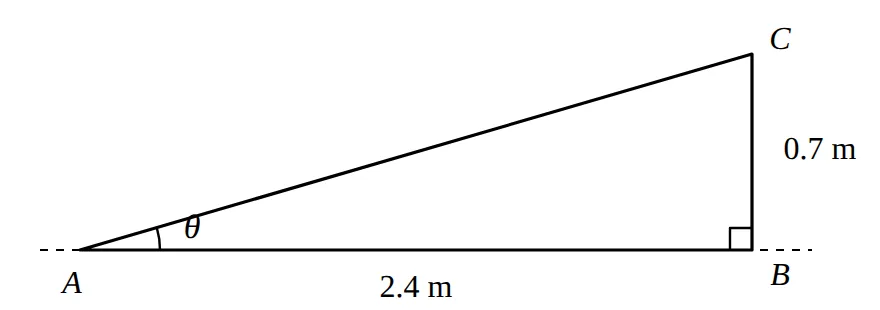
A furniture shop in Pune uses a loading ramp to roll heavy cartons into its delivery van. The figure shows the side view. The ramp AC rises BC=0.7 m (the height of the van floor) over a horizontal distance AB=2.4 m, and it makes an angle θ with the ground.
(i) Find the length of the ramp AC. (1 mark)
Answer.
AC=2.42+0.72=5.76+0.49=6.25=2.5 m — 1 mark
(ii) Find sinθ and cosθ. (1 mark)
Answer.
sinθ=2.50.7=257 and cosθ=2.52.4=2524 — 1 mark
(iii) Find the value of secθ+tanθ, and check that (secθ+tanθ)(secθ−tanθ)=1. (2 marks)
Answer.
secθ=2425, tanθ=247; so secθ+tanθ=2432=34 — 1 mark
secθ−tanθ=2418=43 and 34×43=1; verified — 1 mark
OR
(iii) The same 2.5 m ramp is later used to load a truck whose floor is 1.5 m above the ground. If the ramp now makes an angle ϕ with the ground, find tanϕ and say which slope is steeper. (2 marks)
Answer.
Horizontal distance =2.52−1.52=4=2 m, so tanϕ=21.5=43 — 1 mark
tanθ=247 is less than 43, so on the truck the ramp rises more for each metre across: that slope is steeper — 1 mark
Question 12(4 marks)
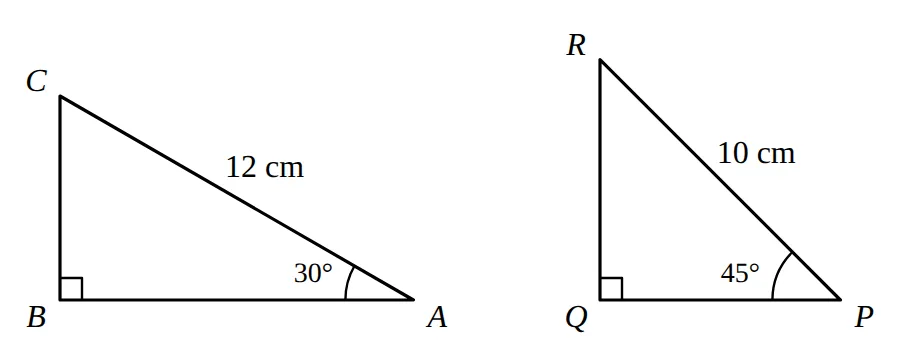
Tanvi's geometry box has two set squares, shown in the figure. In set square ABC, ∠B=90∘, ∠A=30∘ and the longest side AC=12 cm. In set square PQR, ∠Q=90∘, ∠P=45∘ and the longest side PR=10 cm.
(i) Find the length of BC. (1 mark)
Answer.
sin30∘=ACBC, so BC=12×21=6 cm — 1 mark
(ii) Find the length of AB. (1 mark)
Answer.
cos30∘=ACAB, so AB=12×23=63 cm — 1 mark
(iii) Find the lengths of PQ and QR, and the area of the set square PQR. (2 marks)
Answer.
PQ=PRcos45∘=10×21=52 cm and QR=PRsin45∘=52 cm — 1 mark
Area =21×52×52=25 cm2 — 1 mark
OR
(iii) Tanvi draws the perpendicular BD from B to AC on the set square ABC. Using AB from part (ii), find BD and AD. (2 marks)
Answer.
In right △ADB, ∠A=30∘: BD=ABsin30∘=63×21=33 cm — 1 mark
AD=ABcos30∘=63×23=9 cm — 1 mark
Question 13(4 marks)
For an acute angle θ, it is given that secθ−tanθ=91. Answer the following.
(i) Find the value of secθ+tanθ. (1 mark)
Answer.
sec2θ−tan2θ=1 gives (secθ−tanθ)(secθ+tanθ)=1, so secθ+tanθ=9 — 1 mark
(ii) Find secθ and tanθ. (1 mark)
Answer.
Adding: 2secθ=9+91=982, so secθ=941; subtracting: tanθ=940 — 1 mark
(iii) Find sinθ and cosθ, and verify that sin2θ+cos2θ=1. (2 marks)
Answer.
cosθ=secθ1=419 and sinθ=secθtanθ=940×419=4140 — 1 mark
16811600+168181=16811681=1; verified — 1 mark
Question 14(4 marks)
This question is about the expression sec2θ+cosec2θ for an acute angle θ.
(i) Prove that sec2θ+cosec2θ=tanθ+cotθ, where θ is an acute angle. (2 marks)