Triangles
Triangles carries 8 marks in every board paper: the 2026-27 sample paper and the 2025 and both 2026 papers all gave it exactly 8.
A typical share is one or two 1-mark MCQs (a ratio from DE∥BC, similar triangles, a perimeter), a 2-mark item, and a 5-mark question. The 5-marker is usually the Basic Proportionality Theorem (statement, proof and a short use of it) or a similarity proof. Similarity also appears in case studies, such as reflection on a carrom board.
Where marks are usually lost:
- writing the vertices of similar triangles in the wrong order, and so pairing the wrong sides;
- using DBAD=BCDE; the correct pair is BCDE=ABAD;
- missing the construction or the equal-area step in the BPT proof;
- not naming the criterion (AA, SAS, SSS) or the reason for each equal angle.
Revise in 5 Minutes
Similar figures
- Same shape, not necessarily the same size. All squares and all equilateral triangles are similar.
- Two polygons with the same number of sides are similar when (i) corresponding angles are equal and (ii) corresponding sides are in the same ratio. For polygons one condition alone is not enough (square and rectangle; square and rhombus).
Basic Proportionality Theorem (BPT) (the only proof asked)
- If DE∥BC in △ABC (D on AB, E on AC), then DBAD=ECAE. Also ABAD=ACAE.
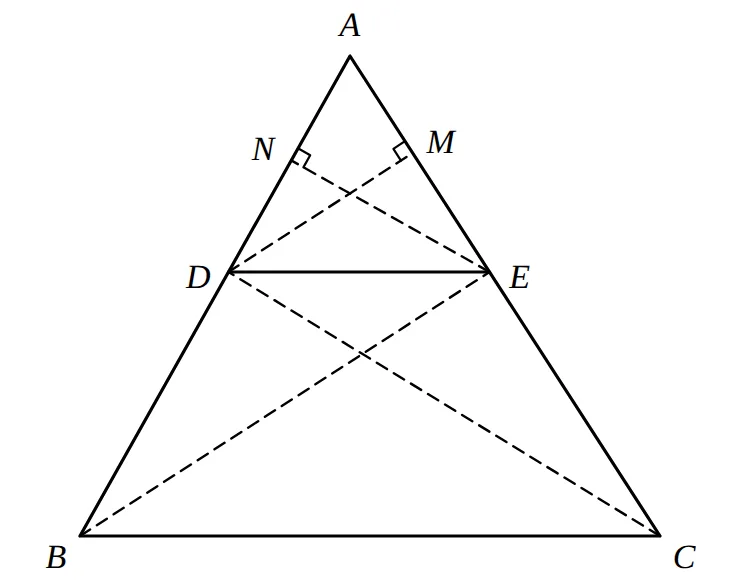
- Proof steps: join BE, CD; draw EN⊥AB, DM⊥AC; ar(BDE)ar(ADE)=DBAD, ar(DEC)ar(ADE)=ECAE; ar(BDE)=ar(DEC) (same base, same parallels).
- Converse: if DBAD=ECAE, then DE∥BC.
Criteria for similar triangles
| Criterion |
What must be shown |
| AA (AAA) |
two pairs of angles equal |
| SSS |
all three pairs of sides in the same ratio |
| SAS |
two pairs of sides in the same ratio and the angles between them equal |
Using similarity
- If △ABC∼△PQR, the order gives the matching: A↔P, B↔Q, C↔R, and PQAB=QRBC=RPCA.
- The ratio of perimeters equals the ratio of corresponding sides.
- Altitude on the hypotenuse: if ∠C=90∘ and CD⊥AB, then △ADC∼△ACB∼△CDB, so AC2=AB×AD, BC2=AB×BD and CD2=AD×DB.
- Common set-ups: DE∥BC gives △ADE∼△ABC; a trapezium's diagonals give △AOB∼△COD.
Traps
- BCDE=ABAD, never DBAD.
- In SAS the equal angle must be the one between the two sides.
- Write the reason for each equal angle: common, vertically opposite, alternate, corresponding, or 90∘.
- The theorem on areas of similar triangles and the Pythagoras theorem (with its converse) are not in this chapter for 2026-27; if a question needs an area ratio, it gives it.
How to use this page: try each question on paper first, then read the answer. The marks against each step show what an examiner looks for. The 1-mark MCQs and Assertion-Reason questions are in the quiz at the end, together with questions that test how well you understand the chapter; every quiz answer comes with its explanation.
Short Answer Questions (2 and 3 Marks)
Question 1 (2 marks)
In △ABC, D and E are points on AB and AC such that DE∥BC. If AD=(x+1) cm, AB=3x cm, AE=4 cm and AC=10 cm, find x and the length of DB.
Answer.
- DE∥BC gives ABAD=ACAE: 3xx+1=104 — 1 mark
- 10x+10=12x, so x=5; AD=6 cm, AB=15 cm, so DB=9 cm — 1 mark
Question 2 (2 marks)
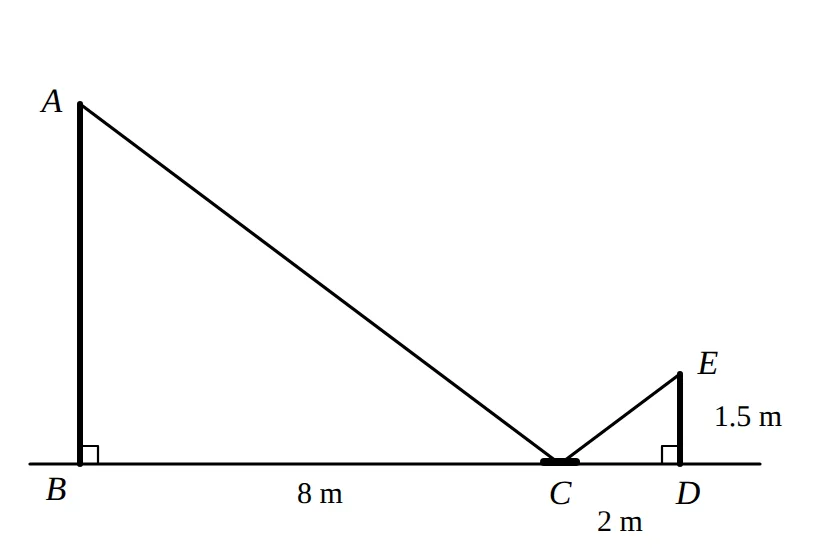
To find the height of a tree AB, Kavya places a small mirror C flat on level ground, 8 m from the foot B of the tree. She walks back to the point D, 2 m beyond the mirror, from where she can see the top A of the tree in the mirror. Her eyes E are 1.5 m above the ground. By the law of reflection, ∠ACB=∠ECD (see the figure). Find the height of the tree.
Answer.
- ∠ABC=∠EDC=90∘ and ∠ACB=∠ECD, so △ABC∼△EDC (AA) — 1 mark
- EDAB=DCBC, so AB=21.5×8=6 m — 1 mark
Question 3 (2 marks)
Give an example to show that (i) two quadrilaterals whose corresponding angles are equal need not be similar, and (ii) two quadrilaterals whose corresponding sides are in the same ratio need not be similar.
Answer.
Model answer:
Two polygons with the same number of sides are similar only when both conditions hold: their corresponding angles are equal and their corresponding sides are in the same ratio.
(i) Take a square of side 2 cm and a rectangle 2 cm long and 4 cm wide. Every angle in both is 90∘, so the corresponding angles are equal. But the ratios of corresponding sides are 22=1 and 42=21, which are not equal. So they are not similar.
(ii) Take a square of side 3 cm and a rhombus of side 3 cm whose angles are 60∘, 120∘, 60∘, 120∘. All corresponding sides are in the ratio 1 : 1. But the angles of the square are 90∘, so the corresponding angles are not equal. So they are not similar.
(For triangles alone, either condition is enough; this is why AA and SSS work only for triangles.)
Marking scheme:
- (i) A square of side 2 cm and a 2 cm by 4 cm rectangle: all angles 90∘, but 22=42, so not similar — 1 mark
- (ii) A square of side 3 cm and a rhombus of side 3 cm with angles 60∘ and 120∘: sides in ratio 1 : 1, but angles not equal, so not similar — 1 mark
Question 4 (3 marks)
In △ABC, AD⊥BC with D on BC. If BD=2 cm, AD=4 cm and DC=8 cm, prove that △BDA∼△ADC, and hence that ∠BAC=90∘.
Answer.
Model answer:
In △BDA and △ADC:
ADBD=42=21 and DCDA=84=21, so ADBD=DCDA.
The angles between these sides are ∠BDA=∠ADC=90∘, since AD⊥BC.
So △BDA∼△ADC by SAS, with B↔A, D↔D and A↔C. Hence ∠BAD=∠ACD.
Now ∠BAC=∠BAD+∠DAC=∠ACD+∠DAC. In △ADC, ∠ACD+∠DAC=180∘−∠ADC=90∘.
Hence ∠BAC=90∘. (Here AD2=16=BD×DC; whenever this holds with AD⊥BC, the angle at A is a right angle.)
Marking scheme:
- ADBD=42=21 and DCDA=84=21 — 1 mark
- ∠BDA=∠ADC=90∘ (included angles), so △BDA∼△ADC (SAS) and ∠BAD=∠ACD — 1 mark
- ∠BAC=∠BAD+∠DAC=∠ACD+∠DAC=180∘−90∘=90∘ (angle sum of △ADC) — 1 mark
Question 5 (3 marks)
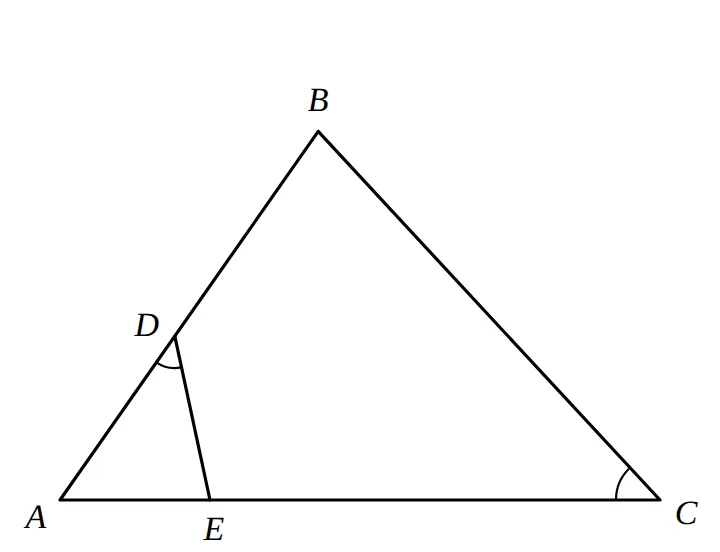
In the figure, D and E are points on the sides AB and AC of △ABC such that ∠ADE=∠ACB. Prove that AD×AB=AE×AC. If AD=4 cm, AB=9 cm and AE=3 cm, find AC.
Answer.
Model answer:
In △ADE and △ACB:
∠DAE=∠CAB (the same angle at A), and ∠ADE=∠ACB (given).
So △ADE∼△ACB by the AA criterion. Note the order: D corresponds to C and E corresponds to B.
Hence ACAD=ABAE=CBDE. From the first two ratios, AD×AB=AE×AC.
Putting in the values: 4×9=3×AC, so AC=12 cm.
(Here DE is not parallel to BC, so BPT cannot be used.)
Marking scheme:
- ∠DAE=∠CAB (common) and ∠ADE=∠ACB (given), so △ADE∼△ACB (AA) — 1 mark
- ACAD=ABAE, so AD×AB=AE×AC — 1 mark
- 4×9=3×AC, so AC=12 cm — 1 mark
Question 6 (3 marks)
A lamp hangs at the top of a pole 4.5 m above level ground outside a shop. Pallavi, who is 1.5 m tall, walks on the ground straight away from the pole. (i) How long is her shadow when she is 4 m from the foot of the pole? (ii) At another moment her shadow is 3.5 m long. How far is she from the pole then?
Answer.
- Pallavi and her shadow form a triangle similar to the one formed by the pole and the line from its foot to the tip of the shadow (AA: right angle and common angle at the tip) — 1 mark
- (i) s+4s=4.51.5=31 gives 3s=s+4, so s=2 m — 1 mark
- (ii) 3.5+x3.5=31 gives 3.5+x=10.5, so x=7 m — 1 mark
Question 7 (3 marks)
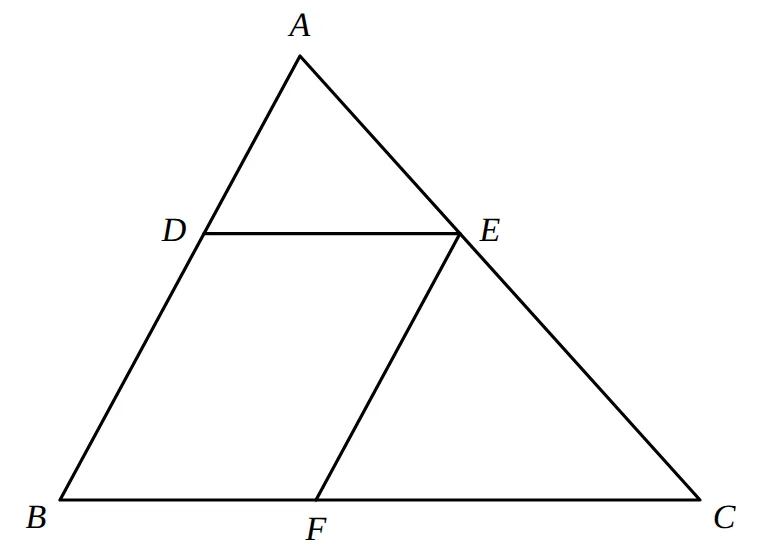
In the figure, D and E are points on the sides AB and AC of △ABC such that DE∥BC, and F is a point on BC such that EF∥AB. Prove that DBAD=FCBF. If AD=3 cm, DB=4.5 cm and BC=7.5 cm, find BF.
Answer.
- In △ABC, DE∥BC, so DBAD=ECAE (BPT) — 1 mark
- In △CAB, EF∥AB, so EACE=FBCF, that is, ECAE=FCBF; hence DBAD=FCBF — 1 mark
- FCBF=4.53=32, so BF=52×7.5=3 cm — 1 mark
Question 8 (3 marks)
In △ABC, D and E are points on AB and AC such that DE∥BC. AD=3 cm, DB=2 cm and DE=4.5 cm. Mohit found BC like this: “By BPT, DBAD=BCDE, so 23=BC4.5 and BC=3 cm.” Point out his mistake and find the correct length of BC.
Answer.
- Mistake: BPT gives DBAD=ECAE; it says nothing about BCDE (and BC=3 cm is shorter than DE, which is impossible) — 1 mark
- DE∥BC gives △ADE∼△ABC (AA), so BCDE=ABAD — 1 mark
- BC4.5=53, so BC=7.5 cm — 1 mark
Question 9 (3 marks)
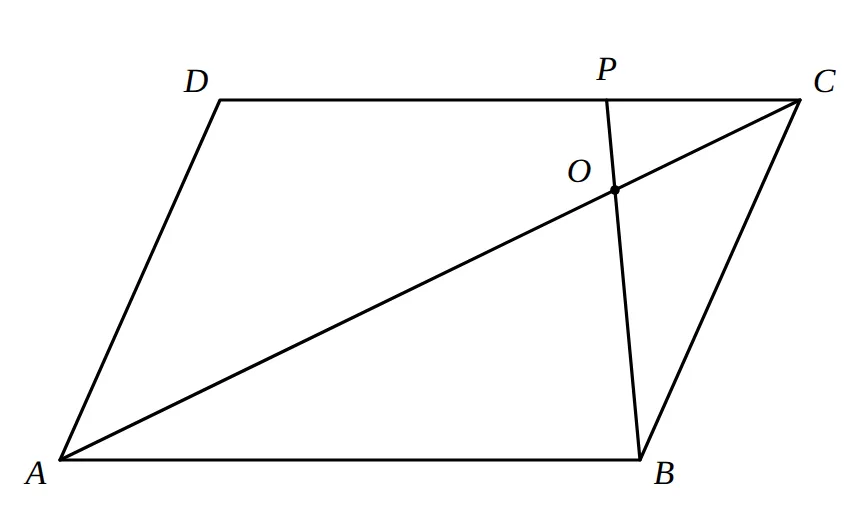
In the figure, ABCD is a parallelogram and P is a point on the side DC such that CP=31CD. The segment BP meets the diagonal AC at O. Prove that △AOB∼△COP. If AC=12 cm, find OC.
Answer.
- ∠OAB=∠OCP (alternate angles, AB∥DC) and ∠AOB=∠COP (vertically opposite), so △AOB∼△COP (AA) — 1 mark
- OCOA=CPAB=31CDCD=3, as AB=CD — 1 mark
- OA=3×OC and OA+OC=12, so OC=3 cm — 1 mark
Question 10 (3 marks)
In the figure, AC is a diagonal of the quadrilateral ABCD such that ∠BAC=∠CAD. AB=4 cm, AC=6 cm and AD=9 cm. Prove that △ABC∼△ACD. If BC=5 cm, find CD.
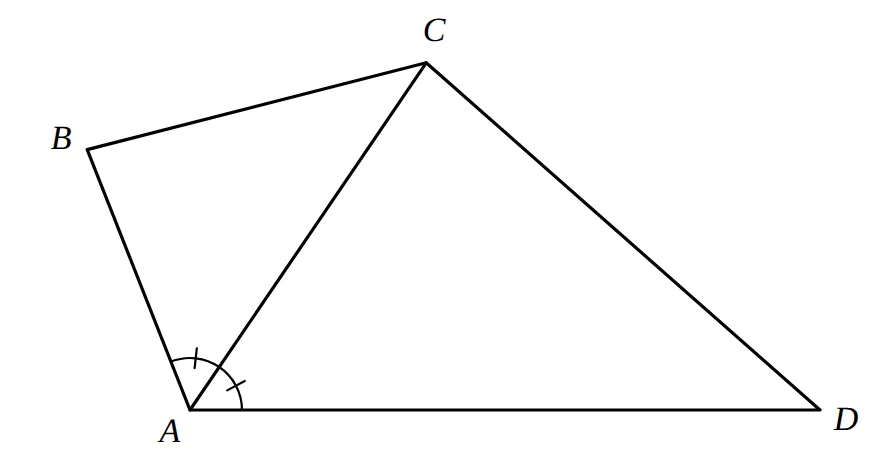
Answer.
- ACAB=64=32 and ADAC=96=32 — 1 mark
- The included angles ∠BAC=∠CAD, so △ABC∼△ACD (SAS) — 1 mark
- CDBC=ACAB=32, so CD=23×5=7.5 cm — 1 mark
Long Answer and Case-Based Questions
Question 11 (5 marks)
State and prove the Basic Proportionality Theorem. Using it, prove the following: in △ABC, D and E are points on AB and AC such that DE∥BC. If BD=CE, then △ABC is isosceles.
Answer.
Model answer:
Statement. If a line is drawn parallel to one side of a triangle to intersect the other two sides in distinct points, the other two sides are divided in the same ratio.
Given: In △ABC, a line parallel to BC meets AB at D and AC at E, so DE∥BC.
To prove: DBAD=ECAE.
Construction: Join BE and CD. Draw EN⊥AB and DM⊥AC (see the figure with the answer).
Proof: Taking AD and DB as bases, △ADE and △BDE have the same height EN. So
ar(△BDE)ar(△ADE)=21×DB×EN21×AD×EN=DBAD …(1)
Taking AE and EC as bases, △ADE and △DEC have the same height DM. So
ar(△DEC)ar(△ADE)=21×EC×DM21×AE×DM=ECAE …(2)
△BDE and △DEC are on the same base DE and between the same parallels DE and BC, so ar(△BDE)=ar(△DEC) …(3)
From (1), (2) and (3), DBAD=ECAE. Hence proved.
Application. Since DE∥BC, by the theorem DBAD=ECAE. We are given BD=CE, so the denominators are equal, and therefore AD=AE.
Adding equal lengths to equal lengths: AD+DB=AE+EC, that is, AB=AC. So △ABC is isosceles.
Marking scheme:
- Correct statement, with given, to prove and figure — 1 mark
- Construction: join BE, CD; draw EN⊥AB, DM⊥AC — 1 mark
- ar(△BDE)ar(△ADE)=DBAD and ar(△DEC)ar(△ADE)=ECAE — 1 mark
- ar(△BDE)=ar(△DEC) (same base DE, between the same parallels), hence DBAD=ECAE — 1 mark
- Application: DBAD=ECAE with DB=EC gives AD=AE, so AB=AC and △ABC is isosceles — 1 mark
OR
State and prove the Basic Proportionality Theorem. Using it, prove the following: ABCD is a trapezium with AB∥DC, and E and F are points on AD and BC such that EF∥AB. Then EDAE=FCBF.
Answer.
Model answer:
Statement. If a line is drawn parallel to one side of a triangle to intersect the other two sides in distinct points, the other two sides are divided in the same ratio.
Given: In △ABC, a line parallel to BC meets AB at D and AC at E, so DE∥BC.
To prove: DBAD=ECAE.
Construction: Join BE and CD. Draw EN⊥AB and DM⊥AC (see the figure with the answer).
Proof: Taking AD and DB as bases, △ADE and △BDE have the same height EN. So
ar(△BDE)ar(△ADE)=21×DB×EN21×AD×EN=DBAD …(1)
Taking AE and EC as bases, △ADE and △DEC have the same height DM. So
ar(△DEC)ar(△ADE)=21×EC×DM21×AE×DM=ECAE …(2)
△BDE and △DEC are on the same base DE and between the same parallels DE and BC, so ar(△BDE)=ar(△DEC) …(3)
From (1), (2) and (3), DBAD=ECAE. Hence proved.
Application. Join AC, and let it meet EF at G.
In △ADC, EG∥DC (as EF∥AB∥DC), so by the theorem EDAE=GCAG …(4)
In △CAB, GF∥AB, so by the theorem GACG=FBCF, that is, GCAG=FCBF …(5)
From (4) and (5), EDAE=FCBF.
Marking scheme:
- Correct statement, with given, to prove and figure — 1 mark
- Construction: join BE, CD; draw EN⊥AB, DM⊥AC — 1 mark
- ar(△BDE)ar(△ADE)=DBAD and ar(△DEC)ar(△ADE)=ECAE — 1 mark
- ar(△BDE)=ar(△DEC) (same base DE, between the same parallels), hence DBAD=ECAE — 1 mark
- Application: join AC meeting EF at G; BPT in △ADC and △CAB gives EDAE=GCAG=FCBF — 1 mark
Question 12 (5 marks)
In the figure, △PQR is right-angled at R, and RS⊥PQ with S on PQ.
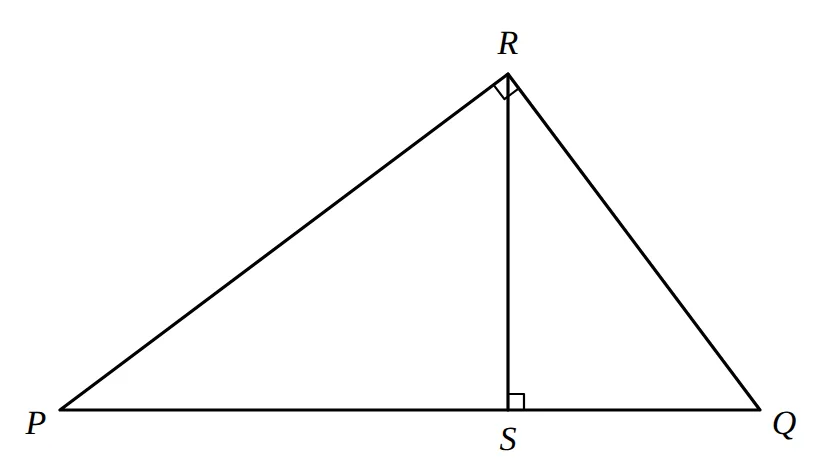
(i) Prove that △PSR∼△PRQ, and hence that PR2=PQ×PS. (2 marks)
Answer.
- ∠P is common and ∠PSR=∠PRQ=90∘, so △PSR∼△PRQ (AA) — 1 mark
- PRPS=PQPR, so PR2=PQ×PS — 1 mark
(ii) Prove that △RSQ∼△PRQ, and hence that QR2=PQ×QS. (1 mark)
Answer.
- ∠Q common, ∠RSQ=∠PRQ=90∘, so △RSQ∼△PRQ (AA); QRQS=PQQR, so QR2=PQ×QS — 1 mark
(iii) If PS=3.2 cm and SQ=1.8 cm, find PR, QR and RS. (2 marks)
Answer.
Model answer:
PQ=PS+SQ=3.2+1.8=5 cm.
From (i): PR2=PQ×PS=5×3.2=16, so PR=4 cm.
From (ii): QR2=PQ×QS=5×1.8=9, so QR=3 cm.
From the similarity in (i), △PSR∼△PRQ gives RQSR=PQPR. So RS=PQQR×PR=53×4=2.4 cm.
(Check: RS2=5.76=3.2×1.8=PS×SQ.)
Marking scheme:
- PQ=5 cm; PR2=5×3.2=16, so PR=4 cm; QR2=5×1.8=9, so QR=3 cm — 1 mark
- From (i), RQSR=PQPR, so RS=53×4=2.4 cm — 1 mark
Question 13 (4 marks)
A lake lies between two points A and B, so the distance AB cannot be measured directly. Sunita, a surveyor, fixes a pole at a point O on land from where both A and B can be seen. She fixes a pole D on AO produced and a pole C on BO produced, with OA=120 m, OD=30 m, OB=180 m and OC=45 m (see the figure). She then measures DC=42 m.
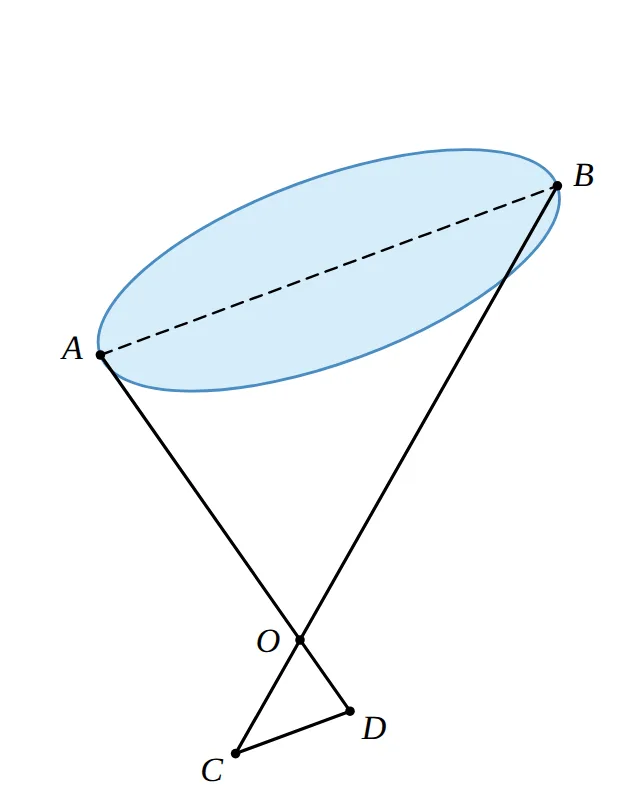
(i) By which similarity criterion is △OAB∼△ODC? (1 mark)
Answer.
- SAS: ODOA=OCOB=4 and ∠AOB=∠DOC (vertically opposite angles) — 1 mark
(ii) Show that DC∥AB. (1 mark)
Answer.
- From the similarity, ∠OAB=∠ODC; these are alternate angles made by AD with AB and DC, so DC∥AB — 1 mark
(iii) Find the width AB of the lake. (2 marks)
Answer.
- DCAB=ODOA=30120=4 — 1 mark
- AB=4×42=168 m — 1 mark
OR
(iii) Her assistant repeats the survey with the same O, fixing the poles so that OD=40 m and OC=60 m, and measures DC=56 m. Find AB from the assistant's measurements. (2 marks)
Answer.
- ODOA=40120=3=60180=OCOB, so again △OAB∼△ODC (SAS) — 1 mark
- AB=3×56=168 m — 1 mark
Question 14 (4 marks)
At a railway goods shed in Nagpur, trolleys are pushed up a straight sloping plank AC. It starts on the ground at A and reaches the edge C of a loading platform 0.5 m high, so BC=0.5 m, where B is the foot of the platform wall below C. The horizontal distance AB is 6 m. Vertical supports such as PQ are fixed under the plank, with P on the plank and Q on the ground (see the figure).
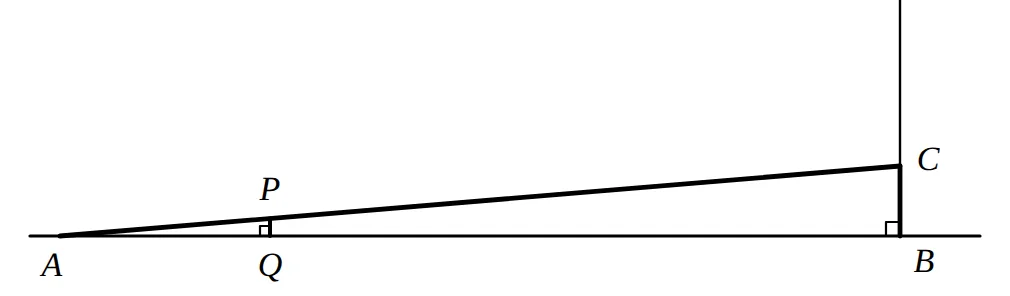
(i) Why is △AQP∼△ABC? Name the criterion. (1 mark)
Answer.
- ∠A is common and ∠AQP=∠ABC=90∘, so they are similar by AA — 1 mark
(ii) Find the height of a support placed 1.5 m from A, that is, with AQ=1.5 m. (1 mark)
Answer.
- BCPQ=ABAQ, so PQ=0.5×61.5=0.125 m, that is, 12.5 cm — 1 mark
(iii) A support 30 cm tall is needed. How far from A must it stand, and how far is it from the wall? (2 marks)
Answer.
- 6AQ=0.50.3, so AQ=3.6 m — 1 mark
- Distance from the wall =QB=6−3.6=2.4 m — 1 mark
OR
(iii) The shed needs a second plank with the same slope, up to a platform 0.75 m high. What horizontal distance does it need, and how much longer is this than for the first plank? (2 marks)
Answer.
- Same slope gives similar triangles: 6x=0.50.75, so x=9 m — 1 mark
- It is 9−6=3 m longer — 1 mark
