
Real Numbers
Real Numbers carries 6 marks in the board paper. It got exactly 6 in the 2026-27 sample paper and in the 2025 and both 2026 board papers.
The marks usually come as one to three 1-mark MCQs or Assertion-Reason items, plus a 2- or 3-mark proof that a number is irrational, and often an HCF-LCM word problem. There has been no 5-mark question from this chapter, so the case-based questions here practise the word problems in board format.
Where marks are usually lost:
- using HCF × LCM = product of the numbers for three numbers (it works only for two);
- in irrationality proofs, not saying that a and b are co-prime, or not stating the contradiction at the end;
- taking the HCF when the question needs the LCM, or the other way round;
- missing a prime factor, such as the extra 2 hidden in a 10.
Revise in 5 Minutes
Key facts
- A prime has exactly two factors, 1 and itself. 1 is neither prime nor composite.
- Fundamental Theorem of Arithmetic: every composite number is a product of primes in exactly one way, apart from the order of the factors.
- Rational: can be written as (, integers, ). Irrational: cannot.
- If a prime divides , then divides .
- is irrational for every prime : , , , , …
- rational + irrational = irrational; non-zero rational × irrational = irrational.
HCF and LCM by prime factorisation
| Take | For and | |
|---|---|---|
| HCF | common primes, smallest power | |
| LCM | every prime, greatest power |
- For two numbers only: HCF × LCM = product of the numbers (). It does not hold for three numbers.
- The HCF always divides the LCM.
- Co-prime numbers: HCF and LCM = product of the numbers.
- Remainders: to find the greatest number dividing two numbers and leaving given remainders, subtract the remainders first, then take the HCF. For the least (or greatest 4-digit) number leaving the same remainder on division by several numbers, use a multiple of their LCM, then add the remainder.
- Word problems: "greatest / largest equal size" means HCF; "least / next together / first time again" means LCM.
Ends with 0? Only if the prime factorisation has both 2 and 5. So never ends with 0.
Proof skeleton for ( prime)
- Assume , with and co-prime and .
- Square: , so divides . Put .
- Then , so divides too.
- is a common factor of and . Contradiction, so is irrational.
For (, rational, ): if it equals a rational , then is rational: contradiction.
Traps
- Using HCF × LCM = product for three numbers.
- Taking the greatest powers for the HCF, or the smallest for the LCM.
- Skipping "co-prime" in step 1 or the final contradiction: both carry marks.
- Two irrationals need not give an irrational: and .
How to use this page: try each question on paper first, then read the answer. The marks against each step show what an examiner looks for. The 1-mark MCQs and Assertion-Reason questions are in the quiz at the end, together with questions that test how well you understand the chapter; every quiz answer comes with its explanation.
Short Answer Questions (2 and 3 Marks)
Question 1 (2 marks)
Given that is irrational, prove that is irrational.
Answer.
Model answer:
Let us assume, to the contrary, that is rational. Then for some rational number .
Multiplying both sides by 3 gives , so .
Since is rational, is also rational. That would make rational. But we are given that is irrational. This contradiction shows that our assumption was wrong.
Hence is irrational.
Marking scheme:
- Assume , where is rational; then — 1 mark
- is rational but is irrational, a contradiction; hence is irrational — 1 mark
Question 2 (2 marks)
State, with reason, whether each of the following is rational or irrational: (i) (ii)
Answer.
- (i) , which is rational — 1 mark
- (ii) ; a rational number plus an irrational number is irrational, so it is irrational — 1 mark
Question 3 (2 marks)
Riya found that the HCF of 8, 12 and 20 is 4 and their LCM is 120. She then wrote . Is she right? Give a reason.
Answer.
Model answer:
No, Riya is not right.
Her HCF and LCM are correct: , and , so HCF and LCM . But , while .
The rule HCF × LCM = product of the numbers holds only for two numbers. For each prime, the HCF takes the lowest power and the LCM takes the highest power. With two numbers, these are exactly the two powers in the numbers, so the product matches. With three numbers, the middle power gets left out. Here the prime 2 appears as , and , which is in the product, but HCF × LCM has only , that is, .
Marking scheme:
- Her HCF and LCM are correct, but while ; so she is wrong — 1 mark
- HCF × LCM = product of the numbers is true only for two numbers; with three numbers the middle power of a prime is left out (here instead of ) — 1 mark
Question 4 (2 marks)
The HCF of two natural numbers, each greater than 1, is 1 and their LCM is 391. Find the two numbers.
Answer.
Model answer:
Since the HCF is 1, the two numbers are co-prime. For any two numbers, HCF × LCM = product of the numbers, so their product is .
Now write 391 as a product of primes: , and both 17 and 23 are prime. By the Fundamental Theorem of Arithmetic this is the only way to break 391 into primes. Each number is more than 1, so one number must be 17 and the other 23.
Check: HCF of 17 and 23 is 1 and their LCM is .
Marking scheme:
- HCF , so the numbers are co-prime and their product — 1 mark
- , a product of two primes; as prime factorisation is unique and each number is more than 1, the numbers are 17 and 23 — 1 mark
Question 5 (3 marks)
Prove that is irrational.
Answer.
Model answer:
Let us assume, to the contrary, that is rational.
Then we can write , where and are integers with no common factor other than 1 (co-prime) and .
Squaring both sides: , so . This means 2 divides . Since 2 is prime, 2 also divides (if a prime divides the square of a number, it divides the number). So we can write for some integer .
Putting : , so . Then 2 divides , and so 2 divides .
Now 2 divides both and . This contradicts the fact that and have no common factor other than 1. The contradiction came from assuming is rational.
Hence is irrational.
Marking scheme:
- Assume is rational: , where and are co-prime integers and — 1 mark
- Squaring, , so 2 divides and hence 2 divides ; write — 1 mark
- Then , so and 2 divides ; 2 is a common factor of and , which contradicts that they are co-prime; hence is irrational — 1 mark
Question 6 (3 marks)
Given that is irrational, prove that is irrational.
Answer.
Model answer:
Let us assume, to the contrary, that is rational, say , where is rational.
Squaring both sides: , that is, .
So , which gives .
Since is rational, is rational and so is . That would make rational, but we are given that is irrational. This contradiction shows our assumption was wrong.
Hence is irrational.
Marking scheme:
- Assume , where is rational — 1 mark
- Squaring, , so — 1 mark
- is rational but is irrational, a contradiction; hence is irrational — 1 mark
Question 7 (3 marks)
Find the HCF and LCM of 504 and 180 by prime factorisation. Also verify that HCF × LCM = product of the two numbers.
Answer.
- and — 1 mark
- HCF ; LCM — 1 mark
- HCF × LCM and ; verified — 1 mark
Question 8 (3 marks)
Kabir thinks of two numbers. He tells Sana that their LCM is 12 times their HCF, and that the LCM is 297 more than the HCF. One of his numbers is 108. Help Sana find the other number.
Answer.
- Let HCF ; then LCM and , so — 1 mark
- LCM , and HCF × LCM = product of the two numbers — 1 mark
- Other number — 1 mark
Question 9 (3 marks)
Find the greatest 4-digit number which, when divided by 12, 15 and 20, leaves a remainder of 7 in each case.
Answer.
- , , ; LCM — 1 mark
- , so the greatest 4-digit multiple of 60 is — 1 mark
- Required number — 1 mark
Question 10 (3 marks)
For a flood relief camp, an NGO has 520 blankets and 781 water bottles. It gives every family the same number of blankets and the same number of bottles. After this, 4 blankets and 7 bottles are left over. What is the largest possible number of families? How many blankets and bottles does each family get?
Answer.
- Items given out: blankets and bottles; the number of families must divide both — 1 mark
- , ; HCF families — 1 mark
- Each family gets blankets and bottles — 1 mark
Long Answer and Case-Based Questions
Question 11 (4 marks)
Aarti looks after the plants in her school garden. She waters the tulsi plants every 6 days, the rose bushes every 9 days and the money plants every 15 days. On 1 March she watered all three.
(i) Write 6, 9 and 15 as products of primes. (1 mark)
Answer.
- , , — 1 mark
(ii) After how many days will she next water the tulsi and the rose bushes on the same day? (1 mark)
Answer.
- LCM of 6 and 9 days — 1 mark
(iii) On which date will she next water all three on the same day? (2 marks)
Answer.
- LCM of 6, 9 and 15 days — 1 mark
- 90 days after 1 March: 30 days of March, 30 of April and 30 of May, so on 30 May — 1 mark
OR
(iii) In the 365 days starting from 1 March (1 March included), on how many days will she water all three plants? (2 marks)
Answer.
- All three are watered together every 90 days (the LCM of 6, 9 and 15) — 1 mark
- Day numbers 0, 90, 180, 270 and 360 lie within the 365 days, so 5 days — 1 mark
Question 12 (4 marks)
Before Diwali, a sweet shop in Jaipur has 540 pieces of kaju katli and 756 besan laddoos. The owner wants to pack them in gift boxes so that every box has the same number of sweets, each box has only one kind of sweet, and the number of boxes is as small as possible.
(i) Write 540 and 756 as products of primes. (1 mark)
Answer.
- and — 1 mark
(ii) How many sweets should go in each box? (1 mark)
Answer.
- HCF sweets — 1 mark
(iii) The owner also gets 648 pieces of barfi, to be packed in the same way along with the other two sweets. Find the number of sweets in each box now, and the total number of boxes. (2 marks)
Answer.
- ; HCF of 540, 756 and 648 — 1 mark
- Boxes — 1 mark
OR
(iii) Suppose instead the owner puts only 36 sweets in each box, still one kind per box. How many more boxes will he need than with 108 sweets per box? (2 marks)
Answer.
- With 36 per box: boxes — 1 mark
- With 108 per box: boxes; so more boxes — 1 mark
Question 13 (4 marks)
In a maths club activity, Meera wrote a number as a product of primes using the factor tree shown. Some numbers in her tree got smudged, and they are shown by the letters , and .
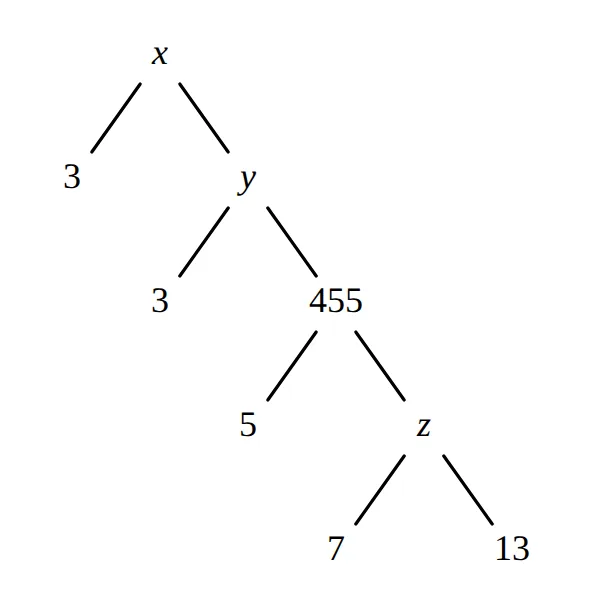
(i) Find the value of . (1 mark)
Answer.
- — 1 mark
(ii) Find and write it as a product of primes. (1 mark)
Answer.
- , so — 1 mark
(iii) Find the HCF and LCM of and 2340. (2 marks)
Answer.
- — 1 mark
- HCF ; LCM — 1 mark
OR
(iii) Find the HCF and LCM of and 1050. (2 marks)
Answer.
- and — 1 mark
- HCF ; LCM — 1 mark
Question 14 (4 marks)
Neha wrote this proof that is irrational.
Step 1: Let , where and are integers and .
Step 2: Then , so 5 divides , and hence 5 divides .
Step 3: Write . Then , so and 5 divides .
Step 4: So 5 divides both and . Hence is irrational.
(i) Which step has a gap? What is missing from it? (1 mark)
Answer.
- Step 1: it must say that and are co-prime (the fraction is in its lowest terms) — 1 mark
(ii) Why does Step 4, as written, not prove anything? Rewrite Step 4 correctly. (1 mark)
Answer.
- Without co-prime, and may well share the factor 5, so there is no contradiction; correct Step 4: 5 is a common factor of and , which contradicts that they are co-prime, so is irrational — 1 mark
(iii) Using the fact that is irrational, show that is irrational. (2 marks)
Answer.
- Assume , where is rational and ; then — 1 mark
- is rational but is irrational, a contradiction; hence is irrational — 1 mark