
Quadratic Equations
Quadratic Equations usually carries 5 to 8 marks in the board paper: 6 in the 2026-27 sample paper, 8 in the main 2026 paper, and 5 in the 2025 paper and in the second 2026 paper.
A 5-mark word problem from this chapter has come in every one of these papers: speed and time, cost and quantity, areas and dimensions, numbers, right-triangle sides. There may also be a 1-mark MCQ on the nature of roots or equal roots, and sometimes a 2-mark discriminant question.
Where marks are usually lost:
- not rejecting a root that makes no sense (a negative speed, a negative number of rows, a cut larger than the sheet);
- sign slips in , especially when is negative;
- dividing both sides by an expression in and losing a root;
- forgetting that when finding for equal roots.
Revise in 5 Minutes
Standard form: , with . Always simplify first: if the terms cancel, the equation is not quadratic.
Methods in the syllabus (completing the square is not)
- Factorisation: split into two terms whose product is , then take out common factors.
- Quadratic formula: .
Discriminant
| Roots | |
|---|---|
| two distinct real roots | |
| two equal real roots, each | |
| no real roots |
A perfect-square (with rational , , ) means the roots are rational; it is not needed for real roots.
Word problems: set-ups to know
- Speed: time = distance ÷ speed; boat upstream , downstream .
- Fixed total shared: amount per person .
- Rectangle: perimeter gives ; area gives .
- Consecutive integers ; consecutive odd or even .
- Right triangle: leg² + leg² = hypotenuse²; reject negative lengths.
- Work: if A alone takes hours and B alone hours, together they take hours where .
"Is it possible?" Form the equation and look at : if , it is not possible.
Traps
- Reject roots that make no sense, and say why in one line.
- Never divide by an expression containing : bring all terms to one side and factorise.
- In "equal roots, find ", throw away any that makes .
- Watch the sign of when finding .
How to use this page: try each question on paper first, then read the answer. The marks against each step show what an examiner looks for. The 1-mark MCQs and Assertion-Reason questions are in the quiz at the end, together with questions that test how well you understand the chapter; every quiz answer comes with its explanation.
Short Answer Questions (2 and 3 Marks)
Question 1 (2 marks)
Find the roots of the quadratic equation by factorisation.
Answer.
- — 1 mark
- Roots and — 1 mark
Question 2 (2 marks)
Show that the equation has equal roots when , and no real roots when .
Answer.
- — 1 mark
- If , : equal roots; if , : no real roots — 1 mark
Question 3 (2 marks)
Find the nature of the roots of the equation . If the roots are real, find them.
Answer.
- , so the roots are real and equal — 1 mark
- Each root — 1 mark
Question 4 (2 marks)
Solve using the quadratic formula.
Answer.
- , — 1 mark
- — 1 mark
Question 5 (2 marks)
Rahul solved by dividing both sides by and wrote the answer . Is his answer complete? Find all the roots.
Answer.
Model answer:
No, Rahul's answer is not complete.
Dividing both sides by is allowed only when . By doing this he has thrown away the case , and does satisfy the equation: .
The right way is to bring everything to one side: , that is, .
So the roots are and . A quadratic equation can have two roots, so never divide by an expression that contains .
Marking scheme:
- No; dividing by assumes , so the root is lost — 1 mark
- gives ; roots 2 and 3 — 1 mark
Question 6 (3 marks)
Solve for : , where .
Answer.
- , so — 1 mark
- , that is, — 1 mark
- or (neither is an excluded value) — 1 mark
Question 7 (3 marks)
The difference of two natural numbers is 5 and the sum of their squares is 157. Find the numbers.
Answer.
- Let the smaller number be ; the larger is and — 1 mark
- , so and — 1 mark
- is not a natural number, so ; the numbers are 6 and 11 — 1 mark
Question 8 (3 marks)
If and are the roots of the quadratic equation , find the values of and .
Answer.
- : — 1 mark
- : , that is, — 1 mark
- gives , so and — 1 mark
Question 9 (3 marks)
Solve for using the quadratic formula: .
Answer.
- Here , , — 1 mark
- , so — 1 mark
- : or — 1 mark
Question 10 (3 marks)
The perimeter of a rectangular plot is 62 m and its area is 228 m². Find the length and breadth of the plot.
Answer.
- Length + breadth m; if the breadth is m, the length is m and — 1 mark
- , so — 1 mark
- or ; the plot is 19 m long and 12 m broad — 1 mark
Long Answer and Case-Based Questions
Question 11 (5 marks)
A ferry on the Brahmaputra at Guwahati goes 24 km upstream and comes back to its starting point in 6 hours in all. The stream flows at 3 km/h. Find the speed of the ferry in still water.
Answer.
Model answer:
Let the speed of the ferry in still water be km/h. Then its speed upstream is km/h and downstream is km/h.
Time = distance ÷ speed, so
.
Multiplying both sides by : , that is, .
Dividing by 6: . Splitting the middle term: .
So or . A speed cannot be negative, so the speed of the ferry in still water is 9 km/h.
Check: upstream time hours and downstream time hours, which add up to 6 hours.
Marking scheme:
- Let the speed in still water be km/h: upstream , downstream — 1 mark
- — 1 mark
- , so — 1 mark
- , that is, — 1 mark
- Speed cannot be negative, so the ferry moves at 9 km/h in still water (check: hours) — 1 mark
Question 12 (5 marks)
A goods train covers the first 200 km of its journey at a uniform speed. For the next 280 km it runs 20 km/h faster. The whole journey of 480 km takes 8 hours. Find the speed of the train for the first part and the time it takes for each part.
Answer.
Model answer:
Let the speed for the first 200 km be km/h. Then the speed for the next 280 km is km/h.
Total time: .
Multiplying by : , that is, .
So . Dividing by 8: .
Splitting the middle term: .
So or . Speed cannot be negative, so the train runs at 50 km/h for the first part and 70 km/h for the second.
Time for the first part hours and for the second hours, which add up to 8 hours.
Marking scheme:
- Let the first speed be km/h: — 1 mark
- , so — 1 mark
- , that is, — 1 mark
- ; is rejected, so the speed is 50 km/h — 1 mark
- Times: hours and hours — 1 mark
Question 13 (5 marks)
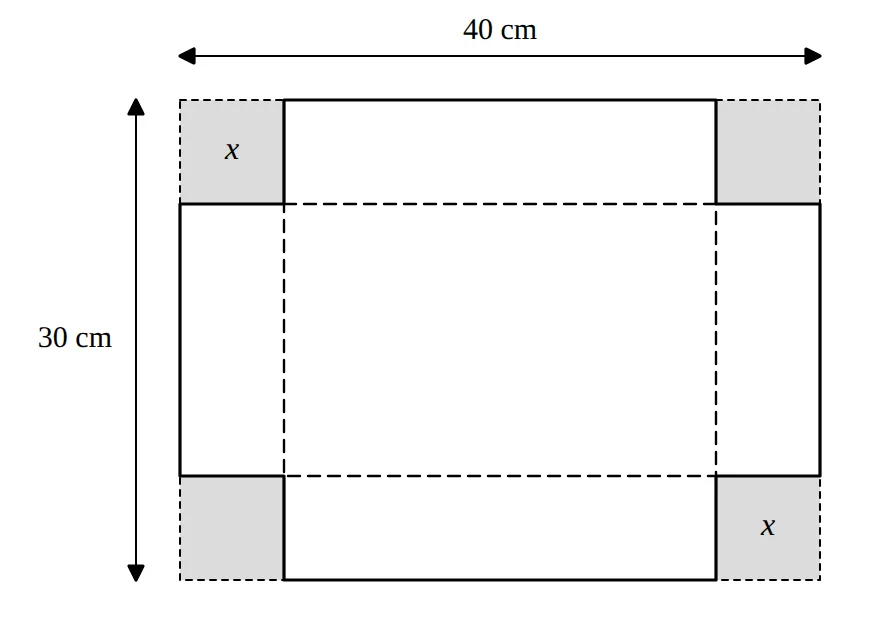
For a Diwali craft fair, the students of a school in Kolkata make open boxes from rectangular cardboard sheets 40 cm long and 30 cm wide. From each corner of a sheet a square of side cm is cut off and the sides are folded up, as shown in the figure. If the base of the box must have an area of 600 cm², find and the volume of the box.
Answer.
- Base of the box: cm by cm; — 1 mark
- , so — 1 mark
- , so or — 1 mark
- is impossible (two 30 cm cuts need a sheet wider than 60 cm), so — 1 mark
- Base 30 cm by 20 cm, height 5 cm; volume cm³ — 1 mark
Question 14 (4 marks)
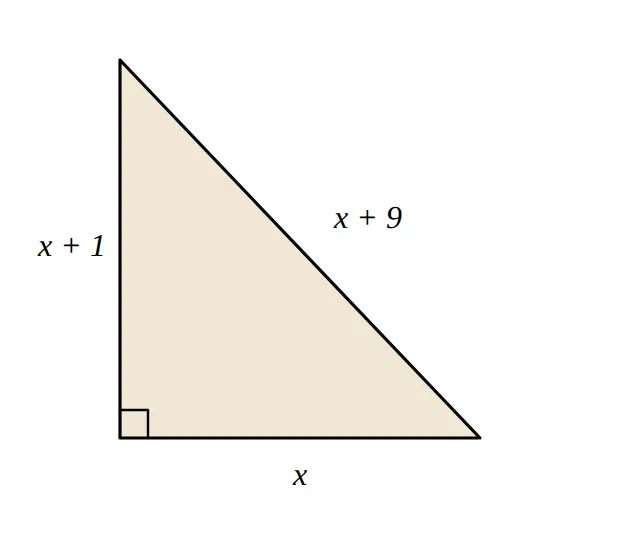
A carpenter in Jodhpur makes a wooden corner shelf in the shape of a right triangle, as shown in the figure. If the shortest side is cm, the other side containing the right angle is cm and the longest side is cm.
(i) Show that . (1 mark)
Answer.
- Pythagoras: gives , that is, — 1 mark
(ii) Find the discriminant of this equation and state the nature of its roots. (1 mark)
Answer.
- : two distinct real (rational) roots — 1 mark
(iii) Find the lengths of the three sides of the shelf. (2 marks)
Answer.
- , so or ; a length cannot be negative, so — 1 mark
- Sides 20 cm, 21 cm and 29 cm — 1 mark
OR
(iii) For a smaller shelf, the three sides of the right triangle are cm, cm and cm. Find them. (2 marks)
Answer.
- gives , that is, — 1 mark
- ( rejected); sides 3 cm, 4 cm and 5 cm — 1 mark
Question 15 (4 marks)
At a science fair in Bhopal, the science club launches a small water rocket straight up. Its height above the ground after seconds is metres.
(i) Write the quadratic equation for the times at which the rocket is 15 m above the ground, in standard form. (1 mark)
Answer.
- , that is, or — 1 mark
(ii) At what times is the rocket 15 m above the ground? (1 mark)
Answer.
- : after 1 s (going up) and after 3 s (coming down) — 1 mark
(iii) Can the rocket reach a height of 25 m? Justify your answer using the discriminant. (2 marks)
Answer.
- gives — 1 mark
- : no real , so the rocket never reaches 25 m — 1 mark
OR
(iii) After how many seconds does the rocket come back to the ground? (2 marks)
Answer.
- : , that is, — 1 mark
- is the launch, so it lands after 4 s — 1 mark