
Coordinate Geometry
Coordinate Geometry carries 6 marks in every board paper: the 2026-27 sample paper and the 2025 and both 2026 papers all gave it exactly 6.
The marks usually come as one or two 1-mark MCQs (a distance, a mid-point, the fourth vertex of a parallelogram, or an Assertion-Reason item), a 2- or 3-mark question on the section formula (often "in what ratio does the x-axis or y-axis divide the segment"), and sometimes a 4-mark case study on a city map drawn on a grid. There has been no 5-mark question from this chapter. Only the distance formula and the section formula (internal division) are in the syllabus; the area of a triangle is not.
Where marks are usually lost:
- sign slips inside the distance formula, such as written as ;
- putting the ratio the wrong way round in the section formula, or using in place of ;
- setting the wrong coordinate to zero: a point on the x-axis has y = 0;
- calling four equal sides a square without checking that the diagonals are equal.
Revise in 5 Minutes
Formulas (only these two, plus the mid-point, are in the syllabus)
| Result | Formula |
|---|---|
| Distance between and | |
| Distance of from the origin | |
| Point dividing internally in | |
| Mid-point () |
- A point on the x-axis is ; a point on the y-axis is .
- The distance of from the x-axis is , and from the y-axis is .
Standard question types
- Ratio in which an axis divides : take the ratio , write the point, and put its y-coordinate (x-axis) or its x-coordinate (y-axis).
- Point on an axis equidistant from and : take or and put .
- Points of trisection: the ratios and .
- on produced with : divides in .
- means .
- Fourth vertex of a parallelogram: the diagonals bisect each other, so the mid-point of = the mid-point of .
- Collinear by distances: the two shorter lengths add up to the longest.
Naming a quadrilateral from its lengths
| Sides | Diagonals | Figure |
|---|---|---|
| all equal | equal | square |
| all equal | not equal | rhombus |
| opposite sides equal | equal | rectangle |
| opposite sides equal | not equal | parallelogram |
Traps
- Square the whole difference: , not or 1.
- Keep the ratio in the order it is given: goes with the second point.
- Area of a triangle from coordinates is not in the 2026-27 syllabus.
How to use this page: try each question on paper first, then read the answer. The marks against each step show what an examiner looks for. The 1-mark MCQs and Assertion-Reason questions are in the quiz at the end, together with questions that test how well you understand the chapter; every quiz answer comes with its explanation.
Short Answer Questions (2 and 3 Marks)
Question 1 (2 marks)
The centre of a circle is and its radius is 5 units. If the circle passes through the point , find the possible values of and the corresponding centres.
Answer.
- : , so , that is, — 1 mark
- or ; the centre is or — 1 mark
Question 2 (2 marks)
Using the distance formula, show that the points , and are collinear.
Answer.
- , , — 1 mark
- , so , and are collinear — 1 mark
Question 3 (2 marks)
is a point on produced beyond such that . If is and is , find the coordinates of .
Answer.
- lies between and with , so divides internally in . Let — 1 mark
- and , so — 1 mark
Question 4 (2 marks)
The vertices of are , and . Find the length of the median .
Answer.
- is the mid-point of : — 1 mark
- units — 1 mark
Question 5 (3 marks)
The line segment joining and meets the y-axis at . Find the ratio and the value of .
Answer.
- Let ; the x-coordinate of gives — 1 mark
- , so — 1 mark
- y-coordinate: , so — 1 mark
Question 6 (3 marks)
and are two points, and is a point on the line segment such that . Find the coordinates of , and verify your answer using the distance formula.
Answer.
- gives , so — 1 mark
- — 1 mark
- , , so ; verified — 1 mark
Question 7 (3 marks)
Using the section formula, show that the points , and are not collinear.
Answer.
Model answer:
Suppose , and were collinear. Then would divide in some ratio , and both coordinates of would come from the section formula with the same .
x-coordinate: gives , so .
With , the y-coordinate would be .
But the y-coordinate of is 3. The two coordinates do not give the same ratio, so no such exists. Hence , and are not collinear. (The point , the mid-point of , is on the line; is 1 unit above it.)
Marking scheme:
- If they were collinear, would divide in some ratio ; its x-coordinate gives — 1 mark
- , so ; then the y-coordinate would be — 1 mark
- But the y-coordinate of is 3, not 2; so is not on the line , and the points are not collinear — 1 mark
Question 8 (3 marks)
The points , and are the vertices of a triangle which is right-angled at . Find the value of .
Answer.
- , , — 1 mark
- Right angle at : , so — 1 mark
- , so — 1 mark
Question 9 (3 marks)
The points , and are three vertices of a parallelogram , taken in order. Find the fourth vertex . Is a rectangle? Give a reason.
Answer.
- The diagonals bisect each other: mid-point of = mid-point of — 1 mark
- and , so — 1 mark
- and ; the diagonals are not equal, so it is not a rectangle — 1 mark
Question 10 (3 marks)
The vertices of are , and . and are the mid-points of and . Find the coordinates of and , and verify that .
Answer.
- and — 1 mark
- — 1 mark
- , so ; verified — 1 mark
Long Answer and Case-Based Questions
Question 11 (4 marks)
For Makar Sankranti, Aarav draws the design of a kite on graph paper, taking the centre of the sheet as the origin. The four corners of the kite are , , and , and its two sticks lie along and (see the figure).
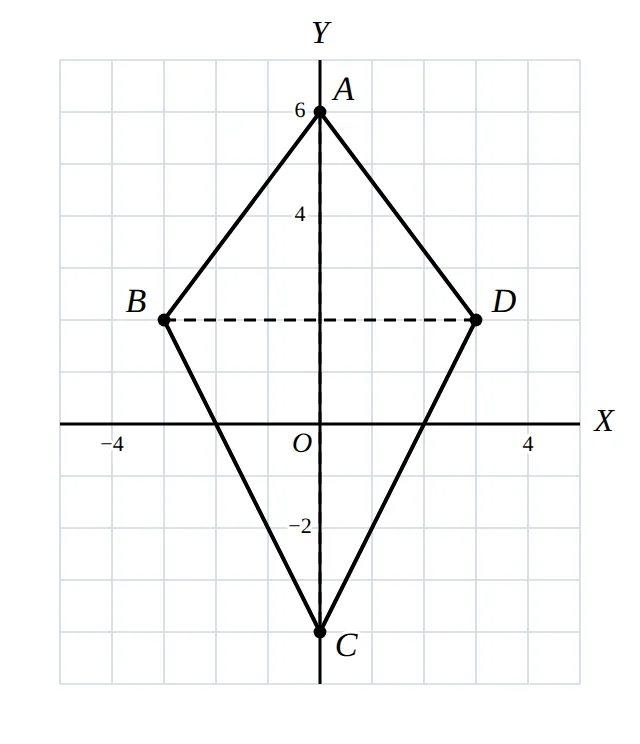
(i) Find the length . (1 mark)
Answer.
- units — 1 mark
(ii) Find the mid-point of , and show that it lies on the stick . (1 mark)
Answer.
- Mid-point of ; and both have x-coordinate 0, so lies on the y-axis and is on it, between and — 1 mark
(iii) Show that and . (2 marks)
Answer.
- — 1 mark
- and , so — 1 mark
OR
(iii) In what ratio does the stick divide the stick ? (2 marks)
Answer.
- meets at ; let , then — 1 mark
- , so the ratio is (check: , ) — 1 mark
Question 12 (4 marks)
A new metro line runs straight from station to station on a city map drawn on a coordinate grid, where 1 unit = 1 km. A hospital is at (see the figure).
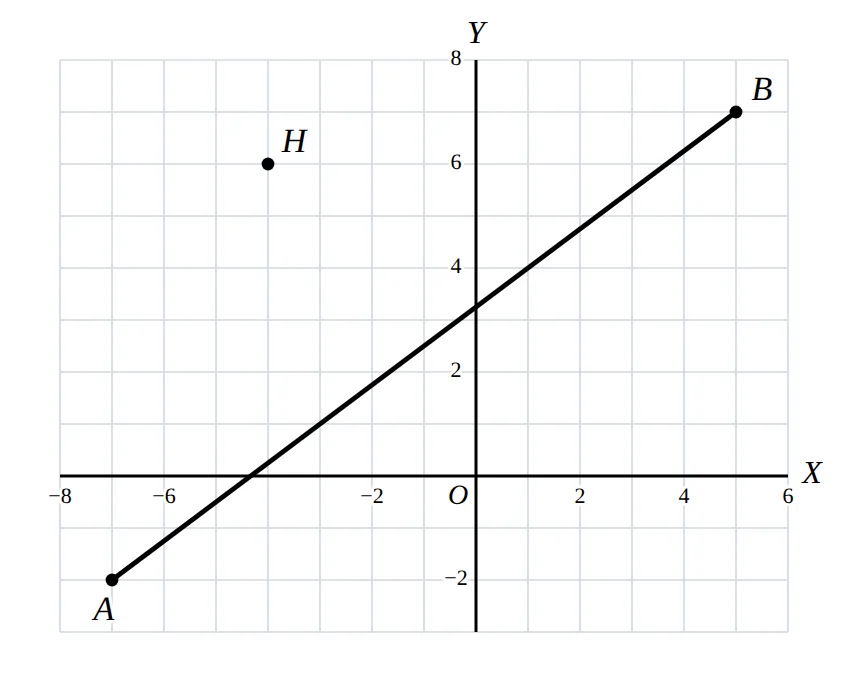
(i) How long is the metro line? (1 mark)
Answer.
- km — 1 mark
(ii) Two more stations and divide into three equal parts, with nearer to . Find their coordinates. (1 mark)
Answer.
- divides in : ; is the mid-point of : — 1 mark
(iii) A river flows along the y-axis. In what ratio does the river divide , and at which point does the metro line cross the river? (2 marks)
Answer.
- Let the ratio be ; on the y-axis, , so : ratio — 1 mark
- Point — 1 mark
OR
(iii) Which of the stations and is nearer to the hospital ? Justify your answer. (2 marks)
Answer.
- km and km — 1 mark
- , so station is nearer — 1 mark
Question 13 (4 marks)
A triangular park in Chandigarh is drawn on a coordinate grid, where 1 unit = 10 m. Its three gates are at the corners , and . A fountain is to be built at the mid-point of the side , and a straight path will join gate to the fountain.
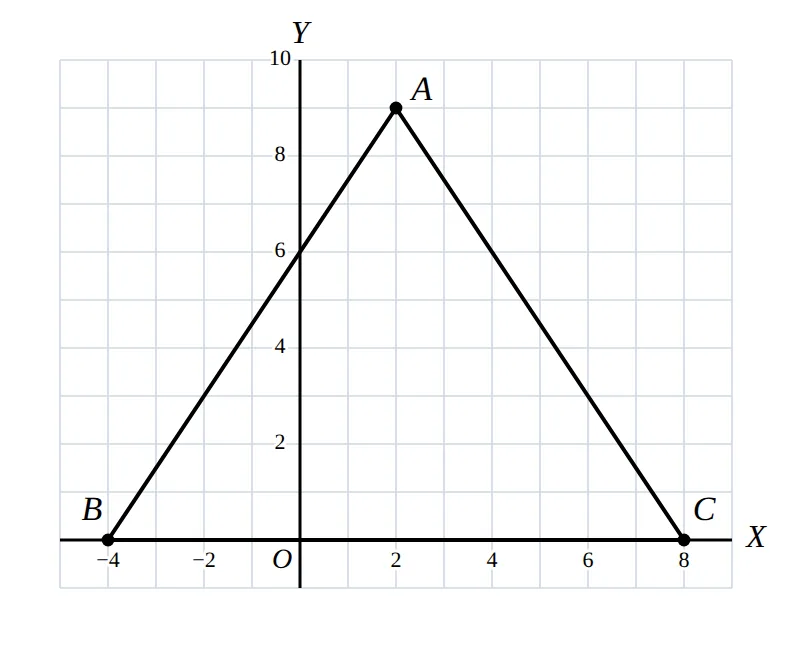
(i) Find the length of the side in metres. (1 mark)
Answer.
- units m — 1 mark
(ii) Find the coordinates of the fountain . (1 mark)
Answer.
- — 1 mark
(iii) A lamp post is fixed on the path such that . Find the coordinates of and its distance from gate in metres. (2 marks)
Answer.
- — 1 mark
- units m — 1 mark
OR
(iii) Show that the gate is equidistant from the gates and , and find this distance. (2 marks)
Answer.
- and , so — 1 mark
- units, that is, m — 1 mark
Question 14 (4 marks)
On Yoga Day, four students stand on the school ground at the points , , and of a coordinate grid marked on it, where 1 unit = 1 m. Ropes are tied along , , and (see the figure).
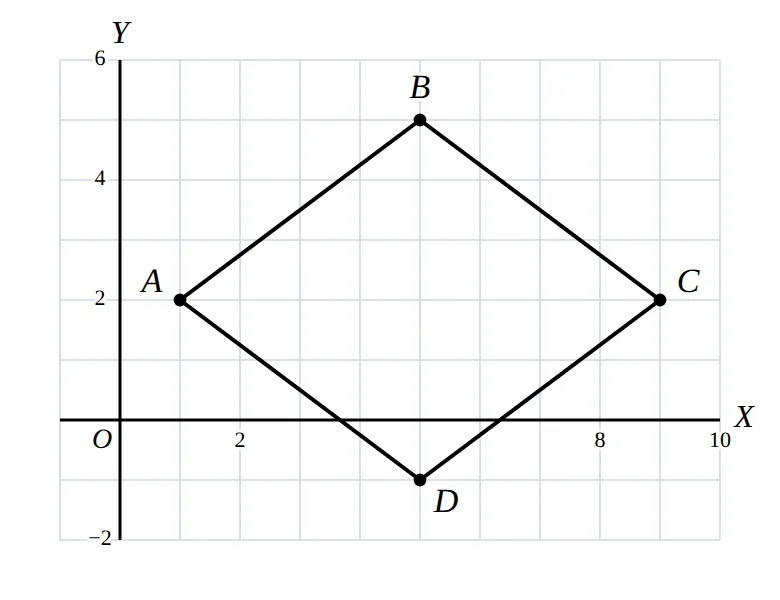
(i) Find the length of the rope . (1 mark)
Answer.
- m — 1 mark
(ii) Show that the diagonals and bisect each other. (1 mark)
Answer.
- Mid-point of and mid-point of : the same point, so they bisect each other — 1 mark
(iii) The coach says that is a square. Is he right? Justify your answer. (2 marks)
Answer.
- m (each is ) — 1 mark
- But m and m are not equal, so is a rhombus, not a square; he is not right — 1 mark
OR
(iii) A water bottle is kept at the point on such that . Find the coordinates of and the distance of the student at from the bottle. (2 marks)
Answer.
- — 1 mark
- m — 1 mark