
Circles
Circles carries 7 marks in the board paper. It got exactly 7 in the 2026-27 sample paper and in the 2025 and both 2026 board papers.
The marks usually come as one or two 1-mark MCQs (angles between tangents, a tangent length by Pythagoras), a 2-mark question, and a 3-mark proof: one of the two theorems, a quadrilateral or parallelogram circumscribing a circle, or parallel tangents with . The sample paper had a case study on tangents to a garden, and the Feb 2026 paper set a 5-mark question split into 1 + 1 + 1 + 2.
Where marks are usually lost:
- not writing the reason "radius tangent" or "tangents from an external point are equal" beside the step that uses it;
- theorem proofs without a figure, "Given", "To prove" and "Construction";
- mixing up (at the external point) with (at the centre);
- using Pythagoras in a triangle whose right angle has not been justified.
Revise in 5 Minutes
Basics
- A tangent meets the circle at exactly one point; a secant at two.
- Tangents from a point inside / on / outside the circle: 0 / 1 / 2.
The two theorems (proofs are asked)
| Theorem | Proof idea |
|---|---|
| The tangent at any point is to the radius through the point of contact. | Any other point of it is outside, so ; the shortest segment is the perpendicular. |
| Tangents from an external point are equal. | (RHS), so . |
Results that follow (tangents , from , centre , radius )
- bisects and , and is the perpendicular bisector of .
- for tangents , .
- Tangents at the ends of a diameter are parallel, a diameter apart.
- Concentric circles: the chord of the larger circle touching the smaller one is bisected there; half-chord .
- Quadrilateral circumscribing a circle: ; opposite sides subtend supplementary angles at the centre.
- A parallelogram circumscribing a circle is a rhombus.
- Parallel tangents , cut by a third tangent at and : .
- A third tangent at meeting , at , : perimeter of .
- Circle inscribed in (touching , , at , , ): , where is half the perimeter; in a right triangle with legs , and hypotenuse , .
- Angle chases: tangent diameter at its end, and the angle in a semicircle is .
Traps
- Write the reason with every use of at a point of contact.
- , not the tangent, is the hypotenuse.
- In a theorem proof, write Given, To prove, Construction and Proof, with a figure.
How to use this page: try each question on paper first, then read the answer. The marks against each step show what an examiner looks for. The 1-mark MCQs and Assertion-Reason questions are in the quiz at the end, together with questions that test how well you understand the chapter; every quiz answer comes with its explanation.
Short Answer Questions (2 and 3 Marks)
Question 1 (2 marks)
Prove that the tangents drawn at the ends of a diameter of a circle are parallel.
Answer.
Model answer:
Let be a diameter of a circle with centre . Let be the tangent at and the tangent at , with and on opposite sides of .
The tangent at any point is perpendicular to the radius through the point of contact. So and , which gives and .
and are alternate angles made by the transversal with the lines and , and they are equal. Hence .
Marking scheme:
- Let be a diameter with centre , and , the tangents at and ; the radius is perpendicular to the tangent, so and — 1 mark
- So ; these are alternate angles made by the transversal , hence — 1 mark
Question 2 (2 marks)
A circular pond in a park in Bhopal has a radius of 9 m. Anu stands at a point , 15 m from the centre of the pond. She walks along a straight path that just touches the edge of the pond at . How far does she walk to reach ?
Answer.
- is a tangent, so and is right-angled at — 1 mark
- m — 1 mark
Question 3 (2 marks)
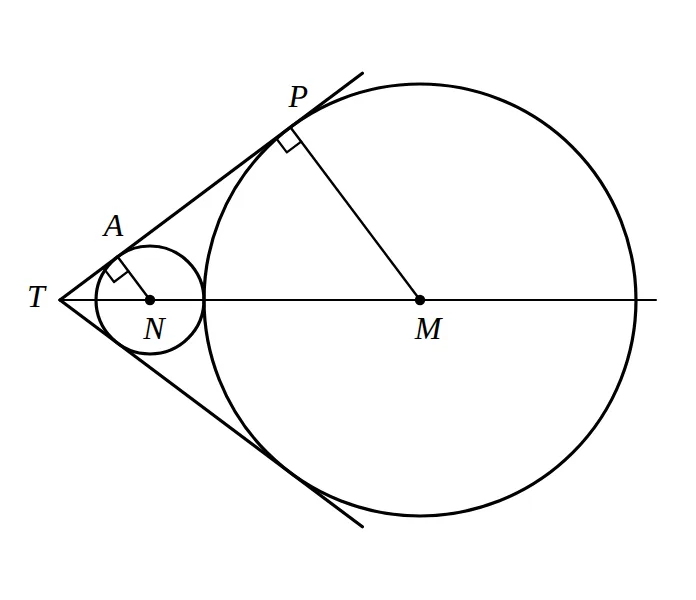
In the figure, is a tangent from to a circle with centre and radius 12 cm, touching it at , and cm. The same line also touches a smaller circle with centre and radius 3 cm at , where lies on . Find and .
Answer.
- and (radius and tangent), and is common, so (AA) — 1 mark
- , so cm and cm — 1 mark
Question 4 (2 marks)
A quadrilateral is drawn to circumscribe a circle. Its sides , , and touch the circle at , , and respectively. Prove that .
Answer.
- Tangents from an external point are equal: , , , — 1 mark
- Adding: , that is, — 1 mark
Question 5 (2 marks)
Two tangents and are drawn from an external point to a circle with centre such that . Prove that .
Answer.
- bisects , so ; and (radius and tangent) — 1 mark
- In right : , so and — 1 mark
Question 6 (3 marks)
Prove that the tangent at any point of a circle is perpendicular to the radius through the point of contact.
Answer.
Model answer:
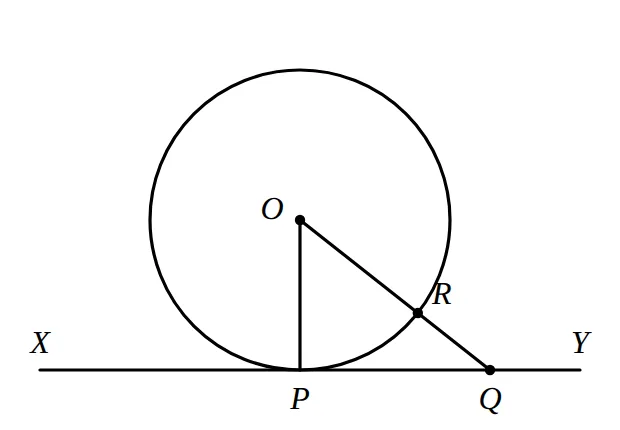
Given: a circle with centre and a tangent to the circle at the point .
To prove: .
Construction: take any point on other than , and join .
Proof: a tangent meets the circle at only one point, . So lies outside the circle. Let meet the circle at . Then , so .
But (radii of the same circle), so .
This is true for every point on other than . So is the shortest of all the segments joining to points of .
The shortest segment from a point to a line is the perpendicular to the line. Hence .
Marking scheme:
- Given: circle with centre , tangent at . To prove: . Take any point on other than and join — 1 mark
- lies outside the circle (a tangent meets the circle only at ), so if meets the circle at , then — 1 mark
- So is the shortest of all segments from to points of ; the shortest segment from a point to a line is the perpendicular, hence — 1 mark
Question 7 (3 marks)
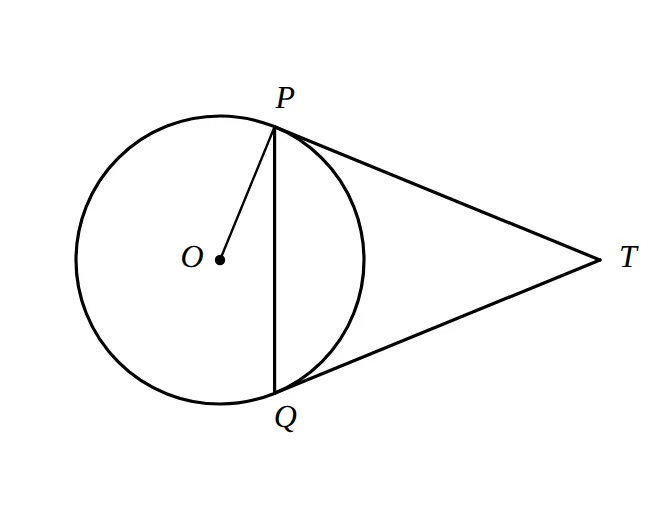
In the figure, and are the two tangents to a circle with centre from an external point . Prove that .
Answer.
Model answer:
Let .
, since the lengths of tangents from an external point are equal. So is isosceles, and .
The radius is perpendicular to the tangent at the point of contact, so .
.
Hence .
Marking scheme:
- Let ; (tangents from ), so — 1 mark
- (radius and tangent), so — 1 mark
- , so — 1 mark
Question 8 (3 marks)
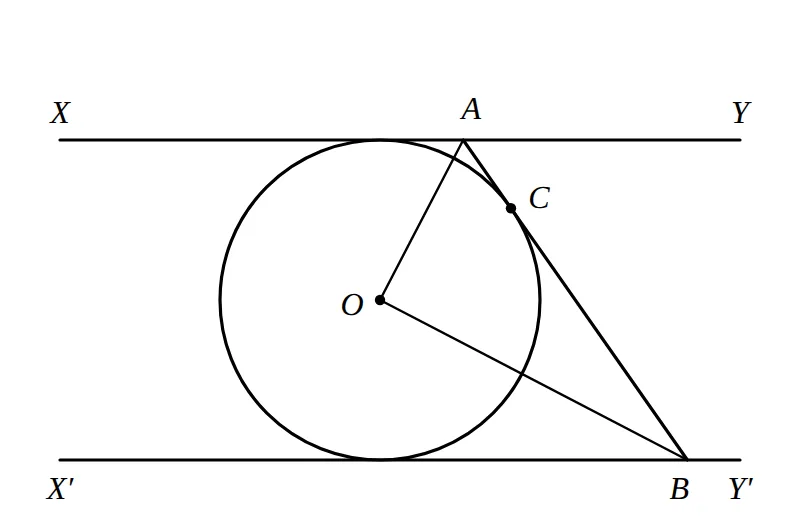
In the figure, and are two parallel tangents to a circle with centre . Another tangent , with point of contact , meets at and at . Prove that .
Answer.
Model answer:
Let touch the circle at and touch it at . Join , , , and .
In right triangles and : (radii), is common and (radius tangent). So (RHS), and . Hence .
In the same way, , so .
and is a transversal, so (co-interior angles).
Therefore , and in , .
Marking scheme:
- Let touch the circle at and at . (RHS: , common), so , that is, — 1 mark
- Similarly ; as , (co-interior angles) — 1 mark
- So , and in , — 1 mark
Question 9 (3 marks)
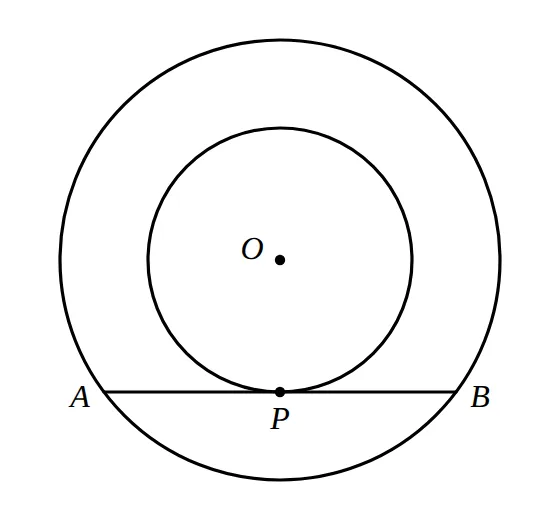
Prove that in two concentric circles, the chord of the larger circle which touches the smaller circle is bisected at the point of contact. Hence find the length of such a chord if the radii of the circles are 10 cm and 6 cm.
Answer.
Model answer:
Let two circles have the same centre , and let the chord of the larger circle touch the smaller circle at . Join .
is a tangent to the smaller circle at , so .
For the larger circle, is a chord and is the perpendicular from the centre to the chord. The perpendicular from the centre to a chord bisects it, so . (Or: by RHS, since , is common and .)
With radii 10 cm and 6 cm: in right , cm. So cm.
Marking scheme:
- Let touch the smaller circle at ; (radius and tangent) — 1 mark
- is a chord of the larger circle and is the perpendicular from the centre to it, so — 1 mark
- cm, so cm — 1 mark
Long Answer and Case-Based Questions
Question 10 (5 marks)
In the figure, and are tangents from an external point to a circle with centre , and the chord meets at .
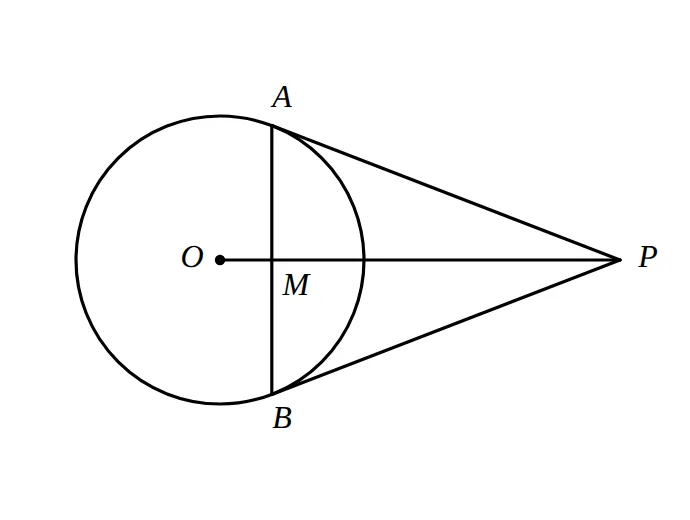
(i) Prove that the lengths of tangents drawn from an external point to a circle are equal, that is, . (3 marks)
Answer.
Model answer:
Given: and are tangents from to a circle with centre , touching it at and .
To prove: .
Construction: join , and .
Proof: the tangent at any point is perpendicular to the radius through the point of contact, so .
In right triangles and : (radii of the same circle) and the hypotenuse is common.
So by RHS congruence. Hence (corresponding parts of congruent triangles).
Marking scheme:
- Join , and ; (radius is perpendicular to the tangent) — 1 mark
- In and : (radii), is common — 1 mark
- (RHS), so (CPCT) — 1 mark
(ii) Hence prove that is the perpendicular bisector of the chord . (2 marks)
Answer.
- From (i), ; in and : , , common, so (SAS) — 1 mark
- So and ; as they add up to , each is ; hence is the perpendicular bisector of — 1 mark
Question 11 (5 marks)
In the figure, a circle with centre is inscribed in . It touches , and at , and respectively.
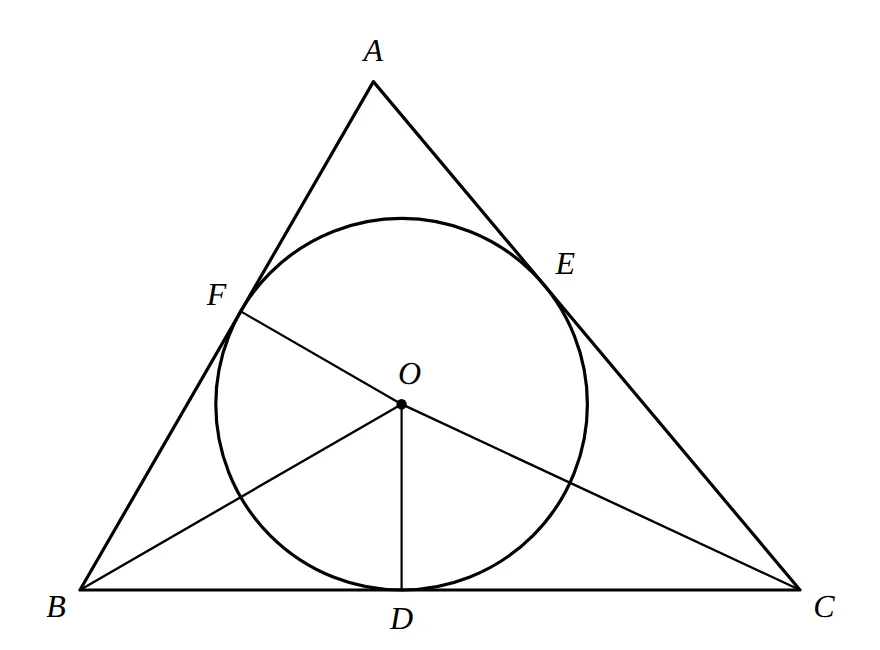
(i) Prove that bisects . (2 marks)
Answer.
- (radius tangent); in and : (radii), common — 1 mark
- (RHS), so ; hence bisects — 1 mark
(ii) Hence prove that . (2 marks)
Answer.
- In the same way bisects ; so in , — 1 mark
- , so — 1 mark
(iii) If , find . (1 mark)
Answer.
- — 1 mark
Question 12 (4 marks)
A school in Mysuru has a garden in the shape of a right triangle , with , m, m and m. A circular flower bed with centre and radius is laid out so that it touches all three sides: at , at and at , as shown in the figure.
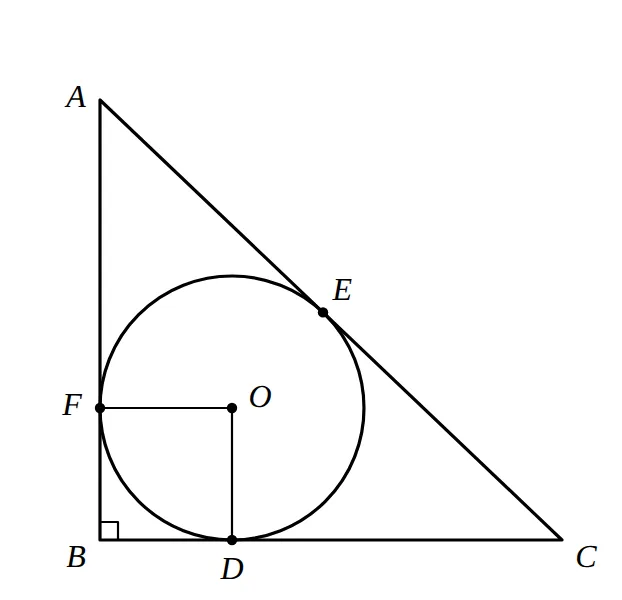
(i) Name the tangent segments equal to and to , and give the reason. (1 mark)
Answer.
- and , because tangents drawn from an external point to a circle are equal — 1 mark
(ii) Show that , and write and in terms of . (1 mark)
Answer.
- has three right angles ( and two radius-tangent angles) and , so it is a square: ; , — 1 mark
(iii) Using m, find the radius of the flower bed. (2 marks)
Answer.
- — 1 mark
- , so m — 1 mark
OR
(iii) Taking m, find the area of the garden and check that it equals (perimeter of ). (2 marks)
Answer.
- Area m — 1 mark
- m; the two are equal (area of + + ) — 1 mark
Question 13 (4 marks)
Neel's family pushes a round table of radius 60 cm into a corner of their room, where two walls meet at a right angle. The table top touches the two walls at and . The figure shows the top view, with the centre of the table top.
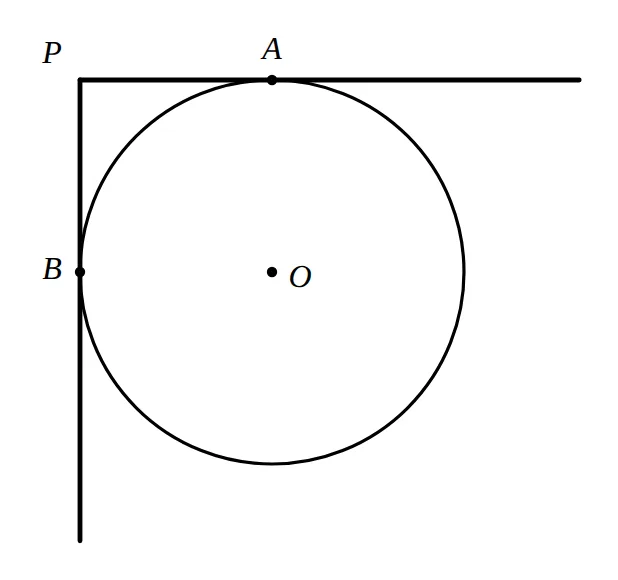
(i) What kind of quadrilateral is ? Give a reason. (1 mark)
Answer.
- A square: (radius and tangent), , so all angles are right angles, and (radii) — 1 mark
(ii) Find the distance of the corner from the point where the table touches the wall. (1 mark)
Answer.
- is a square, so cm — 1 mark
(iii) How far is the corner from the nearest point of the edge of the table? (Use ) (2 marks)
Answer.
- is the diagonal of the square: cm — 1 mark
- The nearest point of the edge lies on , so the distance cm — 1 mark
OR
(iii) Find the length of the segment and the distance of from . (Use ) (2 marks)
Answer.
- is a diagonal of the square : cm — 1 mark
- The diagonals of a square bisect each other at right angles, so the distance of from is half of : cm — 1 mark