
Polynomials
Polynomials usually carries 3 to 5 marks in the board paper: 5 in the 2026-27 sample paper, 4 in the 2025 paper and in the second 2026 paper, and 3 in the main 2026 paper.
The marks come as one or two 1-mark MCQs (often reading the number of zeroes from a graph), sometimes an Assertion-Reason item, and a 2- or 3-mark question on the relationship between zeroes and coefficients. The board has not set a 5-mark or case-study question from this chapter, so the case-based questions here are for practice in the same ideas.
Where marks are usually lost:
- sign slips in , especially when is itself negative;
- writing instead of ;
- using for ;
- counting the point on the -axis as a zero when reading a graph.
Revise in 5 Minutes
Key facts
- A zero of is a number with .
- Geometrically, the zeroes of are the -coordinates of the points where the graph meets the -axis. The point on the -axis is , not a zero.
- A polynomial of degree has at most zeroes. A quadratic has 0, 1 or 2 real zeroes.
- The graph of is a parabola: it opens upwards if and downwards if . It cuts the -axis at .
Zeroes and coefficients of (zeroes , )
| Formula | |
|---|---|
| Sum | |
| Product |
Forming a polynomial: , . So there are infinitely many quadratics with the same zeroes.
Useful forms
| Expression | In terms of and |
|---|---|
Quick checks
- Zeroes equal in size, opposite in sign: .
- Zeroes reciprocal to each other: .
- Both zeroes negative (when the zeroes are real): sum negative and product positive.
Traps
- Losing the minus in when is negative.
- Writing .
- Forgetting that in cannot be 0.
- Splitting the middle term wrongly with surds: check by expanding back.
How to use this page: try each question on paper first, then read the answer. The marks against each step show what an examiner looks for. The 1-mark MCQs and Assertion-Reason questions are in the quiz at the end, together with questions that test how well you understand the chapter; every quiz answer comes with its explanation.
Short Answer Questions (2 and 3 Marks)
Question 1 (2 marks)
The zeroes of the polynomial are 3 and . Find the values of and .
Answer.
- Sum of zeroes , so — 1 mark
- Product of zeroes , so — 1 mark
Question 2 (2 marks)
Find the zeroes of the polynomial and check that their product is equal to .
Answer.
- — 1 mark
- Zeroes (that is, ) and ; product — 1 mark
Question 3 (2 marks)
Aman was asked to write a quadratic polynomial whose zeroes are 5 and . He wrote . Is he correct? If not, write a correct polynomial.
Answer.
Model answer:
No, Aman is not correct.
His polynomial factorises as , so its zeroes are and 2. He has added the sum of the zeroes in the middle term, where it should be subtracted.
For zeroes 5 and : sum and product .
So a correct polynomial is . Check: .
Marking scheme:
- has zeroes and 2, so Aman is not correct (his sum of zeroes is , not 3) — 1 mark
- Sum , product ; correct polynomial (or any non-zero multiple of it) — 1 mark
Question 4 (2 marks)
If and are the zeroes of the polynomial and , find the value of .
Answer.
- , ; — 1 mark
- , so — 1 mark
Question 5 (2 marks)
If is one of the zeroes of the polynomial , find the value of and the other zero.
Answer.
- , so and — 1 mark
- Product of zeroes , so other zero — 1 mark
Question 6 (3 marks)
Find the zeroes of the quadratic polynomial and verify the relationship between the zeroes and the coefficients.
Answer.
- — 1 mark
- Zeroes and — 1 mark
- Sum ; product — 1 mark
Question 7 (3 marks)
If and are the zeroes of the polynomial , find a quadratic polynomial whose zeroes are and .
Answer.
- and — 1 mark
- New sum ; new product — 1 mark
- Required polynomial — 1 mark
Question 8 (3 marks)
If and are the real zeroes of the polynomial such that , find the value of .
Answer.
Model answer:
Here , , , so and .
. Setting this equal to 3 and multiplying by : , that is, .
So , which gives or .
Now check that the zeroes are real, as the question says. The zeroes of are real only when .
For : , so the zeroes are real (the polynomial is ). For : , so has no real zeroes, and this value is rejected.
Hence .
Marking scheme:
- , ; — 1 mark
- , so and — 1 mark
- Real zeroes need : gives 45 (real zeroes), gives (no real zeroes); so — 1 mark
Question 9 (3 marks)
Verify that 2 and are the zeroes of the polynomial . Hence find a quadratic polynomial whose zeroes are the reciprocals of these zeroes.
Answer.
- and ; so both are zeroes — 1 mark
- Reciprocals and : sum , product — 1 mark
- , or — 1 mark
Question 10 (3 marks)
If and are the zeroes of the polynomial and , find the value of and of .
Answer.
- , ; — 1 mark
- Since , — 1 mark
- — 1 mark
Long Answer and Case-Based Questions
Question 11 (4 marks)
The entrance gate of a school in Mysuru has an arch in the shape of a parabola, as shown in the figure. Taking the ground as the -axis and a vertical pole as the -axis, the arch is the graph of , where and are in metres. The arch meets the ground at A and B.
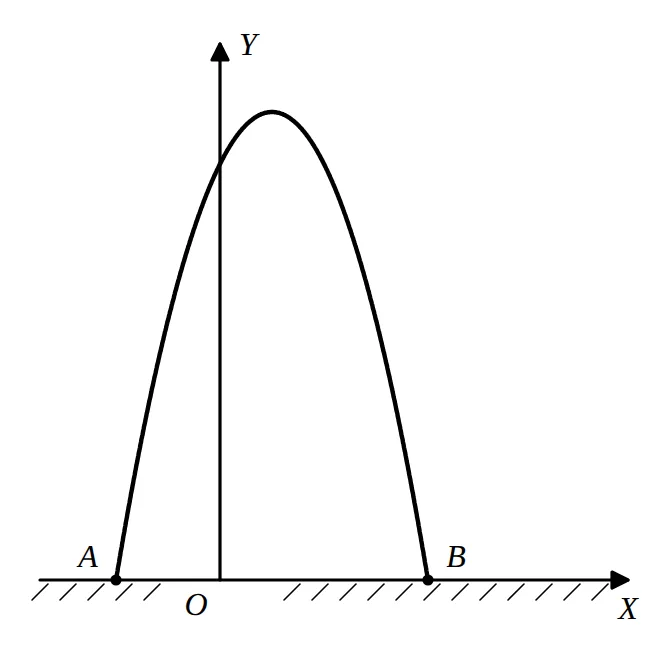
(i) Find the zeroes of . (1 mark)
Answer.
- ; zeroes and — 1 mark
(ii) How wide is the arch at ground level, that is, what is the distance AB? (1 mark)
Answer.
- A and B are and , so AB m — 1 mark
(iii) The highest point of the arch is exactly above the mid-point of AB. Find the height of the arch at this point. (2 marks)
Answer.
- Mid-point of AB: — 1 mark
- Height m — 1 mark
OR
(iii) A smaller arch over a side gate meets the ground 2 m on either side of the -axis, and its highest point is 4 m above the ground, on the -axis. Find the quadratic polynomial whose graph is this arch. (2 marks)
Answer.
- Zeroes and , so — 1 mark
- gives ; so — 1 mark
Question 12 (4 marks)
A small bakery in Indore sells cakes. The owner finds that if hundred cakes are made and sold in a week, the profit (in thousands of rupees) is . A negative value of means a loss, and the values of at which are called the break-even points.
(i) Find the zeroes of . How many cakes give the break-even points? (1 mark)
Answer.
- ; zeroes 2 and 6, that is, 200 and 600 cakes — 1 mark
(ii) Find the profit when 400 cakes are sold in a week. (1 mark)
Answer.
- , so the profit is ₹ 4000 — 1 mark
(iii) Verify the relationship between the zeroes and the coefficients of . (2 marks)
Answer.
- Sum of zeroes and — 1 mark
- Product of zeroes and ; verified — 1 mark
OR
(iii) For the owner's second shop, the profit polynomial is quadratic, its break-even points are at 300 and 500 cakes, and . Find . (2 marks)
Answer.
- Zeroes 3 and 5, so — 1 mark
- gives ; — 1 mark
Question 13 (4 marks)
In a maths lab activity, Tanya plotted the graph of a quadratic polynomial on graph paper, as shown in the figure.
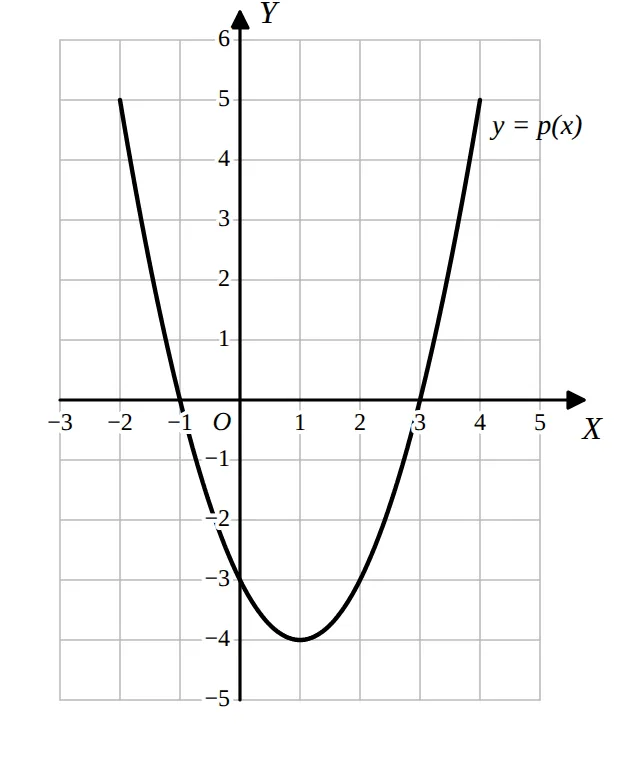
(i) How many zeroes does have? (1 mark)
Answer.
- The graph meets the -axis at two points, so has 2 zeroes — 1 mark
(ii) Write the zeroes of . (1 mark)
Answer.
- The graph meets the -axis at and ; zeroes and 3 — 1 mark
(iii) The graph cuts the -axis at . Find . (2 marks)
Answer.
- — 1 mark
- gives ; — 1 mark
OR
(iii) Find a quadratic polynomial whose zeroes are twice the zeroes of . (2 marks)
Answer.
- New zeroes and 6: sum , product — 1 mark
- Required polynomial — 1 mark
Question 14 (4 marks)
In a maths club game in Patna, Asha thinks of the quadratic polynomial whose zeroes are and 4, with the coefficient of equal to 1. Bala thinks of the polynomial .
(i) Write Asha's polynomial . (1 mark)
Answer.
- Sum , product ; — 1 mark
(ii) Find the zeroes of Bala's polynomial . (1 mark)
Answer.
- ; zeroes 3 and — 1 mark
(iii) Which zero do and share? Find a quadratic polynomial whose zeroes are the two zeroes that are not shared. (2 marks)
Answer.
- Shared zero: ; the other zeroes are 4 and 3 — 1 mark
- Sum , product ; required polynomial — 1 mark
OR
(iii) If and are the zeroes of Asha's polynomial , find the value of without finding the zeroes separately. (2 marks)
Answer.
- , ; — 1 mark
- — 1 mark