
Probability
Probability carries 5 marks in every recent board paper (the 2026-27 sample paper, 2025 and both 2026 papers).
The marks usually come as two or three 1-mark MCQs (cards, dice, numbers, balls in a bag), often an Assertion-Reason item (seen in three of the last four papers), and one 2- or 3-mark question on two dice, a deck of cards or numbered cards. There has been no 5-mark question from this chapter, so the case-based questions here give the longer practice.
Where marks are usually lost:
- taking outcomes that are not equally likely (the 11 sums of two dice, or "two heads, two tails, one of each");
- counting an outcome twice in an "or" event, such as 6 in "a multiple of 2 or 3", or (6, 6) in "at least one 6";
- forgetting that there are 90 two-digit numbers, or that 1 is not a prime;
- not changing the total when cards or balls are removed or added.
Revise in 5 Minutes
Key results
- , only when the outcomes are equally likely.
- . Sure event: . Impossible event: .
- , so .
- The probabilities of all the elementary events of an experiment add up to 1.
- "A or B": count every favourable outcome once; remove the ones in both.
Sample spaces to know
| Experiment | Outcomes |
|---|---|
| One coin | 2: H, T |
| Two coins | 4: HH, HT, TH, TT |
| One die | 6: 1 to 6 |
| Two dice | 36 ordered pairs (1, 1) to (6, 6) |
| Deck of cards | 52 |
Two dice: number of ways to get each sum
| Sum | 2 | 3 | 4 | 5 | 6 | 7 | 8 | 9 | 10 | 11 | 12 |
|---|---|---|---|---|---|---|---|---|---|---|---|
| Ways | 1 | 2 | 3 | 4 | 5 | 6 | 5 | 4 | 3 | 2 | 1 |
Doublets: 6. At least one 6: 11. No 6: 25.
Deck of 52 cards
- 4 suits of 13: hearts and diamonds are red; spades and clubs are black.
- Face cards: jack, queen, king, so 12 in all (3 per suit). Aces: 4.
- Number cards 2 to 10: 36 (9 per suit).
Numbers: primes up to 50 are 2, 3, 5, 7, 11, 13, 17, 19, 23, 29, 31, 37, 41, 43, 47 (15 of them); 1 is neither prime nor composite. Two-digit numbers: 10 to 99, that is, 90.
Traps
- Unequal outcomes treated as equally likely.
- Double counting in "or" events.
- Old total used after cards or balls are removed or added.
- Letters of a word: count every letter, repeats included (PROBABILITY has 11).
How to use this page: try each question on paper first, then read the answer. The marks against each step show what an examiner looks for. The 1-mark MCQs and Assertion-Reason questions are in the quiz at the end, together with questions that test how well you understand the chapter; every quiz answer comes with its explanation.
Short Answer Questions (2 and 3 Marks)
Question 1 (2 marks)
Two dice are thrown at the same time. Find the probability that (i) the difference between the two numbers is 3, (ii) both numbers are greater than 4.
Answer.
- Difference 3: (1, 4), (4, 1), (2, 5), (5, 2), (3, 6), (6, 3), so — 1 mark
- Both greater than 4: (5, 5), (5, 6), (6, 5), (6, 6), so — 1 mark
Question 2 (2 marks)
A number is chosen at random from the numbers 31, 32, 33, …, 50. Find the probability that it is (i) a composite number, (ii) divisible by 4.
Answer.
- 20 numbers; primes 31, 37, 41, 43, 47, so 15 composite numbers and — 1 mark
- Divisible by 4: 32, 36, 40, 44, 48, so — 1 mark
Question 3 (2 marks)
Two spinners each have three equal sectors numbered 1, 2 and 3. Both are spun together and the two numbers are added. Rahul says, 'The sum can be 2, 3, 4, 5 or 6, so the probability that the sum is 4 is .' Is he right? Give a reason and find the correct probability.
Answer.
Model answer:
No, Rahul is not right. Probability = favourable outcomes ÷ total outcomes works only when all the outcomes are equally likely. The five sums are not: a sum of 2 comes only from (1, 1), but a sum of 4 comes from three pairs.
The equally likely outcomes are the pairs (first spinner, second spinner). The sum is 4 for (1, 3), (2, 2) and (3, 1).
So the probability that the sum is 4 .
Marking scheme:
- Not right: the 5 sums are not equally likely; the equally likely outcomes are the 9 pairs (1, 1), (1, 2), …, (3, 3) — 1 mark
- Sum 4: (1, 3), (2, 2), (3, 1), so — 1 mark
Question 4 (2 marks)
Ravi and Sneha play a game. Each tosses a coin at the same time. Ravi wins if both coins show the same face; otherwise Sneha wins. Is the game fair to both? Give a reason.
Answer.
- Outcomes HH, HT, TH, TT are equally likely; Ravi wins with HH, TT: — 1 mark
- Sneha wins with HT, TH: ; equal chances, so the game is fair — 1 mark
Question 5 (2 marks)
For a lucky draw at a school fete in Kanpur, 250 coupons are sold. Of these, 10 coupons win a prize of ₹ 100 each and 5 coupons win a prize of ₹ 500 each. Anu buys one coupon. Find the probability that she (i) wins some prize, (ii) wins ₹ 500.
Answer.
- Prize coupons ; P(some prize) — 1 mark
- P(winning ₹ 500) — 1 mark
Question 6 (3 marks)
A two-digit number is chosen at random. Find the probability that (i) both its digits are the same, (ii) it is a perfect cube, (iii) the sum of its digits is 5.
Answer.
- Two-digit numbers: 10 to 99, that is, 90; same digits: 11, 22, …, 99, so — 1 mark
- Perfect cubes: 27 and 64, so — 1 mark
- Digit sum 5: 14, 23, 32, 41, 50, so — 1 mark
Question 7 (3 marks)
A jar contains 30 marbles, which are red, green or yellow. There are twice as many green marbles as red ones, and the probability of drawing a yellow marble at random is . Find the number of marbles of each colour, and the probability of drawing a green marble.
Answer.
- Yellow , so red + green — 1 mark
- Red , green : , so 8 red and 16 green — 1 mark
- — 1 mark
Question 8 (3 marks)
Two dice are thrown together. Find the probability that (i) the two dice show different numbers, (ii) the product of the numbers is 12, (iii) the sum of the numbers is a perfect square.
Answer.
- Same numbers in 6 outcomes, so different in : — 1 mark
- Product 12: (2, 6), (3, 4), (4, 3), (6, 2), — 1 mark
- Sum 4: 3 ways; sum 9: 4 ways; — 1 mark
Question 9 (3 marks)
A card is drawn at random from a well-shuffled deck of 52 playing cards. Find the probability that it is (i) a face card of hearts, (ii) neither a face card nor an ace, (iii) a card of clubs bearing an even number.
Answer.
- Face cards of hearts: J, Q, K, so — 1 mark
- Face cards 12 and aces 4: , so — 1 mark
- Clubs with even numbers: 2, 4, 6, 8, 10, so — 1 mark
Question 10 (3 marks)
A letter is chosen at random from the letters of the word ASSESSMENT. Find the probability that the letter is (i) S, (ii) a vowel, (iii) a letter that occurs only once in the word.
Answer.
- 10 letters: A, S, S, E, S, S, M, E, N, T; S occurs 4 times, — 1 mark
- Vowels: A, E, E, so — 1 mark
- Letters occurring once: A, M, N, T, so — 1 mark
Long Answer and Case-Based Questions
Question 11 (4 marks)
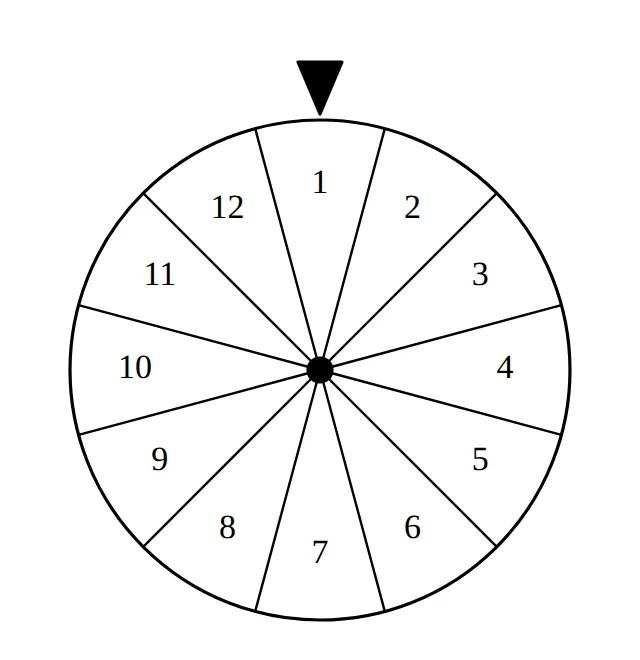
At a Diwali fair in Lucknow, a game stall has a spinning wheel divided into 12 equal sectors numbered 1 to 12, as shown in the figure. A player spins the wheel, and the number in the sector that stops under the fixed pointer at the top is the outcome. All sectors are equally likely.
(i) Find the probability that the arrow stops at a prime number. (1 mark)
Answer.
- Primes: 2, 3, 5, 7, 11, so — 1 mark
(ii) Find the probability that the arrow stops at a factor of 12. (1 mark)
Answer.
- Factors of 12: 1, 2, 3, 4, 6, 12, so — 1 mark
(iii) Find the probability that the arrow stops at (a) a number greater than 12, (b) a number less than 13. What kinds of events are these? (2 marks)
Answer.
- No number is greater than 12: , an impossible event — 1 mark
- Every number is less than 13: , a sure event — 1 mark
OR
(iii) Find the probability that the arrow stops at (a) a perfect square, (b) a number that is not a perfect square. (2 marks)
Answer.
- Perfect squares: 1, 4, 9, so — 1 mark
- Not a perfect square: — 1 mark
Question 12 (4 marks)
Four cousins play Ludo during the summer holidays. A player can bring a piece out of the home only when a 6 comes up on the die. For a faster version of the game, they then decide to throw two dice together on each turn.
(i) With two dice, what is the probability that both dice show 6? (1 mark)
Answer.
- Only (6, 6): — 1 mark
(ii) With two dice, what is the probability that neither die shows 6? (1 mark)
Answer.
- outcomes, so — 1 mark
(iii) With two dice, a player may move a piece out if the sum is 10 or more, or if both dice show the same number. Find the probability of this. (2 marks)
Answer.
- Sum 10 or more: 6 outcomes; same number: 6 outcomes; (5, 5) and (6, 6) are in both — 1 mark
- Favourable , — 1 mark
OR
(iii) With two dice, find the probability that the sum is 7 or 11. (2 marks)
Answer.
- Sum 7: 6 outcomes; sum 11: (5, 6) and (6, 5), 2 outcomes — 1 mark
- — 1 mark
Question 13 (4 marks)
In a 'pick a ball' game at a school carnival in Indore, a bag contains 5 red, 7 blue and 8 green balls, all of the same size. A child draws one ball without looking.
(i) Find the probability that the ball is blue. (1 mark)
Answer.
- — 1 mark
(ii) Find the probability that the ball is not green. (1 mark)
Answer.
- — 1 mark
(iii) Before the next round, 2 red balls are taken out of the bag and 4 green balls are put in. Now find the probability of drawing a green ball and of drawing a red ball. (2 marks)
Answer.
- Now red 3, blue 7, green 12; total 22 — 1 mark
- P(green) ; P(red) — 1 mark
OR
(iii) How many green balls must be added to the original bag so that the probability of drawing a green ball becomes ? (2 marks)
Answer.
- Let green balls be added: — 1 mark
- , so — 1 mark
Question 14 (4 marks)
Neha takes the 13 cards of spades (ace, 2, 3, …, 10, jack, queen, king) out of a deck, shuffles them well and draws one card at random.
(i) Find the probability that the card is a face card. (1 mark)
Answer.
- Jack, queen, king: — 1 mark
(ii) Find the probability that the card bears an even number. (1 mark)
Answer.
- 2, 4, 6, 8, 10: — 1 mark
(iii) The card Neha draws is the king, and she keeps it aside. She then draws another card from the remaining cards. Find the probability that this card is (a) a face card, (b) an ace. (2 marks)
Answer.
- 12 cards remain, with 2 face cards (jack, queen): — 1 mark
- One ace among 12 cards: — 1 mark
OR
(iii) From the 13 cards, find the probability that the card drawn (a) bears a prime number, (b) is neither a face card nor an ace. (2 marks)
Answer.
- Primes 2, 3, 5, 7: — 1 mark
- Cards 2 to 10: 9 cards, — 1 mark