
Pair of Linear Equations in Two Variables
Pair of Linear Equations usually carries 4 to 6 marks in the board paper: 5 in the 2026-27 sample paper, 6 in the 2025 paper and in the second 2026 paper, and 4 in the main 2026 paper.
There is almost always a 1-mark MCQ on the conditions for a unique solution, no solution or infinitely many solutions. The rest comes as a 3-mark word problem, a 5-mark question (either "draw the graphs and find the triangle with an axis" or a word problem), or a 4-mark case study on sales or prices.
Where marks are usually lost:
- mixing up the ratio conditions, especially "no solution" (parallel) and "infinitely many" (coincident);
- in graph questions, not writing a table of values for each line, or reading the vertices of the triangle wrongly;
- defining the variables loosely in word problems (say clearly what and stand for);
- stopping after finding and when the question asks for something more.
Revise in 5 Minutes
Form: and . Each equation is a straight line; a solution is a point on both lines.
Nature of solutions
| Condition | Lines | Solutions | Pair is |
|---|---|---|---|
| intersecting | exactly one | consistent | |
| coincident | infinitely many | consistent (dependent) | |
| parallel | none | inconsistent |
Methods (cross-multiplication is not in the syllabus)
- Substitution: make or the subject in one equation and put it in the other.
- Elimination: multiply to make one coefficient equal, then add or subtract.
- Shortcut: if the coefficients are swapped (, ), add and subtract the equations.
- Graphical: make a table of at least 2 (better 3) points for each line, plot both on the same axes, and read the meeting point.
Graph with an axis: a line meets the -axis where and the -axis where . For the triangle with the -axis, base = distance between the two -intercepts, height = distance of the meeting point from the -axis, that is, , area base height.
Word problems: state the variables with units, write two equations, solve, and answer exactly what is asked.
- Two-digit number: ; reversed: .
- Boat: downstream , upstream .
- Ages: " years ago" subtract from both ages.
Traps
- "Consistent" includes the coincident case.
- A vertical line is , a horizontal line is .
- Check the answer in both original equations.
How to use this page: try each question on paper first, then read the answer. The marks against each step show what an examiner looks for. The 1-mark MCQs and Assertion-Reason questions are in the quiz at the end, together with questions that test how well you understand the chapter; every quiz answer comes with its explanation.
Short Answer Questions (2 and 3 Marks)
Question 1 (2 marks)
Solve for and : and .
Answer.
- Clearing fractions: and — 1 mark
- gives , so and — 1 mark
Question 2 (2 marks)
Solve for and : and .
Answer.
Model answer:
Look at the coefficients: they are 3, 2 in the first equation and 2, 3 in the second. So adding and subtracting the equations is quicker than the usual method.
Adding: , so . … (1)
Subtracting the second from the first: . … (2)
Adding (1) and (2): , so . From (1), .
Check: and . So , .
Marking scheme:
- Adding: , so ; subtracting: — 1 mark
- , so and — 1 mark
Question 3 (2 marks)
Without drawing the graphs, find whether the lines representing each pair intersect, are parallel or coincide: (i) and (ii) and
Answer.
- (i) , so the lines coincide (infinitely many solutions) — 1 mark
- (ii) but , so and the lines intersect (unique solution) — 1 mark
Question 4 (2 marks)
In a parallelogram ABCD, , and . Find the values of and .
Answer.
- Opposite angles are equal: ; adjacent angles are supplementary: , so — 1 mark
- gives , so and — 1 mark
Question 5 (2 marks)
The lines and meet at a point on the -axis. Find the value of .
Answer.
- On the -axis ; from , , so the point is — 1 mark
- lies on : , so — 1 mark
Question 6 (3 marks)
The sum of the digits of a two-digit number is 9. The number obtained by reversing its digits is 27 more than the original number. Find the number.
Answer.
- Let the tens digit be and the units digit : number , and — 1 mark
- gives , so — 1 mark
- : , ; the number is 36 — 1 mark
Question 7 (3 marks)
If 3 is added to the numerator of a fraction and 1 is subtracted from its denominator, the fraction becomes . If 1 is subtracted from both the numerator and the denominator, it becomes . Find the fraction.
Answer.
- Let the fraction be : gives — 1 mark
- gives — 1 mark
- Subtracting: , and ; the fraction is — 1 mark
Question 8 (3 marks)
A motorboat on the Ganga at Varanasi goes 36 km downstream in 2 hours and comes back the same 36 km upstream in 3 hours. Find the speed of the boat in still water and the speed of the current.
Answer.
- Let the boat's speed in still water be km/h and the current km/h; downstream — 1 mark
- Upstream — 1 mark
- : km/h and km/h — 1 mark
Question 9 (3 marks)
Four years ago, Meena's mother was 5 times as old as Meena. Two years from now, she will be 3 times as old as Meena. Find their present ages.
Answer.
- Let the present ages be: mother years, Meena years; gives — 1 mark
- gives — 1 mark
- Subtracting: , , ; mother 34 years, Meena 10 years — 1 mark
Question 10 (3 marks)
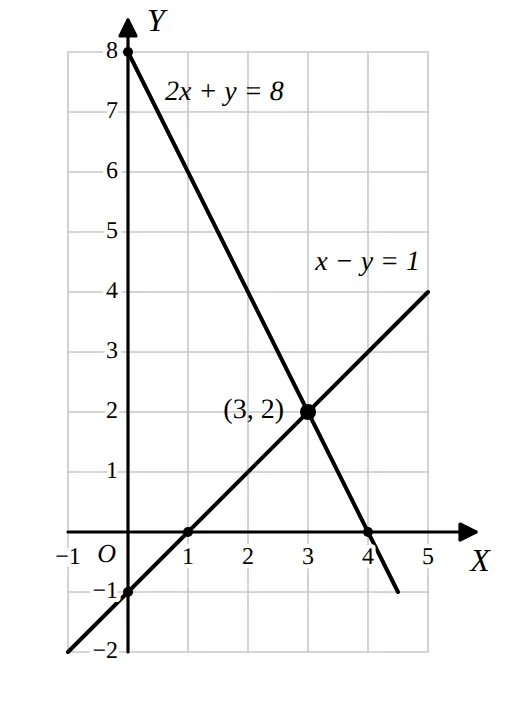
Solve the following pair of linear equations graphically: and .
Answer.
Model answer:
For , that is, :
| 0 | 1 | 3 | |
|---|---|---|---|
| 0 | 2 |
For , that is, :
| 0 | 3 | 4 | |
|---|---|---|---|
| 8 | 2 | 0 |
Plot these points and join them to get two straight lines on the same graph. The lines meet at the point .
So the solution is , . Check: and .
Marking scheme:
- Tables: through , , ; through , , — 1 mark
- Both lines plotted correctly on the same axes — 1 mark
- The lines meet at , so , — 1 mark
Long Answer and Case-Based Questions
Question 11 (5 marks)
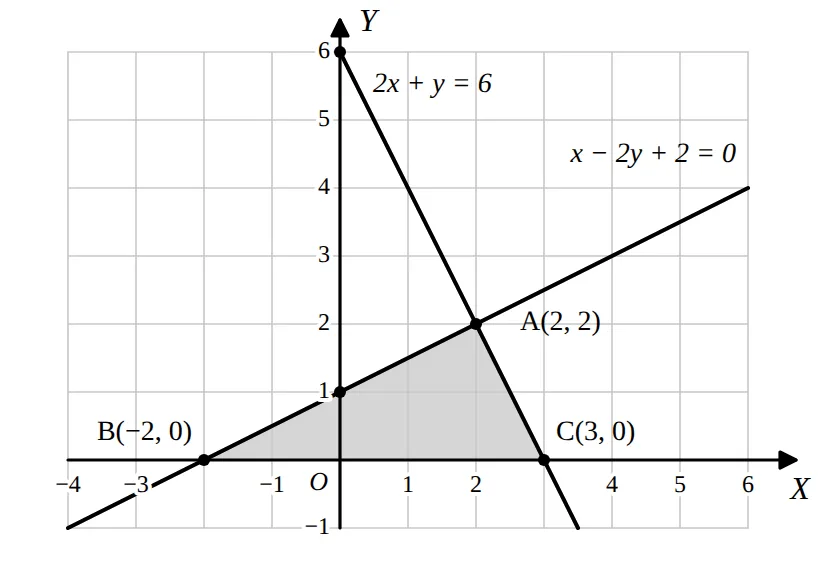
Draw the graphs of the equations and . Find the coordinates of the vertices of the triangle formed by these two lines and the -axis, shade the triangular region, and find its area.
Answer.
Model answer:
For , that is, :
| 0 | 2 | 3 | |
|---|---|---|---|
| 6 | 2 | 0 |
For , that is, :
| 0 | 2 | ||
|---|---|---|---|
| 0 | 1 | 2 |
Plot the points and draw both lines on the same axes. They meet at .
The line meets the -axis at and the line meets it at . So the triangle has vertices A, B and C.
Its base BC lies on the -axis: BC units. The height is the distance of A from the -axis, which is 2 units.
Area square units.
Marking scheme:
- Table for : , , — 1 mark
- Table for : , , — 1 mark
- Both lines drawn correctly and the triangle shaded — 1 mark
- Vertices: , and — 1 mark
- Base units, height units; area square units — 1 mark
Question 12 (5 marks)
Kiran, a school teacher in Bhubaneswar, invested ₹ 25,000 in two schemes. The first pays simple interest at 8% per annum and the second at 10% per annum. Her total interest at the end of one year was ₹ 2,280. How much did she invest in each scheme? If she now moves ₹ 5,000 from the first scheme to the second, what will her interest for one year be?
Answer.
Model answer:
Let Kiran invest ₹ in the 8% scheme and ₹ in the 10% scheme.
Total investment: . … (1)
Interest for one year: . Multiplying by 100 and dividing by 2: . … (2)
Multiplying (1) by 4: . Subtracting this from (2): . Then .
Check: of 11000 is 880 and of 14000 is 1400, and .
So she invested ₹ 11,000 at 8% and ₹ 14,000 at 10%.
After moving ₹ 5,000, the amounts are ₹ 6,000 at 8% and ₹ 19,000 at 10%. Interest , so her yearly interest will be ₹ 2,380, that is, ₹ 100 more.
Marking scheme:
- Let the amounts be ₹ (8%) and ₹ (10%): — 1 mark
- , that is, — 1 mark
- ; subtracting, — 1 mark
- : ₹ 11,000 at 8% and ₹ 14,000 at 10% — 1 mark
- New amounts ₹ 6,000 and ₹ 19,000; interest , that is, ₹ 2,380 — 1 mark
Question 13 (4 marks)
A self-help group of women in a village near Nashik makes jute bags and cloth purses. Each jute bag is sold at ₹ and each cloth purse at ₹ . In the first week they sold 30 bags and 20 purses and earned ₹ 4400. In the second week they sold 20 bags and 40 purses and earned ₹ 4000.
(i) Show that the second week's sales give . (1 mark)
Answer.
- ; dividing by 20, — 1 mark
(ii) A member guesses that a bag costs ₹ 100 and a purse ₹ 70. Check her guess against both weeks. (1 mark)
Answer.
- Week 1: fits, but week 2: ; so the guess is wrong — 1 mark
(iii) Find the selling price of a jute bag and of a cloth purse. (2 marks)
Answer.
- Week 1: ; subtracting : , — 1 mark
- , ; bag ₹ 120, purse ₹ 40 — 1 mark
OR
(iii) In the third week the group sold 50 items in all (bags and purses) at the same prices, a bag for ₹ 120 and a purse for ₹ 40, and earned ₹ 4400. Form a pair of linear equations and find how many bags and how many purses they sold. (2 marks)
Answer.
- Let bags and purses be sold: and , that is, — 1 mark
- Subtracting: ; 30 bags and 20 purses — 1 mark
Question 14 (4 marks)
Two cab services run in Lucknow. Service P charges a fixed ₹ 50 plus ₹ 10 per km. Service Q has no fixed charge and charges ₹ 20 per km. The figure shows the fare (in ₹) against the distance (in km) for both services; the two lines meet at E.
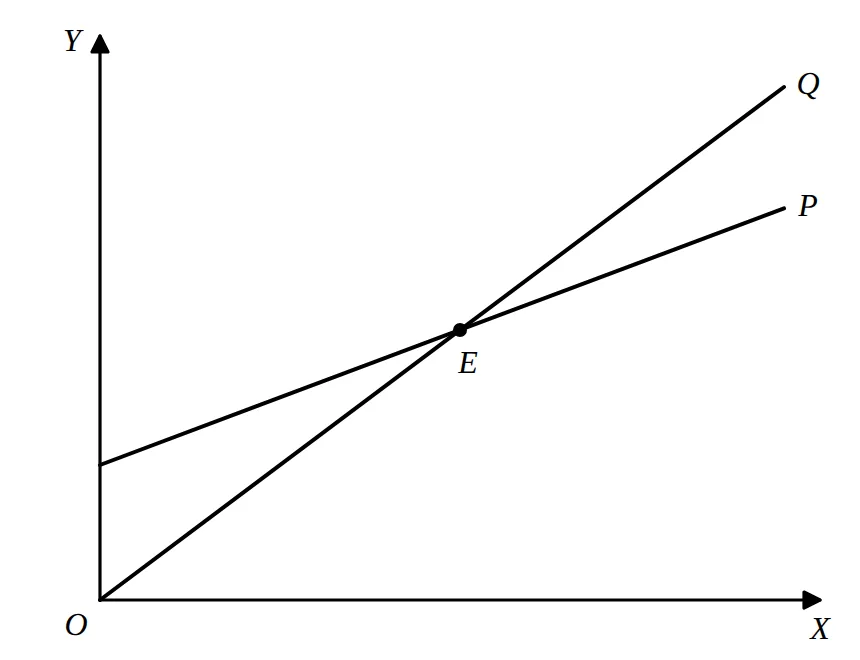
(i) Write the pair of linear equations for the two services. (1 mark)
Answer.
- P: ; Q: — 1 mark
(ii) For what distance do the two services charge the same fare? What is that fare? (1 mark)
Answer.
- gives km; fare ₹ 100 (point E is ) — 1 mark
(iii) Riya has to travel 12 km. Which service is cheaper for her, and by how much? (2 marks)
Answer.
- P: ; Q: — 1 mark
- Service P is cheaper, by ₹ 70 — 1 mark
OR
(iii) Service Q changes its fare to a fixed ₹ 10 plus ₹ 15 per km. Find the distance at which the two services now charge the same fare, and that fare. (2 marks)
Answer.
- New Q: ; — 1 mark
- , km; fare , that is, ₹ 130 — 1 mark