
What an Amino Acid Is
Amino acids are organic compounds containing an amino group and an acidic group as substituents on the same carbon - the -carbon. Because both groups sit on that one carbon, they are called -amino acids.
They are substituted methanes. Take methane, , and replace what is attached to the central carbon. There are four substituent groups occupying the four valency positions:
- Hydrogen
- Carboxyl group,
- Amino group,
- A variable group designated as the R group
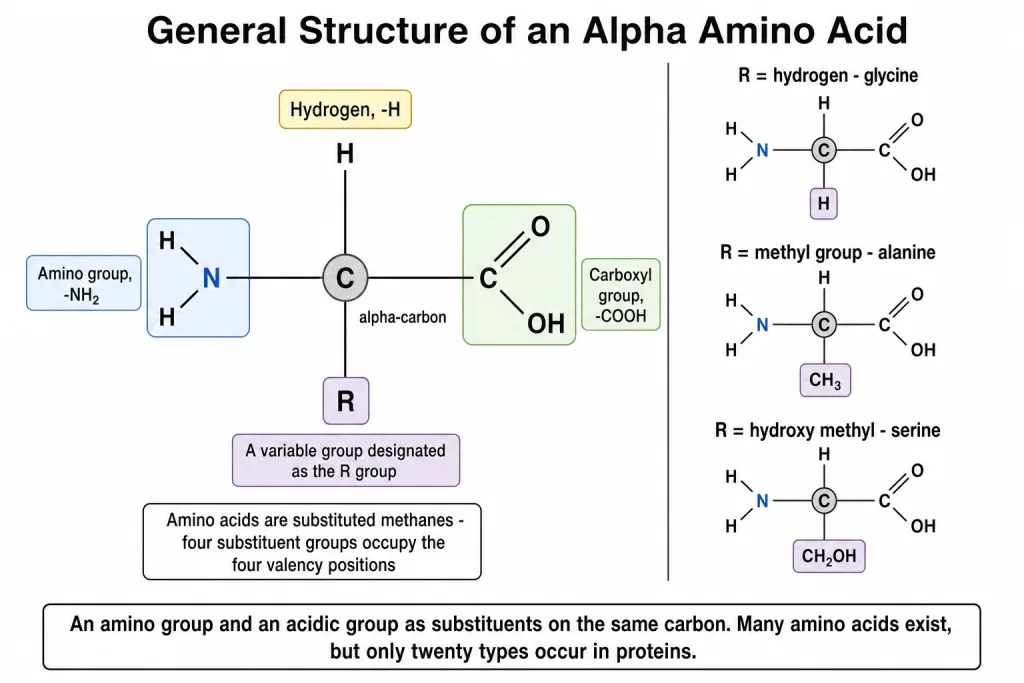
Based on the nature of the R group there are many amino acids. But those which occur in proteins are only of twenty types.
| R group | The amino acid it makes |
|---|---|
| Hydrogen | Glycine |
| A methyl group | Alanine |
| Hydroxy methyl | Serine |
[NEET Important] Two phrases in this block are quoted almost word for word in question stems: "substituted methanes" and "an amino group and an acidic group as substituents on the same carbon". And hold the number carefully - many amino acids exist, but only twenty types occur in proteins.
Sorting the Twenty
The chemical and physical properties of amino acids are essentially those of the amino, carboxyl and R functional groups. Three of those groups are fixed, so the R group is what makes one amino acid differ from another, and it is what every classification below is really about.
By the number of amino and carboxyl groups:
| Type | Example |
|---|---|
| Acidic | Glutamic acid |
| Basic | Lysine |
| Neutral | Valine |
By the presence of an aromatic ring: tyrosine, phenylalanine and tryptophan are the aromatic amino acids.
[NEET Important] These three examples are asked as bare pairings, so learn them as a block: glutamic acid is acidic, lysine is basic, valine is neutral. The aromatic three - tyrosine, phenylalanine, tryptophan - are usually offered as a "which of these is aromatic" item.
The Zwitterion
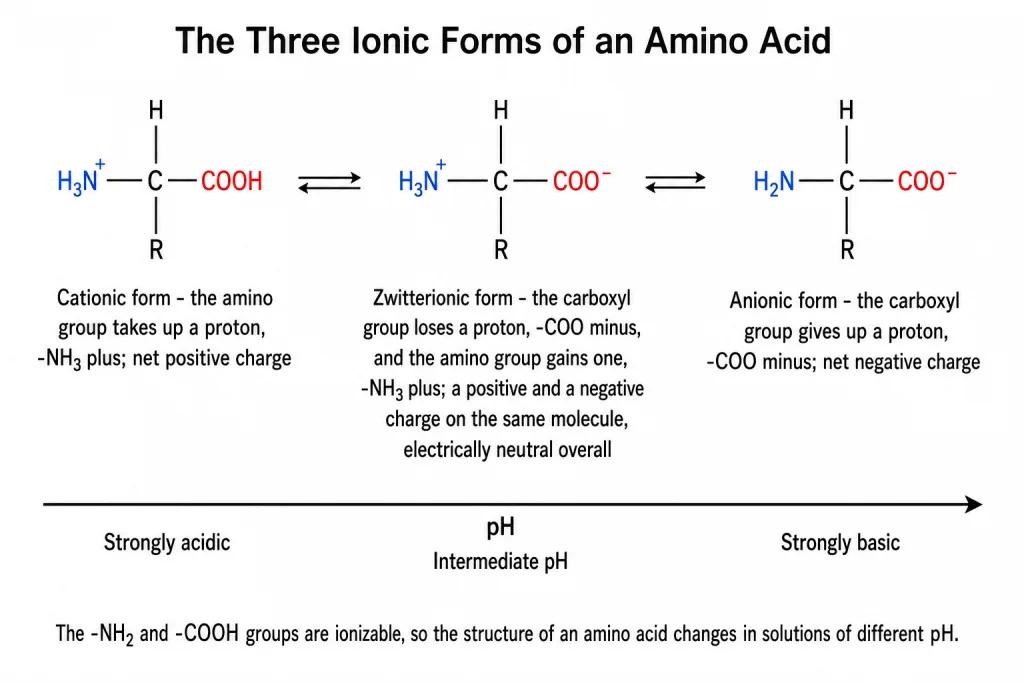
A particular property of amino acids is the ionizable nature of the and groups. Because both can gain or lose a proton, the structure of amino acids changes in solutions of different pH.
- In a strongly acidic solution the amino group takes up a proton and the molecule carries a net positive charge.
- In a strongly basic solution the carboxyl group gives up a proton and the molecule carries a net negative charge.
- At an intermediate pH both happen at once: the loses a proton and the gains one, so the molecule carries a positive and a negative charge on the same molecule while being electrically neutral overall. This is the zwitterionic form.
[NEET Important] The word zwitterionic is the answer to the most common question from this whole section. Learn its defining property precisely: a molecule carrying both a positive and a negative charge at the same time, with no net charge. A distractor that says "no charges at all" is describing something else entirely.
Quick Recap
- An amino acid is an organic compound with an amino group and an acidic group as substituents on the same carbon, the -carbon - hence -amino acids.
- They are substituted methanes, with four substituent groups on the four valency positions: hydrogen, carboxyl group, amino group and a variable R group.
- Many amino acids exist, but only twenty types occur in proteins.
- R group hydrogen - glycine. R group methyl - alanine. R group hydroxy methyl - serine.
- The chemical and physical properties are essentially those of the amino, carboxyl and R groups.
- Acidic - glutamic acid. Basic - lysine. Neutral - valine. Classified by the number of amino and carboxyl groups.
- Aromatic amino acids - tyrosine, phenylalanine, tryptophan.
- The and groups are ionizable, so the structure of an amino acid changes with the pH of the solution.
- The zwitterionic form carries both a positive and a negative charge on the same molecule.
Solved Examples
Question 1
Q. Define an amino acid and say why it is called an -amino acid.
Answer. It is an organic compound containing an amino group and an acidic group as substituents on the same carbon. That carbon is the -carbon, and because both groups sit on it, these are called -amino acids.
Question 2
Q. Why are amino acids described as substituted methanes?
Answer. Because the central carbon carries four substituent groups occupying its four valency positions, just as methane's carbon carries four hydrogens. Here the four are hydrogen, the carboxyl group, the amino group and a variable R group.
Question 3
Q. Name the four groups attached to the -carbon of an amino acid.
Answer. Hydrogen, the carboxyl group , the amino group , and a variable R group.
Question 4
Q. How many types of amino acids occur in proteins?
Answer. Twenty. Based on the nature of the R group there are many amino acids, but those which occur in proteins are only of twenty types.
Question 5
Q. Which amino acid has hydrogen as its R group, and which has a methyl group?
Answer. Hydrogen as the R group gives glycine. A methyl group gives alanine. Hydroxy methyl gives serine.
Question 6
Q. Draw the structure of the amino acid, alanine. This is one of the chapter-end exercises.
Answer. Alanine is an -amino acid whose R group is a methyl group, . Its formula is .
How to draw it. Put one carbon in the centre - this is the -carbon - and draw four bonds from it, one to each corner. Then attach, and label, the four substituents:
- Hydrogen, , on one bond.
- The amino group, , on the second.
- The carboxyl group, , on the third - draw it out as a carbon double bonded to one oxygen and single bonded to an .
- The R group, here a methyl group , on the fourth.
Mark the central carbon as the -carbon, since the whole definition rests on the amino group and the acidic group being on that same carbon. Change only the fourth bond and you get any other amino acid - hydrogen there gives glycine, hydroxy methyl gives serine.
Question 7
Q. On what basis are amino acids classified as acidic, basic or neutral? Give one example of each.
Answer. On the number of amino and carboxyl groups they carry. Acidic - glutamic acid. Basic - lysine. Neutral - valine.
Question 8
Q. Name the aromatic amino acids.
Answer. Tyrosine, phenylalanine and tryptophan.
Question 9
Q. Why does the structure of an amino acid change with pH?
Answer. Because the and groups are ionizable. Depending on how acidic or basic the solution is, these groups gain or lose protons, so in solutions of different pH the structure of amino acids changes.
Question 10
Q. What is the zwitterionic form of an amino acid?
Answer. The form in which the carboxyl group has lost a proton and the amino group has gained one, so the molecule carries both a positive and a negative charge at the same time while being electrically neutral overall.
Question 11
Q. What decides the properties of a particular amino acid?
Answer. The chemical and physical properties of amino acids are essentially those of the amino, carboxyl and R functional groups. Since the amino and carboxyl groups are the same in all of them, it is the R group that makes one amino acid differ from another.
Question 12
Q. Serine, valine and tryptophan - place each in the classification it belongs to.
Answer. Serine is the amino acid whose R group is hydroxy methyl. Valine is a neutral amino acid. Tryptophan is an aromatic amino acid.