
The Third Macromolecule
The other type of macromolecule that one would find in the acid insoluble fraction of any living tissue is the nucleic acid. These are polynucleotides.
That completes a set of three. Together with polysaccharides and polypeptides, nucleic acids comprise the true macromolecular fraction of any living tissue or cell.
| Macromolecule | Its polymer name | Its building block |
|---|---|---|
| Protein | Polypeptide | Amino acid |
| Carbohydrate | Polysaccharide | Monosaccharide |
| Nucleic acid | Polynucleotide | Nucleotide |
[NEET Important] Learn the three as one list, because the question is usually "which three comprise the true macromolecular fraction". The answer is polysaccharides, polypeptides and polynucleotides. Lipids are the classic distractor here - they end up in the acid insoluble fraction, but they are not counted in that trio.
The Nucleotide - Three Components
For nucleic acids, the building block is a nucleotide. A nucleotide has three chemically distinct components.
- A heterocyclic compound - the nitrogenous base.
- A monosaccharide - the sugar.
- A phosphoric acid or phosphate - phosphoric acid is , and it sits in the chain as the phosphate group, .
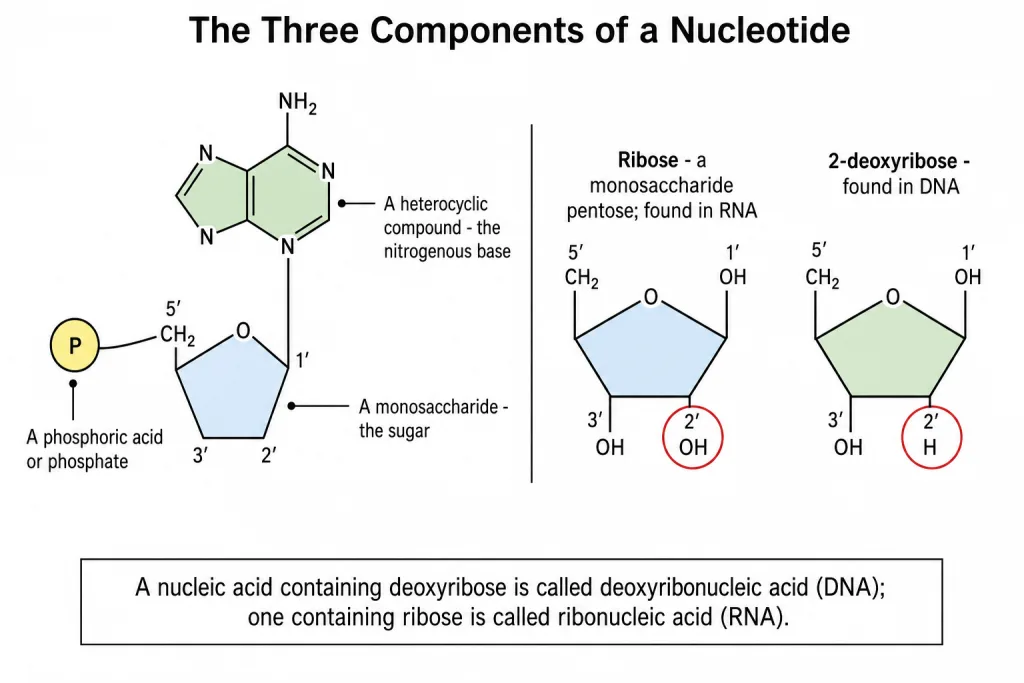
[NEET Important] The counting is the question: three chemically distinct components, and they must be named in the chapter's own terms - a heterocyclic compound, a monosaccharide, and a phosphoric acid or phosphate. A distractor that offers "amino acid" or "fatty acid" as a component of a nucleotide is testing whether you memorised the list.
The Nitrogenous Bases - Purines and Pyrimidines
The heterocyclic compounds in nucleic acids are the nitrogenous bases, and there are five of them: adenine, guanine, uracil, cytosine and thymine.
They fall into two families:
| Family | Bases | The ring |
|---|---|---|
| Substituted purines | Adenine, Guanine | The skeletal heterocyclic ring is called purine |
| Substituted pyrimidines | Uracil, Cytosine, Thymine | The skeletal heterocyclic ring is called pyrimidine |
Adenine and guanine are substituted purines while the rest are substituted pyrimidines. The word substituted matters - the bare ring is the purine or the pyrimidine; the base is that ring with groups attached to it.
[NEET Important] Two purines, three pyrimidines - A and G are purines, and U, C and T are pyrimidines. The memory hook that survives exam pressure is that the two shorter names, adenine and guanine, are the purines. Do not say "adenine is a purine" when the answer wanted is substituted purine, and remember that purine and pyrimidine are the names of the skeletal heterocyclic rings.
The Sugar, and the Difference Between DNA and RNA
The sugar found in polynucleotides is either ribose, a monosaccharide pentose, or 2-deoxyribose. One sugar, one oxygen apart - and that single difference names the whole molecule.
| Sugar present | The nucleic acid is called |
|---|---|
| Deoxyribose | Deoxyribonucleic acid (DNA) |
| Ribose | Ribonucleic acid (RNA) |
A nucleic acid containing deoxyribose is called deoxyribonucleic acid (DNA), while that which contains ribose is called ribonucleic acid (RNA).
What nucleic acids are for. Nucleic acids serve as genetic material. They carry hereditary information and are passed on from parental generation to progeny.
[NEET Important] The definition is built on the sugar and nothing else, so answer it that way: deoxyribose gives DNA, ribose gives RNA. Note also that ribose is described as a monosaccharide pentose - a five-carbon sugar - which is a small phrase examiners like to lift straight into a stem. And the function line, nucleic acids serve as genetic material and carry hereditary information from parental generation to progeny, is the one-mark answer for the role of nucleic acids.
Quick Recap
- The other type of macromolecule in the acid insoluble fraction of any living tissue is the nucleic acid.
- Nucleic acids are polynucleotides.
- Together with polysaccharides and polypeptides, these comprise the true macromolecular fraction of any living tissue or cell.
- For nucleic acids, the building block is a nucleotide.
- A nucleotide has three chemically distinct components - a heterocyclic compound, a monosaccharide, and a phosphoric acid or phosphate.
- The heterocyclic compounds in nucleic acids are the nitrogenous bases - adenine, guanine, uracil, cytosine and thymine.
- Adenine and guanine are substituted purines while the rest are substituted pyrimidines.
- The skeletal heterocyclic ring is called purine and pyrimidine respectively.
- The sugar found in polynucleotides is either ribose, a monosaccharide pentose, or 2-deoxyribose.
- A nucleic acid containing deoxyribose is called deoxyribonucleic acid (DNA); one containing ribose is called ribonucleic acid (RNA).
- Nucleic acids serve as genetic material. They carry hereditary information and are passed on from parental generation to progeny.
Solved Examples
Question 1
Q. What are nucleic acids, chemically?
Answer. They are polynucleotides - polymers whose building block is a nucleotide.
Question 2
Q. In which fraction of a living tissue would you find nucleic acids?
Answer. In the acid insoluble fraction. The other type of macromolecule that one would find in the acid insoluble fraction of any living tissue is the nucleic acid.
Question 3
Q. What comprises the true macromolecular fraction of any living tissue or cell?
Answer. Polysaccharides, polypeptides and polynucleotides - that is, carbohydrate chains, protein chains and nucleic acids together.
Question 4
Q. What is the building block of a nucleic acid?
Answer. A nucleotide.
Question 5
Q. Name the three chemically distinct components of a nucleotide.
Answer. A heterocyclic compound, a monosaccharide, and a phosphoric acid or phosphate.
Question 6
Q. Name the nitrogenous bases found in nucleic acids.
Answer. Adenine, guanine, uracil, cytosine and thymine. These are the heterocyclic compounds in nucleic acids.
Question 7
Q. Which of the nitrogenous bases are purines and which are pyrimidines?
Answer. Adenine and guanine are substituted purines. Uracil, cytosine and thymine are substituted pyrimidines.
Question 8
Q. What is meant by calling a base a substituted purine?
Answer. The skeletal heterocyclic ring is called purine. A base such as adenine is that ring with groups attached to it, so it is described as a substituted purine. The same applies to pyrimidine and the substituted pyrimidines.
Question 9
Q. Which sugars are found in polynucleotides?
Answer. Either ribose, a monosaccharide pentose, or 2-deoxyribose.
Question 10
Q. What kind of sugar is ribose?
Answer. A monosaccharide pentose - a single sugar unit with five carbons.
Question 11
Q. Distinguish DNA from RNA on the basis of the sugar each contains.
Answer. A nucleic acid containing deoxyribose is called deoxyribonucleic acid, DNA. A nucleic acid which contains ribose is called ribonucleic acid, RNA.
Question 12
Q. Give the full forms of DNA and RNA.
Answer. DNA - deoxyribonucleic acid. RNA - ribonucleic acid.
Question 13
Q. What is the biological role of nucleic acids?
Answer. Nucleic acids serve as genetic material. They carry hereditary information and are passed on from parental generation to progeny.