
From Substrate to Product - the ES Complex and the Transition State
The chemical which is converted into a product is called a substrate. So an enzyme, a protein with a three dimensional structure including an active site, converts a substrate into a product . Symbolically:
That single arrow hides four things that have to happen, and every one of them is examinable.
- The substrate has to bind the enzyme at its active site within a given cleft or pocket.
- The substrate has to diffuse towards the active site. There is thus an obligatory formation of an complex, where stands for enzyme. This complex formation is a transient phenomenon.
- During the state where the substrate is bound to the enzyme active site, a new structure of the substrate called the transition state structure is formed.
- Very soon, after the expected bond breaking and making is completed, the product is released from the active site.
In other words, the structure of the substrate gets transformed into the structure of the product. The pathway of this transformation must go through the so-called transition state structure.
There could be many more altered structural states between the stable substrate and the product, and the point to hold on to is this: all other intermediate structural states are unstable. Stability is something related to the energy status of the molecule or the structure.
[NEET Important] The word that carries the marks here is obligatory - the formation of the complex is compulsory, and it is transient. And do not confuse the two new names: the transition state structure is a structure of the substrate, formed while the substrate sits on the active site; it is not the product and not the complex.
The Activation Energy Graph
Because stability is related to energy status, the whole story can be drawn as a graph.
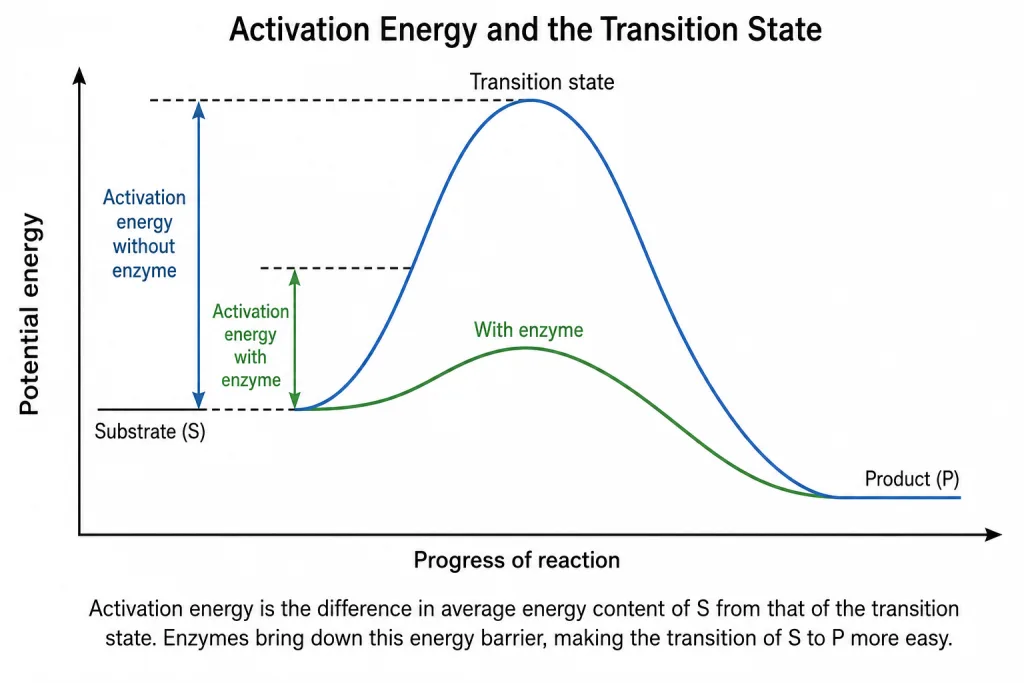
| Axis | What it represents |
|---|---|
| The y-axis | The potential energy content |
| The x-axis | The progression of the structural transformation, or states, through the transition state |
You would notice two things.
One - the energy level difference between and . If is at a lower level than , the reaction is an exothermic reaction. One need not supply energy, by heating, in order to form the product.
Two - the hump in the middle. Whether it is an exothermic or spontaneous reaction, or an endothermic or energy requiring reaction, the has to go through a much higher energy state, or transition state. The difference in average energy content of from that of this transition state is called the activation energy.
And here is what the enzyme does. Enzymes eventually bring down this energy barrier, making the transition of to more easy. The enzyme does not change where and sit on the y-axis; it lowers the hump between them.
[NEET Important] Define activation energy exactly as the book does - the difference in average energy content of from that of the transition state. A very common distractor calls it the difference between and ; that difference decides whether the reaction is exothermic or endothermic, nothing more. Also remember that even a spontaneous exothermic reaction still has to pass through the transition state.
Nature of Enzyme Action - the Catalytic Cycle
Each enzyme has a substrate binding site in its molecule, so that a highly reactive enzyme-substrate complex is produced. This complex is short-lived and dissociates into its products and the unchanged enzyme, with an intermediate formation of the enzyme-product complex .
The formation of the complex is essential for catalysis.
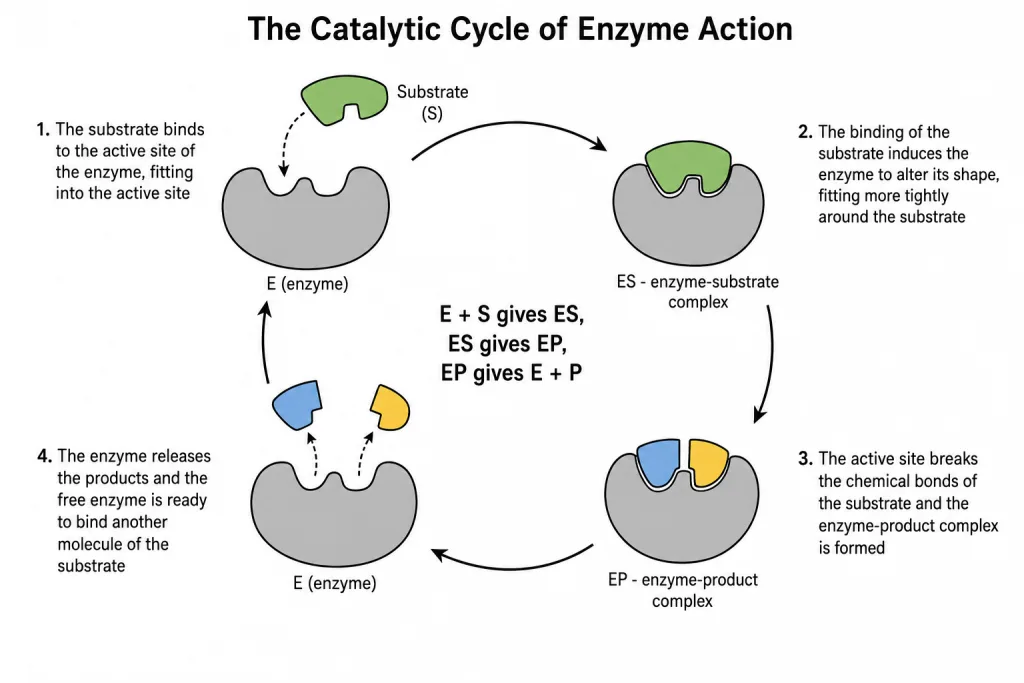
The catalytic cycle of an enzyme action can be described in the following steps:
- First, the substrate binds to the active site of the enzyme, fitting into the active site.
- The binding of the substrate induces the enzyme to alter its shape, fitting more tightly around the substrate.
- The active site of the enzyme, now in close proximity of the substrate, breaks the chemical bonds of the substrate, and the new enzyme-product complex is formed.
- The enzyme releases the products of the reaction, and the free enzyme is ready to bind to another molecule of the substrate and run through the catalytic cycle once again.
Read those four steps as bind, change shape, break bonds, release - and note that the enzyme comes out unchanged, which is why one enzyme molecule can run the cycle again and again.
[NEET Important] Step 2 is the one students drop. The binding of the substrate induces the enzyme to alter its shape - that is the shape change that makes the enzyme fit more tightly around the substrate, and questions ask which step it is. Also learn the sequence in the equation: the complex comes after the complex and before the free enzyme and product.
Quick Recap
- The chemical which is converted into a product is called a substrate, and enzymes convert a substrate into a product : .
- The substrate has to bind the enzyme at its active site within a given cleft or pocket, and has to diffuse towards the active site.
- There is an obligatory formation of an complex, where stands for enzyme, and this complex formation is a transient phenomenon.
- While the substrate is bound to the active site, a new structure of the substrate called the transition state structure is formed.
- Soon after the expected bond breaking and making is completed, the product is released from the active site.
- The pathway of the transformation must go through the transition state structure, and all other intermediate structural states are unstable.
- Stability is related to the energy status of the molecule or structure.
- On the graph, the y-axis represents the potential energy content and the x-axis the progression of the structural transformation through the transition state.
- If is at a lower level than , the reaction is exothermic and no energy need be supplied by heating to form the product.
- Whether the reaction is exothermic or spontaneous, or endothermic or energy requiring, has to go through a much higher energy state, the transition state.
- Activation energy is the difference in average energy content of from that of the transition state.
- Enzymes eventually bring down this energy barrier, making the transition of to more easy.
- Each enzyme has a substrate binding site, so a highly reactive enzyme-substrate complex is produced.
- The complex is short-lived and dissociates into the products and the unchanged enzyme, with an intermediate formation of the enzyme-product complex : .
- The formation of the complex is essential for catalysis.
- The catalytic cycle: (1) the substrate binds to the active site, fitting into it; (2) the binding induces the enzyme to alter its shape, fitting more tightly around the substrate; (3) the active site, now in close proximity of the substrate, breaks the chemical bonds and the enzyme-product complex is formed; (4) the enzyme releases the products and the free enzyme is ready to bind another substrate molecule and run the cycle again.
Solved Examples
Question 1
Q. What is a substrate, and how is the action of an enzyme written symbolically?
Answer. The chemical which is converted into a product is called a substrate. Enzymes, that is proteins with three dimensional structures including an active site, convert a substrate into a product :
Question 2
Q. Why is the formation of an ES complex called obligatory?
Answer. Because the substrate has to bind the enzyme at its active site within a given cleft or pocket and has to diffuse towards the active site before anything can happen. There is thus an obligatory formation of an complex, where stands for enzyme. This complex formation is a transient phenomenon.
Question 3
Q. What is the transition state structure?
Answer. During the state where the substrate is bound to the enzyme active site, a new structure of the substrate is formed, and this is called the transition state structure. The pathway of the transformation of substrate into product must go through this transition state structure.
Question 4
Q. What happens to the product after the bonds are broken and made?
Answer. Very soon, after the expected bond breaking and making is completed, the product is released from the active site. The structure of the substrate has by then been transformed into the structure of the product.
Question 5
Q. Why are the intermediate structural states described as unstable?
Answer. There could be many more altered structural states between the stable substrate and the product, and all other intermediate structural states are unstable. Stability is something related to the energy status of the molecule or the structure - these intermediates sit at a higher energy, so they do not last.
Question 6
Q. What do the two axes of the activation energy graph represent?
Answer. The y-axis represents the potential energy content. The x-axis represents the progression of the structural transformation, or states, through the transition state.
Question 7
Q. When is a reaction called exothermic on this graph?
Answer. If is at a lower level than , the reaction is an exothermic reaction. In that case one need not supply energy, by heating, in order to form the product.
Question 8
Q. Define activation energy.
Answer. Whether the reaction is exothermic or spontaneous, or endothermic or energy requiring, the has to go through a much higher energy state, the transition state. The difference in average energy content of from that of this transition state is called the activation energy.
Question 9
Q. How exactly does an enzyme make a reaction faster, in energy terms?
Answer. Enzymes eventually bring down this energy barrier, making the transition of to more easy. They lower the activation energy - they do not change the energy levels of and themselves.
Question 10
Q. Write the equation for the nature of enzyme action and name every term in it.
Answer.
is the enzyme, the substrate, the highly reactive enzyme-substrate complex, the enzyme-product complex, and the product. The complex is short-lived and dissociates into its products and the unchanged enzyme.
Question 11
Q. Why is the ES complex called essential?
Answer. Because the formation of the complex is essential for catalysis. Each enzyme has a substrate binding site in its molecule so that a highly reactive enzyme-substrate complex is produced; without it the enzyme cannot act on the substrate at all.
Question 12
Q. Describe the catalytic cycle of enzyme action in its four steps.
Answer.
- First, the substrate binds to the active site of the enzyme, fitting into the active site.
- The binding of the substrate induces the enzyme to alter its shape, fitting more tightly around the substrate.
- The active site of the enzyme, now in close proximity of the substrate, breaks the chemical bonds of the substrate, and the new enzyme-product complex is formed.
- The enzyme releases the products of the reaction, and the free enzyme is ready to bind to another molecule of the substrate and run through the catalytic cycle once again.
Question 13
Q. In which step of the catalytic cycle does the enzyme change shape, and why does that matter?
Answer. In the second step. The binding of the substrate induces the enzyme to alter its shape, fitting more tightly around the substrate. That tighter fit brings the active site into close proximity of the substrate, which is what lets the active site break the chemical bonds of the substrate in the next step.
Question 14
Q. Is the enzyme used up in the reaction?
Answer. No. The complex dissociates into its products and the unchanged enzyme. At the end of the cycle the enzyme releases the products and the free enzyme is ready to bind to another molecule of the substrate and run through the catalytic cycle once again.