
Metabolites - Another Name for the Whole List
The most exciting aspect of chemistry deals with isolating thousands of compounds, small and big, from living organisms, determining their structure and if possible synthesising them. That is the work behind every fact in this chapter.
If one were to make a list of biomolecules, such a list would have thousands of organic compounds including amino acids and sugars. We can call these biomolecules metabolites.
So metabolite is not a new class of compound. It is another name for the biomolecules you have already met, used when we want to talk about their role in the chemistry of the living body.
[NEET Important] The word to hold is metabolite, and the fact to hold is that the list runs to thousands of organic compounds. Do not read "metabolite" as something separate from a biomolecule - the same compounds are being renamed.
Primary Metabolites
In animal tissues, one notices the presence of all such categories of compounds. These are primary metabolites.
The categories meant are exactly the ones already covered:
- Amino acids
- Sugars
- Fatty acids
- Glycerol
- Nucleotides
- Nucleosides
- Nitrogen bases
Primary metabolites have identifiable functions and play known roles in normal physiological processes. We know what each one does and where it fits in the working of the body.
[NEET Important] Remember the setting: primary metabolites are what you notice in animal tissues. The defining phrase is "identifiable functions and known roles in normal physiological processes" - that is the exact wording that gets lifted into a question stem.
Secondary Metabolites
When one analyses plant, fungal and microbial cells, one would see thousands of compounds other than these primary metabolites - for example alkaloids, flavonoids, rubber, essential oils, antibiotics, coloured pigments, scents, gums and spices. These are called secondary metabolites.
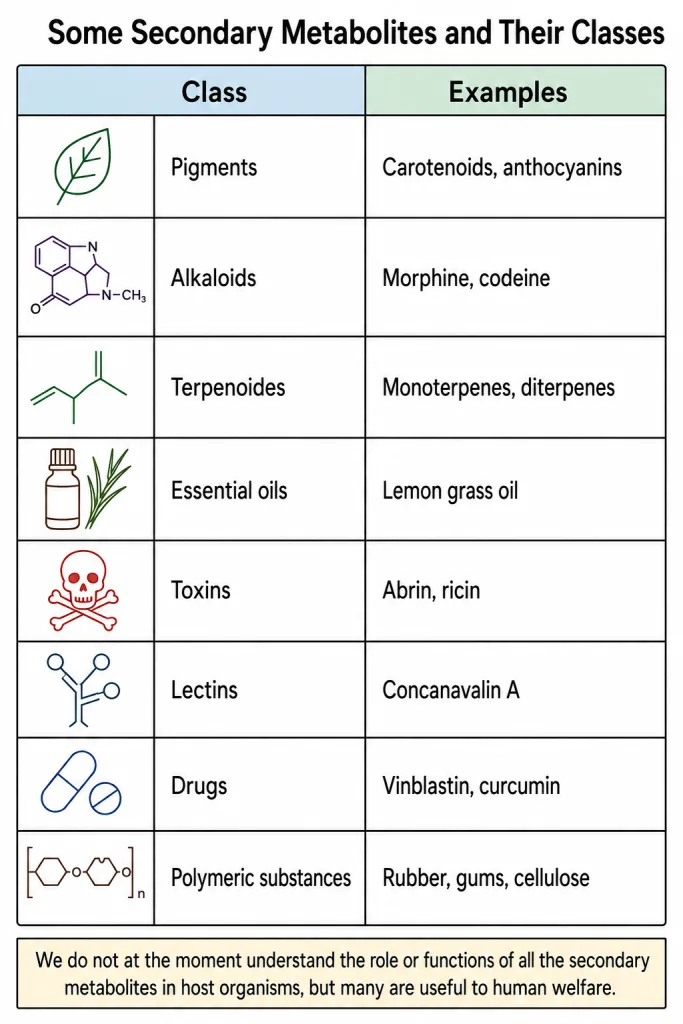
Some secondary metabolites, class by class:
| Class | Examples |
|---|---|
| Pigments | Carotenoids, anthocyanins |
| Alkaloids | Morphine, codeine |
| Terpenoides | Monoterpenes, diterpenes |
| Essential oils | Lemon grass oil |
| Toxins | Abrin, ricin |
| Lectins | Concanavalin A |
| Drugs | Vinblastin, curcumin |
| Polymeric substances | Rubber, gums, cellulose |
The honest position on their function. While primary metabolites have identifiable functions and play known roles in normal physiological processes, we do not at the moment understand the role or functions of all the secondary metabolites in host organisms.
However, many of them are useful to human welfare - rubber, drugs, spices, scents and pigments. Some secondary metabolites have ecological importance.
[NEET Important] Two things get asked from this block. One is a straight match from the table - pick the class that morphine, or abrin, or concanavalin A belongs to. The other is the function statement, and the trap there is an option claiming that the roles of secondary metabolites are fully known. They are not - we do not at the moment understand the role or functions of all of them in host organisms, even though many of them are useful to human welfare.
Quick Recap
- The most exciting aspect of chemistry deals with isolating thousands of compounds, small and big, from living organisms, determining their structure and if possible synthesising them.
- A list of biomolecules would run to thousands of organic compounds including amino acids and sugars; we can call these biomolecules metabolites.
- In animal tissues one notices all such categories - amino acids, sugars, fatty acids, glycerol, nucleotides, nucleosides and nitrogen bases. These are primary metabolites.
- On analysing plant, fungal and microbial cells one sees thousands of compounds other than these - alkaloids, flavonoids, rubber, essential oils, antibiotics, coloured pigments, scents, gums and spices. These are secondary metabolites.
- Pigments - carotenoids, anthocyanins. Alkaloids - morphine, codeine. Terpenoides - monoterpenes, diterpenes.
- Essential oils - lemon grass oil. Toxins - abrin, ricin. Lectins - concanavalin A.
- Drugs - vinblastin, curcumin. Polymeric substances - rubber, gums, cellulose.
- Primary metabolites have identifiable functions and play known roles in normal physiological processes.
- We do not at the moment understand the role or functions of all the secondary metabolites in host organisms.
- Many secondary metabolites are useful to human welfare - rubber, drugs, spices, scents and pigments - and some have ecological importance.
Solved Examples
Question 1
Q. What is the most exciting aspect of the chemistry of living organisms?
Answer. Isolating thousands of compounds, small and big, from living organisms, determining their structure and, if possible, synthesising them.
Question 2
Q. What are metabolites?
Answer. A list of biomolecules would have thousands of organic compounds including amino acids and sugars, and we can call these biomolecules metabolites. The word simply renames the biomolecules obtained from living tissue.
Question 3
Q. What are primary metabolites? Give examples.
Answer. The categories of compounds one notices in animal tissues are primary metabolites. These are amino acids, sugars, fatty acids, glycerol, nucleotides, nucleosides and nitrogen bases. They have identifiable functions and play known roles in normal physiological processes.
Question 4
Q. What are secondary metabolites? Give examples.
Answer. On analysing plant, fungal and microbial cells one sees thousands of compounds other than the primary metabolites, and these are called secondary metabolites. Examples are alkaloids, flavonoids, rubber, essential oils, antibiotics, coloured pigments, scents, gums and spices.
Question 5
Q. In which cells do you find secondary metabolites in large numbers?
Answer. In plant, fungal and microbial cells. In animal tissues one notices the primary metabolites.
Question 6
Q. Distinguish between primary and secondary metabolites in terms of their function.
Answer. Primary metabolites have identifiable functions and play known roles in normal physiological processes. For secondary metabolites, we do not at the moment understand the role or functions of all of them in host organisms, though many are useful to human welfare and some have ecological importance.
Question 7
Q. Give one example each of a pigment, an alkaloid and a terpenoide.
Answer. Pigments - carotenoids and anthocyanins. Alkaloids - morphine and codeine. Terpenoides - monoterpenes and diterpenes.
Question 8
Q. Name two toxins and one lectin listed among the secondary metabolites.
Answer. The toxins are abrin and ricin. The lectin is concanavalin A.
Question 9
Q. Which drugs are listed among the secondary metabolites, and which essential oil?
Answer. The drugs are vinblastin and curcumin. The essential oil is lemon grass oil.
Question 10
Q. Which polymeric substances are listed as secondary metabolites?
Answer. Rubber, gums and cellulose.
Question 11
Q. What are gums made of? Is Fevicol different? This is one of the chapter-end exercises.
Answer. Gums are complex polysaccharides.
- They are long chains of sugar units - that is, polymers whose building blocks are monosaccharides - and they are secreted by plants, often from a cut or an injured surface of the bark.
- Because of this, gums are listed among the secondary metabolites, under polymeric substances, alongside rubber and cellulose. Like the other secondary metabolites, they are found in plant cells and are useful to human welfare even though their role in the host plant is not fully understood.
Yes, Fevicol is different. Fevicol is a synthetic adhesive, a man made polymer manufactured in a factory - it is not a plant polysaccharide and it is not a secondary metabolite of any organism.
So the two differ in origin and in chemistry:
| Point | Plant gum | Fevicol |
|---|---|---|
| Where it comes from | Secreted by a plant | Made synthetically by people |
| What it is chemically | A complex polysaccharide, a polymer of sugar units | A synthetic polymer, not a polysaccharide |
| How it is classed | A secondary metabolite, a polymeric substance | Not a metabolite at all |
What they share is only the property of being sticky polymers. Being a polymer and being an adhesive does not make two substances the same compound.
Question 12
Q. Of what use to us are secondary metabolites?
Answer. Many of them are useful to human welfare - rubber, drugs, spices, scents and pigments. Some secondary metabolites also have ecological importance.
Question 13
Q. Rubber appears in the list of secondary metabolites. Under which class, and with what other examples?
Answer. Under polymeric substances, along with gums and cellulose.