
Long Chains of Sugars
The acid insoluble pellet also has polysaccharides (carbohydrates) as another class of macromolecules. So the pellet you strained out earlier is not only protein - it holds sugar chains too.
Polysaccharides are long chains of sugars. They are threads - literally like a cotton thread - containing different monosaccharides as building blocks.
Take the four named examples:
| Polysaccharide | What it is |
|---|---|
| Cellulose | A polymeric polysaccharide consisting of only one type of monosaccharide, glucose - hence a homopolymer |
| Starch | A variant of this, present as a store house of energy in plant tissues |
| Glycogen | The variant animals have |
| Inulin | A polymer of fructose |
[NEET Important] Two pairings are asked over and over. Starch - the store house of energy in plant tissues. Glycogen - the animal variant. And keep inulin apart from the other three: it is a polymer of fructose, not of glucose. Cellulose is the standard example of a homopolymer, which is exactly why a protein is contrasted with it as a heteropolymer.
Reading a Polysaccharide Chain
A polysaccharide is not a symmetrical object - the two ends of the chain are named differently.
In a polysaccharide chain, say glycogen, the right end is called the reducing end and the left end is called the non-reducing end. It has branches, as the cartoon of glycogen shows.
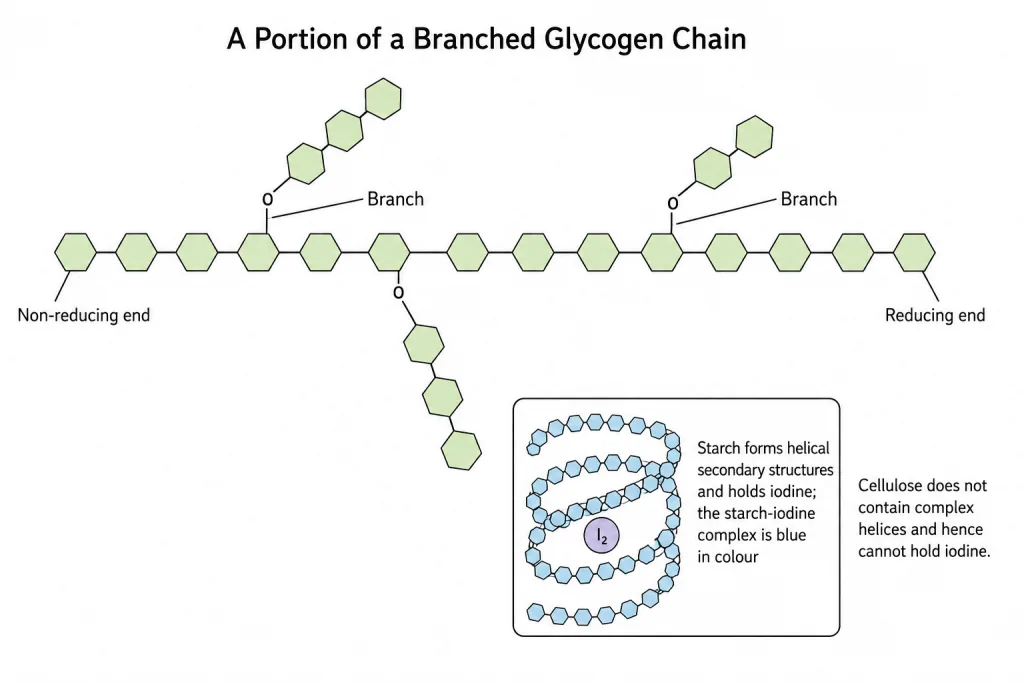
[NEET Important] This is a pure memory item and the two words are easy to swap under time pressure. Right end - reducing end. Left end - non-reducing end. The diagram of glycogen is the one used, and the other detail it shows is that the chain is branched.
Starch, Iodine and Cellulose
Starch forms helical secondary structures. That coil is not just a shape - it is a pocket.
- Starch can hold molecules in the helical portion.
- The starch- complex is blue in colour.
- Cellulose does not contain complex helices and hence cannot hold .
That is the whole chemistry behind the iodine test you have done in the laboratory: the blue colour means starch, because only starch has helices to trap the iodine in.
Cellulose has its own everyday importance:
- Plant cell walls are made of cellulose.
- Paper made from plant pulp is cellulosic.
- Cotton fibre is cellulosic.
[NEET Important] Do not answer "starch reacts with iodine" - it does not react, it holds molecules in the helical portion, and the starch- complex is blue. The reason cellulose fails the test is stated just as precisely: cellulose does not contain complex helices and hence cannot hold .
The More Complex Polysaccharides
There are more complex polysaccharides in nature. They are built from sugars that have been altered:
- They have as building blocks amino-sugars and chemically modified sugars - for example glucosamine and N-acetyl galactosamine.
- Exoskeletons of arthropods have a complex polysaccharide called chitin.
- These complex polysaccharides are mostly homopolymers.
[NEET Important] Chitin - the exoskeleton of arthropods is the pairing that gets asked, and the follow-up is the one students get wrong: the complex polysaccharides are mostly homopolymers, not heteropolymers, even though their building blocks are modified sugars. Also learn the two named building blocks by name - glucosamine and N-acetyl galactosamine.
Quick Recap
- The acid insoluble pellet also has polysaccharides (carbohydrates) as another class of macromolecules.
- Polysaccharides are long chains of sugars - threads containing different monosaccharides as building blocks.
- Cellulose is a polymeric polysaccharide consisting of only one type of monosaccharide, glucose, so cellulose is a homopolymer.
- Starch is a variant of this, present as a store house of energy in plant tissues.
- Animals have another variant called glycogen.
- Inulin is a polymer of fructose.
- In a polysaccharide chain such as glycogen, the right end is the reducing end and the left end is the non-reducing end, and it has branches.
- Starch forms helical secondary structures and can hold molecules in the helical portion; the starch- complex is blue in colour.
- Cellulose does not contain complex helices and hence cannot hold .
- Plant cell walls are made of cellulose, and paper made from plant pulp and cotton fibre are cellulosic.
- More complex polysaccharides have as building blocks amino-sugars and chemically modified sugars such as glucosamine and N-acetyl galactosamine.
- Exoskeletons of arthropods have a complex polysaccharide called chitin.
- These complex polysaccharides are mostly homopolymers.
Solved Examples
Question 1
Q. In which fraction of a ground tissue are polysaccharides found?
Answer. In the acid insoluble pellet. The acid insoluble pellet also has polysaccharides, that is carbohydrates, as another class of macromolecules.
Question 2
Q. What is a polysaccharide?
Answer. A long chain of sugars. They are threads - literally like a cotton thread - containing different monosaccharides as building blocks.
Question 3
Q. Why is cellulose called a homopolymer?
Answer. Because it is a polymeric polysaccharide consisting of only one type of monosaccharide, glucose. A homopolymer has only one type of monomer repeating along the chain, and cellulose fits that exactly.
Question 4
Q. What is starch, and what is glycogen?
Answer. Starch is a variant of cellulose that is present as a store house of energy in plant tissues. Glycogen is the variant animals have. Both are polysaccharides of glucose, used for storage rather than structure.
Question 5
Q. Inulin is a polymer of which sugar?
Answer. Fructose. This is the one named polysaccharide in the section that is not built from glucose.
Question 6
Q. Name the two ends of a polysaccharide chain such as glycogen.
Answer. The right end is called the reducing end and the left end is called the non-reducing end. The chain also has branches.
Question 7
Q. Why does starch give a blue colour with iodine while cellulose does not?
Answer. Starch forms helical secondary structures, and it can hold molecules in the helical portion. The starch- complex is blue in colour. Cellulose does not contain complex helices and hence cannot hold , so no blue colour appears.
Question 8
Q. What is the colour of the starch-iodine complex?
Answer. Blue.
Question 9
Q. What are plant cell walls made of? Name two everyday cellulosic materials.
Answer. Plant cell walls are made of cellulose. Paper made from plant pulp and cotton fibre are both cellulosic.
Question 10
Q. What are the building blocks of the more complex polysaccharides?
Answer. Amino-sugars and chemically modified sugars, for example glucosamine and N-acetyl galactosamine.
Question 11
Q. What is chitin, and where is it found?
Answer. Chitin is a complex polysaccharide. Exoskeletons of arthropods have it.
Question 12
Q. Are the complex polysaccharides homopolymers or heteropolymers?
Answer. These complex polysaccharides are mostly homopolymers. Their building blocks may be modified sugars, but the same modified sugar repeats along the chain.
Question 13
Q. Find out how much cellulose is made by all the plants in the biosphere and compare it with how much of paper is manufactured by man. This is one of the chapter-end exercises.
Answer. Cellulose is the most abundant organic polymer on Earth, because plant cell walls are made of cellulose and plants are everywhere. Working in orders of magnitude, which is all this comparison needs:
| Quantity | Approximate scale per year |
|---|---|
| Cellulose made by all plants in the biosphere | Hundreds of billions of tonnes |
| Paper manufactured by man | Hundreds of millions of tonnes |
The comparison. Hundreds of millions against hundreds of billions is a ratio of roughly one to a thousand, so paper accounts for a very small fraction of one per cent of the cellulose that plants make each year. Treat both figures as approximate orders of magnitude, not exact numbers - different surveys give different totals.
The point of the exercise. Paper is only one use of plant material. Humans also consume vegetation as food, fodder, timber, fuel and fibre such as cotton, so the total human draw on plant cellulose is far larger than the paper figure alone. The exercise is really asking you to feel the scale of plant productivity against the scale of human consumption of vegetation - plants make cellulose on a scale no factory approaches, yet human demand on that stock is large enough to matter.