
What a Lipid Is, and What a Fatty Acid Is
Lipids are generally water insoluble. That one property is why they behave differently from every other small biomolecule you have met so far.
They could be simple fatty acids. A fatty acid has a carboxyl group, , attached to an R group.
The R group could be:
- A methyl group,
- An ethyl group,
- Or a higher number of groups - from 1 carbon to 19 carbons
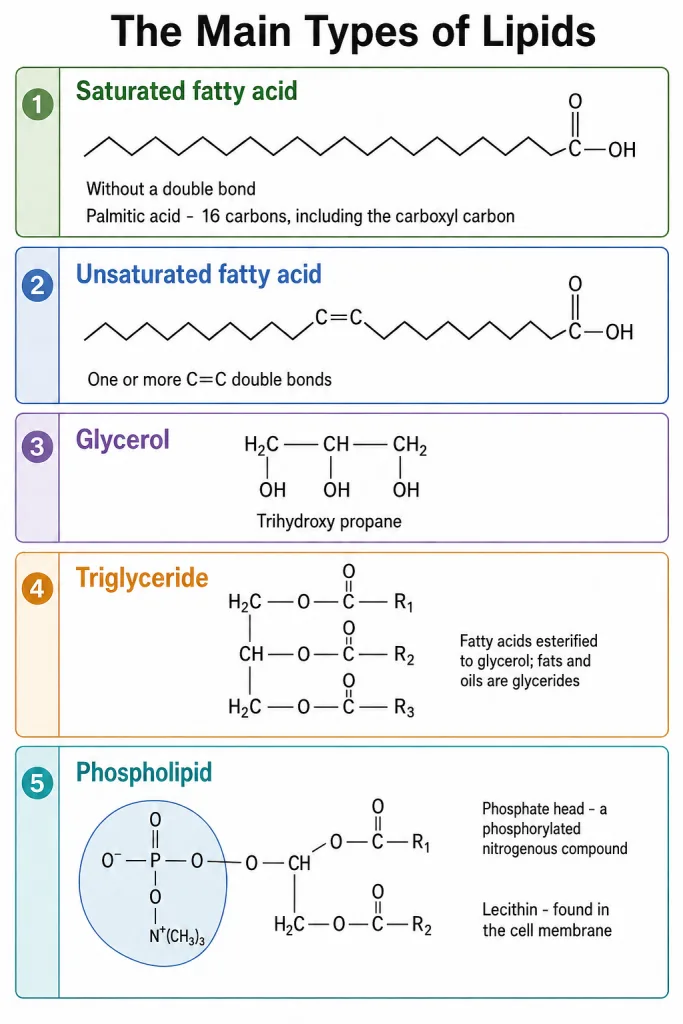
Two named examples, and the counting rule that goes with them:
| Fatty acid | Number of carbons |
|---|---|
| Palmitic acid | 16 carbons, including the carboxyl carbon |
| Arachidonic acid | 20 carbon atoms, including the carboxyl carbon |
Fatty acids could be saturated or unsaturated.
- Saturated - without a double bond.
- Unsaturated - with one or more double bonds.
[NEET Important] The counts are asked as bare numbers, and the trap is the phrase that follows them. Palmitic acid has 16 carbons and arachidonic acid has 20 carbon atoms, and in both the carboxyl carbon is counted in. A distractor will offer 15 or 19 by quietly leaving the carboxyl carbon out. Also fix the pair saturated means no double bond, unsaturated means one or more double bonds - never the reverse.
Glycerol, and the Glycerides
Another simple lipid is glycerol, which is trihydroxy propane. It is a three carbon compound carrying three hydroxyl groups, and those three positions are the whole story of this block.
Many lipids have both glycerol and fatty acids. Here the fatty acids are found esterified with glycerol. Depending on how many of the three hydroxyl groups are used up, you get:
| Product | Fatty acids esterified to glycerol |
|---|---|
| Monoglyceride | One |
| Diglyceride | Two |
| Triglyceride | Three |
These are also called fats and oils, based on melting point.
- Oils have a lower melting point - for example gingelly oil - and hence remain as oil in winters.
- Fats have the higher melting point and stay solid at the same temperature.
Carry this summary line as it is stated: fats and oils are glycerides in which fatty acids are esterified to glycerol.
[NEET Important] Fats and oils differ only in melting point - not in the elements they contain, not in molecular weight, not in the number of hydroxyl groups on glycerol. The stock item is why gingelly oil stays liquid in winter, and the answer is its lower melting point. Remember also that glycerol is trihydroxy propane - the words "trihydroxy propane" are themselves an option in many papers.
Phospholipids, and the More Complex Lipids
Some lipids have phosphorous and a phosphorylated organic compound in them. These are phospholipids.
- They are found in the cell membrane.
- Lecithin is one example.
- The summary statement puts it precisely: phospholipids contain, in addition to glycerol and fatty acids, a phosphorylated nitrogenous compound.
Some tissues, especially the neural tissues, have lipids with more complex structures.
[NEET Important] Three items travel together and are asked as one: phospholipid - has phosphorous and a phosphorylated compound - found in the cell membrane - lecithin. And keep the tissue name exact: it is the neural tissues that have lipids of more complex structure. Do not offer muscle or bone in that slot.
Quick Recap
- Lipids are generally water insoluble.
- A simple fatty acid has a carboxyl group attached to an R group.
- The R group may be a methyl , an ethyl , or a higher number of groups, from 1 carbon to 19 carbons.
- Palmitic acid has 16 carbons including the carboxyl carbon.
- Arachidonic acid has 20 carbon atoms including the carboxyl carbon.
- Fatty acids are saturated - without a double bond - or unsaturated - with one or more double bonds.
- Glycerol is another simple lipid; chemically it is trihydroxy propane.
- Many lipids have both glycerol and fatty acids, with the fatty acids esterified with glycerol.
- These give monoglycerides, diglycerides and triglycerides.
- They are called fats and oils based on melting point. Oils have a lower melting point, for example gingelly oil, and hence remain as oil in winters.
- Fats and oils are glycerides in which fatty acids are esterified to glycerol.
- Phospholipids have phosphorous and a phosphorylated organic compound in them, are found in the cell membrane, and lecithin is one example.
- Phospholipids contain, in addition, a phosphorylated nitrogenous compound.
- Some tissues, especially the neural tissues, have lipids with more complex structures.
Solved Examples
Question 1
Q. What single physical property sets lipids apart from the other small biomolecules?
Answer. Lipids are generally water insoluble. Amino acids, sugars, nucleotides and nitrogen bases all go into the water based acid soluble pool easily; lipids do not.
Question 2
Q. What is a simple fatty acid made of?
Answer. A fatty acid has a carboxyl group, , attached to an R group. Change the R group and you get a different fatty acid.
Question 3
Q. What can the R group of a fatty acid be?
Answer. It could be a methyl group , an ethyl group , or a higher number of groups, running from 1 carbon to 19 carbons.
Question 4
Q. How many carbons does palmitic acid have, and how many does arachidonic acid have?
Answer. Palmitic acid has 16 carbons, including the carboxyl carbon. Arachidonic acid has 20 carbon atoms, including the carboxyl carbon. In both cases the carboxyl carbon is counted in the total - that is the part students drop.
Question 5
Q. Distinguish between a saturated and an unsaturated fatty acid.
Answer. A saturated fatty acid is without a double bond. An unsaturated fatty acid has one or more double bonds.
Question 6
Q. What is glycerol, chemically?
Answer. Glycerol is another simple lipid, and chemically it is trihydroxy propane - a three carbon chain carrying three hydroxyl groups.
Question 7
Q. Explain the composition of triglyceride. This is one of the chapter-end exercises.
Answer. A triglyceride is made of one molecule of glycerol and three molecules of fatty acid.
- Glycerol is trihydroxy propane - a three carbon compound with three hydroxyl groups, one on each carbon.
- Each of the three hydroxyl groups is esterified with a fatty acid, so all three positions are used up. This is why the name carries the prefix "tri".
- The three fatty acids are written as , and . They may be the same or different, and each may be saturated, without a double bond, or unsaturated, with one or more double bonds.
- The bond formed at each position is an ester bond, made between the carboxyl group of the fatty acid and a hydroxyl group of glycerol.
Contrast with the smaller glycerides. A monoglyceride has only one fatty acid esterified to glycerol and a diglyceride has two, leaving the remaining hydroxyl groups free. Only the triglyceride has all three esterified.
Where triglycerides show up. Fats and oils are triglycerides, and they are told apart by melting point - oils have the lower melting point, for example gingelly oil, and hence remain as oil in winters.
Question 8
Q. What are monoglycerides and diglycerides?
Answer. They are lipids in which fatty acids are esterified with glycerol, but not at all three positions. A monoglyceride carries one fatty acid and a diglyceride carries two.
Question 9
Q. On what basis are fats told apart from oils?
Answer. On melting point. Oils have a lower melting point and fats the higher one. Nothing else in their make up differs - both are glycerides in which fatty acids are esterified to glycerol.
Question 10
Q. Why does gingelly oil remain as an oil in winters?
Answer. Because it has a lower melting point. Oils have lower melting points and hence remain as oil in winters, while a fat with a higher melting point would set solid at the same temperature.
Question 11
Q. What is a phospholipid? Where is it found, and give one example.
Answer. A phospholipid is a lipid that has phosphorous and a phosphorylated organic compound in it. They are found in the cell membrane. Lecithin is one example.
Question 12
Q. State in one line what fats and oils are, and what a phospholipid has in addition.
Answer. Fats and oils are glycerides in which fatty acids are esterified to glycerol. Phospholipids contain, in addition, a phosphorylated nitrogenous compound.
Question 13
Q. Which tissues have lipids with more complex structures?
Answer. Some tissues, especially the neural tissues, have lipids with more complex structures.