
The Molecular Weight Divide
There is one feature common to all those compounds found in the acid soluble pool: they have molecular weights ranging from 18 to around 800 daltons (Da) approximately.
The acid insoluble fraction has only four types of organic compounds:
- Proteins
- Nucleic acids
- Polysaccharides
- Lipids
These classes of compounds, with the exception of lipids, have molecular weights in the range of ten thousand daltons and above.
For this reason biomolecules are of two types:
| Type | Molecular weight | Where it is found |
|---|---|---|
| Micromolecules, or simply biomolecules | Less than one thousand dalton | The acid soluble pool |
| Macromolecules, or biomacromolecules | Ten thousand daltons and above | The acid insoluble fraction |
[NEET Important] Three numbers are asked directly and they are easy to swap. The acid soluble pool runs from 18 to around 800 Da. Micromolecules are below one thousand dalton. The macromolecular classes, lipids excepted, are ten thousand daltons and above. Note also the count - the acid insoluble fraction has only four types of organic compounds, and amino acids or nucleotides are never among them.
Why Lipids Sit in the Wrong Basket
The molecules in the insoluble fraction, with the exception of lipids, are polymeric substances. Proteins, nucleic acids and polysaccharides are all long chains built of repeating units.
Then why do lipids, whose molecular weights do not exceed 800 Da, come under the acid insoluble fraction?
The answer is not chemistry but handling.
- Lipids are indeed small molecular weight compounds.
- They are present not only as such but also arranged into structures like the cell membrane and other membranes.
- When we grind a tissue, we are disrupting the cell structure.
- Cell membrane and other membranes are broken into pieces, and form vesicles which are not water soluble.
- Therefore these membrane fragments, in the form of vesicles, get separated along with the acid insoluble pool - and hence land in the macromolecular fraction.
Lipids are not strictly macromolecules. They only travel with them.
[NEET Important] This is the single most asked reasoning item in the whole chapter. The question is why lipids appear in the macromolecular fraction, and the answer must mention membranes broken into water insoluble vesicles on grinding. The distractor says lipids are heavy polymers - they are not. Their molecular weight does not exceed 800 Da and they are not strictly macromolecules.
Putting the Two Pools Back Together
The acid soluble pool represents roughly the cytoplasmic composition. The macromolecules from cytoplasm and organelles become the acid insoluble fraction. Together they represent the entire chemical composition of living tissues or organisms.
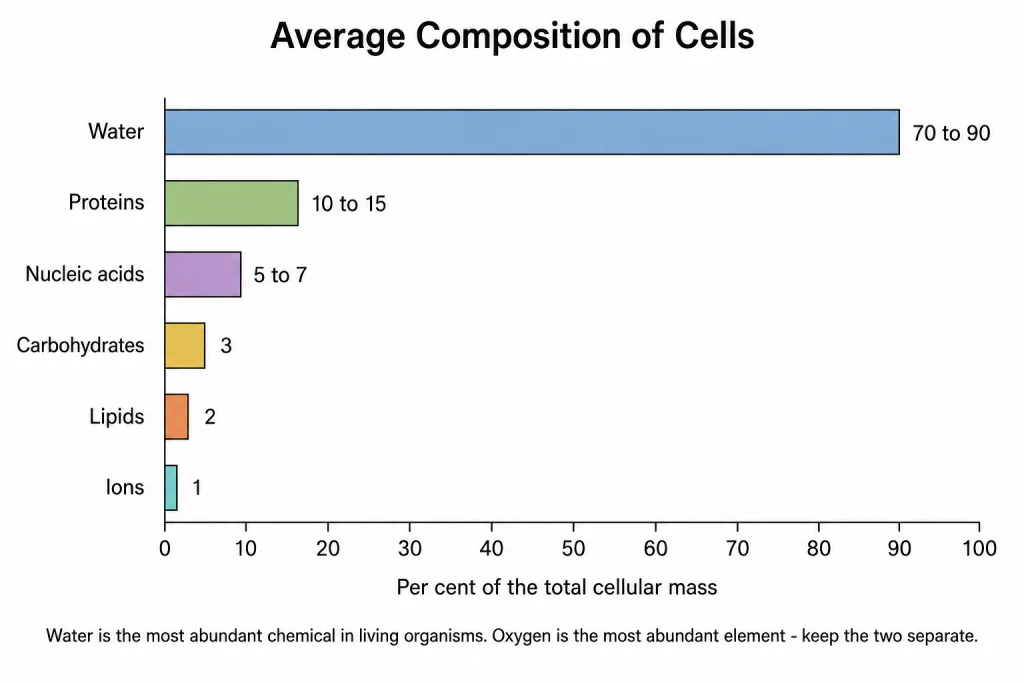
Arrange the classes by abundance and one fact stands out: water is the most abundant chemical in living organisms.
| Component | Per cent of the total cellular mass |
|---|---|
| Water | 70 to 90 |
| Proteins | 10 to 15 |
| Carbohydrates | 3 |
| Lipids | 2 |
| Nucleic acids | 5 to 7 |
| Ions | 1 |
[NEET Important] Learn this table as numbers, because the options are numbers. Water 70 to 90, proteins 10 to 15, nucleic acids 5 to 7, carbohydrates 3, lipids 2, ions 1. Two traps live here. First, water is the most abundant chemical, but oxygen is the most abundant element - keep those separate. Second, nucleic acids at 5 to 7 per cent are above carbohydrates and lipids, which surprises students who expect carbohydrates to be higher.
Quick Recap
- All compounds found in the acid soluble pool have molecular weights ranging from 18 to around 800 daltons (Da) approximately.
- The acid insoluble fraction has only four types of organic compounds - proteins, nucleic acids, polysaccharides and lipids.
- These classes, with the exception of lipids, have molecular weights in the range of ten thousand daltons and above.
- Biomolecules are therefore of two types. Those with molecular weights less than one thousand dalton are usually referred to as micromolecules or simply biomolecules.
- Those found in the acid insoluble fraction are called macromolecules or biomacromolecules.
- The molecules in the insoluble fraction, with the exception of lipids, are polymeric substances.
- Lipids are small molecular weight compounds whose molecular weights do not exceed 800 Da.
- Lipids are present not only as such but also arranged into structures like the cell membrane and other membranes.
- On grinding a tissue the cell structure is disrupted, the membranes break into pieces and form vesicles which are not water soluble.
- These membrane fragments in the form of vesicles get separated along with the acid insoluble pool, so lipids are not strictly macromolecules.
- The acid soluble pool represents roughly the cytoplasmic composition.
- The macromolecules from cytoplasm and organelles become the acid insoluble fraction.
- Together the two represent the entire chemical composition of living tissues or organisms.
- Water is the most abundant chemical in living organisms.
- Average composition of cells, as per cent of total cellular mass - water 70 to 90, proteins 10 to 15, carbohydrates 3, lipids 2, nucleic acids 5 to 7, ions 1.
Solved Examples
Question 1
Q. What is common to all the compounds found in the acid soluble pool?
Answer. They have molecular weights ranging from 18 to around 800 daltons (Da) approximately.
Question 2
Q. Which four types of organic compounds make up the acid insoluble fraction?
Answer. Proteins, nucleic acids, polysaccharides and lipids. Only these four.
Question 3
Q. What is the molecular weight range of the acid insoluble classes?
Answer. With the exception of lipids, they have molecular weights in the range of ten thousand daltons and above.
Question 4
Q. What are macromolecules? Give examples. This is one of the chapter-end exercises.
Answer. Macromolecules, also called biomacromolecules, are the biomolecules found in the acid insoluble fraction of a ground tissue.
Two ways of defining them, and both are worth writing.
- By fraction. When a tissue is ground in acid and strained, the compounds retained in the acid insoluble fraction are the macromolecules, while those in the acid soluble pool, with molecular weights less than one thousand dalton, are the micromolecules or simply biomolecules.
- By molecular weight. The macromolecular classes have molecular weights in the range of ten thousand daltons and above, against the 18 to around 800 Da of the acid soluble pool.
There are only four types of organic compounds in this fraction: proteins, nucleic acids, polysaccharides and lipids.
They are polymers. The molecules in the insoluble fraction, with the exception of lipids, are polymeric substances - long chains built by joining many small building blocks.
Examples.
| Class | Examples |
|---|---|
| Proteins | Collagen |
| Nucleic acids | DNA and RNA |
| Polysaccharides | Cellulose, starch, glycogen, inulin, chitin |
The caveat about lipids. Lipids are included in this fraction but are not strictly macromolecules. Their molecular weights do not exceed 800 Da. They separate here only because they are arranged into the cell membrane and other membranes, which on grinding break into water insoluble vesicles that come away with the acid insoluble pool.
Question 5
Q. What are micromolecules?
Answer. Biomolecules which have molecular weights less than one thousand dalton and are usually referred to as micromolecules, or simply biomolecules. They are the ones found in the acid soluble pool.
Question 6
Q. Are all the molecules of the acid insoluble fraction polymers?
Answer. No. The molecules in the insoluble fraction, with the exception of lipids, are polymeric substances. Lipids are the exception.
Question 7
Q. Why do lipids come under the acid insoluble fraction although their molecular weight does not exceed 800 Da?
Answer. Because of how they are arranged in the cell, not because of their size. Lipids are present not only as such but also arranged into structures like the cell membrane and other membranes. When we grind a tissue we disrupt the cell structure, so the cell membrane and other membranes are broken into pieces and form vesicles which are not water soluble. These membrane fragments in the form of vesicles get separated along with the acid insoluble pool, and hence appear in the macromolecular fraction.
Question 8
Q. Are lipids macromolecules?
Answer. Lipids are not strictly macromolecules. They are small molecular weight compounds that only separate along with the acid insoluble fraction because of their association with membranes.
Question 9
Q. What does the acid soluble pool represent?
Answer. The acid soluble pool represents roughly the cytoplasmic composition.
Question 10
Q. What do the two fractions together represent?
Answer. The macromolecules from cytoplasm and organelles become the acid insoluble fraction, and together with the acid soluble pool they represent the entire chemical composition of living tissues or organisms.
Question 11
Q. Which is the most abundant chemical in living organisms?
Answer. Water. If we arrange the chemical composition of living tissue class wise from an abundance point of view, water is the most abundant chemical in living organisms, at 70 to 90 per cent of the total cellular mass.
Question 12
Q. Give the average composition of a cell as per cent of total cellular mass.
Answer. Water 70 to 90. Proteins 10 to 15. Carbohydrates 3. Lipids 2. Nucleic acids 5 to 7. Ions 1.
Question 13
Q. Which is present in a higher per cent of the total cellular mass, nucleic acids or carbohydrates?
Answer. Nucleic acids. They are 5 to 7 per cent of the total cellular mass, against 3 per cent for carbohydrates and 2 per cent for lipids.