
Proteins Are Polypeptides
Proteins are polypeptides. They are linear chains of amino acids linked by peptide bonds. Nothing more complicated than that - a row of amino acids, joined one after another, in a single line.
Each protein is a polymer of amino acids. Now count the monomers available. There are 20 types of amino acids - alanine, cysteine, proline, tryptophan, lysine and so on. A chain built from a stock of twenty different building blocks cannot be made of one repeating unit, so a protein is a heteropolymer and not a homopolymer.
| Term | What it means | Example |
|---|---|---|
| Homopolymer | Only one type of monomer, repeating "n" number of times | Cellulose - only glucose |
| Heteropolymer | More than one type of monomer in the same chain | A protein - built from 20 types of amino acids |
[NEET Important] The examiner asks this as a one-line reason, so keep the reason attached to the label: a protein is a heteropolymer because there are 20 types of amino acids in it, while a homopolymer has only one type of monomer repeating "n" number of times. The standard distractor calls a protein a homopolymer, and the second-standard one swaps the two definitions.
Essential and Non-essential Amino Acids
The amino acid content of a protein matters for a reason you will meet again in nutrition: certain amino acids are essential for our health and they have to be supplied through our diet. Hence, dietary proteins are the source of essential amino acids.
So amino acids can be essential or non-essential:
| Type | Where it comes from |
|---|---|
| Non-essential amino acids | Those which our body can make |
| Essential amino acids | Those we get through our diet or food |
[NEET Important] The words mislead, and the examiner knows it. Non-essential does not mean the body does not need it - it means the body can make it. Essential means the body cannot make it, so it must come from the diet. Learn the pair as "essential = eaten", and remember the consequence: dietary proteins are the source of essential amino acids.
What Proteins Do
Proteins carry out many functions in living organisms. Some transport nutrients across the cell membrane, some fight infectious organisms, some are hormones, some are enzymes.
| Protein | Function |
|---|---|
| Collagen | Intercellular ground substance |
| Trypsin | Enzyme |
| Insulin | Hormone |
| Antibody | Fights infectious agents |
| Receptor | Sensory reception - smell, taste, hormone |
| GLUT-4 | Enables glucose transport into cells |
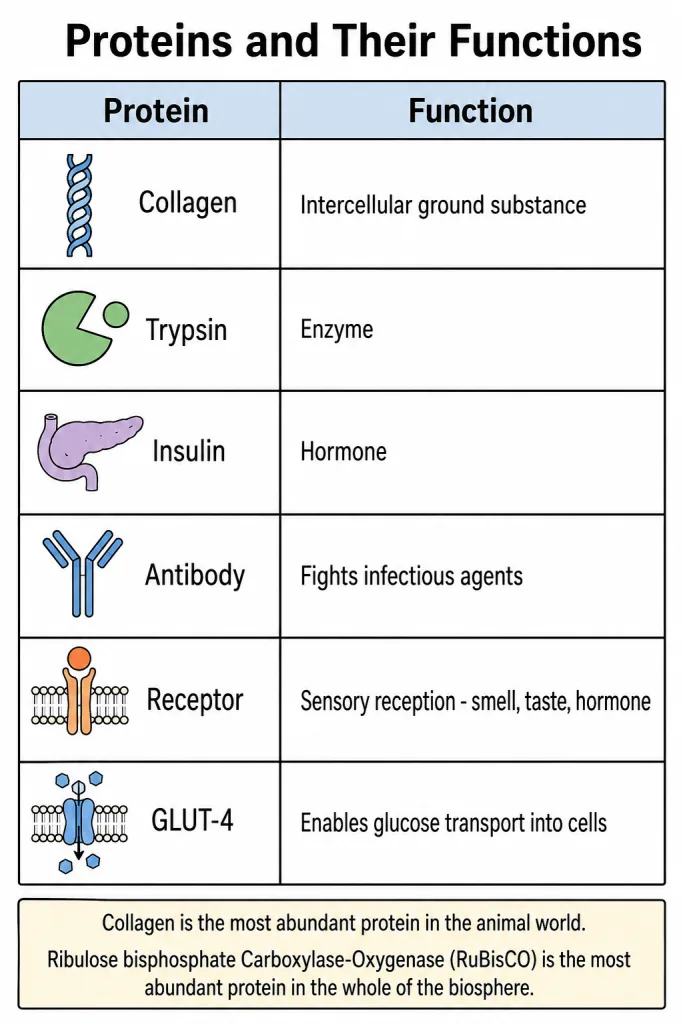
Two records close the section, and both are asked constantly:
- Collagen is the most abundant protein in the animal world.
- Ribulose bisphosphate Carboxylase-Oxygenase (RuBisCO) is the most abundant protein in the whole of the biosphere.
[NEET Important] The trap is the phrase, not the protein. Collagen - animal world. RuBisCO - the whole of the biosphere. A question that says "biosphere" and offers collagen is testing exactly this swap. Also learn GLUT-4 = glucose transport into cells and trypsin = enzyme, since those two are the least familiar rows of the table.
Quick Recap
- Proteins are polypeptides - linear chains of amino acids linked by peptide bonds.
- Each protein is a polymer of amino acids.
- There are 20 types of amino acids - alanine, cysteine, proline, tryptophan, lysine and so on.
- A protein is a heteropolymer and not a homopolymer.
- A homopolymer has only one type of monomer repeating "n" number of times.
- Amino acids can be essential or non-essential. Non-essential ones are those which our body can make; essential ones we get through our diet or food.
- Dietary proteins are the source of essential amino acids.
- Proteins carry out many functions - some transport nutrients across the cell membrane, some fight infectious organisms, some are hormones, some are enzymes.
- Collagen - intercellular ground substance. Trypsin - enzyme. Insulin - hormone. Antibody - fights infectious agents. Receptor - sensory reception of smell, taste and hormone. GLUT-4 - enables glucose transport into cells.
- Collagen is the most abundant protein in the animal world.
- Ribulose bisphosphate Carboxylase-Oxygenase (RuBisCO) is the most abundant protein in the whole of the biosphere.
Solved Examples
Question 1
Q. What are proteins, chemically?
Answer. Proteins are polypeptides. They are linear chains of amino acids linked by peptide bonds.
Question 2
Q. What kind of bond joins one amino acid to the next in a protein?
Answer. A peptide bond. The chain that results is linear, which is why a protein is called a polypeptide.
Question 3
Q. Why is a protein called a heteropolymer and not a homopolymer?
Answer. Because there are 20 types of amino acids - alanine, cysteine, proline, tryptophan, lysine and others - and a protein is a polymer of amino acids built from that stock. Since more than one type of monomer goes into the same chain, it is a heteropolymer.
Question 4
Q. What is a homopolymer?
Answer. A polymer that has only one type of monomer repeating "n" number of times.
Question 5
Q. Distinguish between essential and non-essential amino acids.
Answer. Non-essential amino acids are those which our body can make. Essential amino acids are the ones we get through our diet or food, because the body cannot make them. Note that non-essential does not mean unnecessary - the body needs both.
Question 6
Q. Why are dietary proteins important in nutrition?
Answer. Because certain amino acids are essential for our health and have to be supplied through our diet. Dietary proteins are the source of essential amino acids.
Question 7
Q. Name four kinds of work that proteins do in living organisms.
Answer. Some transport nutrients across the cell membrane, some fight infectious organisms, some are hormones and some are enzymes.
Question 8
Q. Give the function of collagen, of trypsin and of insulin.
Answer. Collagen - intercellular ground substance. Trypsin - an enzyme. Insulin - a hormone.
Question 9
Q. What does GLUT-4 do?
Answer. GLUT-4 enables glucose transport into cells. It is the example of a protein that transports a nutrient across the cell membrane.
Question 10
Q. Which protein fights infectious agents, and which one carries out sensory reception?
Answer. An antibody fights infectious agents. A receptor carries out sensory reception - smell, taste and hormone reception.
Question 11
Q. Which is the most abundant protein in the animal world?
Answer. Collagen.
Question 12
Q. Which is the most abundant protein in the whole of the biosphere? Give its full name.
Answer. Ribulose bisphosphate Carboxylase-Oxygenase, short form RuBisCO. Collagen is the most abundant protein in the animal world, but RuBisCO holds the record for the whole of the biosphere.
Question 13
Q. Find out and make a list of proteins used as therapeutic agents. Find other applications of proteins (e.g., Cosmetics etc.). This is one of the chapter-end exercises.
Answer. Proteins used as therapeutic agents - that is, proteins given to a patient as medicine:
| Protein | Therapeutic use |
|---|---|
| Insulin | A hormone, given to control blood glucose in diabetes |
| Antibodies | Fight infectious agents; given as ready-made protection against infections and toxins |
| Enzymes such as trypsin | Used as digestive aids and to clean wounds |
| Clotting factors | Given to people whose blood does not clot properly |
| Vaccines | Work through protein antigens that train the body to make antibodies |
Other applications of proteins, outside medicine:
- Cosmetics - collagen in skin preparations and keratin in hair products, both structural proteins.
- Food - gelatin, made from collagen, is used to set sweets, jellies and desserts.
- Detergents and industry - enzymes are added to washing powders to break down stains, and are used widely in the food industry.
- Fibres - silk and wool are protein fibres, used for cloth.
Being honest about the source. The chapter itself names only some of these. Insulin as a hormone, antibodies that fight infectious agents, trypsin as an enzyme, collagen as the intercellular ground substance and the most abundant protein in the animal world all come straight from Table 9.5 and the text. Keratin, gelatin, clotting factors, vaccines, detergent enzymes, silk and wool are the results of the "find out" part of the exercise - real applications, but ones you collect from outside this chapter. The pattern to notice is that every use above follows from a function the chapter already lists: hormone, enzyme, defence, or structure.