
Grinding a Tissue, and What Falls Out
To find out what a living body is made of, you do not reason - you grind.
Take any living tissue - a vegetable, a piece of liver - and grind it in trichloroacetic acid, , using a mortar and a pestle. You get a thick slurry. Strain that slurry through a cheesecloth or cotton and it splits into two fractions, and this split is the backbone of the whole chapter.
| Fraction | Other name | What it holds |
|---|---|---|
| The filtrate | Acid-soluble pool | Thousands of organic compounds - the small ones |
| The retentate | Acid-insoluble fraction | Proteins, nucleic acids, polysaccharides and lipids |
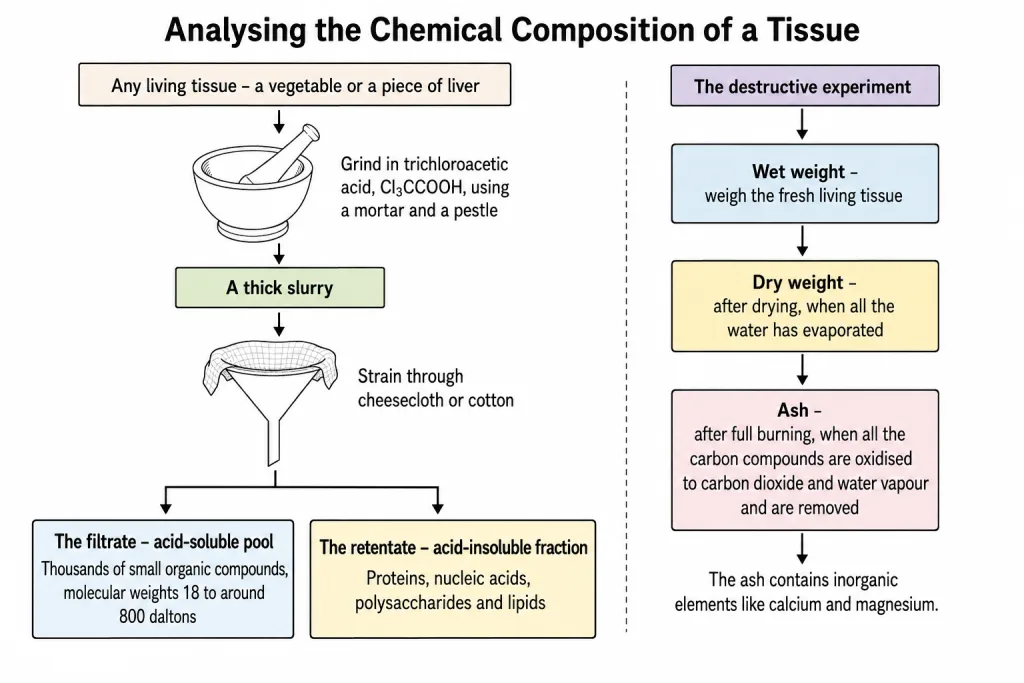
Identifying one compound. You extract the compounds, then subject the extract to various separation techniques until one compound is separated from all the others - in other words you isolate and purify it. Analytical techniques then give the molecular formula and the probable structure.
All the carbon compounds that we get from living tissues can be called biomolecules.
[NEET Important] The pairing is what gets asked, not the procedure: filtrate = acid-soluble pool = small molecules, retentate = acid-insoluble fraction = macromolecules. Every distractor in this area swaps those two words.
The Destructive Experiment - Wet Weight, Dry Weight and Ash
Living organisms also contain inorganic elements and compounds. Finding them needs a slightly different but destructive experiment.
- Weigh a small amount of living tissue - say a leaf or a liver. This is the wet weight.
- Dry it. All the water evaporates. What remains gives the dry weight.
- Burn the tissue fully. All the carbon compounds are oxidised to gaseous form - and water vapour - and are removed.
- What is left is called ash. This ash contains inorganic elements like calcium and magnesium.
Inorganic compounds like sulphate and phosphate are also seen in the acid-soluble fraction.
So the two kinds of analysis answer two different questions:
- Elemental analysis gives the elemental composition of living tissues - hydrogen, oxygen, chlorine, carbon and the rest.
- Analysis for compounds gives the kind of organic and inorganic constituents present.
Classifying what you find. From a chemistry point of view you can identify functional groups like aldehydes, ketones and aromatic compounds. From a biological point of view we classify them into amino acids, nucleotide bases, fatty acids and so on. This chapter takes the biological view throughout.
[NEET Important] Three words, three meanings, and they are asked as a set. Wet weight - before drying. Dry weight - after the water has evaporated. Ash - after full burning, holding only the inorganic elements. Note carefully that burning removes the carbon compounds; the ash is what carbon compounds are not.
What Living Matter Is Made Of
The same elements present in a sample of the earth's crust are also present in a sample of living tissue. A closer examination, though, shows that the relative abundance of carbon and hydrogen is much higher in a living organism than in the earth's crust.
| Element | Per cent weight, earth's crust | Per cent weight, human body |
|---|---|---|
| Hydrogen (H) | 0.14 | 9.5 |
| Carbon (C) | 0.03 | 18.5 |
| Oxygen (O) | 46.6 | 65.0 |
| Nitrogen (N) | very little | 3.3 |
| Sulphur (S) | 0.03 | 0.3 |
| Sodium (Na) | 2.8 | 0.2 |
| Calcium (Ca) | 3.6 | 1.5 |
| Magnesium (Mg) | 2.1 | 0.1 |
| Silicon (Si) | 27.7 | negligible |
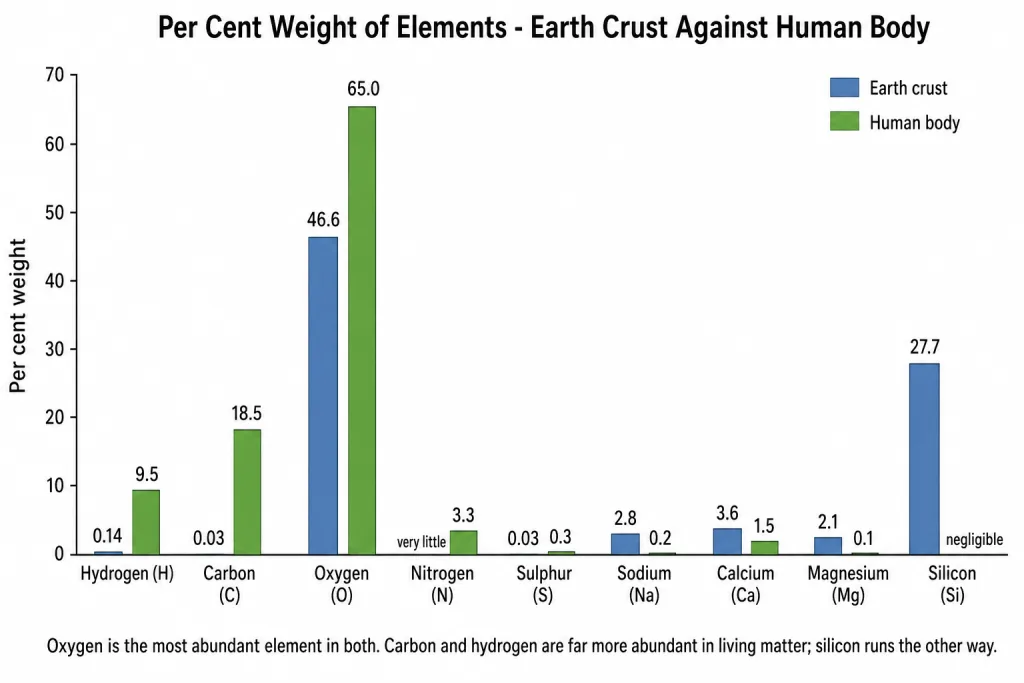
Read the table for the contrasts, not the numbers. Oxygen is the most abundant element in both columns. Carbon jumps from 0.03 to 18.5 and hydrogen from 0.14 to 9.5 - that leap is the whole point of the table. Silicon runs the other way: 27.7 per cent of the crust and negligible in the body.
The inorganic constituents themselves:
| Component | Formula |
|---|---|
| Sodium | |
| Potassium | |
| Calcium | |
| Magnesium | |
| Water | |
| Compounds | , , , |
[NEET Important] Two facts from this table are asked directly. Oxygen is the most abundant element in the human body at 65.0 per cent, and carbon and hydrogen are the elements whose relative abundance is far higher in living matter than in the crust. Do not confuse the most abundant element (oxygen) with the most abundant chemical compound in living organisms, which is water.
Quick Recap
- Grind a living tissue in trichloroacetic acid, , and strain the slurry: the filtrate is the acid-soluble pool and the retentate is the acid-insoluble fraction.
- Thousands of organic compounds are in the acid-soluble pool.
- To identify one compound you extract, separate, isolate and purify it, then use analytical techniques to get its molecular formula and probable structure.
- All the carbon compounds we get from living tissues can be called biomolecules.
- Wet weight - the fresh tissue. Dry weight - after all the water evaporates. Ash - after full burning, when all carbon compounds are oxidised to and water vapour and removed.
- Ash contains the inorganic elements such as calcium and magnesium; sulphate and phosphate also appear in the acid-soluble fraction.
- Elemental analysis gives elemental composition; analysis for compounds gives the organic and inorganic constituents.
- From a chemistry view - functional groups. From a biological view - amino acids, nucleotide bases, fatty acids.
- The same elements are present in the crust and in living tissue, but carbon and hydrogen are relatively far more abundant in living organisms.
- Oxygen is the most abundant element in the human body, 65.0 per cent; carbon 18.5; hydrogen 9.5. Silicon is 27.7 per cent of the crust and negligible in the body.
- Inorganic constituents - , , , , , and compounds such as , , and .
Solved Examples
Question 1
Q. How would you separate the small molecules of a tissue from its large ones?
Answer. Grind the tissue in trichloroacetic acid, , with a mortar and pestle to get a thick slurry, then strain it through cheesecloth or cotton. The filtrate is the acid-soluble pool, holding thousands of small organic compounds, and the retentate is the acid-insoluble fraction, holding the macromolecules.
Question 2
Q. What is another name for the filtrate, and for the retentate?
Answer. The filtrate is the acid-soluble pool. The retentate is the acid-insoluble fraction.
Question 3
Q. How is a single compound identified from a tissue extract?
Answer. You extract the compounds and put the extract through various separation techniques until one compound is separated from all the others - that is, you isolate and purify it. Analytical techniques applied to that purified compound then give its molecular formula and its probable structure.
Question 4
Q. What is a biomolecule?
Answer. All the carbon compounds that we get from living tissues can be called biomolecules.
Question 5
Q. Distinguish between wet weight, dry weight and ash.
Answer. Wet weight is the weight of the fresh living tissue. Dry weight is what is left after drying, when all the water has evaporated. Ash is what is left after the tissue is fully burnt, when all the carbon compounds are oxidised to gaseous form, and water vapour, and are removed.
Question 6
Q. What does ash contain?
Answer. Inorganic elements, such as calcium and magnesium.
Question 7
Q. Why must the experiment for inorganic constituents be a destructive one?
Answer. Because you have to drive off the water and then burn away every carbon compound to see what is left. Drying removes the water and burning oxidises all the carbon compounds to and water vapour, so only the inorganic elements remain as ash. The tissue cannot survive that.
Question 8
Q. What does elemental analysis tell you, and what does analysis for compounds tell you?
Answer. Elemental analysis gives the elemental composition of living tissues - hydrogen, oxygen, chlorine, carbon and so on. Analysis for compounds gives an idea of the kind of organic and inorganic constituents present.
Question 9
Q. How does a chemist and a biologist classify the same set of compounds differently?
Answer. From a chemistry point of view one identifies functional groups - aldehydes, ketones, aromatic compounds. From a biological point of view we classify them into amino acids, nucleotide bases, fatty acids and similar families.
Question 10
Q. Are the elements of living tissue different from those of the earth's crust?
Answer. No. All the elements present in a sample of the earth's crust are also present in a sample of living tissue. What differs is the relative abundance - carbon and hydrogen are far more abundant in a living organism than in the earth's crust.
Question 11
Q. Which element is most abundant in the human body, and what per cent is it?
Answer. Oxygen, at 65.0 per cent by weight. Carbon is 18.5 per cent and hydrogen 9.5 per cent.
Question 12
Q. Compare silicon in the earth's crust with silicon in the human body.
Answer. Silicon is 27.7 per cent of the earth's crust by weight but is negligible in the human body. It is the clearest case of an element being abundant outside living things and almost absent inside them.
Question 13
Q. Name the representative inorganic constituents of living tissue with their formulae.
Answer. Sodium , potassium , calcium , magnesium and water , along with compounds such as , , and .