
Enzymes, and the Pocket That Does the Work
Almost all enzymes are proteins. There are some nucleic acids that behave like enzymes - these are called ribozymes. So the sentence you must be able to write is not "enzymes are proteins" but "almost all enzymes are proteins".
An enzyme, like any protein, has a primary structure - the amino acid sequence of the protein. An enzyme, like any protein, also has a secondary and a tertiary structure.
When you look at a tertiary structure, the chain criss-crosses itself, and hence many crevices or pockets are made. One such pocket is the active site. An active site of an enzyme is a crevice or pocket into which the substrate fits. Thus enzymes, through their active site, catalyse reactions at a high rate.
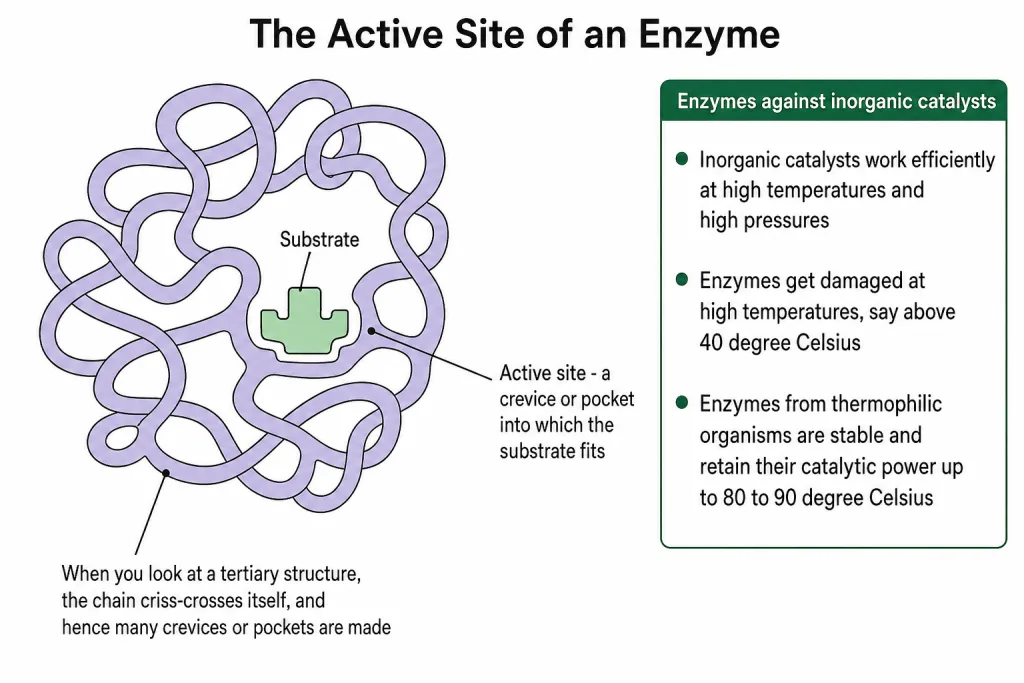
Enzyme catalysts differ from inorganic catalysts in many ways, but one major difference needs mention.
| Inorganic catalysts | Enzymes | |
|---|---|---|
| Working conditions | Work efficiently at high temperatures and high pressures | Get damaged at high temperatures, say above |
There is one exception, and it is examinable. Enzymes isolated from organisms that normally live under extremely high temperatures - for example hot vents and sulphur springs - are stable and retain their catalytic power even at high temperatures, up to to . Thermal stability is thus an important quality of such enzymes isolated from thermophilic organisms.
[NEET Important] Two traps sit in this block. First, almost all enzymes are proteins - a question that says "all enzymes are proteins" is wrong, because ribozymes are nucleic acids that behave like enzymes. Second, the temperature pair: ordinary enzymes are damaged above about , but thermophile enzymes hold up to to . Distractors swap those two numbers.
Physical Change, Chemical Reaction, and the Rate of a Reaction
Before you can say what an enzyme does, you have to be able to say what a chemical reaction is. Chemical compounds undergo two types of changes.
Physical changes - no bonds are broken:
- A physical change simply refers to a change in shape without breaking of bonds.
- Another physical process is a change in state of matter - when ice melts into water, or when water becomes a vapour. These are also physical processes.
Chemical reactions - bonds are broken and new bonds are formed:
- When bonds are broken and new bonds are formed during transformation, this will be called a chemical reaction. An inorganic example:
- Hydrolysis of starch into glucose is an organic chemical reaction.
Rate. Rate of a physical or chemical process refers to the amount of product formed per unit time. It can be expressed as:
Rate can also be called velocity if the direction is specified.
Temperature and rate. Rates of physical and chemical processes are influenced by temperature among other factors. A general rule of thumb is that rate doubles or decreases by half for every change in either direction.
[NEET Important] Learn the three definitions in the exact words the question uses: physical change - a change in shape without breaking of bonds; chemical reaction - bonds are broken and new bonds are formed; rate - the amount of product formed per unit time. The one-line add-on that gets asked on its own is rate is called velocity if the direction is specified, and the number is doubles or halves for every , not .
How Much Faster - Carbonic Anhydrase and Metabolic Pathways
Catalysed reactions proceed at rates vastly higher than that of uncatalysed ones. When enzyme catalysed reactions are observed, the rate would be vastly higher than the same but uncatalysed reaction. The standard example:
that is, carbon dioxide plus water gives carbonic acid.
| Condition | What happens |
|---|---|
| In the absence of any enzyme | The reaction is very slow - about 200 molecules of are formed in an hour |
| With carbonic anhydrase, the enzyme present within the cytoplasm | About 600,000 molecules are formed every second |
| The gain | The enzyme has accelerated the reaction rate by about 10 million times |
Metabolic pathways. There are thousands of types of enzymes, each catalysing a unique chemical or metabolic reaction. A multistep chemical reaction, when each of the steps is catalysed by the same enzyme complex or by different enzymes, is called a metabolic pathway. The example to hold on to is glucose becoming pyruvic acid:
This is actually a metabolic pathway in which glucose becomes pyruvic acid through ten different enzyme catalysed metabolic reactions.
One pathway, different end products. This very metabolic pathway, with one or two additional reactions, gives rise to a variety of metabolic end products.
| Where and under what condition | End product |
|---|---|
| Our skeletal muscle, under anaerobic conditions | Lactic acid |
| Under normal aerobic conditions | Pyruvic acid |
| In yeast, during fermentation | Ethanol (alcohol) |
Hence, in different conditions different products are possible.
[NEET Important] The carbonic anhydrase numbers are asked as bare recall, so fix all three: about 200 molecules in an hour without the enzyme, about 600,000 molecules every second with it, an acceleration of about 10 million times. The other favourite is the definition of a metabolic pathway - a multistep reaction in which each step is catalysed; glucose to pyruvic acid runs through ten enzyme catalysed reactions.
Quick Recap
- Almost all enzymes are proteins. Some nucleic acids behave like enzymes and are called ribozymes.
- An enzyme, like any protein, has a primary structure - the amino acid sequence - and also a secondary and a tertiary structure.
- In the tertiary structure the chain criss-crosses itself, so many crevices or pockets are made. One such pocket is the active site.
- An active site is a crevice or pocket into which the substrate fits. Through their active site, enzymes catalyse reactions at a high rate.
- Inorganic catalysts work efficiently at high temperatures and high pressures; enzymes get damaged at high temperatures, say above .
- Enzymes isolated from organisms living under extremely high temperatures - hot vents and sulphur springs - are stable and retain catalytic power up to to . Thermal stability is an important quality of enzymes from thermophilic organisms.
- A physical change is a change in shape without breaking of bonds. A change in state of matter - ice melting, water becoming vapour - is also a physical process.
- A chemical reaction is when bonds are broken and new bonds are formed, for example , an inorganic reaction, and hydrolysis of starch into glucose, an organic reaction.
- Rate is the amount of product formed per unit time, . Rate is called velocity if the direction is specified.
- Rate doubles or decreases by half for every change in either direction.
- Catalysed reactions proceed at rates vastly higher than uncatalysed ones.
- Without enzyme, about 200 molecules of carbonic acid form in an hour; with carbonic anhydrase, about 600,000 molecules form every second - an acceleration of about 10 million times.
- There are thousands of types of enzymes, each catalysing a unique chemical or metabolic reaction.
- A metabolic pathway is a multistep chemical reaction in which each step is catalysed by the same enzyme complex or by different enzymes.
- Glucose becomes pyruvic acid through ten different enzyme catalysed metabolic reactions.
- The same pathway with one or two extra reactions gives lactic acid in skeletal muscle under anaerobic conditions, pyruvic acid under normal aerobic conditions, and ethanol in yeast during fermentation.
Solved Examples
Question 1
Q. Are all enzymes proteins?
Answer. Almost all enzymes are proteins, but not all. There are some nucleic acids that behave like enzymes, and these are called ribozymes.
Question 2
Q. What levels of structure does an enzyme have?
Answer. The same levels any protein has. A primary structure, that is the amino acid sequence of the protein, and a secondary and a tertiary structure as well.
Question 3
Q. How is the active site of an enzyme formed, and what is it?
Answer. When you look at a tertiary structure, the chain criss-crosses itself, and hence many crevices or pockets are made. One such pocket is the active site. An active site of an enzyme is a crevice or pocket into which the substrate fits, and through their active site enzymes catalyse reactions at a high rate.
Question 4
Q. State one major difference between an inorganic catalyst and an enzyme.
Answer. Inorganic catalysts work efficiently at high temperatures and high pressures, while enzymes get damaged at high temperatures, say above .
Question 5
Q. Some enzymes still work at very high temperatures. Where do they come from?
Answer. From thermophilic organisms - organisms that normally live under extremely high temperatures, for example hot vents and sulphur springs. Enzymes isolated from them are stable and retain their catalytic power even at high temperatures, up to to . Thermal stability is an important quality of such enzymes.
Question 6
Q. Distinguish between a physical change and a chemical reaction.
Answer. A physical change simply refers to a change in shape without breaking of bonds - a change in state of matter, such as ice melting into water or water becoming a vapour, is also a physical process. A chemical reaction is when bonds are broken and new bonds are formed during transformation.
Question 7
Q. Give one inorganic and one organic example of a chemical reaction.
Answer. The inorganic one:
The organic one is the hydrolysis of starch into glucose.
Question 8
Q. How is the rate of a physical or chemical process defined, and when is it called velocity?
Answer. Rate refers to the amount of product formed per unit time, written as
Rate can also be called velocity if the direction is specified.
Question 9
Q. What is the rule of thumb linking temperature and reaction rate?
Answer. Rate doubles or decreases by half for every change in either direction. Rates of physical and chemical processes are influenced by temperature among other factors.
Question 10
Q. Use carbonic anhydrase to show how much an enzyme speeds a reaction up.
Answer. The reaction is
In the absence of any enzyme this reaction is very slow, with about 200 molecules of formed in an hour. With the enzyme carbonic anhydrase, present within the cytoplasm, about 600,000 molecules are formed every second. The enzyme has accelerated the reaction rate by about 10 million times.
Question 11
Q. What is a metabolic pathway?
Answer. A multistep chemical reaction, when each of the steps is catalysed by the same enzyme complex or by different enzymes, is called a metabolic pathway. There are thousands of types of enzymes, each catalysing a unique chemical or metabolic reaction.
Question 12
Q. Show glucose being converted to pyruvic acid, and say why it is a metabolic pathway and not a single reaction.
Answer. The overall conversion is written as
that is, glucose gives 2 pyruvic acid. It is a metabolic pathway because glucose becomes pyruvic acid through ten different enzyme catalysed metabolic reactions, not in one step.
Question 13
Q. The same pathway from glucose gives different end products. List them with their conditions.
Answer. This very metabolic pathway, with one or two additional reactions, gives rise to a variety of metabolic end products.
- In our skeletal muscle, under anaerobic conditions - lactic acid.
- Under normal aerobic conditions - pyruvic acid.
- In yeast, during fermentation - ethanol (alcohol).
Hence, in different conditions different products are possible.