
Heterocyclic Rings and the Five Nitrogen Bases
Living organisms have a number of carbon compounds in which heterocyclic rings can be found. A heterocyclic ring is simply a ring that is not built of carbon alone - here the ring carries nitrogen atoms in it.
Some of these compounds are the nitrogen bases:
- Adenine
- Guanine
- Cytosine
- Uracil
- Thymine
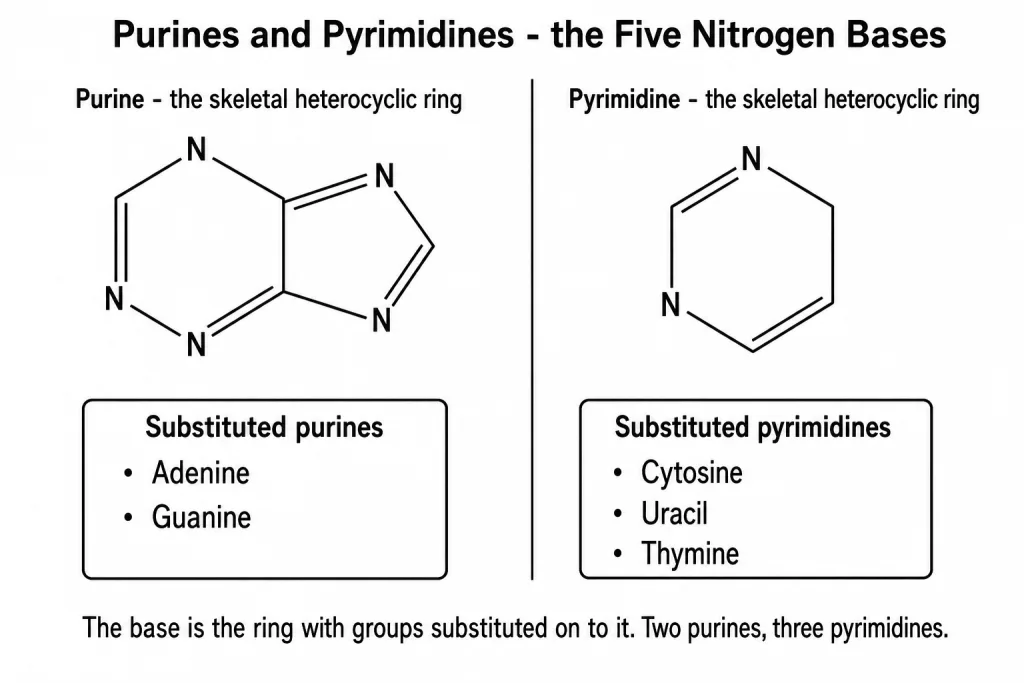
They come in two ring families, and this pairing is worth fixing now.
| Ring skeleton | The bases built on it |
|---|---|
| Purine | Adenine and guanine are substituted purines |
| Pyrimidine | Cytosine, uracil and thymine are substituted pyrimidines |
The skeletal heterocyclic ring itself is called purine and pyrimidine respectively. The base is that ring with groups substituted on to it.
[NEET Important] Two purines - adenine and guanine. Three pyrimidines - cytosine, uracil and thymine. The commonest wrong option puts thymine among the purines, or splits the pair by calling guanine a pyrimidine. Learn the two purines as a pair and everything left over is a pyrimidine.
Nucleoside and Nucleotide - One Phosphate Apart
Take a nitrogen base and add parts to it, one at a time.
- When a nitrogen base is found attached to a sugar, it is called a nucleoside.
- If a phosphate group is also found esterified to the sugar, it is called a nucleotide.
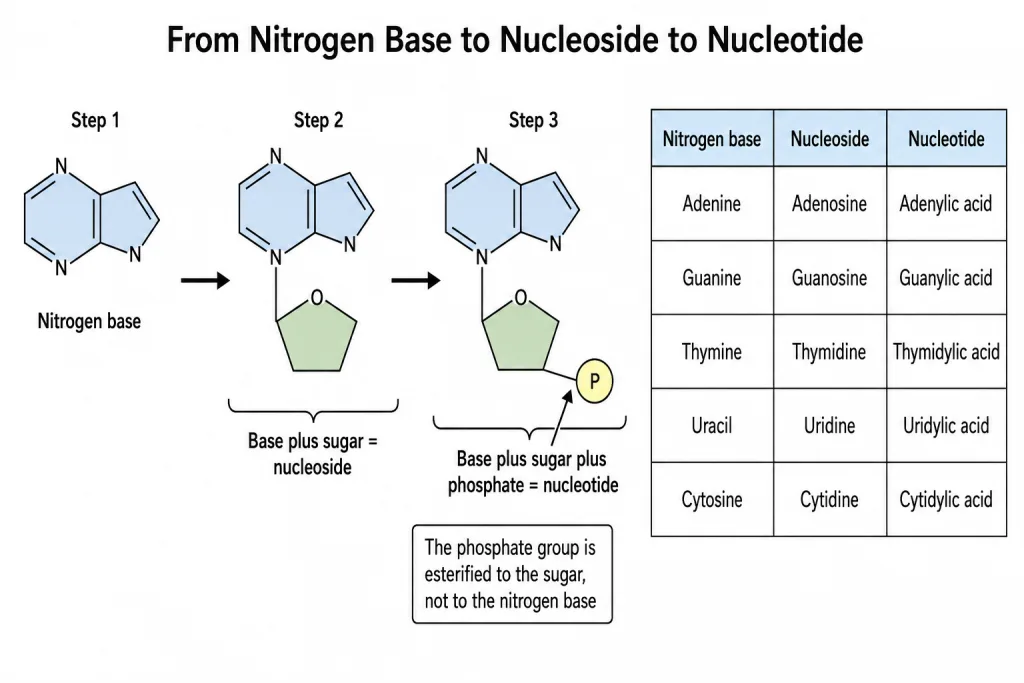
So the build up runs:
nitrogen base plus sugar nucleoside plus phosphate esterified to the sugar nucleotide
Note carefully where the phosphate goes. The phosphate group is esterified to the sugar, not to the nitrogen base.
Adenosine, guanosine, thymidine, uridine and cytidine are nucleosides. Adenylic acid, thymidylic acid, guanylic acid, uridylic acid and cytidylic acid are nucleotides.
[NEET Important] This is a one word difference that is worth a whole mark: a nucleoside is base plus sugar; a nucleotide is base plus sugar plus phosphate. Look at the ending of the name in the option - the ones ending in "-osine", "-idine" and "-idine" are nucleosides, while the ones that are an "acid" - adenylic acid and the rest - are nucleotides.
The One Table to Memorise
Read this table across, row by row. Every row is base, then its nucleoside, then its nucleotide.
| Nitrogen base | Nucleoside | Nucleotide |
|---|---|---|
| Adenine | Adenosine | Adenylic acid |
| Guanine | Guanosine | Guanylic acid |
| Cytosine | Cytidine | Cytidylic acid |
| Uracil | Uridine | Uridylic acid |
| Thymine | Thymidine | Thymidylic acid |
What these build. Nucleic acids like DNA and RNA consist of nucleotides only. DNA and RNA function as genetic material.
[NEET Important] Questions here are almost always a single cell pulled out of this table - "guanosine is the nucleoside of which base", "cytidylic acid is the nucleotide of which base". The trap is the near miss: adenosine and adenylic acid look alike and sit in the same row, but only adenylic acid carries the phosphate. Also hold the closing fact exactly - nucleic acids consist of nucleotides only, not of nucleosides.
Quick Recap
- Living organisms have a number of carbon compounds in which heterocyclic rings can be found.
- Some of these are the nitrogen bases - adenine, guanine, cytosine, uracil and thymine.
- Adenine and guanine are substituted purines; cytosine, uracil and thymine are substituted pyrimidines.
- The skeletal heterocyclic rings themselves are called purine and pyrimidine respectively.
- When a nitrogen base is found attached to a sugar, it is called a nucleoside.
- If a phosphate group is also found esterified to the sugar, it is called a nucleotide.
- The nucleosides are adenosine, guanosine, thymidine, uridine and cytidine.
- The nucleotides are adenylic acid, thymidylic acid, guanylic acid, uridylic acid and cytidylic acid.
- Base plus sugar equals nucleoside. Base plus sugar plus phosphate equals nucleotide.
- Nucleic acids like DNA and RNA consist of nucleotides only.
- DNA and RNA function as genetic material.
Solved Examples
Question 1
Q. Name the nitrogen bases found in living organisms.
Answer. Adenine, guanine, cytosine, uracil and thymine. They are carbon compounds in which heterocyclic rings can be found.
Question 2
Q. What is a nucleoside?
Answer. A nitrogen base found attached to a sugar is called a nucleoside.
Question 3
Q. What is a nucleotide?
Answer. A nucleoside in which a phosphate group is also found esterified to the sugar is called a nucleotide. So a nucleotide is a nitrogen base, a sugar and a phosphate group.
Question 4
Q. Distinguish between a nucleoside and a nucleotide.
Answer. A nucleoside is a nitrogen base attached to a sugar. A nucleotide is the same thing with a phosphate group esterified to the sugar as well. The difference is the phosphate, and note that the phosphate is esterified to the sugar, not to the base.
Question 5
Q. Name the five nucleosides.
Answer. Adenosine, guanosine, thymidine, uridine and cytidine.
Question 6
Q. Name the five nucleotides.
Answer. Adenylic acid, thymidylic acid, guanylic acid, uridylic acid and cytidylic acid.
Question 7
Q. Give the nucleoside and the nucleotide of adenine.
Answer. The nucleoside is adenosine. The nucleotide is adenylic acid.
Question 8
Q. Uridine and uridylic acid come from which nitrogen base?
Answer. From uracil. Uridine is its nucleoside and uridylic acid is its nucleotide.
Question 9
Q. Which base gives thymidine and thymidylic acid?
Answer. Thymine. Thymidine is the nucleoside and thymidylic acid is the nucleotide.
Question 10
Q. Which of the nitrogen bases are substituted purines, and which are substituted pyrimidines?
Answer. Adenine and guanine are substituted purines. Cytosine, uracil and thymine are substituted pyrimidines.
Question 11
Q. What are the skeletal heterocyclic rings of the nitrogen bases called?
Answer. Purine and pyrimidine. Adenine and guanine are built on the purine ring; cytosine, uracil and thymine are built on the pyrimidine ring.
Question 12
Q. What do nucleic acids consist of?
Answer. Nucleic acids like DNA and RNA consist of nucleotides only.
Question 13
Q. What is the function of DNA and RNA?
Answer. DNA and RNA function as genetic material.