
What "Structure" Means, and the Four Levels
Proteins are heteropolymers containing strings of amino acids. Ask what the "structure" of one is, and the answer depends on who you ask - structure of molecules means different things in different contexts.
| Who is describing it | What "structure" means to them |
|---|---|
| Inorganic chemist | The molecular formulae - , |
| Organic chemist | A two dimensional view of the molecule - benzene, naphthalene |
| Physicist | The three dimensional view of the molecular structure |
| Biologist | The protein structure at four levels |
Biologists describe the protein structure at four levels - primary, secondary, tertiary and quaternary.
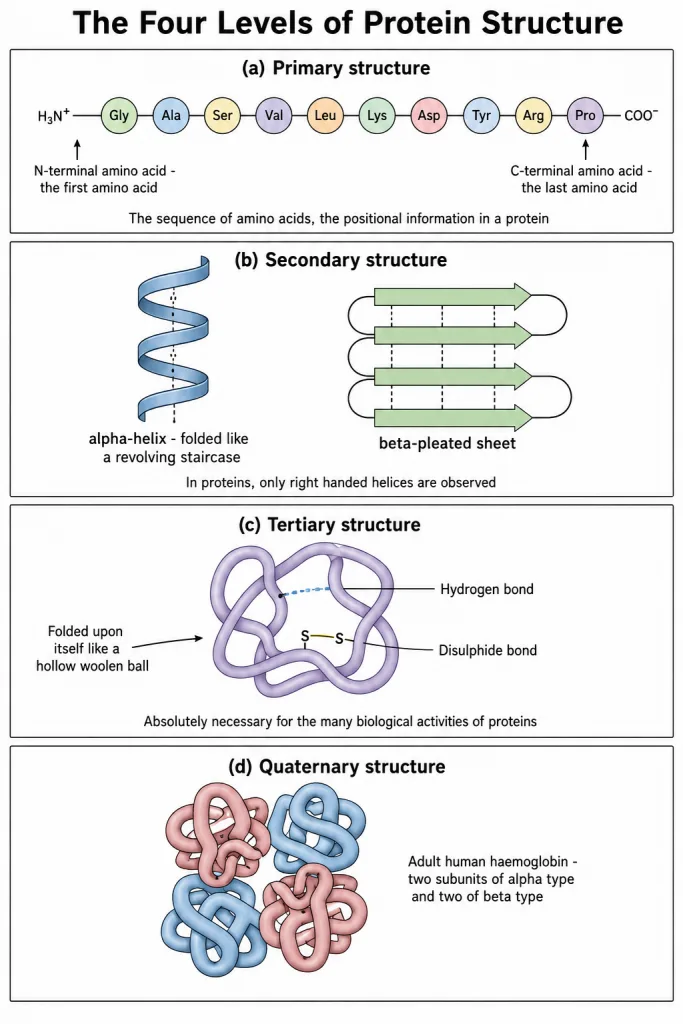
[NEET Important] The number is asked bare: biologists describe protein structure at four levels. Keep them in order - primary, secondary, tertiary, quaternary - because most questions in this area are really asking you to match a description to the right level.
Primary Structure
The sequence of amino acids, that is the positional information in a protein - which is the first amino acid, which is second, and so on - is called the primary structure of a protein.
To picture it, a protein is imagined as a line:
- The left end is represented by the first amino acid.
- The right end is represented by the last amino acid.
- The first amino acid is also called the N-terminal amino acid.
- The last amino acid is called the C-terminal amino acid.
So the primary structure carries no folding and no shape at all - only the order in which the amino acids come.
[NEET Important] The examinable phrase is positional information, and the two end names are asked as a pair. First amino acid = N-terminal. Last amino acid = C-terminal. Distractors reverse them, or attach them to the wrong level of structure.
Secondary Structure
A protein thread does not exist throughout as an extended rigid rod. It bends.
- The thread is folded in the form of a helix, similar to a revolving staircase.
- Of course, only some portions of the protein thread are arranged in the form of a helix.
- In proteins, only right handed helices are observed.
- Other regions of the protein thread are folded into other forms, and all of this together is called the secondary structure.
The two named forms shown in the figure are:
| Form | Note |
|---|---|
| -helix | The coiled form, like a revolving staircase |
| -pleated sheet | The other folded form of the secondary structure |
[NEET Important] Three exact statements from this block are lifted into stems. A protein thread does not exist throughout as an extended rigid rod. Only some portions of the thread are arranged as a helix. And the one students most often get wrong - in proteins, only right handed helices are observed, never left handed and never both.
Tertiary and Quaternary Structure
Tertiary structure. In addition, the long protein chain is also folded upon itself like a hollow woolen ball, giving rise to the tertiary structure. This gives us a three dimensional view of a protein. And it is not decoration - tertiary structure is absolutely necessary for the many biological activities of proteins.
Quaternary structure. Some proteins are an assembly of more than one polypeptide or subunits. The manner in which these individual folded polypeptides or subunits are arranged with respect to each other - for example a linear string of spheres, or spheres arranged one upon each other in the form of a cube or plate - is the architecture of a protein, otherwise called the quaternary structure of a protein.
The standard example. Adult human haemoglobin consists of 4 subunits. Two of these are identical to each other. Hence, two subunits of type and two subunits of type together constitute the human haemoglobin, .
[NEET Important] Tertiary = folded upon itself like a hollow woolen ball, giving the three dimensional view, and absolutely necessary for the many biological activities of proteins. Quaternary = the architecture, the arrangement of subunits with respect to each other, and it exists only in proteins made of more than one polypeptide. The haemoglobin numbers are asked directly: 4 subunits, two alpha and two beta.
Quick Recap
- Proteins are heteropolymers containing strings of amino acids.
- Structure of molecules means different things in different contexts - inorganic chemistry uses molecular formulae such as and , organic chemists write a two dimensional view as for benzene and naphthalene, physicists conjure up three dimensional views, and biologists describe protein structure at four levels.
- Primary structure - the sequence of amino acids, the positional information in a protein, which is the first amino acid, which is second and so on.
- A protein is imagined as a line, the left end represented by the first amino acid and the right end by the last.
- The first amino acid is the N-terminal amino acid; the last is the C-terminal amino acid.
- A protein thread does not exist throughout as an extended rigid rod.
- Secondary structure - the thread is folded in the form of a helix, similar to a revolving staircase. Only some portions of the thread are arranged as a helix, and other regions are folded into other forms.
- In proteins, only right handed helices are observed.
- The named secondary forms are the -helix and the -pleated sheet.
- Tertiary structure - the long protein chain is folded upon itself like a hollow woolen ball, which gives a three dimensional view of a protein.
- Tertiary structure is absolutely necessary for the many biological activities of proteins.
- Quaternary structure - some proteins are an assembly of more than one polypeptide or subunits, and the manner in which these folded subunits are arranged with respect to each other is the architecture of the protein.
- Examples of that arrangement: a linear string of spheres, or spheres arranged one upon each other in the form of a cube or plate.
- Adult human haemoglobin consists of 4 subunits, two of which are identical - two of type and two of type together constitute human haemoglobin, .
Solved Examples
Question 1
Q. Why are proteins called heteropolymers?
Answer. Because they are polymers containing strings of amino acids, and more than one type of amino acid goes into the same chain. A homopolymer would have only one type of monomer repeating.
Question 2
Q. What does the word "structure" mean to an inorganic chemist, an organic chemist and a physicist?
Answer. In inorganic chemistry the structure invariably refers to the molecular formulae, such as and . Organic chemists always write a two dimensional view of the molecule, as for benzene and naphthalene. Physicists conjure up the three dimensional views of molecular structures.
Question 3
Q. At how many levels do biologists describe protein structure? Name them.
Answer. Four levels - primary, secondary, tertiary and quaternary.
Question 4
Q. What is the primary structure of a protein?
Answer. The sequence of amino acids, that is the positional information in a protein - which is the first amino acid, which is second, and so on.
Question 5
Q. How is a protein imagined when we talk about its primary structure?
Answer. As a line, with the left end represented by the first amino acid and the right end represented by the last amino acid.
Question 6
Q. What are the N-terminal and C-terminal amino acids?
Answer. The first amino acid of a protein is called the N-terminal amino acid. The last amino acid is called the C-terminal amino acid.
Question 7
Q. What is the secondary structure of a protein?
Answer. A protein thread does not exist throughout as an extended rigid rod. The thread is folded in the form of a helix, similar to a revolving staircase, and other regions of the thread are folded into other forms. That folding is the secondary structure. Note that only some portions of the protein thread are arranged in the form of a helix.
Question 8
Q. Which kind of helices are observed in proteins?
Answer. Only right handed helices are observed in proteins.
Question 9
Q. Name the two forms of secondary structure shown for proteins.
Answer. The -helix and the -pleated sheet.
Question 10
Q. What is meant by tertiary structure of proteins? This is one of the chapter-end exercises.
Answer. The long protein chain is folded upon itself like a hollow woolen ball, and this folding is called the tertiary structure of a protein.
Take it step by step:
- The primary structure is only the sequence of amino acids, imagined as a line.
- In the secondary structure, the thread is folded in the form of a helix, like a revolving staircase, with other regions folded into other forms.
- In addition, the long protein chain is also folded upon itself like a hollow woolen ball, and that is the tertiary structure.
Why it matters. This gives us a three dimensional view of a protein. Tertiary structure is absolutely necessary for the many biological activities of proteins - an unfolded chain with the right sequence still does no biological work. The shape is what lets a protein act as an enzyme, a hormone, a receptor or a transporter.
Do not confuse it with the quaternary structure, which appears only when a protein is an assembly of more than one polypeptide or subunit and describes how those folded subunits are arranged with respect to each other.
Question 11
Q. Why is the tertiary structure so important?
Answer. Because it is absolutely necessary for the many biological activities of proteins. It also gives us the three dimensional view of a protein.
Question 12
Q. What is the quaternary structure of a protein?
Answer. Some proteins are an assembly of more than one polypeptide or subunits. The manner in which these individual folded polypeptides or subunits are arranged with respect to each other - for example a linear string of spheres, or spheres arranged one upon each other in the form of a cube or plate - is the architecture of a protein, otherwise called the quaternary structure.
Question 13
Q. Describe the quaternary structure of adult human haemoglobin.
Answer. Adult human haemoglobin consists of 4 subunits. Two of these are identical to each other. Two subunits of type and two subunits of type together constitute the human haemoglobin, .
Question 14
Q. Put the four levels of protein structure in order and say in one line what each describes.
Answer. Primary - the sequence of amino acids, the positional information. Secondary - the thread folded in the form of a helix, with other regions folded into other forms. Tertiary - the long chain folded upon itself like a hollow woolen ball, giving the three dimensional view. Quaternary - the arrangement of the individual folded subunits with respect to each other, the architecture of the protein.