
Where Comes From
You have been writing m/s since Chapter 2 and using it in every projectile problem since. Nobody ever told you where the number came from. Time to fix that, because it takes about three lines.
Two ways of writing the same force
Take a body of mass resting on the Earth's surface, or falling freely near it. There are two completely separate ways to describe the force on it.
Way one, from mechanics. The body is accelerating downwards at , so by Newton's second law the force on it must be
Way two, from gravitation. The Earth pulls it. The Earth is a sphere, and Section 2's first shell theorem says a spherically symmetric body attracts an outside particle exactly as though its whole mass sat at the centre. The body is on the surface, so its distance from that centre is :
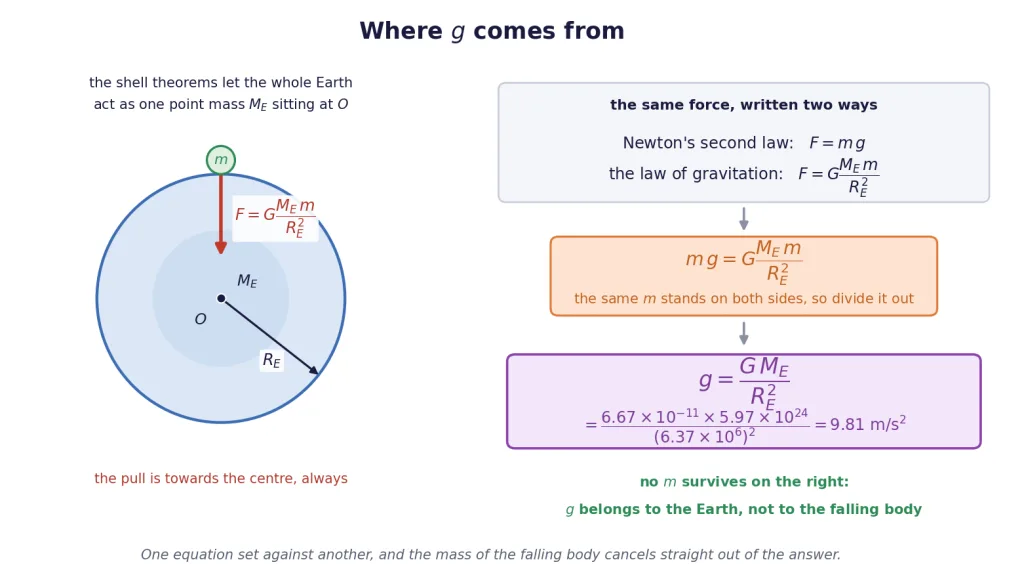
These are two descriptions of one force, so set them equal:
And now the moment that matters. The same stands on both sides. Divide it out.
Key Point — acceleration due to gravity at the Earth's surface: is built entirely out of properties of the Earth — its mass and its radius — together with the universal constant . The falling body contributes nothing at all.
Does the number come out right?
Put in N m/kg, kg and m:
That is the measured value, to three figures. A law written down for planets, and a constant measured on a laboratory bench, together predict how fast a dropped coin speeds up in your room.
Two readings of the same symbol
has units of m/s when you think of it as an acceleration. Rearrange into and the units read N/kg — force per unit mass. Both are correct and they are numerically identical, because 1 N/kg is 1 m/s.
- As an acceleration, tells you how fast a freely falling body speeds up.
- As a force per unit mass, is the strength of the Earth's gravitational field at the surface, and it is a vector, , always pointing towards the centre of the Earth.
[Board Important] "Define acceleration due to gravity and derive " is a standard two-or-three-mark question, and the derivation above is the whole answer. Do not skip the sentence about the shell theorem — that is what licenses the use of as the distance.
A useful second form
Suppose the Earth had uniform density . Then , and substituting:
Key Point: for a uniform sphere of density and radius . So among planets of the same density, is simply proportional to the radius — a bigger planet of the same stuff has stronger surface gravity.
Two forms, two uses. Use when you are given mass and radius; use when you are given density and radius. [JEE Tip] Spotting which of the two a question has handed you saves a minute every time.
This section is about at the surface. It is not really a constant — it changes with height, with depth, with where you stand on the globe. All of that is Section 4's business, and it is developed there in full.
The Consequence That Startled Everybody
Look again at what came out of the algebra:
There is no on the right-hand side. None. A grain of rice and a grand piano, released together in a vacuum, accelerate at exactly the same rate.
That sounds obvious to you because you were taught it in school. It was not obvious for two thousand years. Aristotle taught, and everybody believed, that heavier bodies fall faster. And in ordinary air they usually do — which is precisely why the truth took so long to find.
Why the cancellation happens
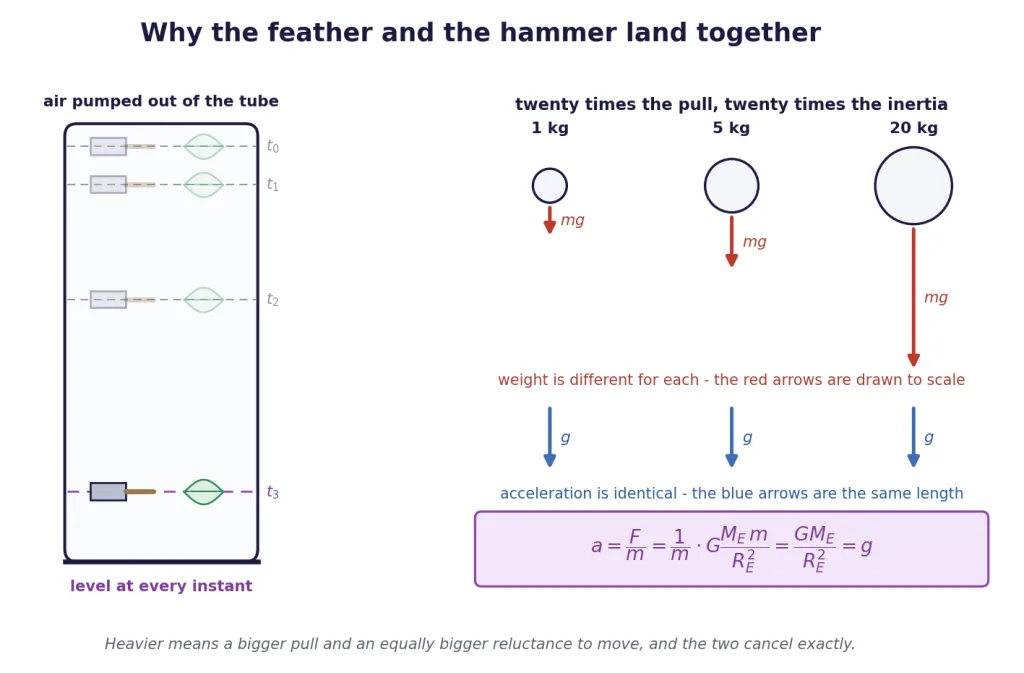
Here is the thing. A body twenty times as massive is pulled twenty times as hard — that is the in . But it is also twenty times as reluctant to accelerate — that is the in . The advantage and the handicap are the same number, so they cancel exactly:
Key Point: In free fall, and in the absence of air, every body has the same acceleration , independent of its mass, its size, its shape and what it is made of. The reason is that the mass appears twice and cancels.
The feather and the hammer
Drop a feather and a hammer in a room and the hammer wins easily. That is not gravity, it is air resistance: the drag force on the feather is comparable with its tiny weight, while on the hammer it is negligible. Pump the air out of a tall glass tube, drop them together, and they stay level all the way down and land at the same instant.
The most famous version of this demonstration was done on the Moon in 1971, where the astronaut David Scott dropped a geological hammer and a falcon feather in front of a television camera. There is no air on the Moon at all. They landed together.
[NEET Important] The standard exam sentence is: in vacuum, all bodies fall with the same acceleration, because is independent of the mass of the falling body. Do not write "because they have the same weight" — they do not.
Two consequences worth carrying around
A body's weight is not a property of the body alone. Weight is : the mass belongs to the body, but belongs to the planet. Carry a 2 kg brick to the Moon and it is still 2 kg of brick, but it weighs about one sixth as much. Mass is invariant; weight is local.
The Earth accelerates too. Newton's third law is not suspended here — the apple pulls the Earth just as hard as the Earth pulls the apple. But the Earth's acceleration is , and with kg that is a number like m/s. The pull is equal; the response is not, because the inertias are wildly different.
[JEE Tip] A favourite trap: "two bodies of masses and are dropped from the same height in vacuum — which lands first?" They land together. The extra pull on buys it nothing.
Weighing the Earth
Now run the formula backwards, and watch something quietly spectacular happen.
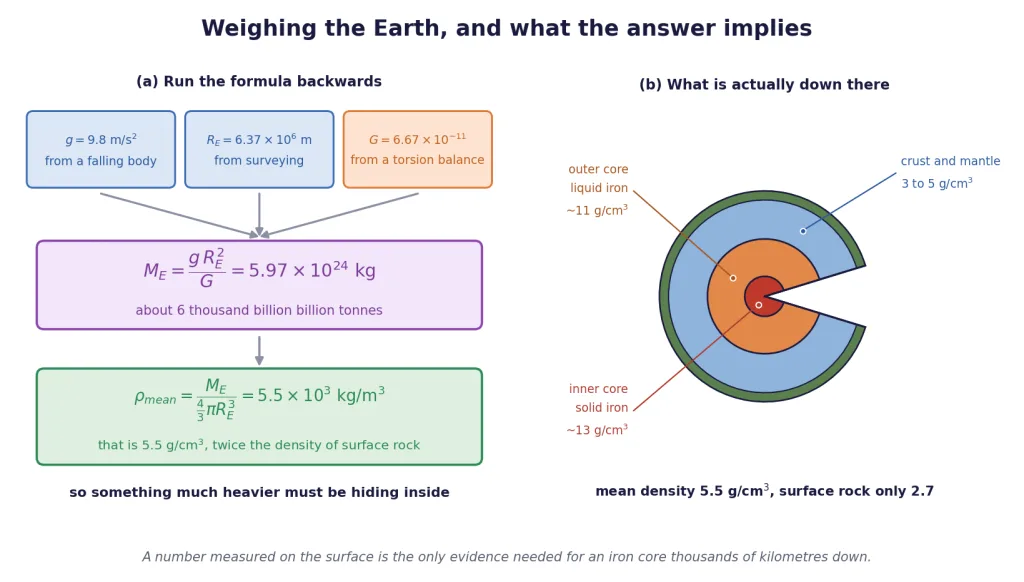
We have . Three of these four quantities can be measured directly:
- — drop something and time it, or time a pendulum. Easy, and known accurately since the 1600s.
- — surveying and astronomy. Known since Eratosthenes, roughly, and known well since the 1700s.
- — Cavendish's torsion balance, described in Section 2.
So solve for the fourth:
Key Point:
Nobody can put the Earth on a balance. But this equation weighs it anyway, using nothing but a falling stone, a map and a laboratory experiment with two lead spheres.
The number
About kg, or six thousand billion billion tonnes. This is why people say "Cavendish weighed the Earth" — strictly he measured , but was the only missing link in this chain, so measuring it amounted to weighing the planet.
From mass to density, and from density to a discovery
Divide the mass by the volume:
That is 5.5 g/cm — five and a half times the density of water.
Now go outside and pick up a rock. Granite is about 2.7 g/cm; basalt about 3.0. The rocks you can actually reach are only half as dense as the planet's average.
Key Point: The Earth's mean density, about 5.5 g/cm, is roughly twice the density of surface rock. Since the average must lie between the extremes, some large part of the interior has to be much denser than 5.5 — and that is direct evidence, from a surface measurement alone, for a dense metallic core.
And so it is. The Earth has an iron-nickel core, liquid on the outside and solid at the centre, running from roughly 10 to 13 g/cm. Seismology later mapped it in detail, but the first hint came from a falling stone, a radius and a torsion balance.
[Board Important] "The mean density of the Earth is greater than the density of its surface rocks — what does this suggest?" is a classic one-mark reasoning question. The answer is: a denser interior, that is, a heavy core.
The same trick works on any planet
If you can measure a planet's radius (from its angular size and distance) and watch anything orbit it, you can extract or and then its mass and mean density. Mean density is how we know Jupiter is mostly gas: it comes out at about 1.24 g/cm, barely denser than water, whereas the rocky planets all come out between 3.9 and 5.5.
on the Moon, and on Other Worlds
was never really about the Earth. Drop the subscripts and it gives the surface gravity of any spherical body, given its mass and radius.
The Moon
Compare with 9.8 on Earth:
which is where the familiar statement "gravity on the Moon is about one sixth of Earth's" comes from. A 60 kg astronaut has a weight of 588 N on Earth and about 97 N on the Moon — but is still 60 kg of astronaut. That is why Apollo crews could bounce around in suits that weighed more than they did.
A short reference table
Every value below was computed from with N m/kg, and each mean density from .
| Body | Mass (kg) | Radius (m) | (m/s) | Mean density (g/cm) | |
|---|---|---|---|---|---|
| Sun | 274 | 27.9 | 1.41 | ||
| Mercury | 3.70 | 0.377 | 5.42 | ||
| Venus | 8.87 | 0.904 | 5.25 | ||
| Earth | 9.81 | 1.00 | 5.51 | ||
| Moon | 1.62 | 0.165 | 3.33 | ||
| Mars | 3.73 | 0.380 | 3.93 | ||
| Jupiter | 24.8 | 2.52 | 1.24 | ||
| Saturn | 10.4 | 1.06 | 0.62 |
Three things to notice in that table
Size alone tells you nothing. Mercury and Mars have almost identical surface gravity, 3.70 and 3.73, even though Mars has nearly twice Mercury's radius and twice its mass. It is the ratio that matters, and the two ratios happen to land in the same place.
Saturn is barely stronger than Earth, despite being ninety-five times as massive, because it is also nine and a half times as wide, and the radius is squared.
Density sorts the solar system into two families. Mercury, Venus, Earth and Mars all come out between 3.9 and 5.5 g/cm — rock and metal. Jupiter and Saturn come out at 1.24 and 0.62 — Saturn is less dense than water. They are not the same kind of object at all.
The ratio method, which is faster than substituting
Comparison questions almost never need . Write
and the constant vanishes. [JEE Tip] If a problem says "a planet has twice the radius and thrice the mass of the Earth", it is a ratio question and will never appear in your working. Reaching for is a sign you have taken the long road.
Inertial Mass and Gravitational Mass
This topic sits outside the rationalised syllabus body text, but it is asked in Boards, JEE Main and NEET nearly every year, so it is developed here from first principles.
Go back to the cancellation in the last section but one, and look at it with suspicion this time.
We cancelled those two 's as if they were obviously the same quantity. They are not obviously the same quantity. They arrive from two completely unrelated corners of physics.
The two definitions
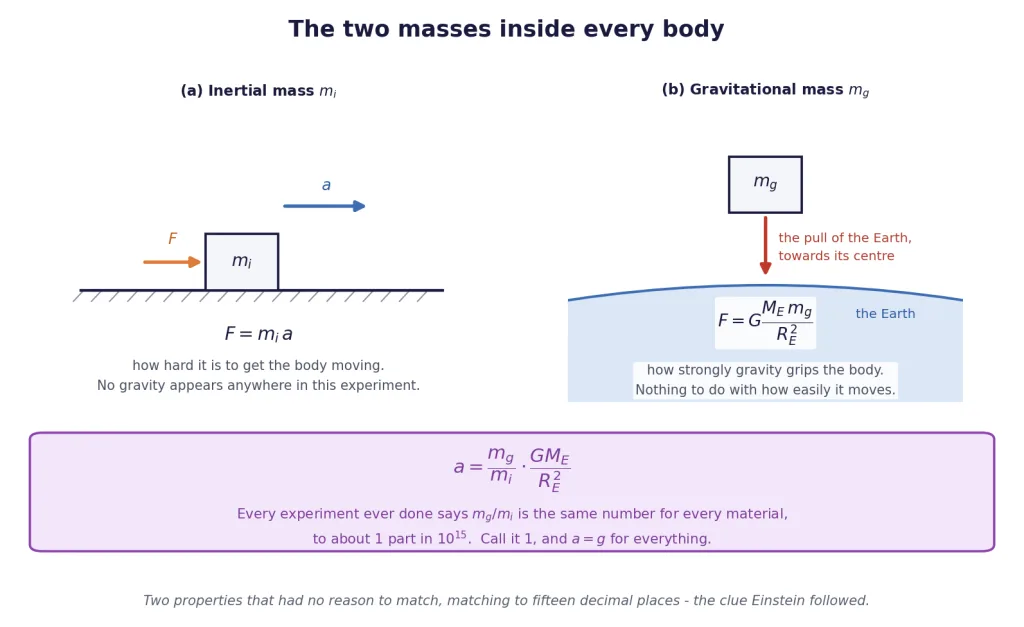
Key Point — inertial mass . Defined by Newton's second law, . It measures a body's resistance to being accelerated. You can measure it on a spacecraft, far from every star: push with a known force, measure the acceleration, divide. Gravity plays no part whatsoever.
Key Point — gravitational mass . Defined by the law of gravitation, . It measures how strongly a body participates in gravitation — it is gravity's "charge", exactly as electric charge is the charge that appears in Coulomb's law. You measure it on a balance.
These play the roles that, in electrostatics, are played by two genuinely different quantities. An electron's inertial mass and its electric charge are unrelated numbers with different units. There is no logical reason why gravitational "charge" should be tied to inertia at all.
What the equality actually buys us
Redo the free-fall calculation without assuming anything:
So a body falls with acceleration only if the ratio is the same for it as for everything else. If lead had a slightly larger ratio than wood, a lead ball and a wooden ball released together would drift apart as they fell.
The experiments
- Newton, around 1680, swung pendulums with bobs of gold, silver, lead, glass, sand, salt and wheat, all of the same size. The period of a simple pendulum depends on ; he found no difference to about 1 part in .
- Eötvös, from the 1880s, hung two different materials from the ends of a horizontal bar on a torsion fibre. The Earth's rotation makes gravity and the centrifugal effect pull in slightly different directions, so a difference in would twist the fibre. No twist, to about 1 part in .
- Dicke and Braginsky, in the 1960s and 70s, used the Sun instead of the Earth as the source and pushed the limit to about 1 part in .
- A satellite experiment in Earth orbit, reporting in 2022, compared two test masses of titanium and platinum in continuous free fall and found agreement to about 1 part in .
Key Point: Inertial mass and gravitational mass are found to be equal, to the precision of the best experiment ever performed — currently about one part in . This is why we write a single symbol for both, and why is the same for every falling body.
Why this is more than a curiosity
The equality is not explained by Newtonian mechanics. It is an experimental coincidence that Newton's theory simply has to accept.
Einstein refused to accept it. He argued that if gravitational and inertial mass are exactly equal, then no experiment done inside a sealed box can distinguish standing still in a gravitational field from accelerating in empty space — because in both cases every object in the box behaves identically, regardless of what it is made of. That statement is the principle of equivalence, and it is the seed from which the general theory of relativity grew in 1915. In that theory gravity is not a force at all but the curvature of spacetime, and the equality of the two masses stops being a coincidence and becomes a definition.
[Board Important] A very common short question: "Distinguish between inertial mass and gravitational mass." Give the two defining equations, say what each measures, note that they are experimentally equal to extremely high precision, and finish with the sentence about the equivalence principle. That is a complete four-mark answer.
[JEE Tip] A conceptual multiple-choice favourite: if were twice for a particular material, what would happen? Answer: that material would fall with acceleration , and everything else would keep falling at .
Solved Examples
Constants used throughout this section, unless a problem states otherwise: N m/kg, kg, m and m/s. The Moon is taken as kg, m.
Example 1: Predicting from scratch
Using N m/kg, kg and m, calculate the acceleration due to gravity at the Earth's surface.
Solution:
Write the result of equating the two expressions for the force.
Numerator.
Denominator.
Divide.
Final Answer: m/s.
Takeaway: Three measured numbers, none of them about falling bodies, predict how fast a body falls. That agreement is the whole case for the universal law being universal.
Example 2: Weighing the Earth, and reading its interior
Taking m/s, m and N m/kg, find (a) the mass of the Earth and (b) its mean density. (c) Surface rocks have densities near 2.7 g/cm. What does the comparison tell you?
Solution:
(a) Make the subject.
(b) Volume of the Earth.
Divide to get the mean density.
(c) Compare. The average, 5.51, is about twice the surface value of 2.7. An average cannot exceed every one of the values it averages, so material well denser than 5.51 g/cm must exist deep inside: a heavy metallic core.
Final Answer: (a) kg; (b) 5.51 g/cm; (c) the interior must contain much denser material than the crust — evidence for an iron core.
Takeaway: A single surface measurement, pushed through two divisions, is an argument about the centre of the planet. [Board Important] This exact three-part question appears in Board papers regularly.
Example 3: Same person, three worlds
A person of mass 70 kg stands on the Earth, then on the Moon, then on Mars. Taking , and m/s, find the mass and the weight in each place.
Solution:
Mass is a property of the body. It does not change: 70 kg everywhere.
Weight is , and belongs to the planet.
Sanity check on the ratio. , matching the familiar "one sixth on the Moon".
Final Answer: mass 70 kg in all three places; weights 686 N, 113 N and 261 N.
Takeaway: Mass is what you are; weight is where you are. [NEET Important] A beam balance compares masses and reads the same on the Moon; a spring balance measures weight and reads about one sixth.
Example 4: A planet of the same stuff, twice the size
A planet is made of material with the same mean density as the Earth but has twice the Earth's radius. Find its surface gravity.
Solution:
Use the density form, because density is what is fixed:
With common to both, .
Therefore
Cross-check the long way. Same density and twice the radius means eight times the mass. Then . Same answer.
Final Answer: m/s, exactly twice the Earth's value.
Takeaway: Equal density means , not and not . The mass grows as and the denominator as , leaving one power of .
Example 5: Twice the mass, twice the radius
Planet X has twice the mass and twice the radius of the Earth. Find on its surface, and its mean density relative to the Earth's.
Solution:
Ratio form of the surface-gravity formula.
So
Density. Volume goes as , so , while :
Final Answer: m/s; the planet's mean density is one quarter of the Earth's.
Takeaway: A more massive planet can easily have weaker surface gravity. The radius is squared in the denominator, so it usually wins.
Example 6: If the Earth shrank
Imagine the Earth were compressed, with no loss of mass, to half its present radius. What would become? What if instead its mass doubled with the radius unchanged?
Solution:
Shrinking, mass fixed. , so halving multiplies by 4:
Doubling the mass, radius fixed. :
Compare the two. Halving the radius is twice as effective as doubling the mass — because the radius carries the square.
Final Answer: m/s and m/s respectively.
Takeaway: Squeeze a body and its surface gravity climbs fast. Push this to the limit and you get white dwarfs, neutron stars and eventually black holes — same mass, tiny radius, colossal .
Example 7: Finding a planet's radius from its gravity
A planet has four times the Earth's mass, and a body weighs exactly the same on its surface as on the Earth's. Find the planet's radius in terms of , and its mean density relative to the Earth's.
Solution:
Equal weight for the same body means equal .
Cancel and and rearrange.
Density. Mass , volume :
Final Answer: ; the planet's mean density is half the Earth's.
Takeaway: "Same weight" is a statement about , not about mass. Convert it into constant immediately and the rest is algebra.
Example 8: Two planets, given densities and radii
Planet A has mean density kg/m and radius m. Planet B has mean density kg/m and radius m. Find the ratio of their surface gravities.
Solution:
Use the density form, since density and radius are what we are given:
Take the ratio; cancels.
So . Planet A is denser but small enough that it still loses.
Final Answer: .
Takeaway: turns a two-variable comparison into a one-line multiplication. [JEE Tip] Recognising which of and fits the given data is most of the marks.
Example 9: The vacuum tube, on two worlds
A coin and a feather are released from rest at the top of an evacuated tube of height 1.5 m. (a) How long do they take to fall, and with what speed do they land? (b) Repeat for the same tube taken to the Moon, where m/s. Take m/s on Earth.
Solution:
(a) Both objects have the same acceleration, since the tube is evacuated. Free fall from rest:
Landing speed.
(b) On the Moon, the same formula with m/s:
Read the pattern. , so a sixth of the gravity gives times the fall time — a slow, floating drop, exactly as the lunar footage looks.
Final Answer: Earth: 0.553 s, landing at 5.42 m/s. Moon: 1.36 s, landing at 2.20 m/s. Coin and feather are together at every instant in both cases.
Takeaway: Nothing in the free-fall equations contains the mass. Once the air is gone, the coin and the feather are indistinguishable problems.
Example 10: How hard does an apple pull the Earth?
An apple of mass 0.20 kg falls from a tree. (a) What force does the Earth exert on it, and what is its acceleration? (b) What force does the apple exert on the Earth, and what is the Earth's resulting acceleration? Use m/s and kg.
Solution:
(a) Force on the apple. Its acceleration is m/s, that is, .
(b) Force on the Earth. By Newton's third law it is the same size, 1.96 N, directed upwards towards the apple.
The Earth's acceleration.
Put that in perspective. At that rate the Earth would take longer than the present age of the universe to move through the width of an atom.
Final Answer: 1.96 N on each body; the apple accelerates at 9.8 m/s, the Earth at m/s.
Takeaway: Equal forces, wildly unequal accelerations — because acceleration is force divided by inertia. The third law is never violated by gravity; it is just invisible on the Earth's side.
Example 11: If the two masses were not equal
Suppose a peculiar material had , while everything else had exactly. (a) With what acceleration would a sample of it fall at the Earth's surface, where ordinary bodies fall at 9.8 m/s? (b) Released together with an ordinary body from a height of 10 m, how much earlier would it land?
Solution:
(a) Do not cancel the masses; carry the ratio.
(b) Fall times from .
Difference.
Why the experiments are hard. A 0.1% violation — enormous by modern standards — shows up as less than a millisecond over a ten-metre drop. Detecting one part in needs an entirely different design, which is why Eötvös used a torsion balance and modern tests use satellites.
Final Answer: (a) m/s; (b) it lands about ms earlier.
Takeaway: The equality of inertial and gravitational mass is a measured fact with a number attached, not a definition. [JEE Tip] Whenever a question hints that the two masses differ, refuse to cancel and carry through as a factor.
Example 12: Reading a planet's mass off its surface gravity
A spacecraft measures the surface gravity of an asteroid as m/s and its radius as m. Assuming it is spherical, find its mass and mean density. Take N m/kg.
Solution:
Invert the surface-gravity formula.
Numerator.
Divide.
Mean density.
Interpret it. About 2.4 g/cm — the density of loose rock, not of solid metal. This asteroid is probably a rubble pile rather than a single boulder.
Final Answer: kg and kg/m.
Takeaway: The formula runs in whichever direction you need. Measure and anywhere in the solar system and you have weighed the object, and its density then tells you what it is made of.