
One Law for the Apple and the Moon
The apple story is probably half legend, but the question behind it is the real one, and it is a very good question.
An apple falls. So does a stone, a raindrop, a person off a ladder. Fine — the Earth pulls things down. But the Moon does not fall. It goes round and round, and has done for four billion years. So is the Moon exempt?
Newton's answer was: no. The Moon is falling too. It is falling all the time, and missing the Earth, because it also has a sideways velocity. The same pull that brings the apple down keeps the Moon in its orbit. And if it really is the same pull, then it must weaken with distance in a way we can check with numbers.
The Moon test
Let's do the check Newton did.
The Moon goes round the Earth in a nearly circular orbit of radius m with a period days s. Circular motion needs a centripetal acceleration
Put the numbers in:
Compare that with the acceleration of the falling apple at the Earth's surface, m/s:
Now, where is the apple and where is the Moon? The apple is at the Earth's surface, a distance m from the centre. The Moon is at m from the same centre. The ratio of the two distances is
Sixty times as far, and thirty-six hundred times less acceleration. 3600 is .
Key Point: The gravitational pull of the Earth falls off as the inverse square of the distance from its centre. The apple and the Moon obey one law, and the Moon test is the evidence.
Here and mean the mass and the radius of the Earth.
(Using m/s, m, m and days, the two numbers come out as 3597 and 3634 — they agree to about 1%, which is exactly the accuracy of the round figures we fed in. Newton called his own version "pretty nearly", and he was right to.)
The statement of the law
Newton then made the leap that gives the law its name. Not just the Earth, and not just the Moon: everything.
Key Point — the universal law of gravitation: Every particle in the universe attracts every other particle with a force that is
- directly proportional to the product of their masses, and
- inversely proportional to the square of the distance between them,
directed along the line joining them.For two point masses and separated by a distance , where is the universal gravitational constant.
What the law is actually claiming
Read the word "universal" as three separate promises:
- Every pair of masses, with no exceptions — two protons, two people, two galaxies.
- The same constant everywhere and always — in this room, at the centre of the Sun, in a galaxy ten billion light years away.
- The same , over every distance that has ever been tested, from a fraction of a millimetre in the laboratory to the scale of galaxy clusters.
Properties of the gravitational force, collected
| Property | What it means |
|---|---|
| always attractive | there is no gravitational repulsion; mass comes in only one sign |
| central | directed along the line joining the two particles, so the torque about either one is zero |
| conservative | the work done depends only on the endpoints, which is why a potential energy exists (Section 5) |
| obeys Newton's third law | the two forces are equal in magnitude and opposite in direction |
| long-range | it never becomes exactly zero, however far apart the masses are |
| independent of the medium | putting a lead sheet between two masses changes nothing at all |
| independent of other bodies | the pull of on is unaffected by whatever else is nearby; the pulls simply add |
| by far the weakest of the four fundamental forces | and yet it runs the universe, because it never cancels |
That last pair deserves a moment. Electric forces are about times stronger, but matter contains equal amounts of positive and negative charge, so on a large scale electric forces cancel out. Mass never cancels. Gravity is feeble and relentless, and relentless wins.
[Board Important] "State the universal law of gravitation" is a two-mark question. Both proportionalities, plus "directed along the line joining them", plus the formula. Say point masses — that qualification is worth having.
[NEET Important] No shielding. There is no such thing as a gravity screen, and a body's weight does not change because another body is placed between it and the Earth.
The Vector Form, and Where the Minus Sign Goes
gives you a size. It says nothing about direction, and in a problem with three masses in a plane the direction is most of the work. So we need the vector statement — and the sign in it is the one thing students get wrong most often, so let's set the notation up carefully and then never deviate from it.
Setting up the notation
Take an origin . Let and be the position vectors of and .
- Write for the position of particle 1 relative to particle 2 — the arrow that runs from 2 to 1. Its magnitude is the separation, , and its unit vector is .
- Write for the force on particle 1 due to particle 2.
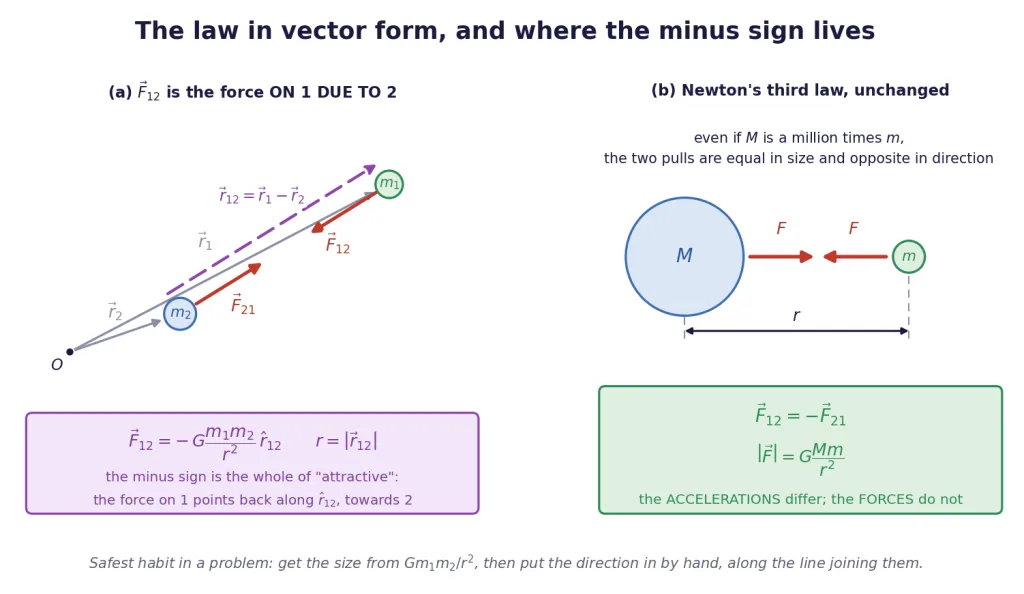
Now think about which way the force on 1 must point. Gravity is attractive, so particle 1 is pulled towards particle 2 — that is, in the direction from 1 to 2, which is opposite to . Hence the minus sign:
Key Point — the law in vector form: The minus sign carries the entire content of the word attractive. Nothing else in the formula does.
Newton's third law falls straight out
Swap the labels 1 and 2 everywhere:
and since , the unit vectors are opposite, . Therefore
Equal in magnitude, opposite in direction. This is not an extra assumption bolted on; it is a consequence of the formula being symmetric in and .
Key Point: The Earth pulls an apple with exactly the same force with which the apple pulls the Earth — about 1 N for a 100 g apple. What differs is the acceleration, because and the Earth's mass is kg. The apple accelerates at 9.8 m/s; the Earth accelerates towards the apple at around m/s, which is why nobody notices.
[JEE Tip] Different books order the subscripts differently, and some define pointing the other way, which flips the sign. Do not memorise a sign. Memorise this instead:
The safe habit: compute the magnitude from , then draw the arrow by hand, pointing from the body you are studying towards the body pulling it. You will never get a sign wrong again.
Two warnings before we go further
Warning 1 — the formula is for POINT masses. is the distance between two points. As soon as the bodies have size, different bits of them are at different distances and in different directions, and you have to add up all those contributions. That is what the shell theorems, a little further on, will rescue us from.
Warning 2 — is never zero. As the formula blows up. That is not a physical prediction; it is a signal that the point-mass idealisation has broken down. Two real bodies touching each other still have their centres a finite distance apart, and the shell theorem tells you exactly what to use.
Superposition: Forces Add as Vectors, One Pair at a Time
Nothing so far tells us what happens when there are three masses instead of two. That needs an extra statement — and, happily, the simplest possible one.
Key Point — the principle of superposition: The gravitational force that several particles exert on a given particle is the vector sum of the forces each of them would exert on its own. The presence of the others changes nothing.
So for a particle in the presence of , , , …
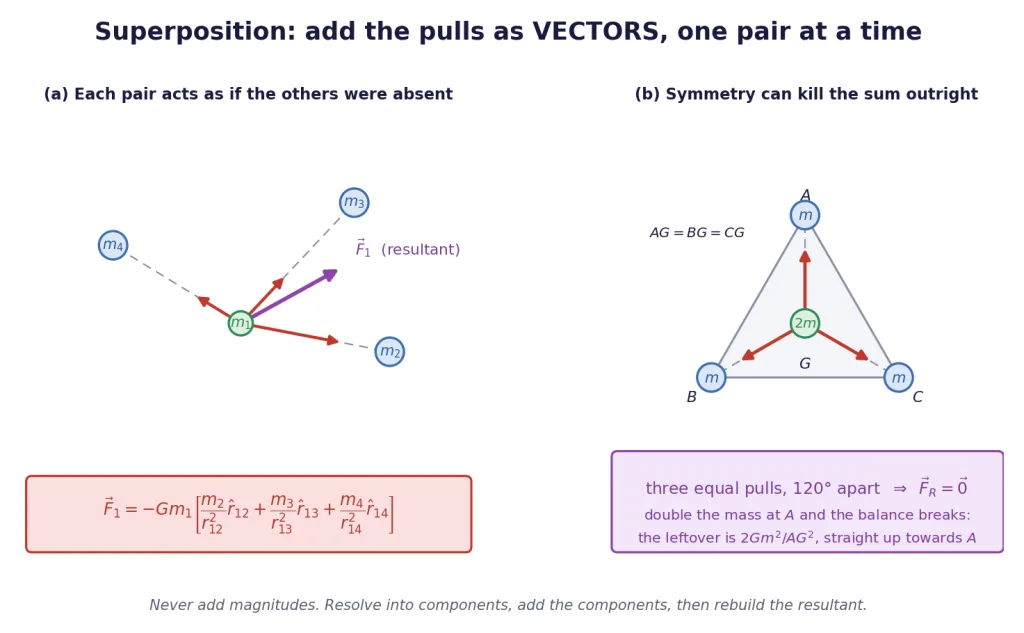
That statement looks obvious and is not. It is a genuine experimental fact about gravity that it does not "saturate" — the pull of on is exactly the same whether or not is sitting between them. The universe did not have to be that way.
The method, which never changes
- Take the pairs one at a time. Ignore every other body while you do it.
- Get each magnitude from .
- Draw each arrow on a clear diagram, pointing from the body you are studying towards each source.
- Resolve into components along convenient axes. Add the -components, add the -components.
- Rebuild: , and the direction from — checking the quadrant with the signs of and .
Key Point: Never add magnitudes. Two pulls of 3 N each do not make 6 N unless they point the same way; at apart they make 3 N, and at they make zero.
Use symmetry before you use algebra
Symmetric arrangements collapse to nothing, and spotting that saves five minutes.
- Three equal masses at the corners of an equilateral triangle, a fourth mass at the centroid: the three pulls are equal in size and apart, so they cancel exactly. Net force zero.
- Four equal masses at the corners of a square, a fifth at the centre: the pulls cancel in diagonal pairs. Net force zero.
- Any regular polygon of equal masses, test mass at the centre: zero, for the same reason.
And the neat corollary that examiners love:
Key Point — the missing-corner trick: If a symmetric arrangement gives zero and you then remove one mass, the resultant of what remains is exactly equal and opposite to the force the removed mass used to exert. So it has magnitude and points away from the empty position.
The reasoning is one line: the full sum is zero, so (sum of the rest) (the removed one).
Two masses on a line, and the null point
A common set-up: two masses and a distance apart, and you must find the point between them where a third mass feels no net force. The two pulls are opposite, so we set the magnitudes equal. With measured from ,
Note cancels — the null point is a property of the field, not of the test mass — and note the square roots, which is where marks are lost. The null point always lies nearer the lighter mass.
[NEET Important] In the ratio , be clear which distance goes with which mass: is measured from , and it carries on top. If the null point sits far from and close to , which is the sanity check.
The Two Shell Theorems: Why a Planet Can Be a Point
Here is the problem we parked earlier. is a law about point masses. The Earth is not a point. It is m of rock, and every cubic metre of it pulls on you from a slightly different direction and distance.
Strictly, we should chop the Earth into little pieces, work out the pull of each on you, and add all those vectors up. That is a triple integral, and it is not a Class 11 calculation. But for a spherically symmetric body the answer collapses into something astonishingly simple. Newton spent years proving it, and it is why he could write the law down at all.
Shell theorem 1: from outside, a shell is a point
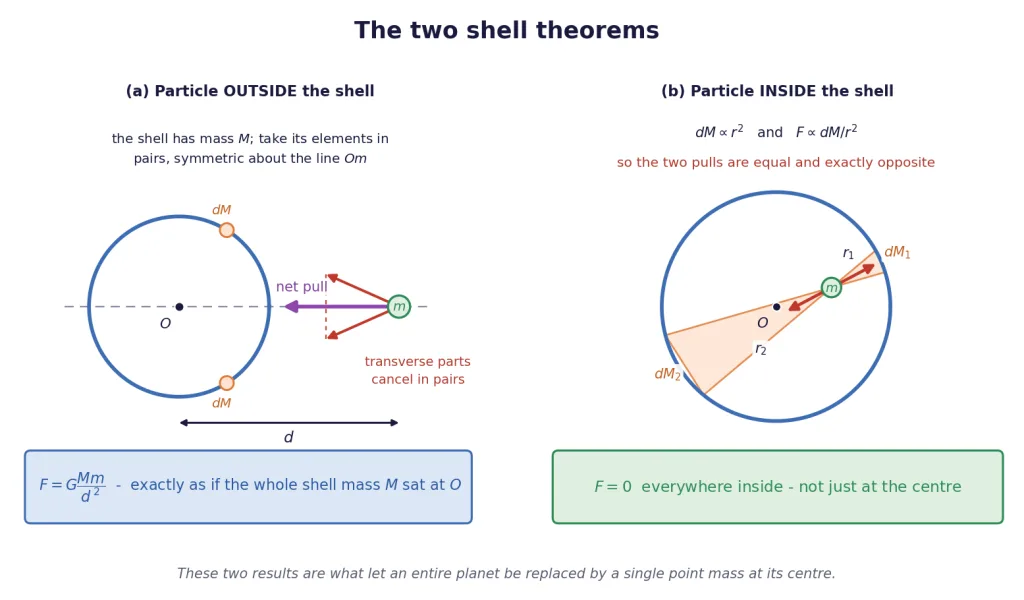
Key Point: A uniform spherical shell of mass attracts a particle of mass lying outside it exactly as though the whole mass were concentrated at the centre of the shell: where is the distance from the particle to the centre.
Why, without the calculus. Take the elements of the shell in pairs, symmetrically placed about the line joining the particle to the centre. Each element pulls the particle along its own line, and that pull has a component along the centre line and a component across it. For each pair, the two transverse components are equal and opposite, so they cancel. Every pair cancels, so the whole transverse sum is zero, and what survives points exactly at the centre. Doing the arithmetic on the surviving components gives exactly — as if all the mass were at .
Shell theorem 2: from inside, a shell pulls not at all
Key Point: A uniform spherical shell exerts no net gravitational force on a particle placed anywhere inside it: This is true at every interior point, not just at the centre.
Why. Put the particle at , off-centre, and draw a narrow double cone with its apex at , opening out in opposite directions to cut two patches out of the shell. Let the two patches be at distances and . The areas of the two patches grow as the square of the distance, so their masses satisfy . But the forces they exert fall off as the inverse square:
The two pulls are equal and exactly opposite, so they cancel. Sweep the double cone around in every direction and the whole shell cancels itself out.
Notice what makes it work: the areas grow as and the force falls as , and the two powers cancel exactly. If gravity went as or , the inside of a shell would not be force-free. This result is a sharp test of the inverse square.
What the two theorems buy you
A solid sphere is a stack of shells. So, for a spherically symmetric body of any internal structure:
Key Point: From outside a spherically symmetric body, it behaves exactly like a point mass equal to its total mass, located at its centre. That is why we may write the Earth's pull on a satellite as with measured from the Earth's centre, and why the Earth's messy layered interior is irrelevant to anything happening above the surface.
And for two spheres:
Key Point: Two uniform spheres attract each other exactly as two point masses at their centres, whatever their radii — even when they are touching. So in is always the centre-to-centre distance, never the gap between the surfaces.
Two lead spheres of radius 5 cm resting against each other have cm, not zero. This one point silently decides several exam questions a year.
From inside a solid body
If you go below the surface, the shells above you contribute nothing (theorem 2), and only the sphere beneath your feet pulls (theorem 1). That single observation gives the whole depth-variation of — and it belongs to Section 4, which develops it in full. Here we simply note that it follows from these two results.
[JEE Tip] For a point on the surface of a sphere, use — theorem 1 still applies, because the surface counts as "outside" the shells below it and "inside" nothing at all.
[Board Important] "State the two results about the gravitational force due to a uniform spherical shell" is a standard two-mark question, and the qualitative reasons above are the standard three-mark follow-up.
The Gravitational Constant , and How It Was Measured
has been sitting in every formula so far without ever being pinned down. Time to fix that.
What actually means
Put kg and m in the law:
Key Point: is numerically the force of attraction between two point masses of 1 kg each, held 1 m apart. Its SI unit is N m/kg, and its modern value is
Look at that number. Two one-kilogram masses a metre apart pull on each other with about N — roughly the weight of a bacterium. Gravity really is extraordinarily feeble.
The dimensional formula
Rearrange the law to make the subject and read off the dimensions:
[Board Important] is a favourite one-mark question, and the negative power of mass is the part people forget.
Why is so hard to measure
Every other fundamental constant is measured with something big and obvious. is not, for three reasons that all come from the same place:
- The force is minuscule. You cannot measure by weighing something, because the Earth's own pull swamps everything. You need two laboratory-sized masses and an instrument sensitive to N.
- Gravity cannot be shielded. In an electrical experiment you put the apparatus in a metal box and the outside world goes away. There is no gravitational box. The experimenter's own body, the walls, a truck outside — everything pulls on the apparatus.
- You cannot amplify it. There is no gravitational equivalent of a transformer or an operational amplifier.
The consequence is that is, even today, the least precisely known of the fundamental constants — we know it to about four significant figures, while the charge on an electron is known to nine.
Cavendish's torsion balance
Henry Cavendish carried out the first successful measurement in 1798, using a torsion balance built earlier by John Michell. It is a beautiful piece of experimental design, and it is regularly asked about.
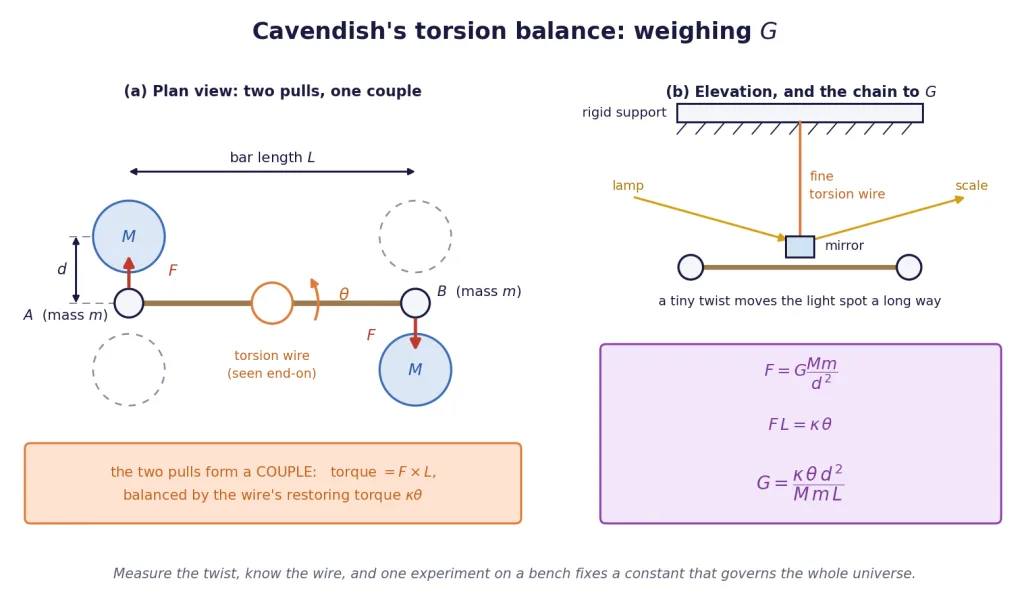
The apparatus. A light horizontal bar of length carries a small lead sphere of mass at each end. The bar hangs from a rigid support by a long, very fine wire attached to its midpoint. A small mirror is fixed to the wire.
The measurement. Two large lead spheres, each of mass , are brought up to the small ones — but on opposite sides, one in front of and one behind . Each large sphere attracts its neighbour with
where is the centre-to-centre distance (shell theorem 1 again — this is what lets us treat the spheres as points).
The two forces are equal in size and opposite in direction, so there is no net force on the bar; there is only a couple. Its torque is
The balance. The bar rotates, twisting the wire, until the wire's restoring torque matches it. For a thin wire the restoring torque is proportional to the angle of twist:
where is the torsional constant of the wire — the restoring couple per unit angle — which is measured separately, by applying a known torque and reading the resulting twist. At equilibrium the two torques are equal:
Key Point — the Cavendish result: Every quantity on the right is measurable on a laboratory bench, so one experiment fixes a constant that governs the entire universe.
Two touches that make it work. First, the twist angle is read by bouncing a beam of light off the small mirror onto a distant scale: rotating the mirror by swings the reflected beam by , and a long light path turns a microscopic twist into a centimetre of movement. Second, moving the big spheres to the other side of the small ones reverses the couple, so the bar swings to a new position and the difference between the two readings is measured — which cancels a great deal of systematic error.
Why this experiment mattered so much
Cavendish's own paper was titled as an experiment to determine the density of the Earth, and that was the real prize: once is known, the measured surface gravity fixes the Earth's mass through . Section 3 carries that out in full — here we only note that a torsion balance on a bench is what made it possible.
Just how weak is gravity?
Take a proton and an electron and compare the two forces between them, using , kg, kg, N m/C and C. Both fall off as , so the distance cancels in the ratio:
Forty orders of magnitude. Inside an atom, gravity is so far beyond negligible that it has never been detected there.
Key Point: Gravity dominates on the astronomical scale not because it is strong but because it never cancels. Charge comes in two signs and bulk matter is neutral; mass comes in one sign and simply piles up.
The mistakes that cost marks
- Using the gap between surfaces instead of the centre-to-centre distance for two spheres.
- Forgetting the square root in the null-point formula.
- Adding force magnitudes instead of vectors.
- Writing — the power of mass is .
- Thinking a body between two masses shields them from each other. It does not.
- Assuming the bigger mass in a pair feels the bigger force. Both feel the same force; only the accelerations differ.
- Applying inside a sphere with the whole mass. Inside, only the mass below you counts.
Solved Examples
Constants used throughout this section, unless a problem states otherwise: N m/kg, kg, m, m/s, and the mass of the Moon kg.
Example 1: How feeble is gravity, exactly?
Two spheres, each of mass 100 kg, are placed with their centres 1.0 m apart. Find the gravitational force between them, and compare it with the weight of one of the spheres.
Solution:
Apply the law, treating each sphere as a point mass at its centre:
The weight of one sphere, with m/s:
The ratio.
Final Answer: N, about times smaller than the weight of either sphere.
Takeaway: The Earth wins because it is enormous, not because gravity is strong. A force of N would not move a grain of sand, and that is what two 100 kg masses manage between them. Everything you have ever felt as "weight" comes from a partner of mass kg.
Example 2: Two spheres in contact, and the distance that matters
Two uniform lead spheres, each of mass 10 kg and radius 5.0 cm, are placed so that they just touch. Find the force between them. What would the formula give if you wrongly used the distance between the surfaces?
Solution:
Find the correct separation. By the shell theorem, each sphere acts as a point mass at its own centre. Touching spheres have their centres two radii apart:
Apply the law.
The wrong route. The distance between the two surfaces is zero, which would put a zero in the denominator and give an infinite force — obvious nonsense, and a useful reminder that is a centre-to-centre distance.
Final Answer: N, using the centre-to-centre separation of 0.10 m.
Takeaway: is always centre to centre. The shell theorem is what licenses that, and it is exactly why gravitational problems about extended spheres are as easy as problems about points. [JEE Tip] Whenever a question gives you radii as well as masses, it is checking this.
Example 3: The Moon test, done properly
The Moon orbits the Earth at a mean distance m with a period of 27.3 days. (a) Find the Moon's centripetal acceleration. (b) Compare it with m/s at the Earth's surface, where m, and show that the comparison supports an inverse-square law.
Solution:
(a) Convert the period.
Centripetal acceleration of a body in a circle of radius with period :
(b) The acceleration ratio.
The distance ratio, squared.
Compare. The two are 3600 and 3630, which agree to about 1% — comfortably inside the precision of the round figures used. So the acceleration really does fall off as measured from the Earth's centre.
Final Answer: m/s, and .
Takeaway: This single comparison is the evidence for the whole chapter. Note that the distances are measured from the Earth's centre, not from its surface — which is only legitimate because of the shell theorem, and Newton knew it.
Example 4: Three equal masses on a triangle
Three equal masses of kg each are fixed at the vertices , , of an equilateral triangle, with m, where is the centroid. (a) Find the force on a mass placed at . (b) Find the force if the mass at is doubled to .
Solution:
(a) Set up axes with at the origin and along . Then and point at and , so the three pulls on the mass at are equal in magnitude and separated by .
Each magnitude is the same:
Add the vectors. Three equal vectors at to one another sum to zero — the -components are , , , which cancel, and the two -components are , which also cancel. Symmetry alone gives this in one line, without any components at all.
(b) Double the mass at . Use superposition cleverly: the arrangement is the original three equal masses (which we have just shown give zero) plus an extra mass at . So the resultant is just what that extra contributes:
Final Answer: (a) zero; (b) newtons, directed along .
Takeaway: Look for the symmetry before you reach for components. And in part (b), the trick of writing the new arrangement as "the symmetric one plus a leftover" turns a three-vector sum into a single term. [JEE Tip] Any regular polygon of equal masses gives zero at the centre, for exactly this reason.
Example 5: A square, and the missing corner
Four equal masses kg sit at the corners of a square of side m. (a) Find the force on a 1.0 kg mass at the centre. (b) One of the four masses is now removed. Find the magnitude and direction of the force on the central mass.
Solution:
(a) The full square. Opposite corners are diametrically opposite the centre and equidistant from it, so their pulls are equal and opposite and cancel in pairs.
(b) Use the missing-corner argument. Call the removed mass . Since the sum of the three that remain is : equal in magnitude to the force the removed mass used to exert, and pointing away from the vacant corner.
Find the distance from the centre to a corner — half the diagonal:
Compute the magnitude.
Final Answer: (a) zero; (b) N, directed along the diagonal away from the empty corner, that is, towards the corner diagonally opposite it.
Takeaway: When a symmetric sum is zero, removing one term leaves minus that term. You never have to add the other three. [NEET Important] The direction is away from the hole — the remaining mass is all on the other side.
Example 6: Superposition with a right angle
A 2.0 kg mass sits at the origin. A 4.0 kg mass is placed at m on the -axis and a 3.0 kg mass at m on the -axis. Find the magnitude and direction of the net gravitational force on the 2.0 kg mass.
Solution:
Pull of the 4.0 kg mass, along (towards it):
Pull of the 3.0 kg mass, along :
They are perpendicular, so the resultant is the hypotenuse:
The direction. Both components are positive, so the resultant lies in the first quadrant, above the -axis.
Final Answer: N, at to the -axis, in the first quadrant.
Takeaway: Note that the larger mass is not automatically the larger pull. The 4 kg mass wins here only because it is closer; had it been at 5 m the 3 kg mass at 4 m would have dominated. Distance enters squared and mass enters linearly.
Example 7: The null point between the Earth and the Moon
The Earth's mass is kg and the Moon's is kg, and their centres are m apart. At what point on the line joining them is the net gravitational force on a spacecraft zero?
Solution:
Let be the distance from the Earth's centre. The two pulls are opposite, so set the magnitudes equal: The spacecraft's mass and the constant cancel — the answer does not depend on what you send.
Take the square root of the ratio.
Solve.
Sanity-check. The Earth is about 81 times heavier, so the null point must be much nearer the Moon — and indeed it sits at 90% of the way there, only m from the Moon's centre.
Final Answer: About m from the Earth's centre, that is, roughly 90% of the way to the Moon.
Takeaway: The mass ratio enters as a square root, so an 81 : 1 mass ratio gives only a 9 : 1 distance ratio. Forgetting the root is the single commonest error in this problem type. [Board Important] The null point belongs to the field, not to the probe: cancels.
Example 8: A clean collinear null point
Masses of 4.0 kg and 9.0 kg are fixed 1.0 m apart. Where on the line joining them should a third mass be placed so that it feels no net gravitational force?
Solution:
Let be measured from the 4.0 kg mass, so the distance from the 9.0 kg mass is .
Balance the magnitudes.
Square-root both sides — the numbers here are perfect squares, which is why they were chosen:
Solve.
Check. and . Equal, as required.
Final Answer: 0.40 m from the 4.0 kg mass (and 0.60 m from the 9.0 kg mass).
Takeaway: The null point lies nearer the lighter mass, in the ratio — here , which splits 1.0 m into 0.4 m and 0.6 m. Any point outside the pair has both pulls in the same direction and can never give zero.
Example 9: A shell, from three different places
A uniform spherical shell has mass 100 kg and radius 0.50 m. Find the gravitational force it exerts on a 2.0 kg particle placed (a) 1.0 m from the centre, (b) exactly on the shell's surface, (c) 0.20 m from the centre, inside the shell.
Solution:
(a) Outside the shell, so the first shell theorem applies and the whole 100 kg acts as a point at the centre, m:
(b) On the surface, m. The same theorem still applies:
(c) Inside the shell. The second shell theorem says the net force is exactly zero, wherever inside the particle sits.
The shape of the answer. Moving inwards from far away, climbs as until you reach the surface, where it takes its largest value N, and then it drops discontinuously to zero the instant you step inside.
Final Answer: (a) N; (b) N; (c) zero.
Takeaway: A shell is not a "weak" attractor inside — it is a zero one. And the jump at the surface is real: for a thin shell the force is discontinuous there. [NEET Important] "Zero everywhere inside", not "zero only at the centre" — that distinction is asked directly.
Example 10: Getting out of a torsion balance
In a Cavendish-type experiment the bar is 0.60 m long and carries a small sphere of mass 0.50 kg at each end. Two large spheres of mass 50 kg each are placed with their centres 0.15 m from the centres of the neighbouring small ones, on opposite sides of the bar. The suspension wire has a torsional constant N m per radian, and the bar is observed to twist through 0.089 rad. Find (a) the force between one pair of spheres and (b) the value of this implies.
Solution:
The restoring torque of the wire at equilibrium is , and it must balance the gravitational couple:
(a) The two equal forces form a couple whose torque is times the full length of the bar:
(b) Now invert the law of gravitation, using the centre-to-centre distance m:
Check the twist is plausible. 0.089 rad is about — small, but easily read with a mirror and a lamp several metres away.
Final Answer: (a) N; (b) N m/kg.
Takeaway: The couple has moment , with the whole bar, not half of it — because both forces contribute, each acting at from the axis. Getting a factor of two wrong here halves or doubles your , and it is the standard trap in this calculation.
Example 11: Gravity against electricity, and the dimensions of
(a) Find the ratio of the gravitational to the electrostatic force between a proton and an electron, using kg, kg, C and N m/C. (b) Obtain the dimensional formula of .
Solution:
(a) Write both forces. Both go as , so the separation cancels in the ratio:
The numerator.
The denominator.
Divide.
(b) Dimensions. Make the subject:
Final Answer: (a) ; (b) .
Takeaway: Forty orders of magnitude is not a small difference; it is a different world. Gravity is irrelevant inside an atom and decisive between galaxies, and the reason is not strength but the fact that mass has only one sign, so gravitational pulls add up and never cancel.