
Going Up: with Altitude
Section 3 gave us the surface value, , and then quietly walked away from a problem. That formula has in it — the distance from the centre of the Earth. Climb a mountain, or fly, or go into orbit, and that distance is no longer .
So is not a constant. It never was. This section is about the four reasons it varies, and this is the first of them.
The exact result
Put a body of mass at a height above the surface. It is now a distance from the centre, and it is outside the Earth, so the shell theorem still applies in full and the whole Earth still acts as a point mass at the centre.
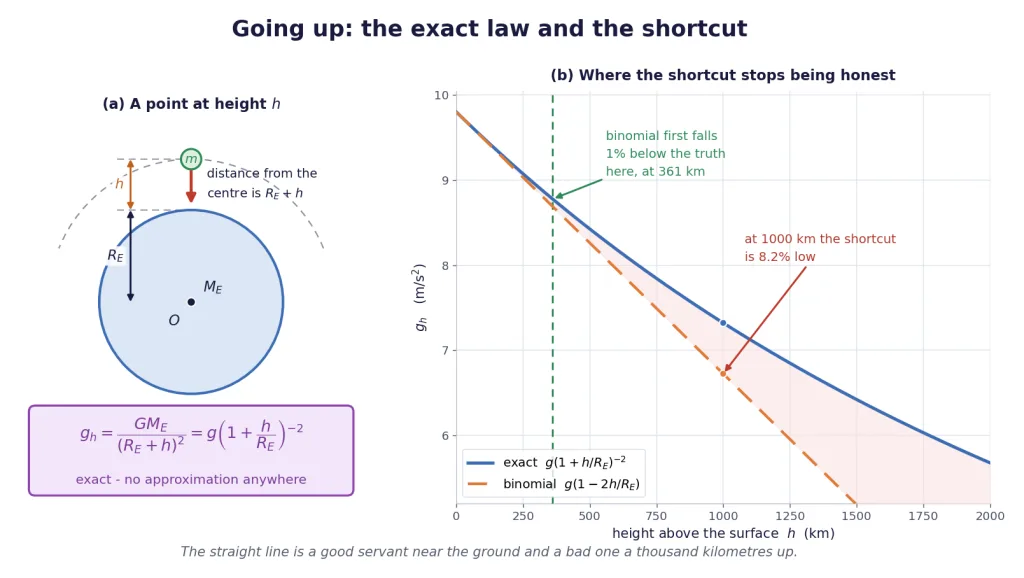
Divide top and bottom by and the surface value appears:
Key Point — at height , exactly: This is exact. No approximation has been made anywhere, and it is valid for any , from a metre to the Moon.
Since for every positive , is always less than . Going up always weakens gravity.
The shortcut, and its price
For small heights the exact form is clumsy to evaluate by hand. Expand it with the binomial theorem, for , with and :
Key Point — the binomial form, for only: The fractional drop in is — note the 2, which comes from the square in the denominator.
Rule of thumb: falls by about 1% for every 32 km you climb. (Set to get km.)
Where does the shortcut break?
Here is a claim you should never accept without a number attached. Let us actually compute both, using m/s and m, and look at the error.
| Height | Exact (m/s) | Binomial (m/s) | Error of the shortcut | |
|---|---|---|---|---|
| 10 km | 0.0016 | 9.769 | 9.769 | about % |
| 32 km | 0.0050 | 9.702 | 9.702 | % |
| 100 km | 0.0157 | 9.499 | 9.492 | % |
| 300 km | 0.0471 | 8.938 | 8.877 | % |
| 500 km | 0.0785 | 8.425 | 8.262 | % |
| 1000 km | 0.157 | 7.321 | 6.723 | % |
| 2000 km | 0.314 | 5.676 | 3.646 | % |
| = 6370 km | 1.000 | 2.450 | absurd |
Read the last line twice. At the exact answer is m/s; the binomial form returns m/s, a negative acceleration due to gravity. The shortcut has not merely become inaccurate, it has become nonsense.
Key Point: The binomial form is within 0.1% up to about 116 km, within 1% up to about 361 km, and should not be trusted at all beyond a few hundred kilometres. Above that, use the exact form.
The error is not mysterious. The full expansion is , so the shortcut throws away , and the relative error is roughly . Setting that equal to 0.01 gives , which is 368 km — close to the 361 km found by solving exactly.
[JEE Tip] If a problem gives a height comparable to — "at a height equal to half the radius of the Earth", "at " — the binomial form is not an option. Use and be done in one line.
[Board Important] Both forms are examinable, and so is the condition attached to the second one. Writing the approximation without stating its condition loses a mark.
Going Down: with Depth
Now dig. A mine, a borehole, a hypothetical tunnel. What happens to ?
Most students guess that increases as you approach the centre, because you are getting closer to the middle of the Earth. It is a reasonable guess and it is wrong, and the reason is one of the two shell theorems from Section 2.
The two-step argument
Stand at a depth , so you are a distance from the centre. Now split the Earth into two pieces at your own radius.
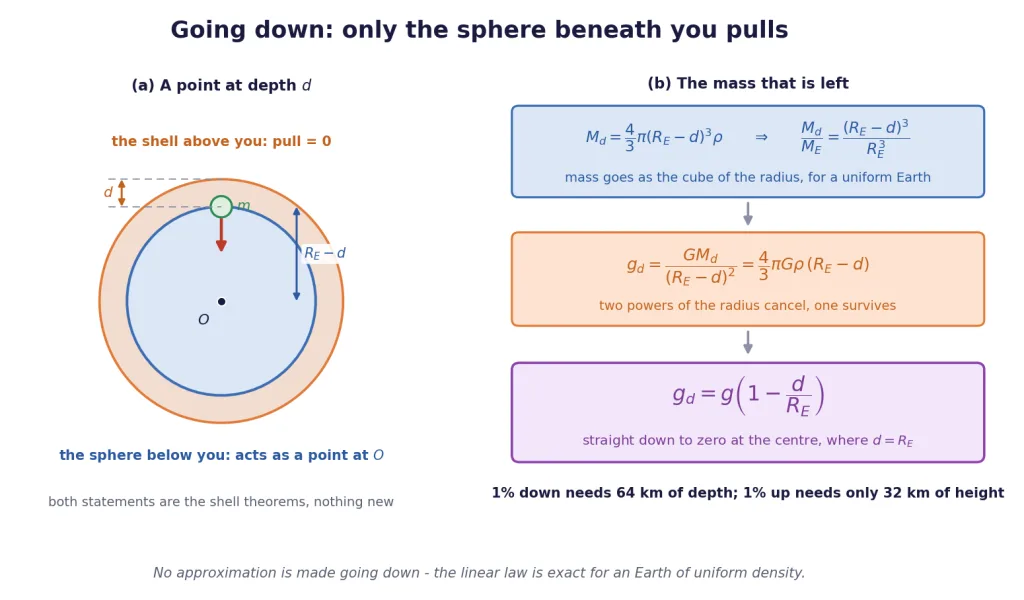
Piece one: everything above you — the spherical shell of thickness between your radius and the surface. You are inside it. The second shell theorem says the net gravitational force from a uniform spherical shell on a particle anywhere inside it is exactly zero. All that rock over your head pulls you in every direction at once, and it cancels perfectly. It contributes nothing.
Piece two: everything below you — a solid sphere of radius . You are on its surface, hence outside it, so the first shell theorem applies and it pulls as though its entire mass sat at the centre.
So only the ball beneath your feet counts.
Doing the algebra
Assume the Earth has uniform density . The mass of the inner sphere is
The acceleration at your position is then
Two powers of cancel and one survives. Using at the surface:
Key Point — at depth : falls linearly with depth, reaching exactly zero at the centre, where . Notice there is no approximation here — for a uniform Earth this result is exact, unlike the binomial form for height.
At the centre every scrap of the Earth surrounds you symmetrically, so every pull is matched by an opposite pull. You would be weightless — not because there is no gravity, but because it cancels.
Up versus down, side by side
For small and the two results sit next to each other beautifully:
Key Point: Near the surface, falls twice as fast going up as it does going down. A 1% drop needs only 32 km of height but 64 km of depth. And whichever way you move, decreases — the surface is where is largest.
That last sentence is the single most examined idea in this section. is a maximum at the Earth's surface and falls off in both directions.
[NEET Important] For equal small displacements , going up costs and going down costs . Setting gives — a favourite one-line question.
An honest footnote about the real Earth
The linear law assumes uniform density, and the real Earth is not uniform: it has a dense iron core, as Section 3 showed. Because so much mass is concentrated near the middle, in the actual Earth does not drop straight away. It creeps slightly upward as you descend through the mantle, peaks near m/s at the boundary of the core about 2900 km down, and only then falls to zero at the centre.
The linear formula is still what every exam wants, because it is the correct answer for the stated model of a uniform sphere. But it is worth knowing that the model, not the physics, is what makes it a straight line.
The Graph of Against Distance from the Centre
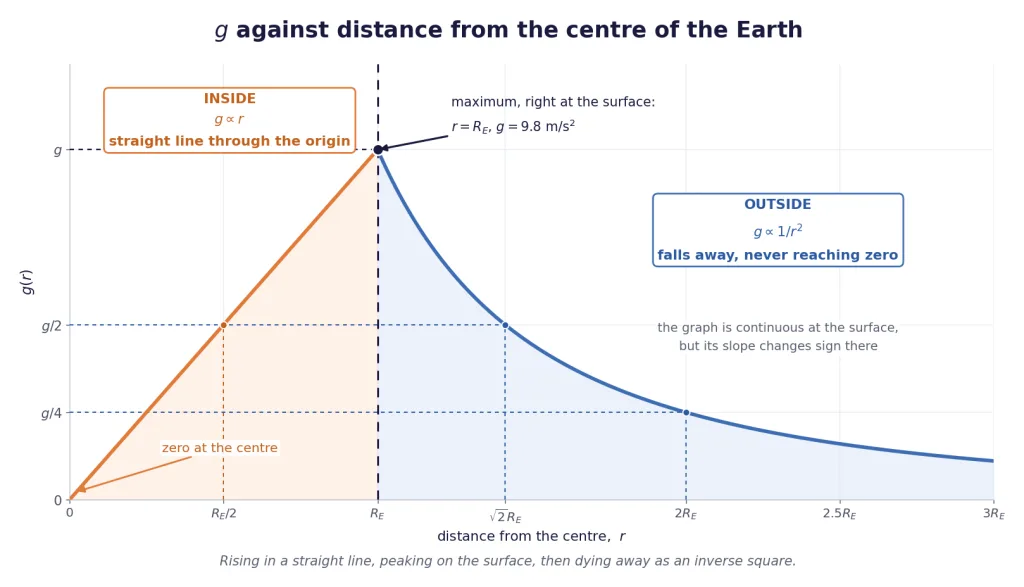
Everything in the last two sections can be put on a single picture, and examiners love this picture. Let be the distance from the centre of the Earth — not from the surface — and plot against for a uniform sphere.
The two branches
Inside, . Here , so the depth result becomes
A straight line through the origin, with slope .
Outside, . Here , so
An inverse-square curve, falling steeply at first and then flattening, approaching zero only as and never actually reaching it.
Key Point: rises linearly from zero at the centre to its maximum value at the surface, , and then falls away as . The maximum is at the surface, and the two branches meet there with the same value — the graph is continuous, though its slope jumps from positive to negative.
Points worth marking on the sketch
| Position | ||
|---|---|---|
| centre | 0 | 0 |
| half way to the surface | ||
| surface | (maximum) | |
Look at rows two and four. The value occurs twice — once inside at , and once outside at , which is a height of about 2640 km. Any value below the maximum is reached at two different distances, one in and one out.
Drawing it in an exam
Four things earn the marks, and students routinely lose them:
- Start at the origin. at , not at some small positive value.
- The inner part is a straight line, not a curve. It is , not and not an arc.
- The peak is exactly at , and it is a sharp corner, not a smooth dome.
- The outer part never touches the axis. It approaches zero asymptotically.
[NEET Important] The commonest wrong option offered is a curve that rises inside as , or one that peaks somewhere above the surface. Both are wrong: linear inside, peak at the surface.
[JEE Tip] For a hollow shell instead of a solid sphere the graph is different: is exactly zero everywhere inside, then jumps discontinuously to at the surface and falls as outside. Compare the two shapes once and you will never confuse them.
Latitude and the Earth's Rotation
The latitude variation of and the effect of the Earth's spin sit outside the rationalised syllabus body text, but they are asked in Boards, JEE Main and NEET every single year, so they are derived here in full.
There is a third reason varies, and it has nothing to do with distance from the centre. The Earth is spinning.
A body sitting on the ground at the equator is not in equilibrium in the way you were taught in Chapter 5. It is going round a circle of radius once a day, so it is accelerating, and some of the Earth's pull has to be spent supplying that centripetal acceleration. Whatever is spent that way is not available to press the body onto a weighing scale. The scale therefore reads less than .
Setting it up at latitude
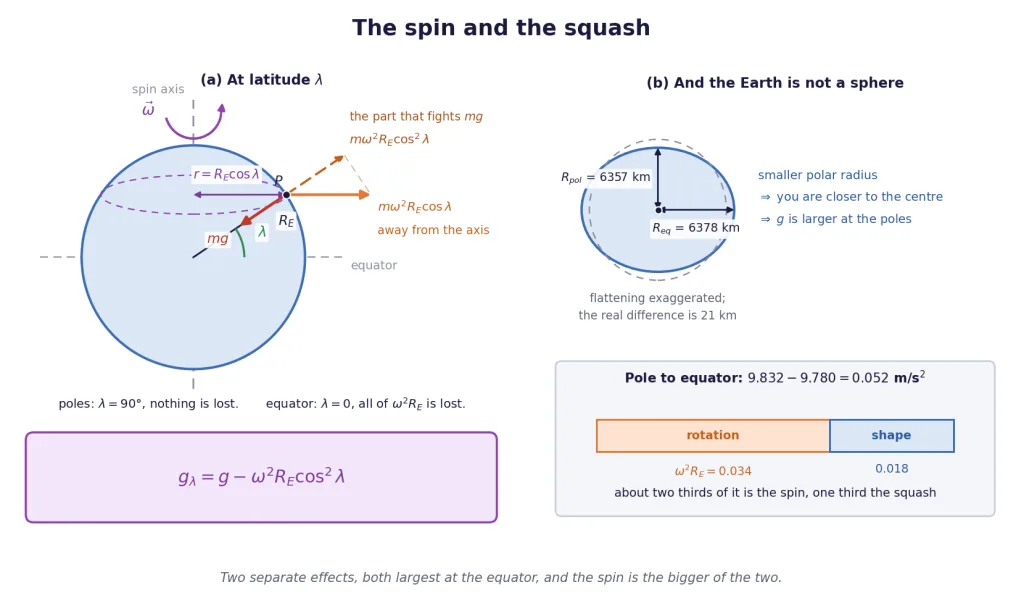
Latitude is the angle between the radius to your position and the equatorial plane: at the equator, at the poles.
As the Earth turns with angular speed , the point does not go round a circle of radius . It goes round the spin axis, on a circle of radius
Work in the frame of the rotating Earth, where you and the ground are both at rest. That frame is non-inertial, so a centrifugal force appears, of magnitude
directed away from the axis — that is, horizontally outwards, parallel to the equatorial plane. It does not point along the radius except at the equator.
Resolving it
The true gravitational pull points along , towards the centre. Resolve the centrifugal force into a component along the outward radius and a component along the meridian:
- along the outward radius:
- along the surface, towards the equator:
Only the first component opposes gravity. The apparent weight is therefore
Key Point — effective at latitude : is the value a spring balance actually reads. The true gravitational field is unchanged; what the rotation changes is the apparent weight.
Reading the formula
At the poles, , so and . A body at the pole sits on the spin axis and goes round in a circle of zero radius, so it needs no centripetal force at all. is a maximum at the poles.
At the equator, , so and
This is the largest reduction, so is a minimum at the equator.
How big is the effect?
The Earth turns once in a sidereal day of 86164 s, so
As a fraction of that is %. Small, but easily measured, and it is why a body weighing exactly 1000 N at the pole weighs about 996.5 N at the equator, from rotation alone.
| Latitude | Loss (m/s) | (m/s) | |
|---|---|---|---|
| (equator) | 1.000 | 0.0339 | 9.766 |
| 0.750 | 0.0254 | 9.775 | |
| 0.500 | 0.0169 | 9.783 | |
| 0.250 | 0.0085 | 9.792 | |
| (poles) | 0.000 | 0.0000 | 9.800 |
(Computed with m/s, m and rad/s.)
Notice from the row that the loss is exactly half its equatorial value there, since .
What if the Earth spun faster?
A classic. Suppose increased. The reduction grows as , and bodies at the equator become lighter. Push it far enough and they float:
So a day of about 1 hour 24 minutes, roughly 17 times the present spin rate, would leave objects at the equator weightless. Things at higher latitudes would still have weight, because their is smaller.
[JEE Tip] Be careful with the corresponding question at a general latitude. Setting gives , but this only makes the radial component vanish. The along-the-surface component is still there, so the body does not truly float — it slides. Only at the equator, where that second component is zero, does everything cancel.
A small bonus: the plumb line does not point at the centre
That leftover surface-directed component means the resultant of gravity and the centrifugal effect is not exactly along . A plumb bob hangs slightly off the true radius, tilted towards the equator by an angle
which is largest at , where it comes to about , or six minutes of arc. Tiny, but real, and surveyors correct for it.
The Shape of the Earth, and All Four Effects Together
One reason for the variation of is left, and it is a consequence of the rotation rather than a separate accident.
The Earth is an oblate spheroid
A spinning ball of rock and liquid does not stay spherical. It bulges at the equator and flattens at the poles. Measured:
- equatorial radius km
- polar radius km
- difference about 21 km, a flattening of roughly 1 part in 300
So the ground at the pole is 21 km closer to the centre than the ground at the equator. Since falls off as the square of the distance, being closer means a stronger pull:
Key Point: Because the Earth is an oblate spheroid with a smaller polar radius, is larger at the poles and smaller at the equator, quite apart from the rotation effect. Both effects push the same way, which is why at the poles exceeds at the equator on both counts.
A rough estimate: , suggesting about m/s. That overshoots, because the equatorial bulge is itself extra mass sitting underneath you when you stand at the equator, and its pull partly compensates for the extra distance. The honest number, extracted from measurements, is nearer m/s.
The measured pole-to-equator difference
That is a variation of about 0.53%, and it splits as
- rotation: m/s, roughly two thirds of it
- shape: about m/s, roughly one third
This is why the standard value 9.8 m/s is a compromise, and why the internationally agreed reference value, 9.80665 m/s, corresponds to sea level at about latitude.
The four effects on one page
| Cause | Formula | Effect on | Notes |
|---|---|---|---|
| Altitude | , and for | decreases | exact form always valid; binomial within 1% only to about 361 km |
| Depth | decreases, linearly to zero at the centre | exact for a uniform Earth; follows from the shell theorems | |
| Latitude and rotation | maximum at the poles, minimum at the equator | affects apparent weight; m/s | |
| Shape (oblateness) | , so is larger at the poles | maximum at the poles, minimum at the equator | contributes about m/s of the total |
The mistakes that cost marks
Mixing up and . In the distance is measured from the centre, not from the ground. Writing is the single most common slip in this chapter.
Using the binomial form when is not small. If the question says or , the shortcut is invalid. See the error table earlier.
Thinking increases as you go down. It does not, for a uniform Earth — it decreases linearly.
Confusing depth and height factors. going up, going down. The 2 belongs to the height.
Using instead of . The first cosine comes from the radius of the circle of latitude, the second from resolving the centrifugal force along the radius. Both are needed.
Saying gravity itself is weaker at the equator because of rotation. It is not — the gravitational field is unchanged by the spin. What changes is the apparent weight, because part of the pull is being used up as the centripetal force.
[Board Important] "State four factors on which the value of depends, with the corresponding expressions" is a standard three-or-four-mark question, and the table above is the complete answer.
Solved Examples
Constants used throughout this section, unless a problem states otherwise: m/s, m, N m/kg, kg and rad/s.
Example 1: A thousand kilometres up, two ways
Find at a height of 1000 km above the Earth's surface, using (a) the exact formula and (b) the binomial approximation. State the error the approximation makes.
Solution:
Compute the ratio first.
(a) Exact form.
(b) Binomial form.
The error.
Why. is not small, and the discarded term of the expansion, , is already 7% of the answer.
Final Answer: exact m/s; binomial m/s; the approximation is 8.2% low.
Takeaway: The binomial form is a convenience, not a law. At 1000 km it is already wrong in the first significant figure, and at it returns a negative .
Example 2: Where does fall to half?
Find (a) the height above the surface and (b) the depth below it at which becomes half its surface value.
Solution:
(a) Use the exact height formula — half is nowhere near a small change, so no binomial.
Take the square root and solve.
(b) Depth. The depth law is linear.
Final Answer: (a) km, about ; (b) km, exactly .
Takeaway: The two halving distances are completely different numbers, 2639 km up and 3185 km down, because one law is an inverse square and the other is a straight line.
Example 3: A one per cent change
At what height, and at what depth, does fall by 1% of its surface value?
Solution:
Height, using the binomial form — legitimate here, since the change is tiny.
Check it against the exact form. Solving exactly gives km, so the shortcut is accurate to 0.7% of itself here. Good enough.
Depth, from the exact linear law.
Final Answer: about 32 km of height, or 63.7 km of depth.
Takeaway: Near the surface, a metre upwards costs twice as much as a metre downwards. That factor of 2 is the whole difference between the two formulae.
Example 4: A 63 N body, above and below
A body weighs 63 N at the Earth's surface. Find the gravitational force on it (a) at a height equal to half the Earth's radius, and (b) at a depth equal to half the Earth's radius.
Solution:
(a) Height . This is not small, so use the exact form.
Weight is proportional to for the same body.
(b) Depth .
Final Answer: (a) 28 N; (b) 31.5 N.
Takeaway: Same distance travelled, different answers — and going up loses more. Working with the ratio avoids ever needing the mass.
Example 5: Matching a height with a depth
At what depth below the Earth's surface does have the same value as at a height of 100 km above it?
Solution:
Compute at the height, exactly.
Set the depth expression equal to it.
Solve.
Compare with the quick rule. For small displacements would predict 200 km. The exact answer is 195 km, so the rule of thumb is good to about 2% here.
Final Answer: km, close to but a little less than .
Takeaway: The rule comes from equating the two small-displacement forms, and it degrades as soon as stops being small compared with .
Example 6: Gravity at the space station
A space station orbits at a height of 300 km. Find there, and express it as a percentage of the surface value.
Solution:
The ratio.
Exact form.
As a percentage.
The binomial form, for comparison, gives m/s, which is 0.69% low — acceptable for a rough estimate but not for a precise one.
Final Answer: m/s, about 91% of the surface value.
Takeaway: Gravity at the space station is barely weaker than on the ground. Astronauts there float not because gravity has vanished, but because the station and everything in it are in free fall together — a point developed properly when satellites are dealt with later in the chapter.
Example 7: Base camp to summit
The summit of the world's highest mountain stands about 8848 m above sea level. By how much, and by what percentage, is smaller there than at sea level?
Solution:
The ratio is tiny, so the binomial form is safe.
Fractional decrease.
Absolute decrease.
Exact check. m/s — the binomial and exact values agree to five figures, as they should at this height.
Final Answer: is smaller by about m/s, a drop of %.
Takeaway: Even the tallest mountain on Earth changes by only a quarter of a per cent. A 70 kg climber weighs about 1.9 N less at the summit — less than the weight of a chocolate bar.
Example 8: Two latitudes
Taking rad/s, m and m/s, find the effective value of at latitude and at latitude , ignoring the Earth's oblateness.
Solution:
Compute the equatorial reduction once.
At , where :
At , where :
Note the pattern. The loss falls off as , so it has already dropped to a quarter of its equatorial value by .
Final Answer: m/s and m/s.
Takeaway: Compute m/s once and reuse it. Every latitude question is then a single multiplication by .
Example 9: The pole-to-equator weighing
A spring balance reads exactly 490 N when a person stands on it at the North Pole. What will it read at the equator, taking only the Earth's rotation into account? Take m/s and m/s.
Solution:
Find the mass from the polar reading, where the rotation contributes nothing:
Effective at the equator.
New reading.
The difference.
Final Answer: about N, some N less than at the pole.
Takeaway: A spring balance reads apparent weight and so notices the spin; a beam balance compares two masses in the same field and does not. [NEET Important] That distinction is a standard one-mark trap.
Example 10: How fast would the Earth have to spin?
(a) Find the angular speed at which bodies at the equator would become weightless, and the corresponding length of the day. (b) How many times faster than at present is that? Take m/s, m and the present day as 86164 s.
Solution:
(a) Weightless means the effective vanishes at .
Substitute.
Length of the day.
(b) Speed-up factor.
Final Answer: rad/s, a day of about 1 h 24 min, roughly 17 times the present spin rate.
Takeaway: The condition is , which is exactly the condition for the ground to stop pushing on you. Note that only the equator is affected this way — at higher latitudes , so some weight always remains.
Example 11: Reading the graph in both directions
For a uniform spherical Earth, find every distance from the centre at which equals half its surface value.
Solution:
Inside the Earth, . Set it equal to :
Outside the Earth, . Set it equal to :
Convert the second to a height above the ground.
Final Answer: at (a depth of 3185 km) and at (a height of 2639 km).
Takeaway: Every value of below the maximum is attained twice, once inside and once outside, because the graph rises to a peak at the surface and then falls. Questions that ask for "the distance" without saying which side are asking for both.
Example 12: Gravity out at geostationary height
Communications satellites sit about m above the Earth's surface. Find at that height, as a fraction of its surface value.
Solution:
The ratio is enormous, so only the exact form will do.
Exact form.
As a fraction of the surface value.
What the binomial form would have said. m/s. Pure nonsense, as expected when is more than 5.
Final Answer: m/s, about 2.3% of the surface value.
Takeaway: Gravity is still very much present at satellite heights — it is what holds the orbit together. The exact form is the only one that survives out here; what the satellite then does with that belongs to the sections on orbits.