
Can You Throw Something Away For Good?
Throw a stone up and it comes back. Throw it harder and it comes back from higher up. A cannon does better, a rocket better still. So a natural question: is there a speed at which it simply never returns?
There is, and the answer takes about four lines. It is not a dynamics problem at all — the force keeps changing all the way up, so chasing it with is hopeless. It is an energy problem, and Section 5 has just given us the tool.
Setting up the accounts
Launch a body of mass from the Earth's surface with speed . With the zero of potential energy at infinity, its total mechanical energy at the moment of launch is
Kinetic energy is positive, potential energy is negative, and gravity is conservative, so this total does not change for the rest of the flight (ignore the atmosphere for now).
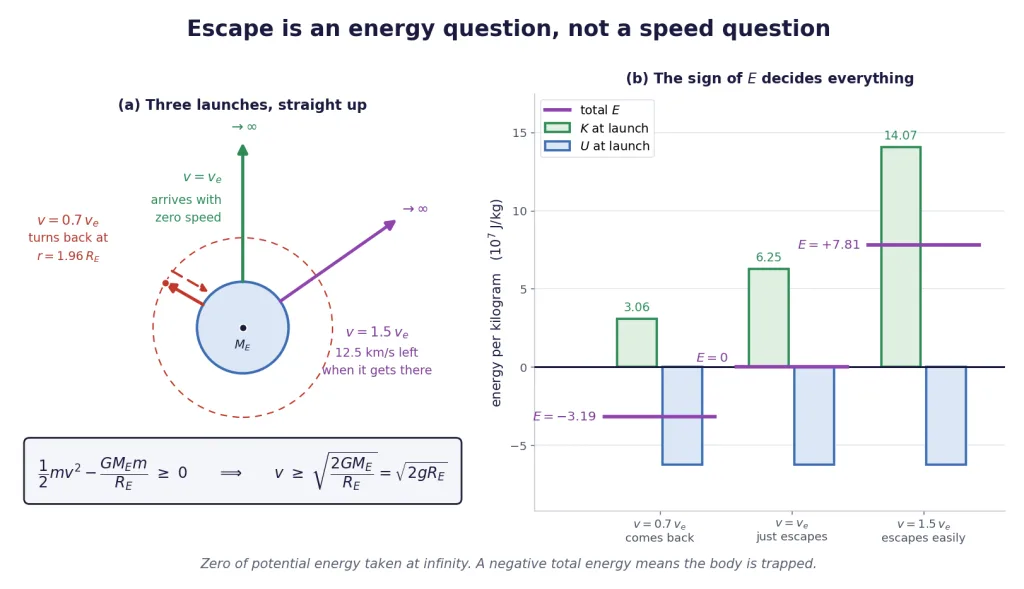
Now ask what has to be true for the body to get infinitely far away. Out there , and its kinetic energy cannot be negative. So the energy it arrives with is
Energy is conserved, so the energy it left with must have been too. That single inequality is the whole of this section.
Key Point — the escape condition: A body escapes if and only if its total mechanical energy is zero or positive, with the zero of potential energy taken at infinity. Negative total energy means it is bound and must come back; zero is the borderline; positive means it escapes and still has speed left over.
The escape speed
The slowest launch that satisfies the condition is the one that turns it into an equality:
The mass has cancelled. We shall come back to that in a moment, because it is the most quoted feature of the result.
Since , we can trade for and get a second form that needs no knowledge of or at all:
Key Point — escape speed: Both forms are examinable. Use the first when you are given and the planet's mass, and the second when you are given the planet's surface gravity.
The number
With N m/kg, kg and m:
and by the other route, with m/s:
Key Point: The escape speed at the Earth's surface is about 11.2 km/s, or roughly 40 000 km/h. Memorise it. It is the single most quoted number in the chapter.
What "just escaping" looks like
A body launched at exactly has . Its speed at a distance from the centre is , which keeps falling but never reaches zero at any finite distance. It arrives at infinity with precisely zero speed, after an infinite time. Launch it a whisker slower and it turns round — very far out, but it turns round. Launch it a whisker faster and it sails away with speed to spare.
[Board Important] The derivation is a standard three-mark question. Write down the total energy at launch, argue that the energy at infinity cannot be negative, set , state the zero-of-potential convention, and solve. Skipping the convention costs a mark.
What It Depends On, and What It Emphatically Does Not
Look at the answer again:
Three things are in it: , the mass of the planet, and the radius of the planet. Three things are conspicuously not in it, and each absence is a favourite exam question.
It does not depend on the mass of the projectile
The cancelled in the very first step, because kinetic energy and gravitational potential energy are both proportional to . A grain of sand, a cricket ball and a fully fuelled rocket all need the same 11.2 km/s.
Key Point: is independent of the mass of the escaping body. A heavier body needs more energy to escape — the energy needed is , which does scale with — but it needs the same speed.
Keep those two sentences apart in your head. "Does a heavier rocket need a bigger escape speed?" No. "Does it need more fuel?" Yes, proportionally.
It does not depend on the direction of launch
This one surprises people. Fire the projectile straight up, at , or almost horizontally — as long as it clears the ground and the atmosphere, 11.2 km/s is enough.
The reason is that energy is a scalar. The condition contains , the square of the speed, and nothing about direction at all. Gravity is a central force, so no matter which way the body sets off, the same energy sum governs whether it can reach infinity.
Key Point: is independent of the direction of projection. This is why it is properly called escape speed, not escape velocity, even though you will hear the second name constantly.
Two honest footnotes. First, a horizontal launch from the ground would plough through the atmosphere and hit a mountain, so in practice rockets go up first and turn later — that is aerodynamics, not gravitation. Second, launching eastward from the equator does help a little, because the surface is already moving east at m/s, about 4.2% of . That is a gift from the Earth's rotation, not a change in the escape speed itself, and it is why launch sites cluster near the equator.
It does not depend on where the body ends up going
The condition is only about reaching infinity. Whether the body ends up drifting to Mars, to another star, or nowhere in particular is a separate question.
It does depend on the planet: on and on
so a more massive planet is harder to leave and a larger one is easier, and the two effects fight each other. For bodies of the same mean density , substituting gives a neat alternative:
Two planets made of the same stuff, one twice as wide, and the bigger one has twice the escape speed. This is the cleanest way to handle any question phrased in terms of density.
The relation to orbital speed
There is one more relation worth carrying, even though its other half belongs to the next section. A satellite skimming just above the Earth's surface moves at the orbital speed , which works out to km/s. Compare:
Key Point: The escape speed from a planet's surface is times the speed of a satellite in a surface-skimming orbit. Numerically, km/s.
Section 7 derives properly from the circular-orbit condition; here it is quoted only so that you can see the factor of , which examiners adore. Note carefully that this relation holds for an orbit at the surface. For a satellite at height the comparison has to be made at the same radius, which Section 8 handles when it does the full energy accounting.
[NEET Important] Three one-line facts to have ready: escape speed does not depend on the mass of the body; does not depend on the direction of projection; and equals times the surface orbital speed.
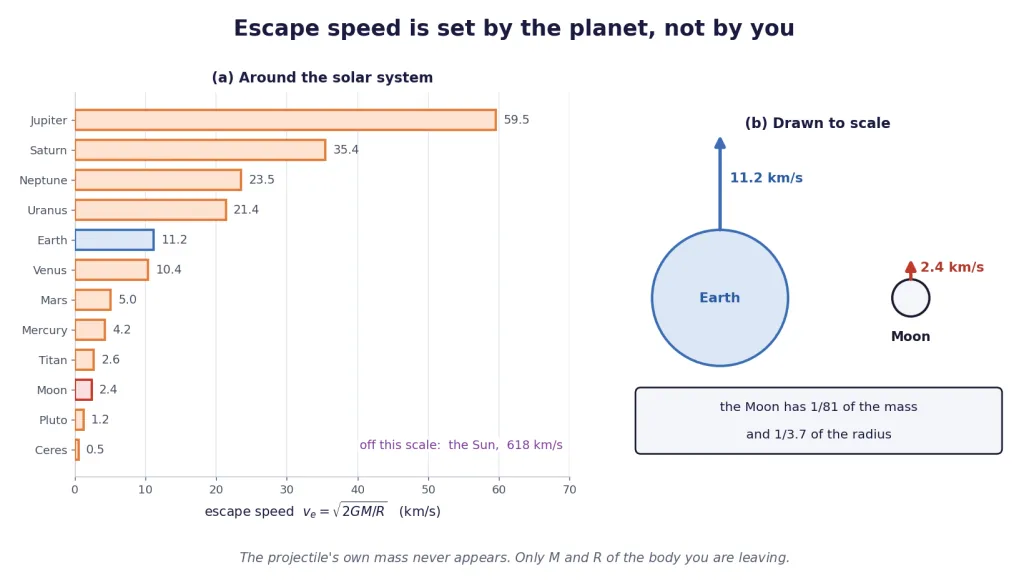
Other Worlds, and Why the Moon Has No Air
Nothing in the derivation was specific to the Earth. For any spherical body of mass and radius ,
where now means the surface gravity of that body. Feed in the numbers and the solar system spreads out over three orders of magnitude.
| Body | Mass (kg) | Radius (m) | Surface (m/s) | (km/s) |
|---|---|---|---|---|
| Ceres | 0.28 | 0.52 | ||
| Pluto | 0.62 | 1.21 | ||
| Moon | 1.62 | 2.37 | ||
| Titan | 1.36 | 2.64 | ||
| Mercury | 3.70 | 4.25 | ||
| Mars | 3.73 | 5.03 | ||
| Venus | 8.87 | 10.36 | ||
| Earth | 9.81 | 11.18 | ||
| Uranus | 8.97 | 21.35 | ||
| Neptune | 11.24 | 23.52 | ||
| Saturn | 10.42 | 35.45 | ||
| Jupiter | 24.79 | 59.54 | ||
| Sun | 274 | 617.6 |
Read a few rows against each other and the competition shows up plainly. Mercury and Mars have nearly the same surface gravity, yet Mars has the higher escape speed, because it is the bigger ball. Uranus has a lower surface gravity than the Earth and an escape speed nearly twice as large, for the same reason. Surface gravity and escape speed do not rank worlds in the same order.
The Moon's missing atmosphere
Here is where escape speed stops being an exam number and starts explaining something you can see.
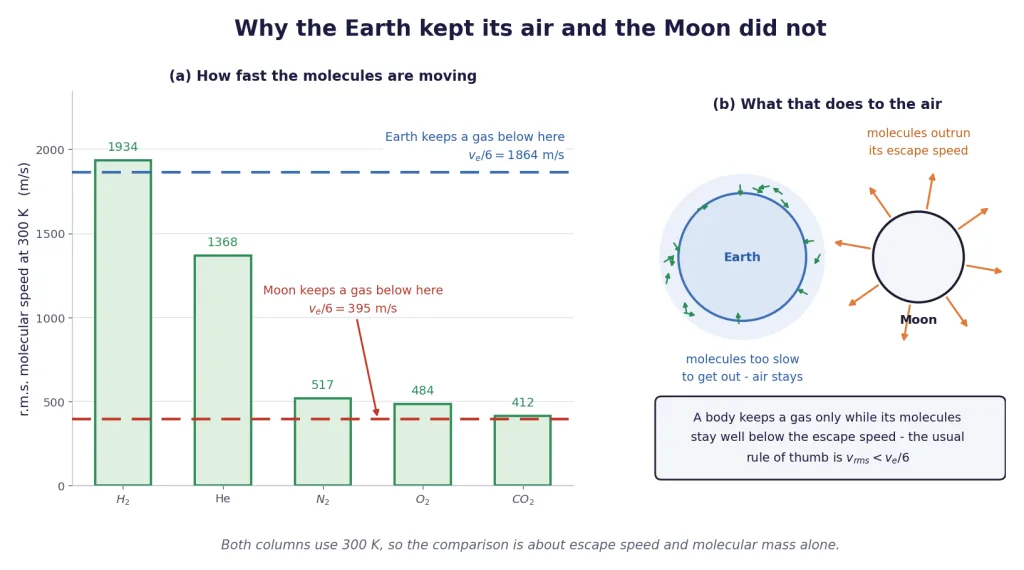
Gas molecules are not all moving at the same speed, but the kinetic theory you will meet in a later chapter gives their typical speed as the root-mean-square speed
with J/mol/K the gas constant, the absolute temperature and the molar mass in kilograms per mole. Light molecules move faster; hot gas moves faster.
At 300 K:
| Gas | Molar mass (g/mol) | at 300 K (m/s) |
|---|---|---|
| Hydrogen, | 2 | 1934 |
| Helium, He | 4 | 1368 |
| Nitrogen, | 28 | 517 |
| Oxygen, | 32 | 484 |
| Carbon dioxide, | 44 | 412 |
Now compare. The Moon's escape speed is 2372 m/s, so hydrogen molecules at 300 K are already moving at 82% of it — and that is only the average; the fastest molecules in the distribution are well past it. Every one of the five gases above is a substantial fraction of the Moon's escape speed, so over geological time the fast tail of every distribution leaks away, and the leak never stops.
The Earth's escape speed is 11 181 m/s. Nitrogen at 517 m/s is under 5% of it. Nitrogen is going nowhere.
Key Point — the retention rule of thumb:
A body holds on to a gas indefinitely only if is well below the escape speed — the usual working criterion is , because it is the fast tail of the distribution that escapes, not the average molecule.
- Earth: m/s. Nitrogen, oxygen and carbon dioxide are far below it and are kept. Hydrogen at 1934 m/s is above it, which is exactly why the Earth has almost no free hydrogen left in its atmosphere, and why helium leaks away too.
- Moon: m/s. Every common gas exceeds it. The Moon keeps nothing.
That is the answer to a question every syllabus asks: the Moon has no atmosphere because its escape speed, 2.4 km/s, is too small compared with the speeds of gas molecules at its surface temperature. Jupiter, at the other end, has an escape speed of 59.5 km/s and has held on even to hydrogen and helium — which is why it is made mostly of them.
[JEE Tip] If a question asks for the temperature at which a gas would escape from a given body, set and solve for : . For nitrogen on the Moon that gives about 6300 K, which sounds comfortably far off — until you remember that the criterion is really , not , and the corresponding temperature drops by a factor of 36.
Leaving From a Height, and Falling In From Far Away
Two variations account for most of the harder questions in this section, and they turn out to be the same calculation read in two directions.
Escaping from a height
Nothing in the derivation demanded that the launch happen at the surface. Start instead at a distance from the centre. The energy condition reads
Key Point — escape speed from a height : Higher up, the potential energy pit is shallower, so less speed is needed. At the requirement is km/s; at 1000 km it is 10.40 km/s; at 300 km, a typical low orbit, it is still 10.93 km/s.
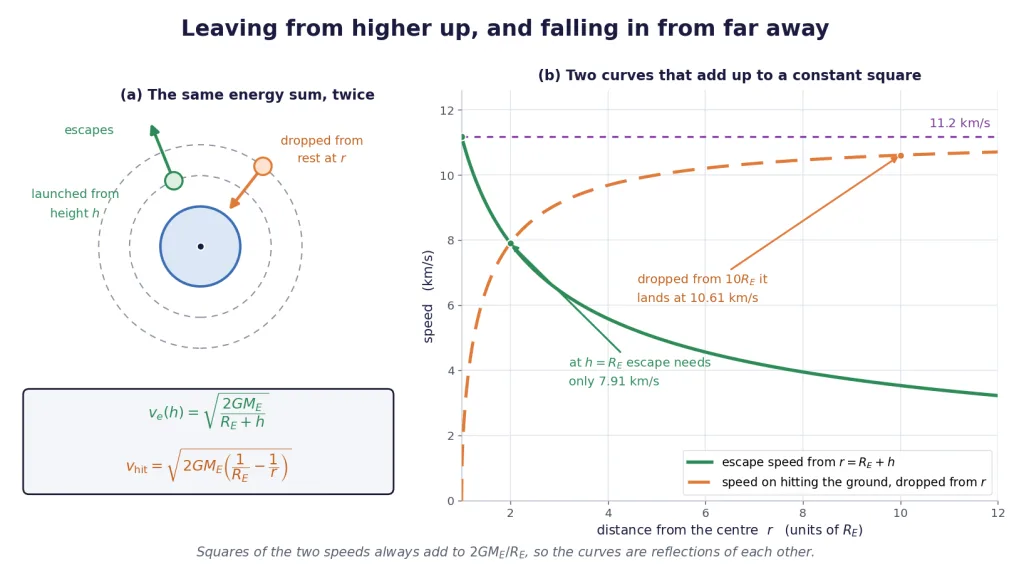
Notice how gently the requirement falls off. Climbing 300 km — higher than most satellites — buys you barely 2%. Gravity's grip weakens slowly because the potential goes as , not .
How high does a sub-escape launch go?
If the body must come back, and energy conservation says exactly where it turns round. At the highest point the speed is zero, so
Solving, and writing for the launch speed as a fraction of the escape speed:
Key Point — the turning point: Half the escape speed gets you only to , a height of km. Seventy per cent of it reaches . The formula blows up as , which is the mathematics telling you the body no longer turns round at all.
Read that first number again. Half the escape speed does not get you half way to escaping — it gets you a third of an Earth radius up. The energy scales as , and the last few per cent of speed buys almost all of the distance.
Falling in from far away
Now run the film backwards. A body starts at rest a distance from the Earth's centre and falls. What speed does it have when it reaches the surface? Same equation, opposite direction:
Key Point — impact speed after a drop from rest at distance : Dropped from it arrives at 10.00 km/s; from , at 10.61 km/s; and in the limit , at exactly km/s.
That limit is worth pausing over.
Key Point: A body released from rest at a very great distance strikes the Earth at the escape speed, 11.2 km/s. It could not be otherwise: escaping and falling in are the same journey run in opposite directions, and energy conservation does not care which way time is running.
So 11.2 km/s is not just the speed you need to leave — it is also the speed at which anything arrives if it fell in from far away with no initial speed. Meteoroids that merely drift into the Earth's grip hit the atmosphere at roughly this speed; ones that were already moving relative to the Earth hit harder.
The two curves in the figure above are reflections of each other, and they are locked together by
a constant. Where one is large the other is small, and both meet at , where each equals km/s.
[JEE Tip] Every problem in this block is the same three-line sum: write with , put a zero wherever the problem gives you "at rest" or "just escapes", and solve. Do not memorise four formulas; memorise one method.
The Shortlist, and the Traps
Everything worth memorising
| Quantity | Formula | Earth's value |
|---|---|---|
| Escape speed at the surface | 11.2 km/s | |
| Escape condition | total energy , zero of at infinity | — |
| In terms of density | , so | — |
| Escape speed from height | 7.91 km/s at | |
| Relation to surface orbital speed | km/s | |
| Height reached if , | for | |
| Speed left far away if | 12.5 km/s if | |
| Impact speed dropped from rest at | 11.2 km/s from very far away | |
| Energy needed to escape, for mass | J per kg | |
| Gas retention criterion | m/s |
Six traps
Trap 1 — thinking a heavier body needs a bigger escape speed. It does not. It needs more energy, and therefore more fuel, but the same speed. The clean statement: speed independent of , energy proportional to .
Trap 2 — thinking the direction matters. It does not, because the energy condition contains and no angle. A body flung at at 11.2 km/s escapes just as surely as one fired straight up.
Trap 3 — using or anywhere in this section. Every distance here is comparable with , so constant- formulas are worthless. Section 5 measured the damage: at , is 100% too large.
Trap 4 — confusing with , or applying at the wrong radius. The relation compares two speeds at the same distance from the centre. Compare the escape speed from a height with the orbital speed at that same height, never with the surface orbital speed.
Trap 5 — forgetting that escape speed changes with the planet. needs the surface gravity of that body. Putting 9.8 m/s into a Moon problem is the commonest single error in this section.
Trap 6 — reading "escape velocity" as a vector. It is a speed. The name is historical and everybody uses it, but a question asking for its "direction" is a trick.
What comes next
The escape condition, , is one half of a bigger picture. Section 7 works out what a body does when its energy is negative and it is moving sideways rather than radially — it goes into orbit — and Section 8 puts , and together for that orbit and shows that escape is simply the case where the total energy has been raised to zero. The energy needed to do that raising has a name, binding energy, and it belongs to Section 8.
[Board Important] The three-mark version of this section is: state the energy condition, derive , evaluate it as 11.2 km/s, and state that it is independent of the mass and the direction of projection. Everything else is variation on that.
Solved Examples
Constants used throughout this section, unless a problem states otherwise: N m/kg, kg, m, m/s and the gas constant J/mol/K. The zero of potential energy is at infinity throughout.
Example 1: The escape speed from the Earth, two ways
Calculate the escape speed at the Earth's surface (a) from , and , and (b) from and . Comment on the agreement.
Solution:
(a) From the masses.
(b) From the surface gravity.
Why they differ in the fourth figure. The two routes are algebraically identical, since . The rounded value 9.8 m/s is slightly below the m/s that these particular constants produce, and the 0.1% gap in becomes a 0.05% gap in , because of the square root.
Final Answer: km/s by both routes.
Takeaway: Pick whichever form matches the data you are given, and say which value of you used. Never mix 9.8 and 10 inside one problem.
Example 2: Leaving the Moon
The Moon has mass kg and radius m. Find its escape speed, and check it against using the Moon's surface gravity.
Solution:
From the mass and radius.
Cross-check with the surface gravity. The Moon's surface gravity is
Compare with the Earth. , so it is nearly five times easier to leave the Moon.
Final Answer: about km/s, roughly one fifth of the Earth's value.
Takeaway: The Moon has of the Earth's mass but only of its radius, and turns that into a factor of about 4.7 — not 81, and not 9.
Example 3: Leaving Jupiter
Jupiter has mass kg and radius m. Find its escape speed and express it as a multiple of the Earth's.
Solution:
Substitute.
As a multiple of the Earth's.
Where that factor comes from. Jupiter is 318 times as massive but 11.2 times as wide, so . The two effects genuinely do fight, and mass wins.
Final Answer: km/s, about 5.3 times the Earth's escape speed.
Takeaway: This is why Jupiter still has its hydrogen. At 59.5 km/s nothing in its atmosphere is going anywhere, which is a large part of why the giant planets look so different from the rocky ones.
Example 4: A heavier, wider planet
A planet has ten times the mass of the Earth and twice its radius. What is the escape speed at its surface?
Solution:
Work with the ratio rather than the raw numbers.
Multiply.
Direct check.
Final Answer: km/s.
Takeaway: Ratios are faster and safer than substituting nine-digit constants. Whenever a problem gives you multiples of Earth values, work in multiples all the way to the last line.
Example 5: Same rock, bigger ball
A planet is made of the same material as the Earth, with the same mean density, but has twice the radius. Find its escape speed. Also find the escape speed of a body with the Earth's mass compressed to half the Earth's radius.
Solution:
Rewrite in terms of density. Put into :
So at fixed density, . Doubling the radius doubles the escape speed.
Sanity check on the Earth's mean density. and does return m/s, as it must.
The compressed Earth. Same mass, half the radius, so :
Final Answer: km/s for the twice-as-wide planet of the same density; km/s for the Earth squeezed to half its radius.
Takeaway: at fixed density, but at fixed mass. Read carefully which of the two a question is holding constant — they push in opposite directions.
Example 6: A pebble, a rocket, and a sideways launch
A 2 kg pebble and a 2000 kg rocket are both to escape from the Earth. (a) Compare the speeds they need. (b) Compare the energies. (c) Does firing at to the vertical change either answer?
Solution:
(a) Speeds. The escape condition, , has on both sides. Cancel it:
(b) Energies. The minimum energy is , which is J per kilogram. a factor of 1000 apart, exactly the mass ratio.
(c) Direction. The condition contains , the square of the speed, with no reference to direction, so needs the same 11.2 km/s. (In practice a shallow launch would have to cross far more atmosphere, but that is drag, not gravity.)
Final Answer: same speed, 11.2 km/s, for both; energies of J and J; direction irrelevant.
Takeaway: "Same speed, different energy" is the sentence to write in an exam. Saying only "escape speed is independent of mass" without adding what does scale with mass usually loses the second mark.
Example 7: Only half as fast
A body is projected vertically upward from the Earth's surface with half the escape speed. How high does it rise?
Solution:
Energy conservation, with zero speed at the top.
Put , so .
Tidy up.
Height above the surface.
Final Answer: it rises , about 2123 km.
Takeaway: Half the escape speed does not take you anywhere near half way. Energy goes as , so half the speed is a quarter of the energy, and a quarter of the way out of a pit is barely off the ground.
Example 8: Fifty per cent over
A projectile leaves the Earth's surface at times the escape speed. With what speed is it travelling when it is very far away?
Solution:
Energy conservation between the surface and infinity, where .
Recognise and cancel .
Substitute .
Evaluate.
Final Answer: about km/s, which is times the escape speed.
Takeaway: is the whole of this family of problems. Half the launch speed's worth of energy was spent climbing out; only the surplus survives.
Example 9: Escaping from orbit height
What speed would a body need in order to escape from a point one Earth radius above the surface? Compare with the surface value.
Solution:
The launch radius. At the distance from the centre is .
Apply the condition at that radius.
Evaluate.
Compare. That is exactly km/s, a saving of 29% for a climb of 6370 km.
Final Answer: km/s, which is of the surface escape speed.
Takeaway: Height helps, but slowly. Because the potential goes as , you have to double your distance from the centre to cut the escape speed by only 29%.
Example 10: Dropped from far away
(a) With what speed does a body released from rest at a very great distance strike the Earth's surface? (b) What if it is released from rest at from the centre? Ignore the atmosphere.
Solution:
(a) Energy conservation from infinity. At the start, both and are zero.
(b) From a finite distance .
Evaluate.
Or, more quickly, use km/s.
Final Answer: (a) km/s; (b) km/s.
Takeaway: A body falling in from infinity arrives at exactly the escape speed, because escaping and falling in are one journey run in opposite directions. Note also that four fifths of that final speed is picked up between and the surface.
Example 11: Which gases can a world keep?
Take 300 K for both worlds. Using with J/mol/K, decide whether the Earth and the Moon can retain hydrogen and nitrogen, using the criterion .
Solution:
Molecular speeds at 300 K.
The two thresholds.
Compare, one line at a time.
| Gas | (m/s) | Earth (threshold 1864) | Moon (threshold 395) |
|---|---|---|---|
| Hydrogen | 1934 | above it, escapes | far above it, escapes |
| Nitrogen | 517 | far below it, retained | above it, escapes |
- Read the result. The Earth keeps nitrogen comfortably — 517 m/s is under 5% of its escape speed — but loses hydrogen, which is exactly what we observe: free hydrogen is essentially absent from the Earth's atmosphere. The Moon loses both, and everything else besides.
Final Answer: the Earth retains nitrogen and loses hydrogen; the Moon retains neither, which is why it has no atmosphere.
Takeaway: The Moon is airless because its escape speed of 2.4 km/s is simply too small compared with molecular speeds, not because the Moon somehow "lost" its air in an event. It is a slow, permanent leak.
Example 12: How fast at the Moon's distance?
A probe leaves the Earth's surface at km/s. How fast is it moving when it crosses the Moon's orbit, m from the Earth's centre? Ignore the Moon's own gravity.
Solution:
Energy conservation between the two radii.
Rearrange for .
The two potential terms.
Substitute.
Final Answer: about km/s.
Takeaway: The probe has shed more than half its speed by the time it reaches the Moon, and almost all of that loss happened in the first few Earth radii. Since it left above escape speed, it still has 5.77 km/s at the Moon's distance and would arrive at infinity with km/s.