Gravitation is one of those chapters where every idea eventually talks to every other one. A satellite question is a circular-motion question and an energy question at the same time. A "how deep is the mine" question is a shell-theorem question. A comet question is Kepler plus angular momentum plus energy. These 44 problems are laid out so the early ones drill a single idea and the later ones make two or three of them work together.
Work them with a pen. Cover the solution, try it, then compare — including the checks at the end of each solution, because the checks are where marks are usually lost.
The five questions to ask before you write anything
Which distance goes in the formula? Almost always the distance between centres, never between surfaces, and never the height above the ground unless the formula is specifically written in terms of h.
Am I being asked for U or for V? Gravitational potential energy U belongs to a pair of bodies and is measured in joules. Gravitational potential V belongs to a point in space and is measured in joules per kilogram. Mixing them is the single most expensive error in this chapter.
Is anything a vector here? Force and field add as vectors and can cancel. Potential energy and potential are scalars and, for ordinary masses, are all negative — so they can only pile up.
What is my zero? Everywhere below, the zero of both U and V is at infinity. That is what makes both of them negative near a mass.
Does the sign make sense?U negative, V negative, the total energy of a bound orbit negative, binding energy positive. If a "binding energy" comes out negative you have dropped a minus sign.
Key Point:g, the gravitational field, and g, the acceleration due to gravity, are the same quantity in the same units. A satellite in orbit has an acceleration exactly equal to the local g, because gravity is the only force on it.
The constants, and the value of g
Unless a problem states its own data, everything below uses
Quantity
Symbol
Value
Gravitational constant
G
6.67×10⁻¹¹ N m2/kg2
Mass of the Earth
ME
5.97×1024 kg
Radius of the Earth
RE
6.37×10⁶ m
Product, worth memorising
GME
3.982×10¹⁴ m3/s2
Surface gravity
g
9.8 m/s2
Mass of the Sun
MS
about 2×1030 kg
One astronomical unit
AU
1.5×10¹¹ m
Each problem states the data it uses in its own statement, and no problem mixes g=9.8 with g=10. Several problems deliberately quote slightly different values of ME and RE (such as 6.0×1024 kg and 6.4×10⁶ m) — when that happens the statement says so, and the answer is worked with those numbers throughout.
[Board Important] Every solution below writes the formula on its own line before any number goes into it. Do the same in the exam. A correct formula with an arithmetic slip still earns most of the marks; a bare number earns none.
Solved Examples
Part 1: Kepler's Three Laws — Planets, Moons and Comets
Example 1: A planet that laps the Earth
Suppose a planet existed that went round the Sun exactly twice as fast as the Earth does — that is, its year is half of ours. How would the size of its orbit compare with the size of the Earth's?
Solution:
Quote the harmonic law. For any two bodies orbiting the same Sun,
TE2Tp2=aE3ap3
where a is the semi-major axis. For a nearly circular orbit, a is just the radius.
Put in the period ratio,TETp=21:
aE3ap3=(21)2=41
Take the cube root.aEap=(41)1/3=4−1/3=0.630
Read it in kilometres. With aE=1.5×10¹¹ m, the planet would sit at
ap=0.630×1.5×1011=9.45×10¹⁰ m
which is between the orbits of Venus and the Earth.
Check the speed too. Orbital speed goes as a1, so the planet moves 0.6301=1.26 times as fast as the Earth. Half the period on a 0.63-sized orbit means T2πa has gone up by 0.50.63=1.26. Consistent.
Final Answer: its orbit would be 0.63 times the size of the Earth's, about 9.45×10¹⁰ m, and it would travel 1.26 times as fast.
Takeaway:Halving the period does not halve the radius — it shrinks it only to 0.63 of the original. The two-thirds power in a∝T2/3 makes orbital size respond lazily to changes in period.
Example 2: How far out is Saturn?
A year on Saturn lasts 29.5 Earth years. The Earth's orbit has a mean radius of 1.50×10⁸ km. How far is Saturn from the Sun?
Solution:
Quote the law and rearrange it for a.TE2TS2=aE3aS3⟹aS=aE(TETS)2/3
SubstituteTETS=29.5:
(29.5)2/3=9.55
Multiply out.aS=9.55×1.50×108=1.43×10⁹ km=1.43×10¹² m
Sanity check. That is 9.55 AU. Saturn is indeed a little under ten times as far from the Sun as we are, and takes about thirty times as long to get round. The three-halves relation between those two numbers (9.553/2=29.5) is Kepler's third law in one line.
Final Answer: about 1.43×10⁹ km from the Sun, or 9.55 AU.
Takeaway:You never need G or the Sun's mass to compare two orbits round the same star. Ratios are enough, and ratios are much less error-prone than absolute values.
Example 3: Weighing Jupiter with one of its moons
Io, one of Jupiter's moons, has an orbital period of 1.769 days and an orbital radius of 4.22×10⁸ m. Find Jupiter's mass, and compare it with the Sun's mass of 2×1030 kg. Take G=6.67×10⁻¹¹ N m2/kg2.
Solution:
The period rule for a satellite of a body of mass M.T=2πGMr3⟹M=GT24π2r3
Convert the period to seconds.T=1.769×24×3600=1.528×10⁵ s
Work out the two big pieces.r3=(4.22×10⁸)3=7.515×1025 m3T2=(1.528×10⁵)2=2.336×10¹⁰ s2
Assemble.MJ=6.67×10−11×2.336×10104π2×7.515×1025=1.5582.967×1027=1.90×1027 kg
Compare with the Sun.MSMJ=2×10301.90×1027=9.5×10⁻⁴≈10501
Final Answer:MJ=1.90×1027 kg, which is about one thousandth of the Sun's mass.
Takeaway:Watch anything go round a body and you have weighed that body. The orbiting object's own mass never appears — Io's mass is nowhere in this calculation, and that is why one moon is enough.
Example 4: How long is a galactic year?
Take our galaxy to contain 2.5×10¹¹ stars, each of one solar mass (2×1030 kg), and suppose that mass acts as though it were concentrated at the galactic centre. How long does a star 50000 light-years out take to complete one revolution? Take one light-year as 9.46×10¹⁵ m and G=6.67×10⁻¹¹ N m2/kg2.
Solution:
The total mass.M=2.5×1011×2×1030=5.0×1041 kg
The orbital radius in metres.r=5.0×104×9.46×1015=4.73×10²⁰ m
Quote the period formula and substitute.T=2πGMr3r3=(4.73×10²⁰)3=1.058×1062 m3GM=6.67×10−11×5.0×1041=3.335×1031 m3/s2
Evaluate.T=2π3.335×10311.058×1062=2π3.17×1030=2π×1.78×1015T=1.12×10¹⁶ s
In years. One year is 3.156×10⁷ s, so
T=3.156×1071.12×1016=3.55×10⁸ years
Final Answer: about 1.12×10¹⁶ s, which is roughly 355 million years.
Takeaway:A galactic year is about 355 million years, so the Sun has gone round perhaps twenty times since it formed. The model here is crude — real galactic mass is spread out, not lumped at the centre — but the order of magnitude is right, and the method is exactly the method used on Jupiter two problems ago.
Example 5: What stays constant as a comet goes round
A comet moves round the Sun on a very elongated ellipse. Neglecting any mass it loses when it comes close to the Sun, state whether each of the following stays constant through one orbit: (a) linear speed, (b) angular speed, (c) angular momentum about the Sun, (d) kinetic energy, (e) potential energy, (f) total energy.
Solution:
The two things that genuinely do not change. The only force on the comet is the Sun's pull. It acts along the line joining them, so its torque about the Sun is zero, so angular momentum about the Sun is constant. That force is also conservative, so total energy is constant.
(a) Linear speed — not constant. At perihelion the comet is deep in the Sun's potential well and moves fastest; at aphelion it crawls. For an orbit with perihelion and aphelion distances rp and ra, conservation of angular momentum gives
vprp=vara⟹vavp=rpra
For a comet with ra=50rp, the speed changes by a factor of fifty.
(b) Angular speed — not constant. Constant areal velocity means r2ω is constant, so ω∝r21. Between the two ends of that same orbit, ω changes by a factor of 502=2500.
(c) Angular momentum — constant. As argued in step 1. This is exactly the content of the equal-areas law, since the areal velocity is 2mL.
(d) Kinetic energy — not constant. It follows the speed, so it varies enormously.
(e) Potential energy — not constant.U=−rGMSm changes as r changes; it is most negative at perihelion.
(f) Total energy — constant.K and U trade back and forth, but their sum does not move.
Quantity
Constant?
Why
linear speed
no
fastest at perihelion, slowest at aphelion
angular speed
no
ω∝r21
angular momentum
yes
the Sun's pull exerts no torque about the Sun
kinetic energy
no
it follows the speed
potential energy
no
it follows r1
total energy
yes
gravity is a conservative force
Final Answer: only the angular momentum about the Sun and the total energy are constant. The other four all vary through the orbit.
Takeaway:Two conserved quantities, four that change. Nearly every elliptical-orbit numerical in this chapter is solved by writing down those same two conservation statements and nothing else.
Example 6: Two moons of Saturn
Titan orbits Saturn at a mean distance of 1.222×10⁹ m with a period of 15.95 days. Rhea orbits the same planet at 5.27×10⁸ m. Find (a) Rhea's period and (b) the mass of Saturn. Take G=6.67×10⁻¹¹ N m2/kg2.
Solution:
(a) Two satellites of the same planet, so use the ratio form.TTTR=(rTrR)3/2
The radius ratio.rTrR=1.222×1095.27×108=0.4313(0.4313)3/2=0.4313×0.4313=0.4313×0.6567=0.2832
So Rhea's period isTR=0.2832×15.95=4.52 days=3.90×10⁵ s
(b) For the mass, now we do need G. Use Titan, converting its period:
TT=15.95×86400=1.378×10⁶ sM=GTT24π2rT3=6.67×10−11×(1.378×106)24π2(1.222×10⁹)3
Evaluate.rT3=1.825×1027 m3,TT2=1.899×10¹² s2M=126.77.205×1028=5.69×1026 kg
Cross-check with Rhea. Using rR and the TR we just predicted must give the same mass, because that is precisely the statement T2r3 is the same for both. It does.
Final Answer: Rhea's period is about 4.52 days, and Saturn's mass is 5.69×1026 kg — roughly 95 Earth masses.
Takeaway:Part (a) needed no constants at all; part (b) needed G. Ratios of orbits round one body are free; absolute masses always cost you a G.
Part 2: Adding Up Forces — Two, Three and Four Masses, and Null Points
Example 7: Two heavy spheres on a table
Two spheres, each of mass 100 kg and radius 0.10 m, are placed on a horizontal table with their centres 1.0 m apart. Find the gravitational force and the gravitational potential at the mid-point of the line joining the centres. Is a small object placed there in equilibrium? If so, is it stable? Take G=6.67×10⁻¹¹ N m2/kg2.
Solution:
First, the shell theorem lets us treat each sphere as a point. Each sphere is uniform and the test point lies outside both of them, so each behaves exactly as though its whole 100 kg sat at its centre. The radius 0.10 m plays no part except to confirm the point is outside.
The force. The mid-point is 0.50 m from each centre. The two pulls have equal magnitude
F1=F2=r2Gm×mtest=0.256.67×10−11×100mtest
but they point in exactly opposite directions along the line, so
Fnet=0
The potential. Potential is a scalar, so there is no cancellation — the two contributions add.
V=−rGm−rGm=−0.502×6.67×10−11×100V=−2.67×10⁻⁸ J/kg
with the zero taken at infinity.
Is it equilibrium? Yes — zero net force is exactly what equilibrium means.
Is it stable? Displace the object a little along the line, towards one sphere. It is now nearer that sphere and further from the other, so the near pull grows and the far pull shrinks, and the net force drags it further along. That is the signature of instability. (Displace it sideways instead and the two pulls do develop a small restoring component — but a point that is unstable in even one direction is an unstable equilibrium.)
Final Answer: the net force is zero, the potential is −2.67×10⁻⁸ J/kg, and the object is in unstable equilibrium.
Takeaway:Zero field does not mean zero potential. Vectors cancel; scalars from ordinary masses cannot, because they all carry the same negative sign.
Example 8: Three masses in a row
Masses of 2 kg, 4 kg and 6 kg lie along a straight line at x=0, x=1.0 m and x=3.0 m. Find the net gravitational force on the 4 kg mass. Take G=6.67×10⁻¹¹ N m2/kg2.
Solution:
List the two pulls on the 4 kg, each from Newton's law F=r2Gm1m2.
From the 2 kg, a distance 1.0 m away, pulling in the −x direction:
F1=1.02G×2×4=8G
From the 6 kg, a distance 2.0 m away, pulling in the +x direction:
F2=2.02G×4×6=424G=6G
Add them as vectors. They are anti-parallel, so subtract magnitudes and keep the sign of the larger:
Fnet=8G−6G=2G=2×6.67×10−11=1.33×10⁻¹⁰ N
in the −x direction, that is, towards the 2 kg mass.
The point of the problem. The 6 kg is the heavier neighbour, yet it loses. Trebling the mass multiplies the pull by 3; doubling the distance divides it by 4. Distance wins.
Final Answer:1.33×10⁻¹⁰ N directed towards the 2 kg mass, along the −x direction.
Takeaway:In an inverse-square law, distance is a stronger lever than mass. Always compare r2m, never m alone.
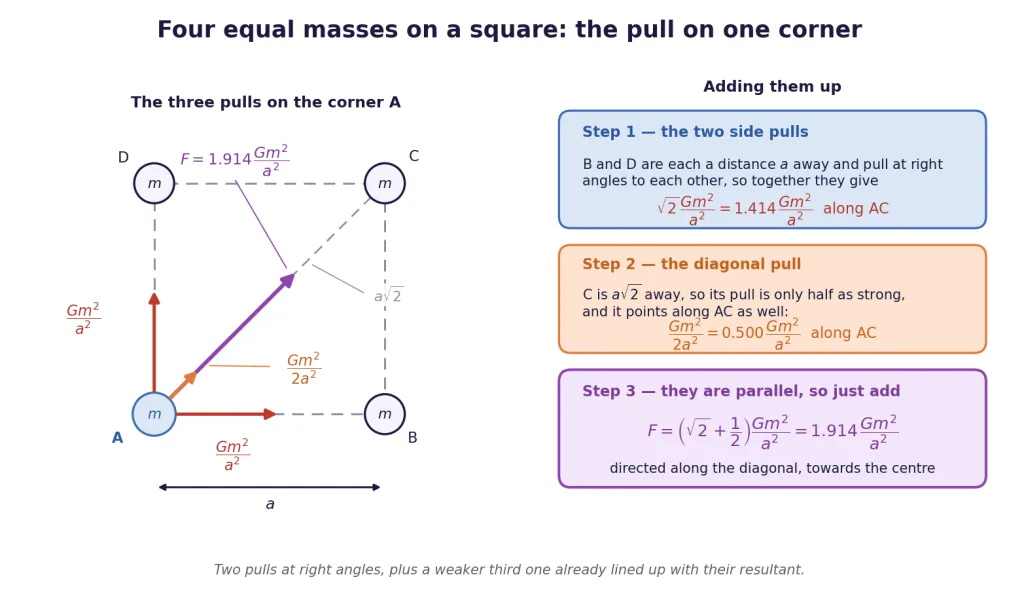
Example 9: Four masses on a square, and the pull on one corner
Four equal masses m sit at the corners of a square of side a. Find the net gravitational force on any one of them due to the other three. Then evaluate it for m=20 kg and a=0.50 m, with G=6.67×10⁻¹¹ N m2/kg2.
Solution:
Name the corners. Call the corner we are interested in A, the two next to it B and D, and the far one C. Then AB=AD=a and AC=a2.
The two side pulls. Each has magnitude
Fside=a2Gm2
and they are at right angles to each other, so their resultant is
2a2Gm2=1.414a2Gm2
directed along the diagonal AC — which is just the diagonal of the square built on the two equal arrows.
The diagonal pull.C is a2 away, so
Fdiag=(a2)2Gm2=2a2Gm2=0.500a2Gm2
and it points along AC as well.
They are parallel, so simply add.F=(2+21)a2Gm2=1.914a2Gm2
directed along the diagonal, towards the centre of the square.
Put the numbers in.a2Gm2=0.256.67×10−11×400=1.067×10⁻⁷ NF=1.914×1.067×10−7=2.04×10⁻⁷ N
A symmetry check. By the same argument, every corner feels a pull of the same size directed at the centre. Four inward pulls, arranged symmetrically — so the whole set would collapse inwards on itself, which is exactly what an isolated four-mass square would do.
Final Answer:F=1.914a2Gm2 along the diagonal towards the centre; for the given numbers, 2.04×10⁻⁷ N.
Takeaway:Do the two perpendicular pulls first, then notice the third one is already lined up with their resultant. Choosing that order turns a three-vector problem into one right-angled triangle and one addition.
Example 10: Firing a rocket at the Sun
A rocket is launched from the Earth straight towards the Sun. At what distance from the Earth's centre does the net gravitational force on it fall to zero? Take the Sun's mass as 2×1030 kg, the Earth's as 6×1024 kg, and the Earth-Sun distance as 1.5×10¹¹ m. Neglect all other bodies.
Solution:
Set up. Let the null point be a distance x from the Earth's centre, so it is d−x from the Sun's centre, with d=1.5×10¹¹ m. The two pulls act in opposite directions there, so setting them equal:
x2GMEmr=(d−x)2GMSmr
The rocket's mass mr cancels, and so does G. Take the square root of both sides:
xd−x=MEMS
The mass ratio.MEMS=6×10242×1030=3.333×10⁵⟹MEMS=577.4
Solve for x.d−x=577.4x⟹d=578.4x⟹x=578.41.5×1011x=2.59×10⁸ m
Read it. That is about 2.6×10⁵ km from the Earth's centre — only 0.17% of the way to the Sun, and about two-thirds of the way out to the Moon, whose orbit sits at 3.84×10⁸ m.
Why so close to the Earth? The Sun is 333000 times heavier, so to balance it the rocket must be 333000=577 times closer to the Earth than to the Sun.
Final Answer: about 2.59×10⁸ m from the Earth's centre, on the line towards the Sun.
Takeaway:The null point always sits far nearer the lighter body, and the ratio of distances is the square root of the ratio of masses. Take that square root early — the numbers get much friendlier.
Example 11: An unequal triangle, done properly with components
Masses of 1 kg, 2 kg and 3 kg sit at the corners A, B and C of an equilateral triangle of side 1.0 m. Find the magnitude and direction of the net gravitational force on the 3 kg mass. Take G=6.67×10⁻¹¹ N m2/kg2.
Solution:
Set up coordinates. Put A at the origin, B at (1,0), and C at (0.5,0.866), all in metres, since the height of an equilateral triangle of side 1 is 23=0.866.
The two pulls on the 3 kg at C. Both have r=1.0 m.
FCA=12G×3×1=3G,FCB=12G×3×2=6GFCA points from C towards A, and FCB from C towards B.
The unit vectors.u^CA=(−0.5,−0.866),u^CB=(+0.5,−0.866)
Magnitude.F=G1.52+7.7942=G2.25+60.75=G63=7.937GF=7.937×6.67×10−11=5.29×10⁻¹⁰ N
Direction. Taking the angle from the +x axis,
θ=tan−1(+1.5−7.794)=−79.1°
so the force points downward and slightly to the right: 79.1° below the +x axis, which is 10.9° away from straight down, tilted towards B.
Check it with the cosine rule. The angle between the two pulls is 60°, so
F=G32+62+2(3)(6)cos60°=G9+36+18=G63
The same 63. Good.
Final Answer:5.29×10⁻¹⁰ N, directed 79.1° below the AB direction — that is, mostly straight down towards the side AB, leaning 10.9° towards the heavier neighbour B.
Takeaway:Resolve into components and let the signs do the work. Two arrows and a cosine rule is faster here, but components generalise to four masses, five masses and any awkward angle, and they never let you lose a direction.
Example 12: The Sun pulls harder, the Moon raises the bigger tide
Compare (a) the gravitational force the Sun exerts on the Earth with that exerted by the Moon, and (b) the difference in that pull between the near side and the far side of the Earth for each of them. Use MS=2×1030 kg at 1.5×10¹¹ m, MM=7.35×10²² kg at 3.84×10⁸ m, ME=5.97×1024 kg and RE=6.37×10⁶ m.
Solution:
(a) The two pulls.FS=rSE2GMSME=(1.5×10¹¹)26.67×10−11×2×1030×5.97×1024=3.54×10²² NFM=rME2GMMME=(3.84×10⁸)26.67×10−11×7.35×1022×5.97×1024=1.98×10²⁰ NFMFS=1.98×10203.54×1022=178
So the Sun wins comfortably — by a factor of nearly 180.
(b) But a tide is not caused by the pull. A tide is caused by the pull being stronger on the near side than on the far side, which stretches the oceans. The relevant quantity is therefore the difference
Δg=GM[(r−RE)21−(r+RE)21]≈r34GMRE
Take the ratio of those differences. The 4GRE cancels:
ΔgSΔgM=MSMM(rMErSE)3=2×10307.35×1022×(3.84×1081.5×1011)3
Read it. The Moon's tidal stretch is about 2.2 times the Sun's, even though the Moon's pull is 178 times weaker.
Final Answer: the Sun pulls 178 times harder, but the Moon's tidal effect is about 2.2 times the Sun's.
Takeaway:The pull goes as r2M, but the tide goes as r3M. That extra power of r is the whole story: being close beats being massive when what matters is how much the field changes across an object.
Part 3: Inside and Outside a Sphere, Weighing Worlds, and the Variations of g
Example 13: Can you hide from gravity inside a hollow shell?
A charge can be shielded from an electric field by putting it inside a hollow conductor. Can a body be shielded from the gravitational influence of nearby matter by putting it inside a hollow sphere, or by any other means? Support the answer with a calculation. Take G=6.67×10⁻¹¹ N m2/kg2.
Solution:
What the shell itself does. A uniform spherical shell exerts no net force on any body placed anywhere inside it. That is genuine and exact: for any point inside, the extra mass of the far part of the shell is precisely compensated by its extra distance, so
gshell,inside=0
So far, so encouraging — but that is not shielding. Shielding would mean the shell blocking the field of something else. It does not.
A number to prove it. Put a hollow shell of mass 1000 kg and radius 1.0 m around a small body, and place a 100 kg mass 2.0 m from the centre, outside the shell. The field at the centre from that external mass is
gext=r2GM=(2.0)26.67×10−11×100=1.67×10⁻⁹ m/s2
Exactly what it would have been with no shell at all. The shell contributes zero, and it removes nothing.
Why electricity is different. A conductor shields because it has mobile charges of both signs, which rearrange until they cancel the outside field within the metal. Mass comes in only one sign, so nothing can rearrange to cancel anything. There is no negative mass to work with.
Final Answer: No. A hollow sphere contributes zero field inside itself, but it does not screen the field of any external body, and no arrangement of matter can. Gravitational shielding does not exist.
Takeaway:"Zero field from the shell" and "shielded from everything" are different statements. Inside a shell you are free of the shell — you are not free of the Earth, the Sun or the person standing next to you.
Example 14: A solid sphere, from three different places
A uniform solid sphere has mass 1000 kg and radius 0.50 m. Find the gravitational force it exerts on a 1.0 kg particle placed (a) 1.0 m from the centre, (b) exactly on its surface, and (c) 0.25 m from the centre. Take G=6.67×10⁻¹¹ N m2/kg2.
Solution:
The two rules for a uniform sphere. Outside, the sphere behaves as a point mass at its centre. Inside, only the mass within the particle's radius counts, and it too acts as though it were at the centre:
r≥R:F=r2GMmr≤R:F=R3GMmr
(a) At r=1.0 m, outside.F=1.026.67×10−11×1000×1.0=6.67×10⁻⁸ N
(b) On the surface, r=R=0.50 m. Both formulas agree here, which is a useful check:
F=0.256.67×10−11×1000×1.0=2.67×10⁻⁷ N
(c) At r=0.25 m, inside. Only the inner sphere of radius 0.25 m pulls, and it holds (0.500.25)3=81 of the mass, that is 125 kg, at a distance of 0.25 m:
F=(0.25)26.67×10−11×125×1.0=0.06258.34×10−9=1.33×10⁻⁷ N
Check against the linear rule. At half the radius the inside formula predicts exactly half the surface value: 22.67×10−7=1.33×10⁻⁷ N. It agrees.
Final Answer: (a) 6.67×10⁻⁸ N, (b) 2.67×10⁻⁷ N, (c) 1.33×10⁻⁷ N.
Takeaway:The maximum pull of a uniform sphere is at its surface. Move outwards and it falls as r21; move inwards and it falls linearly to zero at the centre. Two different laws meeting at one point.
Example 15: A 250 N body, taken down and taken up
A body weighs 250 N at the Earth's surface. Assuming the Earth to be a sphere of uniform density, find its weight (a) half way down to the centre and (b) at a height equal to half the Earth's radius.
Solution:
(a) Depth: use the linear law. With d=2RE,
gd=g(1−REd)=g(1−21)=2g
So the weight halves.Wd=2250=125 N
(b) Height: use the inverse square law, with r=RE+2RE=23RE:
gh=g(rRE)2=g(32)2=94g
So the weight becomesWh=94×250=111 N
Compare the two. The same displacement of half an Earth radius costs 50% of the weight going down but 56% going up. Going up is worse — because the inverse square is a steeper law than the straight line.
Final Answer: (a) 125 N half way to the centre; (b) 111 N at a height of half an Earth radius.
Takeaway:Down is linear, up is inverse-square, and they are not symmetric. The only place where both give the same value is the surface itself.
Example 16: A tunnel to the centre
Imagine a narrow tunnel bored from the surface of the Earth to its centre, and take the Earth to be a uniform sphere with g=9.8 m/s2 at the surface and RE=6.37×10⁶ m. (a) Write the acceleration of a body at a distance r from the centre. (b) Find g at a depth of 1000 km. (c) Where along the tunnel is the pull greatest, and where is it least?
Solution:
(a) Only the sphere below you counts. At a distance r from the centre, the mass inside is Mr=ME(REr)3, and the shells above contribute nothing. So
gr=r2GMr=RE3GMEr=gREr
The pull is directly proportional to the distance from the centre.
In terms of depth d=RE−r, the same statement reads
gd=g(1−REd)
(b) At d=1000 km =1.0×10⁶ m.REd=6.37×1061.0×106=0.157gd=9.8×(1−0.157)=9.8×0.843=8.26 m/s2
A drop of about 16% for a thousand kilometres of descent.
(c) Greatest and least. Since gr rises steadily with r all the way out to the surface, and then falls as r21 beyond it, the maximum is at the surface itself, 9.8 m/s2. The minimum along the tunnel is at the centre, where r=0 and so g=0: a body released at the centre would float, because it is pulled equally in every direction.
A caution about the real Earth. The Earth is not uniform; the iron core is roughly four times denser than the crust. As a result the real g actually rises slightly for the first few thousand kilometres of depth before falling. The uniform-density model is the one intended in every exam question, and it is the one used here.
Final Answer: (a) gr=gREr; (b) 8.26 m/s2 at a depth of 1000 km; (c) greatest at the surface, zero at the centre.
Takeaway:The centre of the Earth is the one place where a body has weight zero because the field is zero. Remember that later, when weightlessness in orbit turns out to be a completely different phenomenon with the same instrument reading.
Example 17: Weighing the Earth from a stone dropped down a well
A stone dropped from rest into a dry well falls 20.0 m in 2.02 s. Using only this measurement and RE=6.37×10⁶ m, find the mass of the Earth and its mean density. Take G=6.67×10⁻¹¹ N m2/kg2 and ignore air resistance.
Solution:
Get g from the fall. From rest, h=21gt2, so
g=t22h=(2.02)22×20.0=4.08040.0=9.80 m/s2
Quote the surface-gravity relation and invert it.g=RE2GME⟹ME=GgRE2
Substitute.RE2=(6.37×10⁶)2=4.058×10¹³ m2ME=6.67×10−119.80×4.058×1013=6.67×10−113.977×1014=5.96×1024 kg
The mean density.ρ=34πRE3ME=34π(6.37×10⁶)35.96×1024=1.083×10215.96×1024=5.51×10³ kg/m3
What that tells you about the inside. Surface rock has a density near 2700 kg/m3, only half of this. So the interior must be far denser than the crust — which is exactly how we know there is an iron core down there, without ever having been near it.
Final Answer:ME≈5.96×1024 kg, with a mean density of about 5510 kg/m3, or 5.51 g/cm3.
Takeaway:A tape measure, a stopwatch and the value of G are enough to weigh the planet you are standing on. This is why Cavendish's experiment mattered so much — before G was known, gRE2 was all anyone could measure.
Example 18: Weighing the Sun, twice over
Estimate the Sun's mass (a) from the Earth's orbit, of mean radius 1.50×10¹¹ m and period one year, and (b) from Jupiter's orbit, of mean radius 7.78×10¹¹ m and period 11.86 years. Comment on the agreement. Take one year as 3.156×10⁷ s and G=6.67×10⁻¹¹ N m2/kg2.
Solution:
The idea. The Sun's pull supplies the centripetal force for a planet in a circular orbit:
r2GMSm=rmv2=T24π2mr⟹MS=GT24π2r3
The planet's mass m has cancelled, which is why any planet will do.
(a) From the Earth.r3=(1.50×10¹¹)3=3.375×1033 m3,T2=(3.156×10⁷)2=9.96×10¹⁴ s2MS=6.67×10−11×9.96×10144π2×3.375×1033=6.643×1041.332×1035=2.01×1030 kg
(b) From Jupiter.T=11.86×3.156×107=3.743×10⁸ sr3=(7.78×10¹¹)3=4.709×1035 m3,T2=1.401×10¹⁷ s2MS=6.67×10−11×1.401×10174π2×4.709×1035=9.345×1061.859×1037=1.99×1030 kg
The comparison. The two answers differ by less than 1%, even though Jupiter's orbit is five times wider and its year twelve times longer. That agreement is Kepler's third law being confirmed and used at the same time.
Final Answer: about 2.0×1030 kg either way — 2.01×1030 kg from the Earth and 1.99×1030 kg from Jupiter.
Takeaway:Every planet gives the same answer for the Sun's mass, and that is the real test of the theory. If different planets gave different answers, the inverse-square law would be wrong.
Example 19: The tower and the mine
Take g=9.8 m/s2 at the Earth's surface and RE=6.37×10⁶ m, and treat the Earth as uniform. Find g (a) at the top of a tower 828 m high and (b) at the bottom of a mine 3.9 km deep. In part (a), compare the exact inverse-square answer with the binomial shortcut and say how big the shortcut's error is.
Solution:
(a) The exact form.gh=g(RE+hRE)2=g(1+REh)−2REh=6.37×106828=1.300×10⁻⁴gh=9.8×(1.00013)−2=9.79745 m/s2
so the exact drop is 9.8−9.79745=2.5472×10⁻³ m/s2.
The binomial shortcut, valid when h≪RE:
gh≈g(1−RE2h)⟹drop≈RE2gh=2.5477×10⁻³ m/s2
How wrong is the shortcut?error=2.54722.5477−2.5472=1.95×10−4=0.02%
Two parts in ten thousand — utterly negligible. (The general result is that the binomial form overstates the drop by a fraction 2RE3h, which for any tower on Earth is tiny.)
(b) The mine, using the depth law.gd=g(1−REd)=9.8(1−6.37×1063900)=9.8(1−6.122×10⁻⁴)gd=9.8−6.00×10−3=9.7940 m/s2
Compare the two losses. Going up 828 m costs 2.55×10⁻³ m/s2; going down 3900 m costs 6.00×10⁻³ m/s2 — about 2.4 times as much, for 4.7 times the displacement.
Why the ratio is not 4.7. Per metre, altitude costs RE2g and depth costs only REg — exactly half as much. So 4.7 metres of depth is worth only 2.35 metres of height, and 24.71=2.36, which is the ratio we found.
Final Answer: (a) 9.79745 m/s2 at the top of the tower, with the binomial shortcut in error by only 0.02%; (b) 9.7940 m/s2 at the bottom of the mine.
Takeaway:Near the surface, one metre of depth is worth exactly half a metre of height. And the binomial approximation is not a guess — its error is 2RE3h, which you can quote and defend.
Example 20: How much of your weight does the Earth's spin steal?
The Earth turns once relative to the stars in 8.6164×10⁴ s. Taking RE=6.37×10⁶ m and g=9.8 m/s2 in the absence of rotation, find (a) the reduction in apparent g at the equator, as a percentage, (b) the latitude at which the reduction is exactly half its equatorial value, and (c) how much lighter a 60 kg person is at the equator than at the pole, on this account alone.
Solution:
Quote the latitude formula. At latitude λ, the body moves on a circle of radius REcosλ, and only the component of the centripetal requirement along the local vertical shows up in a spring balance:
gλ=g−ω2REcos2λ
The angular speed.ω=T2π=8.6164×1042π=7.292×10⁻⁵ rad/s
(a) At the equator, λ=0, so cos2λ=1:ω2RE=(7.292×10⁻⁵)2×6.37×106=5.317×10−9×6.37×106=3.387×10⁻² m/s2gω2RE=9.80.03387=3.46×10−3=0.35%
(b) Half of that reduction requires cos2λ=21, so
cosλ=21⟹λ=45°
and there
g45=9.8−0.03387×0.5=9.783 m/s2
(c) The 60 kg person. At the pole the spring balance reads 60×9.8=588 N. At the equator it reads
60×(9.8−0.03387)=60×9.766=585.97 N
a loss of
60×0.03387=2.03 N
A note on the real Earth. The measured difference between pole and equator is about 0.05 m/s2, larger than the 0.034 m/s2 found here, because the Earth is also flattened — the equator is about 21 km further from the centre. Rotation accounts for roughly two-thirds of the observed pole-to-equator difference, and the bulge for the rest.
Final Answer: (a) 0.35%; (b) at latitude 45°, where gλ=9.783 m/s2; (c) about 2.0 N lighter, which is roughly 200 grams on a kitchen scale.
Takeaway:Rotation robs you of a third of a percent at the equator and nothing at all at the poles, with a cos2λ in between. Note that this is an apparent change: the Earth's actual pull on you has not altered by one newton.
Part 4: Potential Energy, Potential, and Bodies Set Free
A reminder before you start this part.U is a property of a system of masses and is measured in joules. V is a property of a point in space and is measured in joules per kilogram. Everywhere below, the zero of both is at infinity, which is why both come out negative.
Example 21: A right-angled triangle of masses
Masses of 3 kg, 4 kg and 5 kg are placed at the corners of a right-angled triangle whose sides are 3 m, 4 m and 5 m: the 3 kg at the right-angle corner, the 4 kg at the far end of the 4 m side, and the 5 kg at the far end of the 3 m side. Find (a) the gravitational potential energy of the system, and (b) the gravitational potential and the gravitational field at the mid-point of the hypotenuse. Take G=6.67×10⁻¹¹ N m2/kg2.
Solution:
Set coordinates. Put the 3 kg at the origin A(0,0), the 4 kg at B(4,0) and the 5 kg at C(0,3), all in metres. Then AB=4 m, AC=3 m and BC=5 m, which is the hypotenuse.
(a) Three particles give three pairs.U=−G(ABmAmB+ACmAmC+BCmBmC)U=−G(43×4+33×5+54×5)=−G(3+5+4)=−12GU=−12×6.67×10−11=−8.00×10⁻¹⁰ J
(b) The mid-point of the hypotenuse is M(2,1.5). Now a small piece of geometry pays off: in a right-angled triangle the mid-point of the hypotenuse is equidistant from all three vertices. Check it:
MA=22+1.52=2.5 m,MB=22+1.52=2.5 m,MC=22+1.52=2.5 m
The potential is then a one-line scalar sum.VM=−2.5G(3+4+5)=−2.512G=−4.8G=−3.20×10⁻¹⁰ J/kg
The field is not a one-liner — it needs components. Each mass pulls towards itself with 2.52Gm=6.25Gm. The unit vectors from M are
u^MA=(−0.8,−0.6),u^MB=(+0.8,−0.6),u^MC=(−0.8,+0.6)gx=6.25G[3(−0.8)+4(+0.8)+5(−0.8)]=6.25G(−3.2)=−0.512Ggy=6.25G[3(−0.6)+4(−0.6)+5(+0.6)]=6.25G(−1.2)=−0.192G
Magnitude and direction.∣g∣=G0.5122+0.1922=0.547G=3.65×10⁻¹¹ m/s2θ=tan−1(−0.512−0.192) in the third quadrant =180°+20.6°=200.6°
that is, pointing down and to the left, 20.6° below the −x direction.
Final Answer: (a) U=−8.00×10⁻¹⁰ J; (b) VM=−3.20×10⁻¹⁰ J/kg and ∣g∣=3.65×10⁻¹¹ m/s2 directed 20.6° below the −x axis.
Takeaway:One picture, three questions, three different amounts of work.U needed three pairs, V needed one division, and g needed six components. Learn to spot which one is actually being asked.
Example 22: Two particles released in deep space
Two particles of masses 1.0 kg and 2.0 kg are held 1.0 m apart in deep space, far from everything else, and released from rest. Find their speeds when their separation has fallen to 0.50 m. Take G=6.67×10⁻¹¹ N m2/kg2.
Solution:
Two conservation laws, because there is no external force.momentum:m1v1=m2v2energy:Kf+Uf=Ki+Ui
Momentum first. They start at rest, so the total momentum is zero and stays zero. With m1=1 and m2=2,
1×v1=2×v2⟹v1=2v2
The light one moves twice as fast, as expected.
The energy released.Ui=−1.0Gm1m2=−1.334×10⁻¹⁰ J,Uf=−0.50Gm1m2=−2.668×10⁻¹⁰ JKf=Ui−Uf=−1.334×10⁻¹⁰+2.668×10−10=1.334×10⁻¹⁰ J
Share that kinetic energy out.Kf=21(1)(2v2)2+21(2)v22=2v22+v22=3v223v22=1.334×10⁻¹⁰⟹v22=4.447×10⁻¹¹v2=6.67×10⁻⁶ m/s,v1=1.33×10−5 m/s
The speed of approach. They close on each other at v1+v2=2.00×10⁻⁵ m/s — about 20 micrometres per second. Gravity between kilogram masses really is that feeble.
Final Answer: the 1 kg mass moves at 1.33×10⁻⁵ m/s and the 2 kg mass at 6.67×10⁻⁶ m/s, closing at 2.00×10⁻⁵ m/s.
Takeaway:In deep space, momentum conservation is not optional. Writing 21mv2=ΔU for one particle alone is the standard mistake here — both bodies move, and both carry kinetic energy.
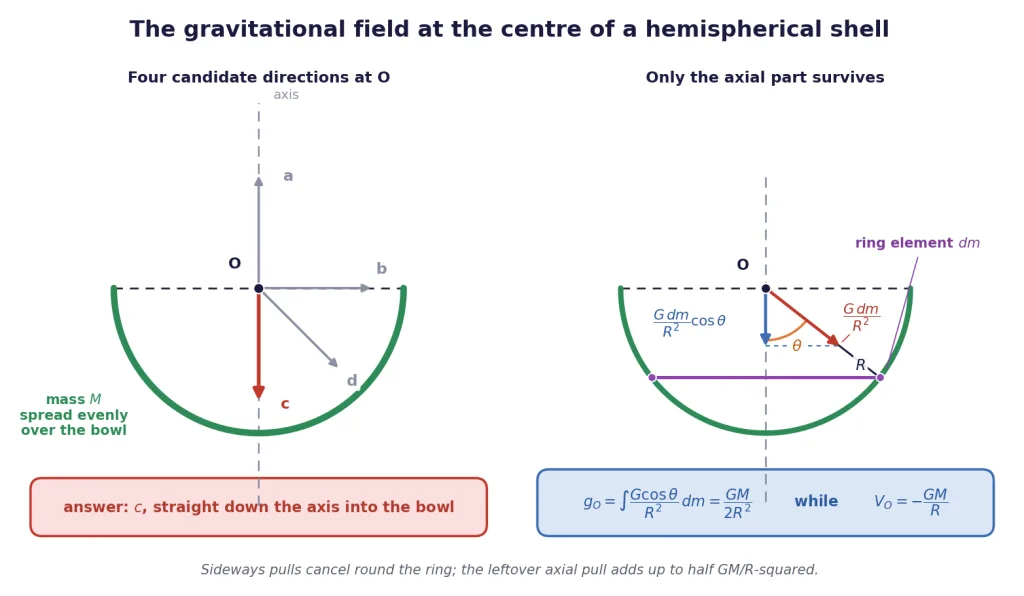
Example 23: The field at the centre of a hemispherical bowl
A uniform hemispherical shell — a thin bowl — has mass M and radius R. Find the direction and magnitude of the gravitational field at O, the centre of its circular rim, and also the gravitational potential there. Then evaluate both for M=100 kg and R=0.40 m, with G=6.67×10⁻¹¹ N m2/kg2.
Solution:
The direction, by symmetry alone. Slice the bowl into thin rings, each centred on the axis of symmetry. Every ring pulls O towards itself, and by symmetry the sideways contributions from opposite sides of a ring cancel exactly. Only the component along the axis survives, and it points from O into the bowl. So the field at O is directed straight down the axis, towards the material.
The magnitude, by adding up the rings. Take the ring at polar angle θ from the axis. Every point of it is exactly R from O, so it contributes R2Gdm, of which the surviving axial part is R2Gdmcosθ.
Write dm for that ring. With surface density σ=2πR2M, a ring of angular width dθ has circumference 2πRsinθ and width Rdθ, so
dm=σ2πR2sinθdθ=Msinθdθ
Integrate over the hemisphere,θ from 0 to 2π:
gO=∫0π/2R2GMsinθcosθdθ=R2GM[2sin2θ]0π/2=2R2GM
The potential is far easier. Every element of the bowl is exactly R from O, and potential is a scalar, so
VO=−RGM
which is the same as for a complete sphere of mass M and radius R.
The numbers.gO=2×(0.40)26.67×10−11×100=0.326.67×10−9=2.08×10⁻⁸ m/s2VO=−0.406.67×10−11×100=−1.67×10−8 J/kg
Final Answer:g at O has magnitude 2R2GM=2.08×10⁻⁸ m/s2 directed along the axis into the bowl, while VO=−RGM=−1.67×10⁻⁸ J/kg.
Takeaway:Half a sphere gives the full sphere's potential but only half the "point-mass" field, and the field is no longer zero. Closing the bowl into a complete shell would drive the field to zero while leaving V untouched — a clean demonstration that V knows nothing about direction.
Example 24: Three spheres in a row, and one of them removed
Three small spheres, each of mass 5.0 kg, lie on a straight line at x=0, x=1.0 m and x=2.0 m. Find (a) the gravitational potential energy of the system, (b) the work an external agent must do to take the middle sphere away to infinity while the other two stay put, and (c) the work needed to scatter all three to infinity. Take G=6.67×10⁻¹¹ N m2/kg2.
Solution:
(a) Three particles, three pairs. Two pairs are 1.0 m apart and one pair is 2.0 m apart:
Ui=−G(1.025+1.025+2.025)=−G(25+25+12.5)=−62.5GUi=−62.5×6.67×10−11=−4.17×10⁻⁹ J
(b) Remove the middle one. Two of the three pairs disappear; the outer pair, 2.0 m apart, survives:
Uf=−2.025G=−12.5G=−8.34×10⁻¹⁰ J
The work is the change in energy.W=Uf−Ui=−12.5G−(−62.5G)=50G=3.34×10⁻⁹ J
(c) Scatter all three. Now the final state has no pairs left at all, so Uf=0:
Wall=0−Ui=62.5G=4.17×10⁻⁹ J
A quick sanity comparison. Taking away one sphere costs 80% of the price of taking away all three. That is because the middle sphere is involved in two of the three bonds, and in the two tightest ones.
Final Answer: (a) −4.17×10⁻⁹ J; (b) 3.34×10⁻⁹ J; (c) 4.17×10⁻⁹ J.
Takeaway:The work needed to dismantle a system is +∣U∣ only if you dismantle it completely. Remove one particle and you must recompute U for what is left — never assume the whole thing goes to zero.
Example 25: A rocket fired straight up at 5 km/s
A rocket is fired vertically from the Earth's surface with a speed of 5.0 km/s. Neglecting air resistance and the Earth's rotation, how far from the Earth's centre does it get before falling back? Take the Earth's mass as 6.0×1024 kg, its radius as 6.4×10⁶ m and G=6.67×10⁻¹¹ N m2/kg2.
Solution:
Note first that 5 km/s is well under the escape speed, which for this data is RE2GME=11.2 km/s. So the rocket must come back, and it has a definite highest point.
Energy conservation, per kilogram, with the exact potential energy. At the highest point the speed is zero:
21v2−REGME=0−rmaxGME
Evaluate the two terms on the left.GME=6.67×10−11×6.0×1024=4.002×10¹⁴ m3/s221v2=21(5000)2=1.250×107 J/kgREGME=6.4×1064.002×1014=6.253×107 J/kg
So the total energy per kilogram isE=1.250×10⁷−6.253×107=−5.003×10⁷ J/kg
Negative, confirming that the rocket is bound.
Find rmax.−rmaxGME=−5.003×10⁷⟹rmax=5.003×1074.002×1014=8.0×10⁶ m
The height above the surface.h=8.0×10⁶−6.4×106=1.6×10⁶ m=1600 km
What a constant-g estimate would have said. With g=RE2GME=9.77 m/s2 held fixed, h=2gv2=1280 km — a 20% underestimate, because g has already fallen to 6.3 m/s2 by the top of the climb.
Final Answer: the rocket reaches 8.0×10⁶ m from the Earth's centre, that is 1600 km above the surface.
Takeaway:Once the climb is a sizeable fraction of RE, 2gv2 is no longer good enough. Write energy conservation with −rGMm and let the algebra hand you rmax directly.
Example 26: Two stars falling together
Two stars, each of one solar mass (2×1030 kg) and radius 104 km, are 109 km apart and approaching each other head-on with negligible speed. With what speed do they collide? Assume they stay undistorted until they touch, and take G=6.67×10⁻¹¹ N m2/kg2.
Solution:
Convert to metres. Initial separation di=109 km =1.0×10¹² m. Each radius is 104 km =1.0×10⁷ m, so at the moment of contact their centres are
df=2×1.0×107=2.0×10⁷ m
apart. Note that the collision separation is centre-to-centre, not surface-to-surface.
Symmetry does the momentum bookkeeping. Equal masses starting at rest means each ends with the same speed v, in opposite directions.
Energy conservation for the pair.0−diGM2=2(21Mv2)−dfGM2Mv2=GM2(df1−di1)
Substitute.GM2=6.67×10−11×(2×1030)2=2.668×1050df1−di1=2.0×1071−1.0×10121=5.0×10⁻⁸−1.0×10⁻¹²≈5.0×10⁻⁸
The starting separation contributes almost nothing — the stars might as well have begun infinitely far apart.
Solve for v.Mv2=2.668×1050×5.0×10−8=1.334×1043v2=2×10301.334×1043=6.67×10¹²⟹v=2.58×10⁶ m/s
Final Answer: each star is moving at about 2.6×10⁶ m/s when they touch, so they close on each other at some 5.2×10⁶ m/s.
Takeaway:When the starting separation is enormous compared with the finishing one, the di1 term is dead weight — but write it down anyway. Checking that it is negligible is a legitimate step; assuming it is, is not.
Part 5: Escape Speed — What It Depends On, and What It Does Not
Example 27: What escape speed depends on
Does the escape speed of a body from the Earth depend on (a) the mass of the body, (b) where on the surface it is launched from, (c) the direction of launch, or (d) the height of the launch point? Justify each answer, and back the last one with numbers. Use GME=3.982×10¹⁴ m3/s2 and RE=6.37×10⁶ m.
Solution:
Start from the definition. Escape means arriving at infinity with zero speed, so the total energy must be exactly zero:
21mve2−rGMEm=0⟹ve=r2GME
(a) The body's mass — no. It cancelled in step 1. A marble and a spacecraft need exactly the same speed. Their energies differ enormously, but their speeds do not.
(b) Where on the surface — essentially no.ve depends on r only, so for a perfectly spherical, non-rotating Earth every launch site is identical. (The real Earth is a little wider at the equator and spinning, so an equatorial launch is very slightly cheaper — but that is a correction of a fraction of a percent, and it is not what the question is testing.)
(c) The direction — no. Energy is a scalar. Only the magnitude of the velocity enters 21mv2. Fire the body straight up, at 45°, or horizontally: as long as nothing is in the way, the same speed escapes.
(d) The height — yes, and strongly. Here r genuinely changes.
at the surface: ve=6.37×1062×3.982×1014=1.12×10⁴ m/s=11.2 km/sat r=2RE:ve=211.2=7.91 km/s
Summarise.
Does ve depend on it?
Verdict
mass of the body
no — it cancels
launch site on the surface
no, for a spherical non-rotating Earth
direction of projection
no — energy has no direction
height of the launch point
yes — ve∝r1
Final Answer: (a) no, (b) no, (c) no, (d) yes — escape speed falls as r1 as the launch point rises.
Takeaway:Escape speed is a property of the place, not of the projectile. Three of the four answers are "no" precisely because the projectile's mass and direction never survive the energy equation.
Example 28: Launched at three times escape speed
The escape speed at the Earth's surface is 11.2 km/s. A body is projected outward at three times this speed. How fast is it moving when it is very far away? Ignore the Sun and the other planets.
Solution:
Write energy conservation between the surface and infinity. Far away U→0:
21v02−REGME=21v∞2
Recognise the middle term. By definition REGME=21ve2, so
21v02−21ve2=21v∞2⟹v∞=v02−ve2
This little formula is worth memorising.
Notice what was lost. The body set out at 33.6 km/s and arrives at 31.7 km/s. Gravity has taken 5.7% of its speed — but 91 of its kinetic energy, since v02ve2=91.
Final Answer: about 31.7 km/s.
Takeaway:v∞=v02−ve2, and never v0−ve. Speeds do not subtract in gravity problems; the squares of speeds do, because energy is what is conserved.
Example 29: Leaving the Sun, and how small a star would have to be
The Sun has mass 1.99×1030 kg and radius 6.96×10⁸ m. (a) Find the escape speed at its surface. (b) If the same mass were squeezed into a smaller and smaller ball, at what radius would the escape speed reach the speed of light, 3.0×10⁸ m/s? Take G=6.67×10⁻¹¹ N m2/kg2.
Solution:
(a) Quote and substitute.ve=RS2GMSGMS=6.67×10−11×1.99×1030=1.327×10²⁰ m3/s2ve=6.96×1082×1.327×1020=3.814×1011=6.18×105 m/s
Read it. That is 618 km/s — about 55 times the Earth's escape speed, and about a five-hundredth of the speed of light.
(b) Rearrange for the radius.ve=c⟹c2=R2GMS⟹R=c22GMS
Substitute.R=(3.0×10⁸)22×1.327×1020=9.0×10162.655×1020=2.95×10³ m
Read it. About 3 km. The Sun would have to be compressed from a 700000 km ball down to something the size of a small town.
Final Answer: (a) 618 km/s; (b) a radius of about 2.95 km, roughly 3 km.
Takeaway:Escape speed rises as RM, so shrinking a body is a far more violent way to raise it than fattening one. The radius in part (b) is a famous number in astrophysics; the Newtonian calculation gives exactly the right answer, though for reasons the full theory has to supply.
Example 30: The energy bill on three worlds
Find the energy needed per kilogram to escape completely from the Earth, the Moon and Mars, and the corresponding escape speeds. Use ME=5.97×1024 kg with RE=6.37×10⁶ m; Mmoon=7.35×10²² kg with Rmoon=1.74×10⁶ m; Mmars=6.42×10²³ kg with Rmars=3.39×10⁶ m. Take G=6.67×10⁻¹¹ N m2/kg2.
Solution:
The energy per kilogram is just the depth of the potential well. To go from rest on the surface to rest at infinity,
mE=0−(−RGM)=RGM
and the escape speed follows from 21ve2=RGM.
The Earth.REGME=6.37×1063.982×1014=6.25×10⁷ J/kg,ve=2×6.25×107=11.2 km/s
The Moon.GM=6.67×10−11×7.35×1022=4.903×10¹²RGM=1.74×1064.903×1012=2.82×10⁶ J/kg,ve=2.37 km/s
Read the table. Getting a kilogram off the Moon costs about one twenty-second of what it costs to get it off the Earth. That single number is the entire engineering case for assembling deep-space missions in orbit or on the Moon rather than on the ground.
Final Answer:6.25×10⁷, 1.26×10⁷ and 2.82×10⁶ J/kg for the Earth, Mars and the Moon, with escape speeds 11.2, 5.03 and 2.37 km/s.
Takeaway:The energy bill scales as ve2, so a world with half the escape speed is four times cheaper to leave. Comparing worlds by speed understates how different they really are.
Example 31: A half-hearted launch from the Moon
A projectile is fired vertically from the Moon's surface at 2.0 km/s. How high does it rise? Compare with what a constant-gravity calculation would predict. Take Mmoon=7.35×10²² kg, Rmoon=1.74×10⁶ m and G=6.67×10⁻¹¹ N m2/kg2.
Solution:
Check first that it does not escape. From the previous problem, the Moon's escape speed is 2.37 km/s. At 2.0 km/s the projectile is bound, but only just — it is at 84% of escape speed.
Energy conservation per kilogram, with v=0 at the top.21v02−RGM=−rmaxGM
The numbers.GM=4.903×10¹²,RGM=2.818×10⁶ J/kg,21v02=2.00×106 J/kgrmaxGM=2.818×106−2.00×106=8.18×105 J/kg
Solve.rmax=8.18×1054.903×1012=6.00×10⁶ mh=6.00×10⁶−1.74×106=4.26×10⁶ m=4260 km
The constant-gravity prediction. The Moon's surface gravity is
gmoon=R2GM=3.028×10124.903×1012=1.62 m/s2hnaive=2gmoonv02=3.244.0×106=1.24×106 m=1240 km
Compare. The true height is 12404260=3.4 times the naive one. The constant-g formula is not slightly wrong here, it is wrong by a factor of three, because the projectile climbs to nearly 3.5 lunar radii where gravity has fallen to a twelfth of its surface value.
Final Answer: it rises about 4260 km above the Moon's surface — some 3.4 times the constant-gravity estimate of 1240 km.
Takeaway:The closer the launch speed creeps towards ve, the more spectacularly 2gv2 fails. At 84% of escape speed it is already out by a factor of three; at 100% it predicts a finite height for a body that never comes back.
Example 32: Escaping from two different altitudes
Find the speed a body needs in order to escape from the Earth (a) from a point 2000 km above the surface, and (b) from geostationary altitude, where the orbital radius is 4.223×10⁷ m. In case (b), how much extra speed would a satellite already in that orbit need? Use GME=3.982×10¹⁴ m3/s2 and RE=6.37×10⁶ m.
Solution:
The rule. From any radius r,
ve(r)=r2GME
(a) At 2000 km up,r=6.37×10⁶+2.0×106=8.37×10⁶ mve=8.37×1062×3.982×1014=9.515×107=9.75×10³ m/s=9.75 km/s
That is 87% of the surface value, for a climb of only 2000 km.
(b) At geostationary radius,ve=4.223×1072×3.982×1014=1.886×107=4.34×10³ m/s=4.34 km/s
only 39% of the surface value.
How much extra does a satellite there need? It is already moving at the orbital speed
vo=rGME=2ve=3.07 km/s
so the extra speed required is
Δv=ve−vo=4.34−3.07=1.27 km/s
The general fact behind step 4. For any circular orbit,
vove=2⟹Δv=(2−1)vo=0.414vo
A satellite always needs a 41.4% boost to break free, wherever it happens to be orbiting.
Final Answer: (a) 9.75 km/s; (b) 4.34 km/s, of which a geostationary satellite already has 3.07 km/s, so it needs a further 1.27 km/s.
Takeaway:Height is the cheapest thing you can buy in this chapter. Escaping from geostationary orbit needs less than 40% of the surface escape speed — and if you are already in orbit, less than 12% of it.
Part 6: Orbits, Satellite Energetics and Orbit Raising
Example 33: What it costs to set a satellite free
A satellite of mass 200 kg orbits the Earth in a circular path 400 km above the surface. How much energy must be spent to rocket it out of the Earth's gravitational influence altogether? State K, U and E separately with their signs. Take the Earth's mass as 6.0×1024 kg, its radius as 6.4×10⁶ m and G=6.67×10⁻¹¹ N m2/kg2.
Solution:
The orbital radius.r=6.4×10⁶+4.0×105=6.8×10⁶ mGME=6.67×10−11×6.0×1024=4.002×10¹⁴ m3/s2
The orbital speed.vo=rGME=6.8×1064.002×1014=5.885×107=7.67×10³ m/s
Potential energy, with the zero at infinity:
U=−rGMEm=−6.8×1064.002×1014×200=−1.177×10¹⁰ J
Total energy.E=K+U=5.89×10⁹−1.177×1010=−5.89×10⁹ J
Negative, as every bound orbit must be. Note also that E=−K and U=2E, the standard relations.
The energy needed to free it. "Out of the Earth's influence" means final total energy zero, so
Eneeded=0−E=+5.89×10⁹ J
Final Answer: about 5.9×10⁹ J. In orbit the satellite has K=+5.89×10⁹ J, U=−1.177×10¹⁰ J and E=−5.89×10⁹ J.
Takeaway:The binding energy of a circular orbit is just ∣E∣, which equals K. So you can read the escape bill straight off the kinetic energy, without computing anything else.
Example 34: Orbiting is already half the battle
Take a 500 kg body at a height of 1000 km above the Earth. Compare the energy needed to send it out of the Earth's gravitational influence when it is (a) in a circular orbit at that height and (b) simply parked at rest at that height. Use GME=3.982×10¹⁴ m3/s2 and RE=6.37×10⁶ m.
Solution:
The radius is the same in both cases.r=6.37×10⁶+1.0×106=7.37×10⁶ m
(a) In orbit. The orbital speed is
vo=7.37×1063.982×1014=5.403×107=7350 m/s
so
K=21×500×5.403×107=+1.351×10¹⁰ JU=−7.37×1063.982×1014×500=−2.701×10¹⁰ JEa=K+U=−1.351×10¹⁰ J
So freeing the orbiting body costs0−Ea=1.351×10¹⁰ J
(b) At rest at the same height. Now K=0, so
Eb=U=−2.701×10¹⁰ J
and freeing it costs
0−Eb=2.701×10¹⁰ J
The comparison. Exactly twice as much. And that is not a coincidence of these numbers: for any circular orbit E=2U, so a stationary body at the same radius always needs precisely twice the energy that the orbiting one needs.
The physical reading. The orbiting satellite already carries half the energy it needs, in the form of kinetic energy. The parked body carries none.
Final Answer:1.35×10¹⁰ J for the orbiting body and 2.70×10¹⁰ J for the stationary one — exactly twice as much.
Takeaway:An orbiting satellite is halfway out of the well already. This is why "escape velocity from the Earth's surface" is a misleading target for real missions: nobody escapes from the surface, they escape from orbit.
Example 35: Designing a ninety-minute orbit
A satellite is to circle the Earth once every 90 minutes. Find the radius of its orbit, its height above the surface and its orbital speed. Use GME=3.982×10¹⁴ m3/s2 and RE=6.37×10⁶ m.
Solution:
Quote the period relation and invert it.T=2πGMEr3⟹r3=4π2GMET2
The period in seconds.T=90×60=5400 s,T2=2.916×10⁷ s2
The speed.vo=T2πr=54002π×6.65×106=54004.178×107=7.74×10³ m/s
Cross-check with rGME=5.988×107=7.74×10³ m/s. They agree.
Final Answer:r=6.65×10⁶ m, that is 280 km above the surface, moving at 7.74 km/s.
Takeaway:Ninety minutes is about the shortest period a satellite of the Earth can have. A surface-skimming orbit takes 84.4 minutes, so 90 minutes puts you only a few hundred kilometres up — which is exactly where crewed spacecraft fly.
Example 36: Lifting a satellite to geostationary height
A 1000 kg satellite is in a circular orbit 300 km above the Earth. How much energy is needed to move it to a geostationary circular orbit of radius 4.223×10⁷ m? Find the changes in its kinetic and potential energy separately. Use GME=3.982×10¹⁴ m3/s2 and RE=6.37×10⁶ m.
Solution:
The two radii.r1=6.37×10⁶+3.0×105=6.67×10⁶ m,r2=4.223×10⁷ m
Quote the total energy of a circular orbit.E=−2rGMEm
The two total energies.E1=−2×6.67×1063.982×1014×1000=−2.985×10¹⁰ JE2=−2×4.223×1073.982×1014×1000=−4.715×10⁹ J
The energy needed is the difference.ΔE=E2−E1=−4.715×10⁹+2.985×1010=+2.51×10¹⁰ J
Now the parts. Since K=−E and U=2E,
K1=+2.985×10¹⁰ J,K2=+4.715×10⁹ J⟹ΔK=−2.51×10¹⁰ JU1=−5.970×10¹⁰ J,U2=−9.430×10⁹ J⟹ΔU=+5.03×10¹⁰ J
Read the bookkeeping. You pay 2.51×10¹⁰ J. The potential energy rises by twice that, 5.03×10¹⁰ J, and the kinetic energy falls by 2.51×10¹⁰ J, giving up exactly half of what you paid. The satellite ends up higher and slower:
v1=7.73 km/s⟶v2=3.07 km/s
Final Answer:2.51×10¹⁰ J, with ΔU=+5.03×10¹⁰ J and ΔK=−2.51×10¹⁰ J.
Takeaway:Every joule you spend raising an orbit buys two joules of potential energy and gives one back as lost kinetic energy. That is the meaning of ΔU=−2ΔK, and it is why higher orbits are slower.
Example 37: Weighing the Earth from the space station
The International Space Station circles the Earth at a height of about 408 km with a period of about 92.9 minutes. Use this to estimate the Earth's mass, and compare it with the accepted value of 5.97×1024 kg. Take RE=6.37×10⁶ m and G=6.67×10⁻¹¹ N m2/kg2.
Solution:
The orbital radius.r=6.37×10⁶+4.08×105=6.778×10⁶ m
The period in seconds.T=92.9×60=5574 s
Quote the mass formula.ME=GT24π2r3
The pieces.r3=(6.778×10⁶)3=3.114×10²⁰ m3,T2=(5574)2=3.107×10⁷ s2
Assemble.ME=6.67×10−11×3.107×1074π2×3.114×1020=2.072×10−31.229×1022=5.93×1024 kg
Compare.5.975.93−5.97=−0.6%
Well within the accuracy of "about 408 km" and "about 92.9 minutes" — the station's orbit is slightly elliptical and its altitude is deliberately raised every few months to fight atmospheric drag.
Final Answer:ME≈5.93×1024 kg, about 0.6% below the accepted value.
Takeaway:Anything in orbit is a mass-measuring instrument for the body it orbits. The Moon, the space station and a stopwatch all give the Earth's mass to within a percent of one another.
Example 38: Putting a satellite into geostationary orbit from the ground
A 1200 kg satellite is to be placed in a geostationary circular orbit of radius 4.223×10⁷ m, starting from rest on the Earth's surface. Find (a) the height of the orbit, (b) the minimum energy required, ignoring the Earth's rotation and air resistance, and (c) how much rocket fuel that represents if the fuel releases 43 MJ per kilogram. Use GME=3.982×10¹⁴ m3/s2 and RE=6.37×10⁶ m.
Solution:
(a) The height.h=4.223×10⁷−6.37×106=3.586×10⁷ m≈35860 km
(b) The initial energy. At rest on the surface, K=0 and
Ei=−REGMEm=−6.37×1063.982×1014×1200=−7.501×10¹⁰ J
The final energy, in a circular orbit of radius r:
Ef=−2rGMEm=−2×4.223×1073.982×1014×1200=−5.658×10⁹ J
made up of K=+5.658×10⁹ J and U=−1.132×10¹⁰ J.
The energy required.ΔE=Ef−Ei=−5.658×10⁹+7.501×1010=6.94×10¹⁰ J
(c) The fuel.mfuel=43×1066.94×1010=1.61×10³ kg
A reality check. A real launcher needs many tonnes of propellant for a payload like this, not 1.6 tonnes, because it must also lift the fuel itself, fight the air, and throw exhaust backwards rather than converting energy perfectly. The number above is a lower bound — a floor set by physics that no engineering can go below.
Final Answer: (a) about 35860 km up; (b) 6.94×10¹⁰ J; (c) at least about 1600 kg of fuel.
Takeaway:Getting a satellite to geostationary orbit costs about 5.8×10⁷ J per kilogram — very close to the escape bill of 6.25×10⁷ J/kg. Geostationary orbit is nearly as expensive as leaving the Earth altogether.
Example 39: How tightly is the Earth bound to the Sun?
Treat the Earth's orbit as a circle of radius 1.496×10¹¹ m about a Sun of mass 1.99×1030 kg. Find the Earth's orbital speed, its kinetic, potential and total energy, and the extra speed it would need to leave the Solar System. Take ME=5.97×1024 kg and G=6.67×10⁻¹¹ N m2/kg2.
Solution:
The orbital speed.vo=rGMS=1.496×10116.67×10−11×1.99×1030=8.873×108=2.98×10⁴ m/s
About 29.8 km/s — a useful number to know.
Potential energy, zero at infinity:
U=−rGMSME=−1.496×10111.327×1020×5.97×1024=−5.30×1033 J
Total energy.E=K+U=2.65×1033−5.30×1033=−2.65×1033 J
so the binding energy of the Earth to the Sun is +2.65×1033 J.
The extra speed to escape. The escape speed from the Earth's orbital position is
ve=2vo=1.414×29.8=42.1 km/sΔv=42.1−29.8=12.3 km/s
Put the size of that energy in perspective. Humanity uses roughly 6×10²⁰ J a year. The Earth's binding energy to the Sun is about 4×10¹² times that — some four thousand billion years of total world energy consumption.
Final Answer:vo=29.8 km/s, K=+2.65×1033 J, U=−5.30×1033 J, E=−2.65×1033 J, and the Earth would need another 12.3 km/s to escape.
Takeaway:The relations E=−K and U=2E apply to planets exactly as they do to satellites. A planet is a satellite of its star; nothing in the physics knows the difference.
Part 7: Weightlessness, and Five Problems That Use Everything
Example 40: Can an astronaut in a big station detect gravity?
An astronaut inside a small spacecraft orbiting the Earth cannot detect gravity. If the station were very large instead, could gravity be detected? Support the answer with numbers for a station orbiting 400 km up, comparing a 100 m station with a 2 m capsule. Use GME=3.982×10¹⁴ m3/s2 and RE=6.37×10⁶ m.
Solution:
Why a small capsule detects nothing. Every object in the capsule, and the capsule itself, is in free fall with the same acceleration. Nothing presses on anything, so there is no way to tell which way is "down" — the capsule is a laboratory in which gravity appears to have switched off.
But the field is not uniform. It falls off as r21, so two objects at slightly different radii accelerate slightly differently. Differentiate:
g=r2GME⟹drdg=r32GME
Evaluate at 400 km up, where r=6.77×10⁶ m:
g=(6.77×10⁶)23.982×1014=8.69 m/s2drdg=(6.77×106)32×3.982×1014=3.103×10207.964×1014=2.57×10−6 s−2
A 100 m station. Two floating objects 100 m apart radially differ in acceleration by
Δa=2.57×10−6×100=2.57×10⁻⁴ m/s2
Starting together, they drift apart by 1 m in
t=2.57×10−42×1=88 s
Less than two minutes. That is a detection.
A 2 m capsule. Now Δa=5.1×10⁻⁶ m/s2, and the same 1 m of drift takes
t=5.1×10−62=624 s≈10 minutes
and 1 m of drift is more than the capsule is wide. In practice the astronaut sees nothing.
The name for it. These differential effects are tidal effects — exactly the same physics that raises the ocean tides, applied to a smaller object. They can never be transformed away, however small the laboratory, only made too weak to notice.
Final Answer: yes, in a large station gravity can be detected, through the tidal drift of freely floating objects — about 2.6×10⁻⁴ m/s2 of relative acceleration across 100 m, enough to separate two objects by a metre in 88 seconds.
Takeaway:Weightlessness is exact only at a point. Over any real distance the field varies, and that variation is the one piece of gravity that free fall cannot hide.
Example 41: What space does to an astronaut's body
Which of these is an astronaut in orbit likely to suffer: (a) swollen feet, (b) a swollen face, (c) headache, (d) difficulty with orientation? Explain in terms of what free fall removes.
Solution:
What free fall removes. On the ground, blood is pulled downwards, and the body's circulation is built around fighting that — valves in the leg veins, higher pressure below the heart, and so on. In orbit that downward pull is no longer resisted by a floor, so the whole body is in free fall and the hydrostatic pressure difference between head and feet vanishes.
(a) Swollen feet — no. Fluid is no longer being pulled downwards, so it drains out of the legs. Astronauts get thinner legs, not swollen ones. The nickname in the trade is "bird legs".
(b) Swollen face — yes. All that fluid has to go somewhere, and it redistributes towards the upper body and head. Astronauts' faces are noticeably puffy for the first few days.
(c) Headache — yes. The same fluid shift raises pressure inside the skull, which very commonly produces headaches early in a flight.
(d) Orientational problems — yes. The balance organs in the inner ear detect the direction of gravity by the settling of tiny crystals. In free fall they settle nowhere, so the ear sends no "down" signal while the eyes still report the walls of the cabin. The conflict produces disorientation and space sickness.
Final Answer: (b), (c) and (d) are all likely; (a) is not — the legs get thinner, not swollen.
Takeaway:Every symptom traces back to one fact: in free fall nothing tells the body which way is down. Fluids stop being pulled to the feet, and the inner ear stops reporting.
Example 42: The aeroplane that flies people weightless
An aircraft used for weightlessness training pulls up to 45° above the horizontal at a speed of 200 m/s and then follows a free-fall path, with its engines set to cancel air resistance exactly. Take g=9.8 m/s2. (a) Find the vertical component of its velocity at the start of the manoeuvre. (b) How long do the passengers float? (c) How much height does the aircraft gain? (d) Explain in one sentence why the passengers feel weightless.
Solution:
(a) Resolve the velocity.vy=vsin45°=200×0.7071=141 m/s
(b) The weightless phase lasts from pull-up to pull-out, which is exactly a projectile flight with acceleration g downwards throughout:
t=g2vy=9.82×141=28.9 s
(c) The height gained is the rise of a projectile:
Δh=2gvy2=2×9.8(141)2=19.62.0×104=1.02×10³ m
about a kilometre.
(d) Why they float. Write Newton's second law for a passenger of mass m standing on the cabin floor, taking downwards as positive:
mg−N=ma
During the parabola the aircraft's acceleration is a=g, so
N=m(g−a)=0
The floor is falling away from the passenger at exactly the rate the passenger is falling. Nothing presses on anything.
What has not happened. Gravity has not weakened. At 10 km altitude g is still 9.77 m/s2, and the passenger's weight mg is essentially unchanged. Only the normal reaction has gone to zero.
Final Answer: (a) 141 m/s; (b) about 29 s; (c) about 1.02 km; (d) because the cabin and the passenger have the same acceleration, so the floor exerts no normal force.
Takeaway:Weightlessness is a statement about the normal reaction, not about gravity. A falling lift, a diving aircraft and an orbiting station all produce it by the same mechanism, and none of them has less gravity than the ground below.
Example 43: A satellite stopped dead
A satellite is orbiting the Earth in a circle of radius 2RE. Its engines are fired so that it is brought instantaneously to rest, and it then falls freely. With what speed does it strike the Earth's surface? Compare that with the speed it had while in orbit. Ignore the atmosphere and the Earth's rotation. Use GME=3.982×10¹⁴ m3/s2 and RE=6.37×10⁶ m.
Solution:
The speed it had in orbit.vorbit=2REGME=1.274×1073.982×1014=3.126×107=5.59×10³ m/s
After the engines fire it is at rest at r=2RE, so its total energy per kilogram is
E=0−2REGME=−3.126×10⁷ J/kg
Energy conservation down to the surface.21v2−REGME=−2REGME21v2=REGME−2REGME=2REGME
Sov=REGME=6.37×1063.982×1014=6.251×107=7.91×10³ m/s
Notice what that number is.REGME is exactly the orbital speed of a satellite skimming the Earth's surface, 7.91 km/s. The falling satellite arrives at surface-orbital speed — a coincidence of this particular starting radius, but a striking one.
Compare. It was cruising at 5.59 km/s, was stopped dead, and now hits the ground at 7.91 km/s — over 40% faster than when it was happily in orbit. Stopping a satellite does not make it safe; it makes it a meteorite.
Final Answer: it strikes the surface at 7.91 km/s, compared with the 5.59 km/s it had in orbit.
Takeaway:Killing a satellite's speed does not kill its energy. All the potential energy is still there, and gravity converts it into a larger speed than the orbit ever had.
Example 44: One planet, the whole chapter
A planet has a surface gravity of 6.0 m/s2, a radius of 4.0×10⁶ m and a day of 18 hours. Taking G=6.67×10⁻¹¹ N m2/kg2, find (a) its mass and mean density, (b) its escape speed, (c) the speed and period of a satellite skimming its surface, and (d) the height above its surface of a stationary orbit.
Solution:
(a) Mass, from surface gravity.gp=Rp2GMp⟹GMp=gpRp2=6.0×(4.0×106)2=9.6×10¹³ m3/s2Mp=6.67×10−119.6×1013=1.44×1024 kg
Mean density.ρ=34πRp3Mp=34π(4.0×10⁶)31.44×1024=2.68×10201.44×1024=5.37×10³ kg/m3
Almost exactly the Earth's — a rocky world.
(b) Escape speed, most easily from gp and Rp:
ve=2gpRp=2×6.0×4.0×106=4.8×107=6.93×10³ m/s
(c) A surface-skimming satellite.vo=gpRp=2ve=4.90×10³ m/sT=vo2πRp=48992π×4.0×106=48992.513×107=5.13×103 s=85.5 min
(d) The stationary orbit must have a period equal to the planet's day:
Tday=18×3600=6.48×10⁴ sr3=4π2GMpTday2=39.489.6×1013×(6.48×104)2=39.489.6×1013×4.199×109r3=39.484.031×1023=1.021×10²² m3⟹r=2.17×10⁷ m
The height.h=2.17×10⁷−4.0×106=1.77×10⁷ m≈17700 km
A last cross-check on part (d). The ratio Rpr=5.42, and the period ratio should be 5.423/2=12.6. Indeed 5.13×1036.48×104=12.6. Everything is consistent.
Final Answer: (a) 1.44×1024 kg with a mean density of 5370 kg/m3; (b) 6.93 km/s; (c) 4.90 km/s with a period of 85.5 minutes; (d) about 17700 km above the surface.
Takeaway:gp and Rp together are the whole planet. From those two numbers you can get the mass, the density, the escape speed, every orbital speed and every period — and if you also know the length of the day, the stationary orbit as well. That is the entire chapter in one problem.
Ready to test your knowledge?
Take a quick interactive quiz on this topic —
free, works without login.