
Twenty Years of Data, Boiled Down to Three Sentences
Here is the thing about gravitation: nobody discovered it by staring at the sky and having an idea. It came out of arithmetic — a mountain of it.
Tycho Brahe spent decades before the telescope measuring where the planets actually were, night after night, to about one sixtieth of a degree. When he died, that notebook passed to his assistant, Johannes Kepler. Kepler then spent roughly twenty years trying to fit circles to the numbers for Mars, failing, and finally throwing the circles away. What he was left with are the three statements this section is about.
They are empirical laws: descriptions of what the planets do, extracted from data, with no explanation attached. The explanation — one force, one formula — is Newton's, and it comes in the next section. Kepler got there first, and without him Newton would have had nothing to explain.
Law 1: the law of orbits
Key Point — the law of orbits: Every planet moves in an ellipse, with the Sun at one focus of that ellipse.
Read that carefully, because the two commonest errors in the whole chapter are hiding in it. The Sun is at a focus, not at the centre. And the other focus is completely empty — there is nothing there at all.
The geometry of an ellipse, made concrete
An ellipse is the set of points whose total distance from two fixed points is constant. Those two fixed points are the foci, and . If is any point on the curve,
That is exactly the two-pins-and-a-loop-of-string construction you may have drawn in a maths class: pin the string at and , pull it taut with a pencil, and go round.
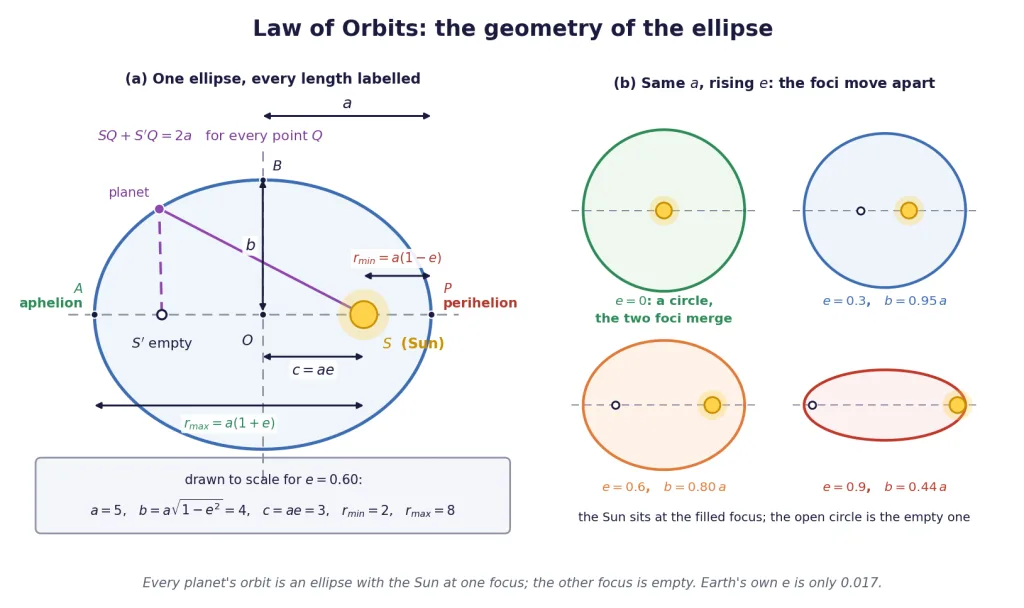
Everything else follows from that one property. Let be the midpoint of , which is the centre of the ellipse.
| Symbol | Name | Meaning |
|---|---|---|
| semi-major axis | half the longest diameter; | |
| semi-minor axis | half the shortest diameter; | |
| focal distance | ||
| eccentricity | , a pure number with |
The three lengths are locked together. Put the pencil at , the end of the minor axis: by symmetry , and since , each of them is . Now is a right-angled triangle with hypotenuse and legs and , so
The two extreme distances
The planet is nearest the Sun at and farthest at , the two ends of the major axis.
Key Point — the apsidal distances: With the Sun at focus , and therefore
Those last two are worth more marks than anything else in this block, because most problems hand you the two extreme distances and expect you to produce and in one line each. Note that is the arithmetic mean of the two extremes.
Naming, so you are not caught out: for an orbit round the Sun the near and far points are the perihelion and the aphelion. For an orbit round the Earth — a satellite, the Moon — they are the perigee and the apogee. Same geometry, different prefix.
Where the circle went
Set . Then , so the two foci collapse onto each other at the centre, , and . The ellipse becomes a circle of radius , with the Sun exactly at the middle.
Key Point: A circle is not a different kind of orbit. It is the special case of an ellipse, and the semi-major axis becomes the radius. Every formula in this section reduces correctly when you set — which is a free check on your algebra.
How elliptical are the real orbits?
Textbook diagrams draw wildly stretched ellipses so that you can see what is going on. Real planetary orbits are almost circular.
| Body | Comment | |
|---|---|---|
| Venus | 0.007 | very nearly a perfect circle |
| Earth | 0.017 | is only about 3.4% more than |
| Jupiter | 0.049 | |
| Mars | 0.093 | the one Kepler worked on, and the reason he succeeded |
| Mercury | 0.206 | the most eccentric of the eight |
| Halley's comet | 0.967 | a long thin cigar |
Kepler cracked the problem on Mars precisely because Mars is eccentric enough for the discrepancy to exceed Tycho's measurement error. Had he picked Venus, the circle would have fitted and the law would have waited another century.
[Board Important] "State Kepler's first law and define eccentricity" is a standard two-mark opener. Say ellipse, say Sun at one focus, and define with the distance from the centre to a focus.
[JEE Tip] When a question gives you and , immediately write and before reading the rest of the question. Nine times out of ten those two numbers are what the rest of the problem is built on.
Law 2: The Law of Areas — Which Is Really a Conservation Law
Kepler noticed something in the data that had no business being true if the planets simply ran round at a steady rate: a planet speeds up when it is near the Sun and slows down when it is far away, and it does so in a very particular, very exact way.
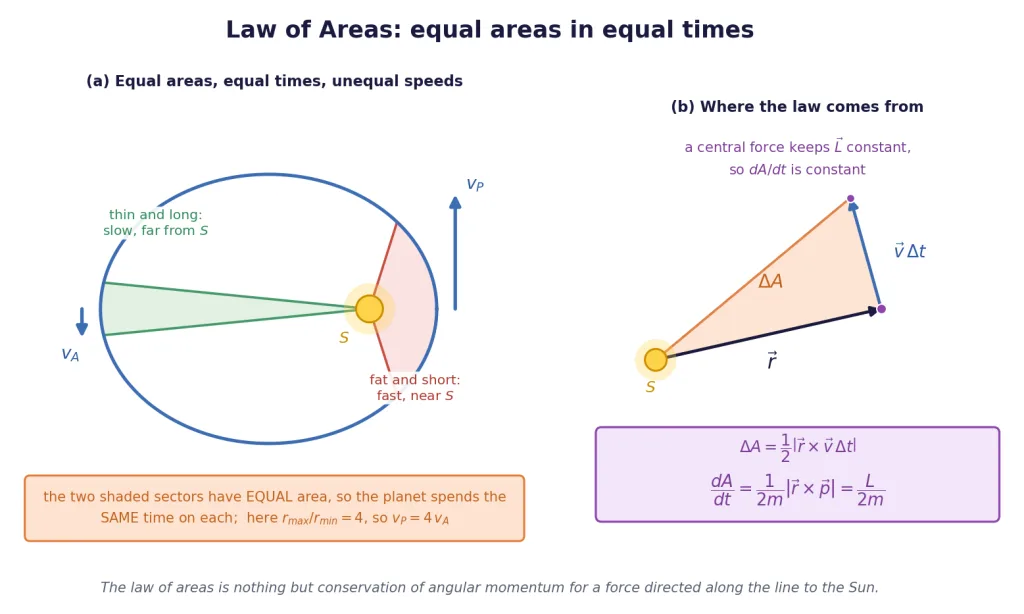
Key Point — the law of areas: The line joining a planet to the Sun sweeps out equal areas in equal intervals of time.
So a "fat and short" wedge close to the Sun and a "thin and long" wedge far from it, drawn with the same area, take the planet exactly the same time to traverse.
Now let's break this down, because there is a beautiful reason for it
Put the Sun at the origin. Let the planet, of mass , be at position with velocity and momentum .
In a short time the planet moves through . The area swept by the radius vector is the area of the thin triangle with those two sides — and the area of a triangle built on two vectors is half the magnitude of their cross product:
Divide by and let it shrink:
using from the previous chapter. The quantity is called the areal velocity.
Key Point: The area swept per second is the angular momentum per unit mass, halved. So the law of areas is exactly the statement that is constant.
Why is constant here?
Because the Sun's pull on the planet is a central force — it always points along the line joining the two, that is, along itself. The torque about the Sun is then
because the cross product of two parallel (or antiparallel) vectors vanishes. Zero torque means
and therefore is constant. That is the whole proof.
Key Point: The law of areas needs only that the force is central. It does not need the inverse square. Kepler's first and third laws do need the inverse square specifically; the second one would hold even if gravity fell off as or grew as .
[JEE Tip] That distinction is asked directly. "Which of Kepler's laws follows from conservation of angular momentum alone?" — the second.
Two more things the constancy of buys you
- The orbit is flat. is perpendicular to both and . If the direction of never changes, then is forever confined to the single plane perpendicular to . A planet cannot wander out of its orbital plane.
- The speeds at the two apses are locked together. At perihelion and at aphelion — and only there — the velocity is exactly perpendicular to the radius, so is simply . Equating the angular momentum at the two ends,
Key Point — the apsidal speed relation: The planet is fastest at perihelion and slowest at aphelion, in the exact inverse ratio of the distances.
[NEET Important] Be careful: works only at the two apses. Anywhere else on the ellipse the velocity is not perpendicular to , and the correct statement is constant, with the angle between and .
What is conserved and what is not
- Angular momentum : constant, in magnitude and direction.
- Areal velocity : constant.
- Speed : definitely not constant.
- Linear momentum : not constant — there is an external force on the planet.
- Kinetic energy: not constant. It is largest at perihelion.
A student favourite that is simply wrong: "equal areas in equal times means the planet covers equal arc lengths in equal times." It does not. Near perihelion the arc is long, because the radius is short and the area has to be made up somehow.
The Earth's own version of this
The Earth reaches perihelion in early January and aphelion in early July, so it is moving fastest in the northern winter and slowest in the northern summer. The result is that the half-year from the March equinox to the September equinox lasts about 186 days, while the other half lasts about 179 days. Seven days of difference, and every bit of it is the law of areas.
Law 3: The Law of Periods
The first two laws describe a single orbit. The third one ties different orbits together, and it is the one that does the real work in exam problems.
Key Point — the law of periods: The square of a planet's period of revolution is proportional to the cube of the semi-major axis of its orbit:
Note that it is , the semi-major axis, that appears — not the distance at any particular moment, and not the perihelion or aphelion distance.
Deriving it for a circular orbit
For the special case we can get the whole thing in three lines, borrowing the inverse-square law that the next section establishes properly.
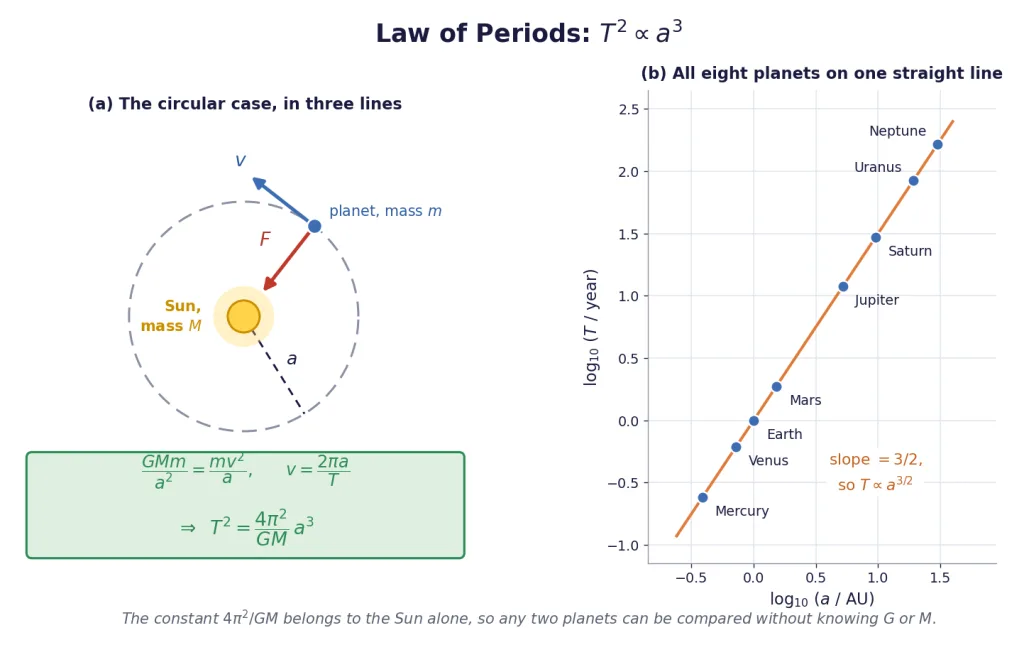
A planet of mass moves in a circle of radius about a Sun of mass . The gravitational pull supplies exactly the centripetal force the circle demands:
The mass of the planet cancels immediately — remember that, it matters. So . Now the planet covers the circumference once per period:
And for an ellipse?
The full derivation for a general ellipse needs more calculus than Class 11 assumes, so take the result:
Key Point: For an elliptical orbit the same formula holds with the semi-major axis: Two orbits with the same have the same period, however different their eccentricities. A nearly circular orbit and a long thin cigar of the same semi-major axis take exactly the same time to go round.
That last sentence is a favourite trap, and it is worth pausing on: the period does not depend on at all.
Read the constant carefully
The right-hand side contains only and the mass of the central body. It contains nothing about the orbiting body — not its mass, not its size, not its eccentricity. So:
- All eight planets share one value of , because they all orbit the Sun.
- Jupiter's moons share a different value among themselves, set by Jupiter's mass.
- Earth's satellites share a third value, set by the Earth's mass.
Never compare across families. Comparing the Moon with Mars using a single constant is a guaranteed zero.
The data, which is where the law came from
Here is in units of m and in years, so comes out in units of y m.
| Planet | ( m) | (years) | |
|---|---|---|---|
| Mercury | 5.79 | 0.241 | 2.99 |
| Venus | 10.8 | 0.615 | 3.00 |
| Earth | 15.0 | 1.000 | 2.96 |
| Mars | 22.8 | 1.881 | 2.99 |
| Jupiter | 77.8 | 11.86 | 2.99 |
| Saturn | 143 | 29.46 | 2.97 |
| Uranus | 287 | 84.01 | 2.99 |
| Neptune | 450 | 164.8 | 2.98 |
Eight bodies, distances spanning a factor of nearly 80, periods spanning a factor of nearly 700 — and the last column is flat to about one part in a hundred. That is what a law looks like.
Working in astronomical units
If you measure in astronomical units (1 AU = the Earth's semi-major axis m) and in years, then for the Earth and , so the constant is exactly 1 and the law becomes
This is the single most useful line in the section for solving problems quickly.
[Board Important] "Derive Kepler's third law for a circular orbit" is a standard three-mark derivation. The three lines are: gravitational force equals centripetal force, substitute , rearrange.
[NEET Important] Watch the exponents. and . If is multiplied by 4, is multiplied by . If is multiplied by 8, is multiplied by .
Section 7 takes this constant, puts a measured into it, and reads off the mass of the central body — which is how astronomers weigh the Sun and every planet with a moon. We will not do that here; here we do the thing that needs no at all.
Using the Three Laws: Comparing Two Planets Without Knowing Anything
This is the practical heart of the section, and it is the skill that gets tested. You almost never need , and you almost never need the mass of the Sun. You need a ratio.
The ratio form of the third law
Write constant for two bodies orbiting the same central body and divide one by the other. The constant cancels and takes , and with it:
Key Point — the workhorse formula: equivalently and .
Everything on the right is a ratio of two lengths, and everything on the left is a ratio of two times. Units cancel: measure both distances in metres, or both in AU, or both in "Earth distances" — the answer is the same.
The same trick for speed
For a circular orbit, and , so
Key Point: A planet further out moves more slowly and takes longer — the two effects add up, which is why Neptune's year is 165 of ours. Speed goes as , period as .
Angular speed follows too: .
A conversion table you can build in ten seconds
If the semi-major axis is multiplied by a factor , then:
| Quantity | Depends on as | Multiplied by |
|---|---|---|
| period | ||
| orbital speed (circular) | ||
| angular speed | ||
| areal velocity |
The last row is worth a check: , and with at fixed and , that gives .
Reading orbital speeds off the area law
The area of an ellipse is , and the planet sweeps all of it in one period at a constant rate. So
which gives you the angular momentum per unit mass of any orbit whose , and you know:
And once you have , the speed at either apse comes out immediately, since there:
The recipe for a Kepler problem
- Identify the central body. Everything you compare must orbit the same one.
- Write down what you are given in the language of , , , , . Convert extremes to and at once.
- If it is a comparison, use the ratio form and choose convenient units — AU and years if the Sun is central.
- If it is a single orbit at two moments, use the area law — , which is just at the apses.
- Sanity-check: further out must mean slower and longer; nearer must mean faster and shorter; always.
The traps, collected
- Using instead of . For a circular orbit they are the same and no harm is done. For an ellipse, , never or .
- Forgetting that the answer is a ratio. If you find yourself needing the mass of the Sun for a "compare two planets" question, you have taken a wrong turn.
- Squaring when you should cube. , so . It is , not — check by asking whether a distant planet should take longer.
- Mixing families. The constant for the Sun's planets is not the constant for Jupiter's moons.
- Assuming the period depends on . It does not.
- Putting the Sun at the centre of the ellipse. It is at a focus, offset by .
What the Laws Do and Do Not Cover
A short block, but the statements here are asked as often as the formulae.
They are not just about planets
Nothing in the derivation of the area law mentioned the Sun, and nothing in the derivation of mentioned planets. All three laws hold for any small body orbiting a much heavier one under an inverse-square attraction:
- planets round the Sun,
- moons round a planet,
- artificial satellites round the Earth,
- a comet on a long thin ellipse,
- to good approximation, the members of a binary star system.
Only the value of the constant changes, and it changes because changes.
The one assumption hiding in the background
The derivation quietly assumed the central body stays put. Strictly, both bodies orbit their common centre of mass. That is a superb approximation when — the Sun is about 330,000 times the Earth's mass — and a poor one for two stars of comparable mass, which is why the binary-star case needs a correction that belongs to a more advanced treatment.
What the laws are, and what Newton added
Kepler's laws are kinematic: they say what the planets do. They came out of measurements, and Kepler could not say why any of them was true. Newton's universal law of gravitation, in the next section, says why — and the test of that law is that all three of Kepler's fall out of it as consequences. That is the pattern of the whole chapter:
observation gives Kepler's laws; one force law explains all three; the same force law then also explains falling apples, tides, and satellites.
Where the laws are not exactly right
- Each planet is pulled a little by the others as well as by the Sun, so the orbits are not perfectly closed ellipses. These perturbations are what led to the prediction and then the discovery of Neptune.
- Mercury's orbit slowly rotates — its perihelion precesses — by a little more than Newtonian gravity can account for. The leftover was explained only by general relativity. It is a tiny effect, and a famous one.
A misconception clearout
Key Point — six things that are false:
- "The Sun is at the centre of the orbit." No — at a focus. The centre is empty space, and so is the other focus.
- "Equal areas means equal arc lengths." No. Near the Sun the arc is longer, because the radius is shorter.
- "The planet's speed is constant." No. Only the areal velocity and the angular momentum are constant.
- " depends on the eccentricity." No. depends only on and on the central mass.
- "The heavier planet takes longer." No. The orbiting body's own mass cancelled out in the very first line of the derivation.
- "Kepler's laws only work for the solar system." No — any inverse-square central attraction will do.
[Board Important] A three-mark question that recurs: "State Kepler's three laws." Give the three statements cleanly, name the semi-major axis in the third one, and add the one-line remark that the second law is conservation of angular momentum. That last sentence is usually worth the third mark.
[JEE Tip] If a problem gives you an orbit at two general points — not the apses — you cannot use . You need either the full or, more often, angular momentum together with energy conservation. That combination belongs to the later sections of this chapter.
Solved Examples
Where a number needed physical constants, the values used were N m/kg, 1 AU m and 1 year s — but notice how few of the problems need any constant at all. That is the point of this section.
Example 1: Mercury's orbit, end to end
Mercury's orbit has semi-major axis m and eccentricity . Find (a) the perihelion and aphelion distances, (b) the semi-minor axis, (c) how far the Sun sits from the centre of the ellipse, and (d) the ratio of Mercury's speed at perihelion to its speed at aphelion.
Solution:
(a) The two extremes.
(b) The semi-minor axis. Only about 2% shorter than — the ellipse itself is nearly round.
(c) The offset of the Sun. That is over 20% of . So the shape is nearly circular but the Sun is decidedly off-centre.
(d) The speed ratio, from the area law. At the apses the velocity is perpendicular to the radius, so :
Final Answer: (a) m and m; (b) m; (c) m; (d) .
Takeaway: An "almost circular" orbit is not an "almost centred" orbit. depends on and stays near 1, but depends on itself. A modest eccentricity gives a very slightly squashed curve with a badly off-centre focus — and it is the off-centre focus that makes the speed vary by 52%.
Example 2: Reading and off the two extremes
A comet's closest approach to the Sun is m and its farthest recession is m. Find its semi-major axis, its eccentricity, and the ratio of its speeds at the two ends.
Solution:
Semi-major axis is the mean of the two extremes:
Eccentricity.
Check it the other way. m, which is to the accuracy we are carrying.
Speed ratio.
Final Answer: m, , and the comet moves 65 times faster at perihelion than at aphelion.
Takeaway: Two distances in, two orbital parameters out, in one line each. And note what a large does to the speeds: a comet spends almost all of its life crawling through the outer solar system and then whips past the Sun in a few weeks.
Example 3: Halley's comet
Halley's comet returns every 76 years and comes as close to the Sun as m. Take 1 AU m and the Earth's period as one year. Find (a) the semi-major axis of the comet's orbit, (b) its farthest distance from the Sun, and (c) its eccentricity.
Solution:
(a) Use the ratio form of the third law against the Earth, working in AU and years so that :
(b) The far end, from : That is beyond Neptune, whose semi-major axis is about 30 AU.
(c) The eccentricity.
Final Answer: AU m, m, .
Takeaway: The mass of the Sun never appeared, and neither did . Working in AU and years turns the third law into and the whole problem into a cube root. [JEE Tip] Memorise that: with AU and years, the constant is exactly 1.
Example 4: Mars, from the Earth alone
Mars orbits at a semi-major axis 1.524 times the Earth's. How long is a Martian year?
Solution:
Ratio form of the third law.
Take the square root.
Convert. With year,
Final Answer: About 1.88 Earth years, or 687 days.
Takeaway: Two lines, one ratio, no constants. The shortcut is directly. [NEET Important] If a question gives a distance ratio and asks for a period ratio, raise to the power ; going the other way, raise to the power .
Example 5: A planet with an eight-year year
An imaginary planet takes exactly 8 Earth years to go round the Sun. (a) What is its semi-major axis, in AU? (b) If its orbital eccentricity is 0.5, find its perihelion and aphelion distances in AU and the ratio of its speeds there. (c) A second planet has the same semi-major axis but . What is its period?
Solution:
(a) Third law in AU and years.
(b) The two extremes.
(c) The second planet. The period depends on alone: Identical. The two orbits are shaped completely differently, and they take exactly the same time.
Final Answer: (a) 4 AU; (b) 2 AU and 6 AU, with ; (c) 8 years, the same.
Takeaway: Eccentricity controls the shape and the speeds; the semi-major axis alone controls the period. Part (c) is the trap in this topic, and it is set every year.
Example 6: Two moons of Jupiter
Io orbits Jupiter at a mean distance m with a period of 1.77 days. Callisto orbits the same planet at m. Find Callisto's period.
Solution:
Same central body, so the ratio form applies with Jupiter's constant cancelling:
The distance ratio.
Raise to the power .
Multiply.
Final Answer: About 16.7 days, which is what is observed.
Takeaway: Kepler's third law is not a law about the Sun; it is a law about any central mass. Jupiter's moons obey it among themselves, with their own constant, and Galileo's four moons were in fact the first system in which it was checked away from the Sun. [JEE Tip] Never mix Io with Mars in one ratio — different central bodies, different constants.
Example 7: The Earth's areal velocity and angular momentum
The Earth's orbit has m and , and its period is s. Its mass is kg. Find (a) the area of its orbit, (b) its areal velocity, and (c) its orbital angular momentum about the Sun.
Solution:
(a) The area of an ellipse is , with : With this small, is 0.99986 and the ellipse is indistinguishable from a circle of radius .
(b) Areal velocity. The whole area is swept in one period, at a constant rate:
(c) Angular momentum, from :
Final Answer: (a) m; (b) m/s; (c) kg m/s.
Takeaway: The area law is a calculation tool, not just a picture. gives you the angular momentum of any orbit whose geometry and period you know — and it does so without ever mentioning a force.
Example 8: A comet at both ends of its orbit
A comet is m from the Sun at perihelion, where it moves at 60 km/s. Its aphelion distance is m. Find (a) its speed at aphelion, (b) the semi-major axis and eccentricity of its orbit, and (c) its period in years. Take 1 AU m.
Solution:
(a) Area law at the two apses, where :
(b) Geometry.
(c) Period. In AU, AU, so
Final Answer: (a) 10 km/s; (b) m and ; (c) about 3.58 years.
Takeaway: The area law and the period law do different jobs and are used in that order. The area law relates two moments on one orbit; the period law relates different orbits, or one orbit to the Earth's. Part (a) needed no constants; part (c) needed only the length of an AU.
Example 9: Which stretch takes longer?
A planet moves round the Sun on an ellipse with the Sun at focus . and are the two ends of the minor axis, is the perihelion and the aphelion. Does the planet take longer to travel the arc (the half that contains the aphelion) or the arc (the half that contains the perihelion)?
Solution:
Split the ellipse with the minor axis. The chord is the minor axis, which passes through the centre of the ellipse — not through the Sun .
Compare the two areas. Because lies on the side of (at a distance from it), the region bounded by , the arc through , and is larger than the region on the other side. In fact the aphelion half exceeds half the ellipse by the area of triangle , and the perihelion half falls short by exactly the same amount.
Apply the law of areas. Equal areas take equal times, so a larger area takes a longer time.
Cross-check with the speeds. On the aphelion side the planet is farther from the Sun and therefore moving more slowly, over a path that is not shorter. Both arguments agree.
Final Answer: The arc through the aphelion takes longer.
Takeaway: Turn "how long?" into "how much area?" and the answer is immediate. The Earth does exactly this: it passes perihelion in early January, so the northern summer half of the year runs about seven days longer than the northern winter half.
Example 10: Two circular orbits, one ratio
Planet X orbits the Sun in a circle of radius ; planet Y orbits in a circle of radius . Find the ratio of (a) their periods, (b) their orbital speeds, (c) their angular speeds.
Solution:
(a) Periods, from with for a circle:
(b) Speeds, from : Check it directly instead of trusting the exponent: . Agreed.
(c) Angular speeds, from :
Final Answer: ; ; .
Takeaway: Nine times as far means one third the speed and twenty-seven times the year. The outer planet is slower and has further to go, and the two effects multiply. [NEET Important] Speed falls only as , but the period rises as — do not swap them.
Example 11: Checking the law against the data, and predicting
Using in AU and in years, verify the constancy of for Mars (, ) and Saturn (, ), and then predict the period of an asteroid whose semi-major axis is 2.8 AU.
Solution:
Mars.
Saturn.
Read the result. Both come out at 1.000 to three figures, as they must in these units, because the Earth has and .
Predict. For the asteroid,
Final Answer: for both planets; the asteroid's period is about 4.69 years.
Takeaway: In AU and years, Kepler's third law is simply , and the check is a two-button calculation. Most asteroids sit between Mars and Jupiter with around 2 to 3.5 AU, which is why asteroid years run from roughly 3 to 7 of ours.