
The Trouble with
You have been writing since Class 9. It works. Drop a ball, catch it, do the sum, and the numbers come out right.
Here is the thing, though. That formula has a constant buried inside it — and Section 4 has just spent a whole section proving that is not constant. It falls off as once you leave the surface. So cannot possibly be the whole truth. It is a local rule, valid in the thin shell of air near the ground where genuinely does not change much, and it quietly stops being right the moment you go anywhere interesting.
This section builds the honest version.
Gravity is conservative, so a potential energy exists
Before we can define a potential energy at all, we need one guarantee: the work done by gravity in moving a body from point A to point B must not depend on the path taken. A force with that property is called conservative, and only for such a force can we bottle up the work as a stored energy that depends on position alone.
Gravity passes the test. It is a central force — it always points along the line joining the two bodies, and its size depends only on the separation . Move along a circular arc centred on the source and gravity does zero work, because the force is perpendicular to the motion. Move radially and the work depends only on the starting and finishing values of . Any path whatsoever can be chopped into arcs and radial steps, so the total work depends only on where you started and where you ended.
Key Point: Gravity is a conservative force. That is what licenses us to define a gravitational potential energy such that the work done by gravity going from A to B is .
Doing the integral
Take a body of mass at a distance from the centre of a body of mass , with outside so that the shell theorem lets us treat as a point at its centre. The gravitational force on points inwards, towards :
where points radially outwards. Now carry from very far away in to the distance , and add up the work gravity does. Over a small outward step the work is , so
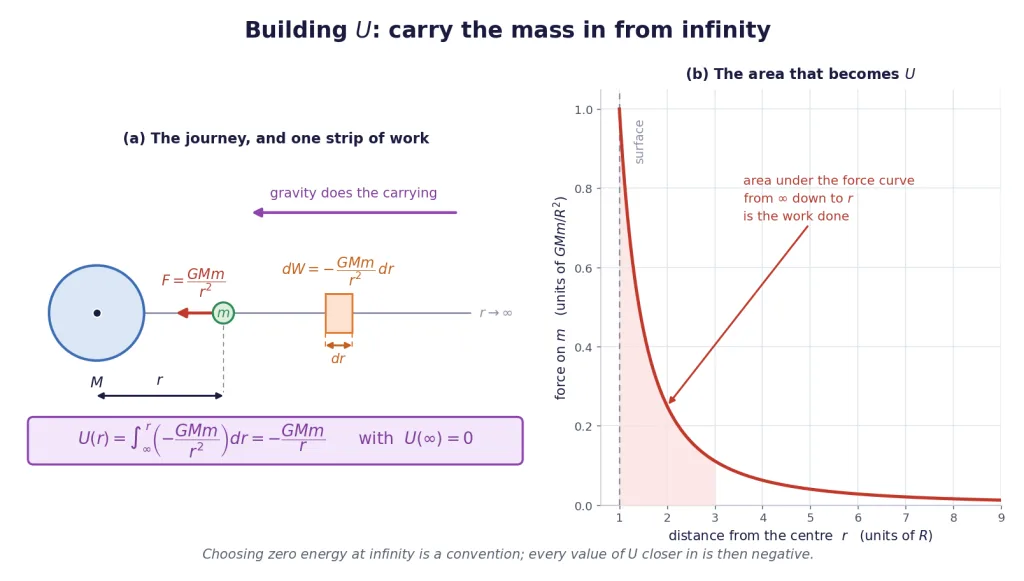
Fixing the zero, and why we put it at infinity
Notice what actually came out of that integral: a difference, . Only differences in potential energy have physical meaning, because only differences show up as work. The absolute value of at any one place is ours to choose.
So we choose. And the natural choice is the place where the two bodies stop interacting at all — infinite separation.
Key Point — the zero-of-potential-energy convention:
We set when the two bodies are infinitely far apart. With that convention, and is then, by construction, the work done by gravity in bringing from infinity to — or equivalently, minus the work an external agent must do to bring it in slowly.
State this convention whenever you write down a value of . Every negative sign in this chapter descends from it.
If somebody instead chose at the Earth's surface, they would write , and every energy difference they computed would come out exactly the same. Their numbers for itself would be different, and mostly positive. Nothing physical changes. But the infinity convention is universal, so use it, and say you are using it.
Where the formula is valid
holds for , that is, from the surface outwards. Inside a solid sphere the enclosed mass changes with and the expression is different — that is a JEE-level extension and it is developed in the JEE Corner section rather than here.
[Board Important] Two marks are routinely lost by writing without the minus sign, and one more by not saying where the zero is. Write both, every time.
What That Minus Sign Actually Means
A negative energy sounds alarming the first time you meet it. It is not. It is a bookkeeping statement, and once you read it correctly it tells you something real.
Reading the sign
is negative for every finite . Since we agreed that at infinity, that means:
Key Point: A body sitting a finite distance from a mass has less energy than the same body infinitely far away. The deficit, , is exactly the energy you would have to supply to drag it out to infinity and leave it there at rest. That is the physical content of the minus sign: the body is in an energy pit, and is how deep the pit is.
Three consequences follow immediately, and all three are examined:
- increases as increases. Going from J to J is going up. Less negative means larger. Students lose marks here constantly.
- is largest at infinity, where it equals zero. There is nowhere with a larger value.
- approaches as . The pit has no bottom for idealised point masses. For real bodies you stop at the surface, and the shell theorem takes over inside.
Recovering — and watching it fail
Now let us prove that really is the near-surface limit of the real thing, and find out precisely where it stops working.
Raise a mass from the surface, , to a height , . The rise in potential energy is
Use to trade for :
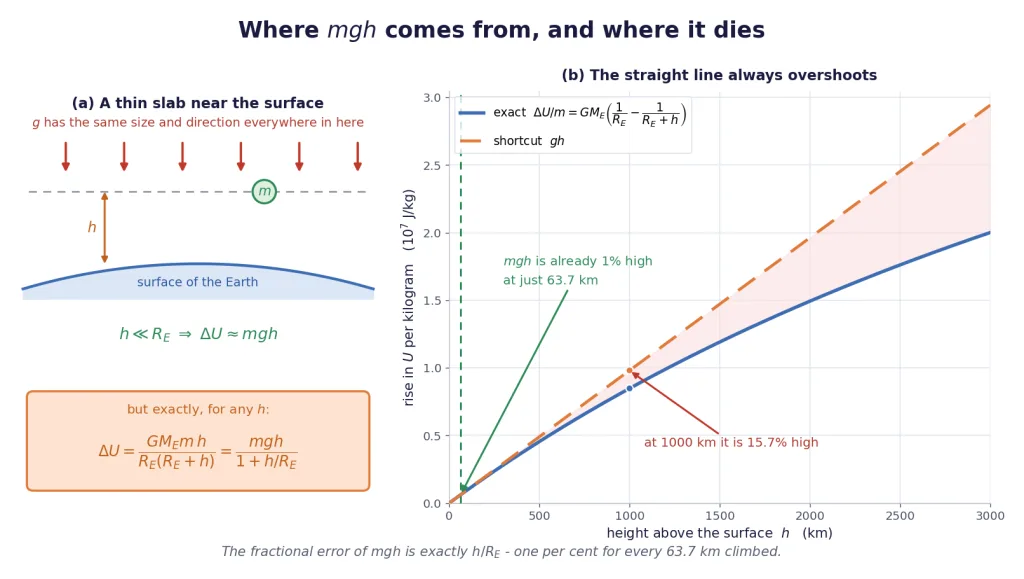
Key Point — the exact rise in , and its limit: So is not wrong — it is the first term of the exact result, and it is always an overestimate. The fractional error is exactly .
That last sentence is worth more than the formula. You do not have to guess whether is safe; you can compute the error in your head.
The error, with numbers attached
Using m and , which comes to m/s with N m/kg and kg:
| Height | Exact per kg (J/kg) | (J/kg) | is too high by | |
|---|---|---|---|---|
| 1 km | 0.00016 | 0.016% | ||
| 10 km | 0.00157 | 0.16% | ||
| 63.7 km | 0.0100 | 1.0% | ||
| 100 km | 0.0157 | 1.6% | ||
| 300 km | 0.0471 | 4.7% | ||
| 1000 km | 0.157 | 15.7% | ||
| = 6370 km | 1.000 | 100% |
Read the last row carefully. At , gives exactly twice the true answer. Not slightly off — double.
Key Point: is trustworthy to about 1% up to 64 km and to about 5% up to 300 km. Beyond that, use .
Compare this with the altitude rule for itself from Section 4: loses 1% in 32 km, while goes 1% wrong in 64 km. Different quantities, different tolerances — do not mix the two numbers up.
[JEE Tip] Any problem phrased with , , "half the radius of the Earth" or "the height at which halves" is telling you plainly that is banned. Reach for at both ends and subtract.
A System of Masses: Count Every Pair Exactly Once
So far there have been two bodies. Real problems put three, four or six masses in a row, in a triangle, at the corners of a square. The rule for handling them is short, and the mistake people make with it is always the same.
The rule
Potential energy belongs to a pair, not to a single body. You cannot ask "what is the potential energy of that particle" in isolation — you can only ask what the energy of the configuration is. So:
Key Point — potential energy of a system: Take every distinct pair once, write for it, and add. With particles there are pairs: 1 for two particles, 3 for three, 6 for four, 10 for five. Zero of potential energy at infinite separation, as always.
The mistake is double counting — treating the pair and the pair as two different terms and getting an answer twice too big. Count pairs, not ordered pairs. Listing them explicitly before you start (, , , , , for four particles) costs ten seconds and removes the error entirely.
What the number means
is the work done by gravity while the particles are brought in from infinite separation and assembled. Equivalently, is the work an external agent must supply to pull them all apart again and leave them at rest infinitely far from one another.
Key Point: Work to assemble the system (negative — gravity helps you). Work to dismantle it completely (positive — you have to pay).
The square, worked in general
Four equal masses at the corners of a square of side . There are six pairs: four sides, each of length , and two diagonals, each of length .
Notice how the diagonals contribute less per pair, because they are longer. Notice too that the answer does not care which corner is which — the configuration has an energy, the individual particles do not.
Adding a mass to an existing system
A common exam move: three masses already sit at fixed positions, and you are asked for the work needed to bring a fourth in from infinity. You do not recompute the whole system. The three existing pairs are unchanged; only the three new pairs appear. So
which, as the next block will show, is just times the potential the other three had already created at that spot. That is exactly the shortcut potential was invented for.
[NEET Important] For two particles, the numerical value of changes if either mass changes or if the separation changes — nothing else. Rotating the pair, or moving both of them together across the room, changes nothing.
Gravitational Potential: the Field's Own Property
Look again at . The source mass and the distance describe the field. The mass is just whatever you happened to put there. Divide it out, and what is left belongs to the field alone.
Key Point — gravitational potential: at a point is the potential energy per unit mass of a body placed at that point, or equivalently the work done by gravity per unit mass in bringing a body from infinity to that point. Zero of potential at infinity, as before, so is negative everywhere around a mass. SI unit: joule per kilogram (J/kg), equivalently m/s. Dimensions .
exists at a point whether or not any mass is sitting there — exactly like . In fact and are two descriptions of the same field, one a scalar and one a vector, and the rest of this block is about the relationship between them.
Why potential is so much easier than field
Because is a scalar, potentials from several sources add by ordinary arithmetic:
Key Point — superposition of potential: where each is the distance from that source to the point . No components, no angles, no resolving. Compare that with , which needs full vector addition.
This is why potential is worth learning even though the field already tells you everything. A problem that takes half a page with vectors takes one line with potentials.
Potential at the centre of a square
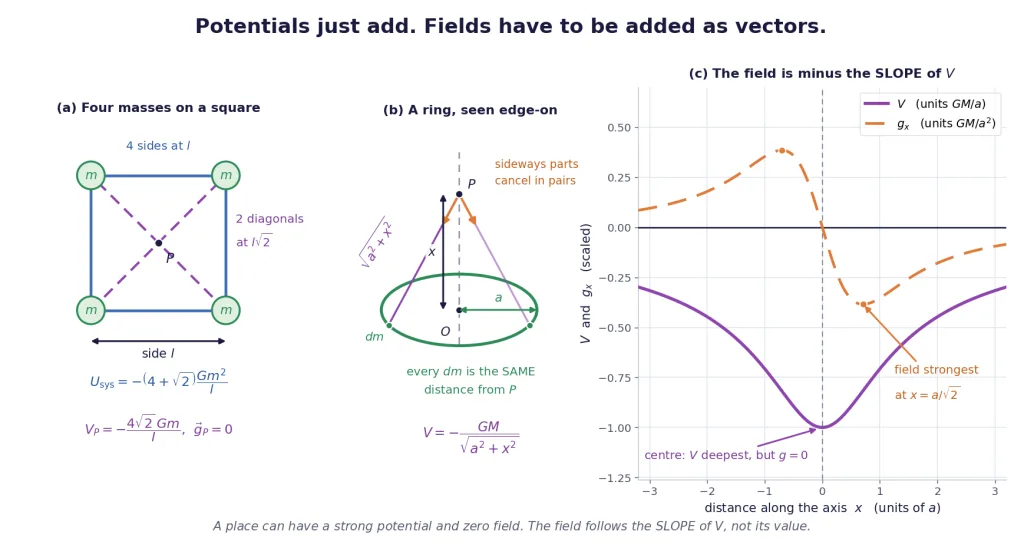
Four masses at the corners of a square of side . The centre is a distance from every corner, so
And the field there? By symmetry each corner's pull is cancelled by the diagonally opposite corner, so
Stop and look at that pair of results. At the centre of the square the potential is at its most negative anywhere in the square, and the field is exactly zero. A large potential does not mean a large field. Hold on to that; it is the single most productive source of exam questions in this section.
Potential and field on the axis of a ring
Take a ring of mass and radius , and a point on its axis a distance from the centre. Every mass element of the ring is the same distance from — that is the whole trick. So the scalar sum is trivial:
At the centre, , this gives .
The field is harder, because the pulls from opposite elements point in different directions. Their components perpendicular to the axis cancel in pairs, and only the axial components survive, each scaled by :
the minus sign saying it points back towards the ring. At the centre, makes : the deepest potential on the axis, and no field at all. The field is largest at , where it reaches .
The bridge: field is minus the slope of potential
Those two ring results are not independent. Differentiate the potential and you get the field:
That is completely general.
Key Point — the field-potential relation: The gravitational field is minus the rate of change of potential with distance. Check it on the point mass: gives , so — the familiar inward field. The minus sign says the field points downhill in potential, from less negative towards more negative.
Read the relation both ways and you have the whole story of this block:
- Where is changing fastest, the field is strongest.
- Where has a maximum or a minimum along a line, the field along that line is zero. That is the centre of the square, and the centre of the ring.
- can be large and negative with ; can be large where happens to be unremarkable. They are the value and the slope of the same curve.
The reverse trip works too: knowing the field everywhere, you recover the potential by integrating, , with the same zero at infinity.
[JEE Tip] If a question hands you as a function of position and asks for the field, differentiate — do not go back to masses and distances. If it hands you in two dimensions, such as , differentiate with respect to each coordinate in turn: , .
versus : the Distinction Examiners Live On
If you take one thing from this section, take this. More marks are lost to confusing gravitational potential energy with gravitational potential than to anything else in the chapter, because the two symbols look alike, the two formulas differ by a single letter, and both are negative.
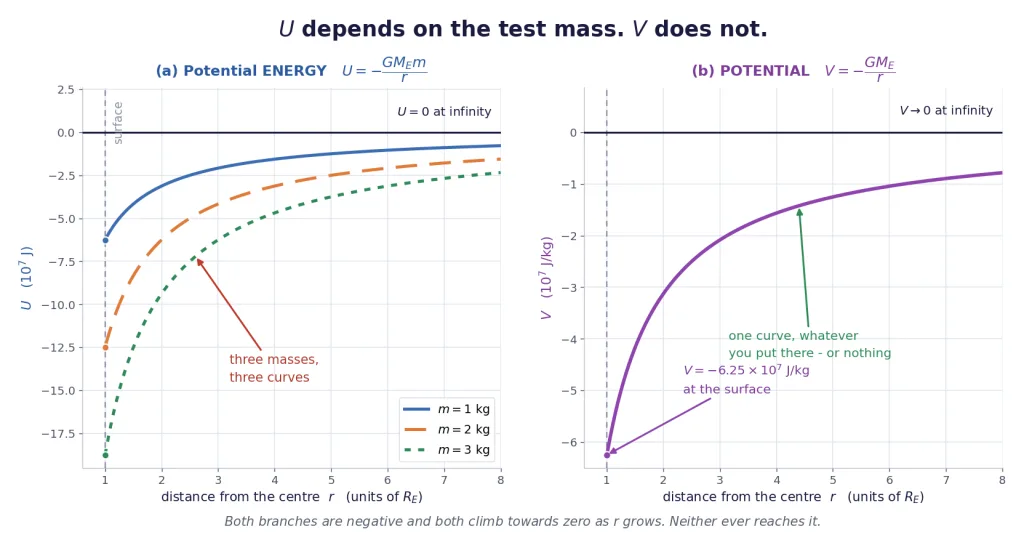
Key Point — the one-line version:
is a property of the field. is a property of the field and the body you put in it.
exists at a point in empty space. only exists once you have placed a mass there, and then . Change and changes in proportion; does not budge.
Look at the two graphs above. On the left, three different test masses give three different curves through the same region of space. On the right there is one curve, and it would be the same curve if nothing were there at all. Both are negative, both climb towards zero as grows, and neither ever reaches it.
Side by side
| Potential energy | Potential | |
|---|---|---|
| Belongs to | the pair: source and the placed body | the field alone, i.e. the point in space |
| Exists without a test mass? | No | Yes |
| Point mass , distance | ||
| Depends on the placed mass ? | Yes, directly proportional | Never |
| Scalar or vector | scalar | scalar |
| SI unit | joule, J | joule per kilogram, J/kg |
| Dimensions | ||
| Zero taken at | infinite separation | infinite distance |
| Sign around a mass | negative | negative |
| Converting between them | ||
| Adding several sources | sum over pairs, once each | sum the source potentials at that point |
| What you get by differentiating | force, | field, |
| Typical exam use | work done, energy conservation | quick superposition, then multiply by |
The four traps
Trap 1 — writing for a system of particles. There is no such thing as "the potential of a system". Potential is defined at a point. If a question says "find the gravitational potential due to four masses at the centre of the square", it wants a scalar sum of four terms giving J/kg. If it says "find the gravitational potential energy of the four masses", it wants a sum over the six pairs, in joules. Same figure, completely different sums, different units.
Trap 2 — thinking zero potential means zero field. These are independent. At the centre of a square of equal masses, and . At the neutral point between the Earth and the Moon, but is a large negative number. And a point exactly halfway between two equal masses has neither zero.
Trap 3 — treating "more negative" as "more". J/kg is a larger potential than J/kg. Potential increases outwards. If a question asks where the potential is maximum, the answer for an isolated mass is "at infinity, where it is zero".
Trap 4 — dropping the mass, or adding it twice. . If you have already used to do the superposition, multiply by once at the end. A dimensional check catches this instantly: joules or joules per kilogram?
A checking habit worth building
Before you write a final answer in this section, ask three questions.
- Units? J means , J/kg means .
- Sign? Both must be negative for ordinary masses with the zero at infinity. A positive answer means a lost minus sign — unless you were asked for work done against gravity, which is positive.
- Pairs or points? Energy of a configuration counts pairs. Potential at a place counts sources.
[Board Important] The definitions are themselves worth marks, and they must include the convention. Write: "The gravitational potential at a point is the work done by an external agent, per unit mass, in bringing a small test mass from infinity to that point without acceleration; the potential at infinity is taken as zero."
Everything in the next four sections is built on this block. Escape speed is a statement about at the surface. Orbital energetics is plus . Binding energy is . Get and straight now and the rest of the chapter becomes bookkeeping.
Solved Examples
Constants used throughout this section, unless a problem states otherwise: N m/kg, kg, m, and where a rounded surface value is needed, m/s. The zero of potential energy and of potential is at infinity everywhere in this section.
Example 1: How deep is the pit?
Find the gravitational potential energy of a 1 kg stone resting on the Earth's surface, and the gravitational potential there. What do the two numbers mean?
Solution:
Potential energy, with the zero at infinity:
Potential is the same thing per kilogram:
Meaning. To carry that stone away from the Earth entirely and leave it at rest infinitely far off, you must supply J. That is 62.5 megajoules for a single kilogram — roughly the energy in one and a half litres of petrol.
Final Answer: J and J/kg.
Takeaway: The two have the same magnitude here only because kg. For a 5 kg stone would be five times as big while would not change at all — check your units before you decide which one you have computed.
Example 2: Lifting 2 kg by one Earth radius
How much work must be done against gravity to raise a 2 kg mass from the Earth's surface to a height equal to the Earth's radius? Compare with what would predict.
Solution:
The exact change. The mass goes from to .
Put the numbers in.
What would say, with m/s and :
The comparison. The shortcut is almost exactly twice the truth. That is no accident: at the exact result is .
Final Answer: J. The estimate, J, is 100% too large.
Takeaway: always overestimates, and by the factor . Once is comparable with the shortcut is not approximate, it is simply wrong.
Example 3: How high can you trust ?
At what height does become 1% too large? What is its error at 1000 km?
Solution:
Write the exact ratio. so the fractional error of the shortcut is exactly .
Set that to 0.01.
At km.
Sanity check with real energies per kilogram. Exact: J/kg. Shortcut: J/kg. Ratio . It agrees.
Final Answer: 1% error at 63.7 km; 15.7% error at 1000 km.
Takeaway: You never have to guess whether is allowed. Divide by and you have the percentage error directly.
Example 4: Four masses on a square
Four particles, each of mass 1000 kg, sit at the corners of a square of side 1 m. Find (a) the potential energy of the system, (b) the gravitational potential at the centre, and (c) the gravitational field at the centre.
Solution:
(a) List the pairs. Four particles give pairs: four sides of length and two diagonals of length .
Substitute. With kg and m, J.
(b) Potential at the centre. Every corner is m away, and potentials are scalars, so just add four equal terms.
(c) Field at the centre. Each corner pulls with the same magnitude, and the diagonally opposite corner pulls equally in the opposite direction.
Final Answer: (a) J; (b) J/kg; (c) zero.
Takeaway: Six pairs for the energy, four terms for the potential, and a symmetry argument for the field. Three different questions about one picture, and only the first one involves pairs.
Example 5: An unequal triangle, assembled and dismantled
Masses of 100 kg, 200 kg and 300 kg sit at the corners of an equilateral triangle of side 1 m. Find the potential energy of the system, and the work an external agent must do to separate the three masses to infinity.
Solution:
Three particles, three pairs. All three separations are the same, 1 m, so
The products.
Evaluate.
Work to dismantle. The final state is complete separation, where by our convention.
Final Answer: J; the work needed to pull them apart is J, about 7.3 microjoules.
Takeaway: Work to dismantle is always , and work to assemble is itself. The zero at infinity is what makes the two numbers mirror images.
Example 6: A square with unequal masses — potential and field
Masses , , and are placed in that order around the corners of a square of side . Find the gravitational potential and the gravitational field at the centre.
Solution:
Set up. Label the corners , , , going round, and let be the centre. Every corner is a distance from .
Potential — a scalar sum, so the geometry does not matter at all.
Field — now the geometry matters. Take the diagonals in turn. Along the pulls from and oppose, leaving a net effect equal to a mass sitting at :
Along , the pulls from and leave a net equal to at , so the same magnitude , directed from towards .
Add the two. and are perpendicular, so and it points along the bisector of and , that is, towards the midpoint of the side that carries the two heaviest masses.
Final Answer: and , pointing towards the midpoint of the side joining and .
Takeaway: The potential needed one line and no diagram; the field needed a diagram and two vector steps. That difference is the entire practical argument for learning potential.
Example 7: On the axis of a ring
A thin ring of mass 200 kg and radius 3 m lies in a plane. Find the gravitational potential and the gravitational field at a point on the axis 4 m from the centre. Where on the axis is the field strongest?
Solution:
The distance from every element to the point.
Potential. Every mass element is exactly 5 m away, so the scalar sum is immediate.
Field. Differentiate, or quote the axial result: directed along the axis, towards the centre of the ring.
Where is it strongest? Set ; the maximum sits at
Final Answer: J/kg, m/s towards the ring; the field peaks at m with m/s.
Takeaway: At the centre of the ring the potential is deepest and the field is exactly zero. Move outwards and the field climbs to a peak at before falling away — the classic shape of a curve whose slope, not whose value, is the field.
Example 8: From potential to field, in a plane
In a certain region the gravitational potential is J/kg, with and in metres. Find the gravitational field there.
Solution:
Differentiate with respect to each coordinate. The field is minus the rate of change of along each direction.
Assemble the vector.
Magnitude and direction. at above the -axis.
Check the sense. decreases as and increase, and the field points the way decreases — towards larger and . Consistent.
Final Answer: , of magnitude m/s at to the -axis.
Takeaway: The field always points downhill in potential. When is given as a function of position, you never need to know what masses produced it.
Example 9: The neutral point between the Earth and the Moon
The Moon has mass kg and its centre is m from the Earth's centre. Find the point on the line joining them where the gravitational field vanishes, and the gravitational potential there.
Solution:
Set up. Let the point be a distance from the Earth's centre, so it is from the Moon's. Equate the two field magnitudes.
The mass ratio.
Solve. That is 90% of the way to the Moon, leaving m, about 38 300 km, still to go.
Potential there — and this is the point of the question. Potentials are scalars, so they simply add; there is no cancellation.
Final Answer: the null point is m from the Earth's centre; the potential there is J/kg, which is emphatically not zero.
Takeaway: Zero field and zero potential are different conditions and they almost never coincide. Fields are vectors and can cancel; potentials from ordinary masses are all negative and can only pile up.
Example 10: Moving a mass outwards
Calculate the work required to move a 5 kg body from a point from the Earth's centre to a point from the centre.
Solution:
Initial and final potential energies.
Subtract.
Numbers.
Sign check. The body ends up further out, so has increased, so an external agent has paid. Positive, as it must be. Gravity meanwhile did J of work.
Final Answer: J of work by the external agent.
Takeaway: Doubling the distance does not halve the job. Going from to costs , while going from the surface to costs twice as much — most of the price is paid in the first few thousand kilometres.
Example 11: Released from three Earth radii
A body is released from rest at a distance from the Earth's centre. With what speed does it reach the surface? Ignore the atmosphere and the Earth's rotation. Compare with the schoolbook answer .
Solution:
Energy conservation, with the exact potential energy. No kinetic energy at the start.
Cancel and rearrange.
Evaluate.
The naive answer. With and a constant m/s, which is 73% too large, because is nothing like 9.8 m/s for most of that fall.
Final Answer: km/s. The constant- estimate of km/s is badly wrong.
Takeaway: Falls that start high need the real potential energy. Section 6 takes the same calculation to its limit and asks what happens when the body is released from infinitely far away.
Example 12: Pulling two masses apart
Two particles of masses 10 kg and 20 kg are 1 m apart. How much work must be done to increase their separation to 4 m?
Solution:
One pair, so one term at each end.
The work is the change.
Note what it is not. It is not or — the separation appears as a reciprocal, so differences of reciprocals are what count. Here , giving .
Final Answer: J, about 10 nanojoules.
Takeaway: To go all the way to infinity would cost only J — a third as much again. Three quarters of the total price of separating two masses is paid in going from to .