
Staying Up Is Really About Going Sideways
Section 6 asked how fast you must throw something for it never to come back. This section asks a gentler question: how fast must you throw it so that it never comes down, but never leaves either?
The answer is the whole business of satellites, and it is one of the shorter derivations in the chapter.
First, get the picture right
A satellite in orbit is not balanced against gravity, and it is not beyond gravity's reach. Gravity acts on it with full force. The satellite is falling, continuously, exactly as a dropped stone falls.
The difference is that it is also moving sideways, fast. By the time it has fallen a few metres towards the Earth, it has travelled far enough along its path that the Earth's surface has curved away by the same few metres. It falls and misses. Then it does it again, and again, for years.
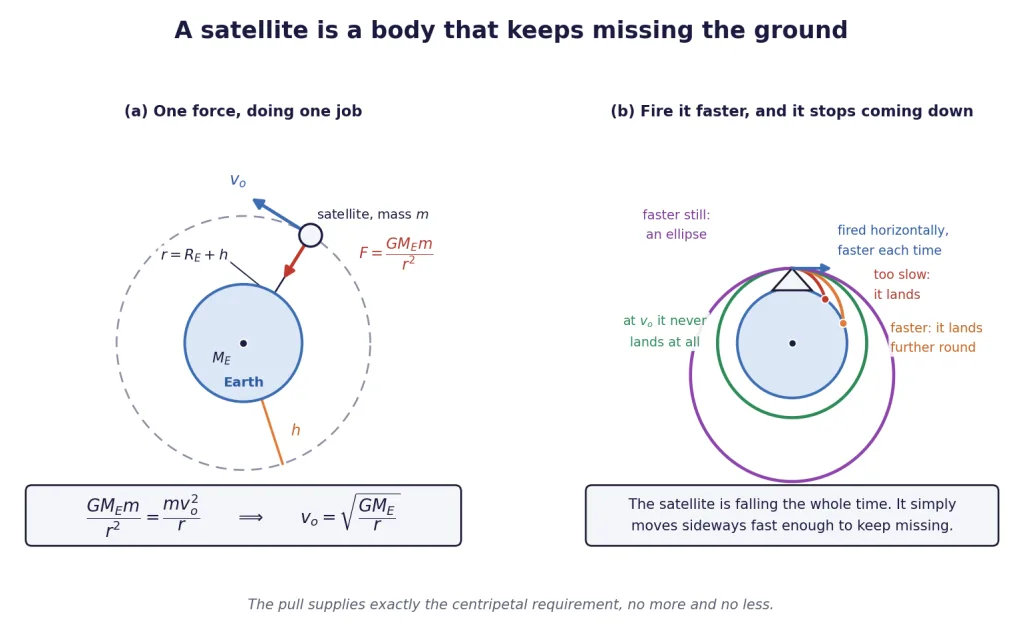
Newton put it as a thought experiment. Fire a cannonball horizontally from a mountain top. Slow, and it lands nearby. Faster, and it lands further round the curve of the Earth. There is one particular speed at which it never lands at all — the ground curves away exactly as fast as the ball falls — and that speed is what we are about to calculate.
The one-line dynamics
Take a satellite of mass in a circular orbit of radius about the Earth's centre. If it flies at a height above the surface,
That radius is measured from the centre, not from the ground. Half the mistakes in this section are made in that one line.
Now, a body in a circular path of radius at speed needs a centripetal force
pointing at the centre of the circle. Out in orbit there is exactly one force available, and it happens to point at exactly the right place:
An orbit is nothing more than the statement that these two are equal.
Key Point — the circular-orbit condition: Gravity supplies the centripetal requirement, no more and no less. Too slow, and the pull wins and the satellite spirals in; too fast, and the satellite climbs into a wider path.
Cancel from both sides, cancel one power of , and take the square root:
Key Point — orbital speed: This is the speed a satellite must have at that radius. It is not a speed you choose; it is a speed the radius chooses for you.
The mass of the satellite has vanished
Look what cancelled. The mass appeared on both sides — once in the gravitational pull, once in the centripetal requirement — and left the answer entirely.
Key Point: The orbital speed is independent of the mass of the satellite. A loose bolt and a 400-tonne space station in the same orbit travel at exactly the same speed, side by side. This is the same cancellation that made the escape speed mass-independent in Section 6, and for the same reason.
A second form, when you are given
Very often a problem gives you the surface gravity of a planet rather than its mass. Use , so :
Key Point: and for a low orbit, where , this collapses to the very useful .
The number
With N m/kg, kg and m, a satellite skimming the surface would need
At a realistic low-orbit height of 300 km the radius is m and the speed drops slightly, to 7.73 km/s. Both are about 28 000 km/h, which is why a low-orbit satellite crosses India in roughly four minutes.
Section 6 quoted the 7.91 km/s figure and promised a derivation. That was it.
[Board Important] The three-mark version: draw the circular orbit, write the gravitational force, write the centripetal requirement, equate them, cancel , and state . Marking schemes want the phrase "the gravitational force provides the necessary centripetal force" written out in words.
The Time Period, and an Old Friend Returns
Speed is only half the story. The other half is how long the satellite takes to go once round, which is what actually matters if you want to know when it will next fly over your town.
Getting from
A circular orbit of radius has circumference , and the satellite covers it at the constant speed . So
Key Point — time period of a satellite: As always, is measured from the centre of the Earth.
Square it, and look what falls out
Stare at that for a moment. , with a constant that depends only on the mass of the central body. That is Kepler's third law — the law of periods you met in Section 1, where it was an empirical pattern that Kepler had extracted from decades of naked-eye observations of the planets and could not explain.
Here it is not observed. It is derived, in four lines, from the inverse-square law and . That is the difference between a pattern and a physical theory, and it is exactly why Newton's law was accepted so quickly.
Key Point: For Earth satellites, Every satellite of the Earth — a space station, a navigation satellite, the Moon — obeys with this same . Planets going round the Sun obey the same law with instead, which is about s/m.
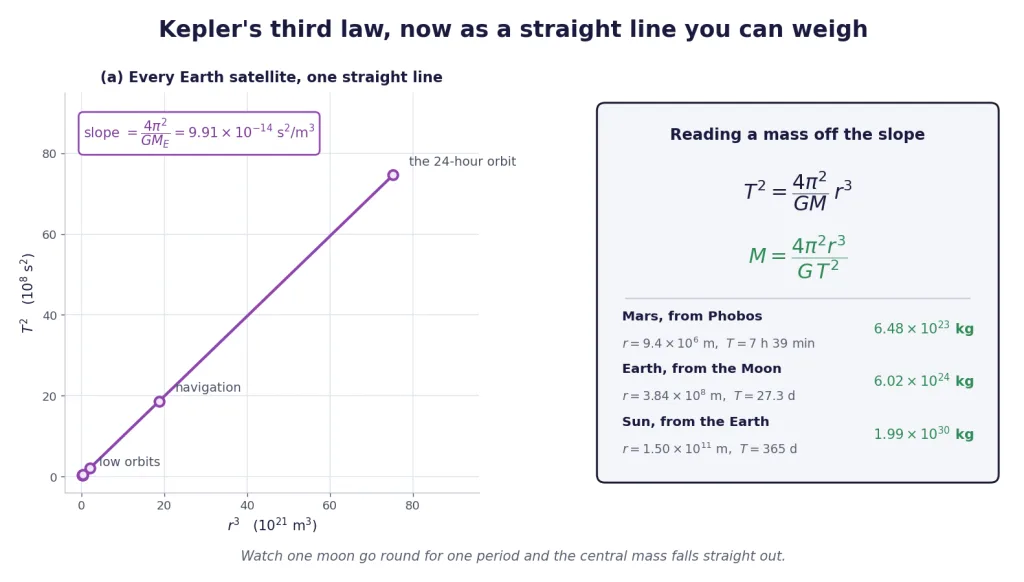
Plot against for Earth satellites and you get a straight line through the origin whose slope is . We shall use that slope in a moment to weigh the Earth.
What about elliptical orbits?
Real orbits are ellipses; circles are the special case. The result survives almost unchanged: for an elliptical orbit you simply replace by the semi-major axis ,
with the Earth at one focus. The proof needs a little more machinery than Class 11 requires, so take the statement on trust here — it is examinable as a statement, and it is what lets you handle a satellite in an eccentric orbit without ever finding its speed.
[JEE Tip] Almost every satellite question that compares two orbits is faster as a ratio. From and :
Never substitute into a ratio question. You will only lose a digit somewhere.
Higher Means Slower — and Yet It Takes Longer
Here is the fact that catches almost everybody the first time.
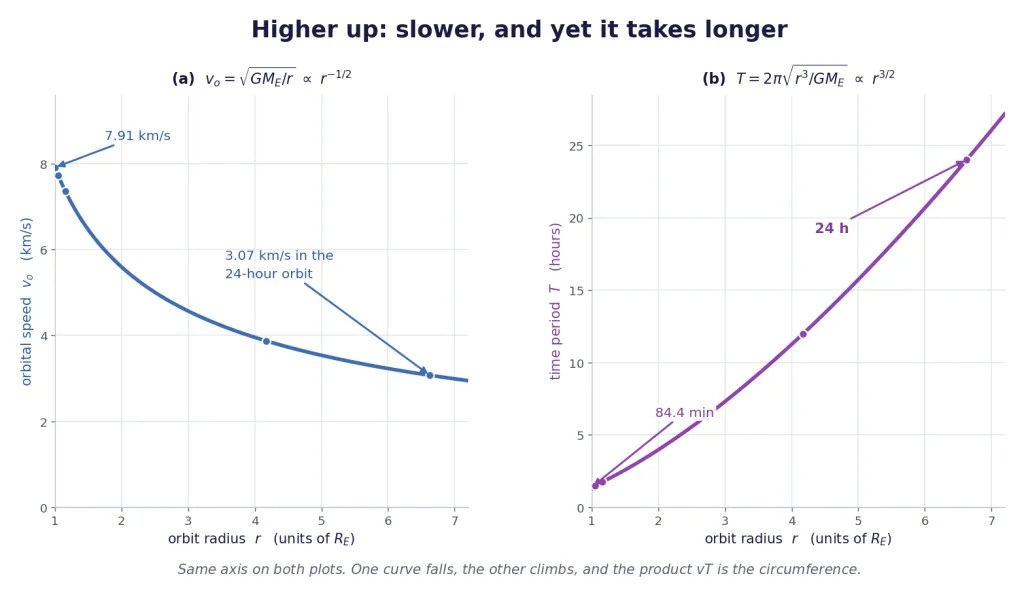
A higher satellite moves more slowly. A higher satellite takes longer to go round. Both at once. The speed and the period run in opposite directions, and a great many students, asked "which satellite is faster, the high one or the low one?", answer with the period instead of the speed.
Why there is no contradiction
Think of it this way. The period is the distance round divided by the speed:
Go twice as far out, and the lap is twice as long — a factor of 2 working to increase . At the same time the speed drops by a factor of , which is another factor of working to increase . The two effects push the same way, and together they give , which is exactly the we derived.
So the slower speed does not shorten the period; it lengthens it further. The lap is longer and it is being run more slowly. No contradiction at all.
Key Point: Doubling the radius multiplies the speed by and the period by . Quadrupling the radius halves the speed and multiplies the period by 8.
The ladder of orbits
| Orbit | (km) | (km) | (km/s) | |
|---|---|---|---|---|
| surface skimming (ideal) | 0 | 6 370 | 7.91 | 84.4 min |
| space-station height | 400 | 6 770 | 7.67 | 92.6 min |
| typical low orbit | 300 | 6 670 | 7.73 | 90.4 min |
| typical polar orbit | 800 | 7 170 | 7.45 | 100.8 min |
| — | 1 000 | 7 370 | 7.35 | 105.0 min |
| one Earth radius up | 6 370 | 12 740 | 5.59 | 3.98 h |
| navigation satellites | 20 200 | 26 570 | 3.87 | 11.98 h |
| the 24-hour orbit | 35 860 | 42 230 | 3.07 | 24.00 h |
| the Moon | 378 000 | 384 400 | 1.02 | 27.4 d |
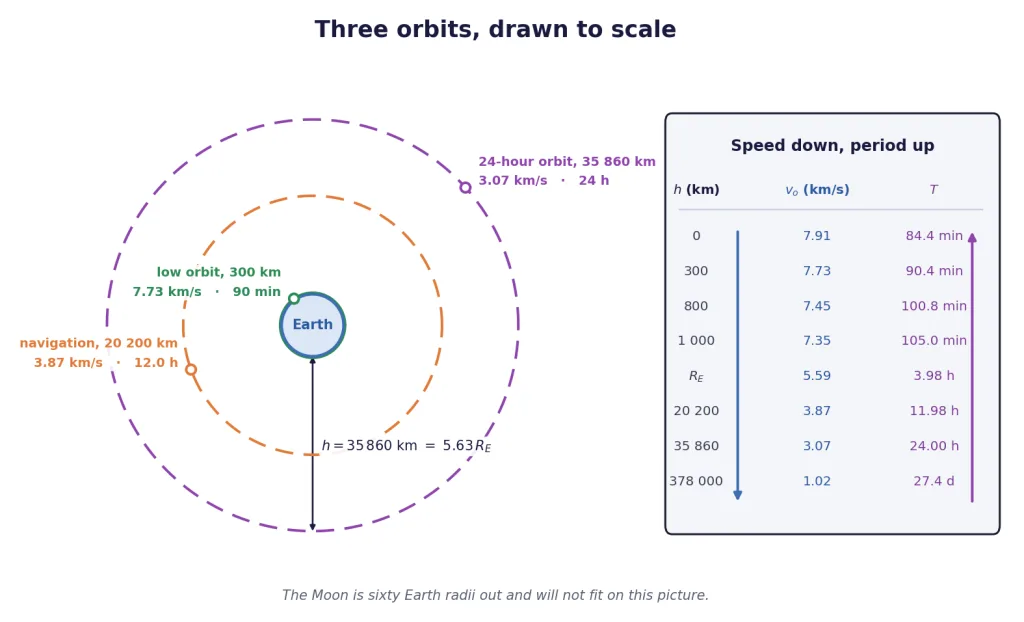
Read the last two columns against each other, top to bottom. The speed column falls steadily; the period column climbs, and climbs much faster.
A concrete comparison worth carrying: raising a satellite from 300 km to 1000 km — a climb of 700 km, about 10% in radius — cuts the speed by only 4.9%, but stretches the period by 16.1%. Small changes in radius are amplified into bigger changes in period, because of the power.
[NEET Important] Three one-line facts that get asked directly:
- orbital speed decreases with height;
- time period increases with height;
- neither depends on the mass of the satellite.
The Moon, checked
The Moon is 384 400 km from the Earth's centre, so m. Our formula gives
The Moon's observed orbital period is 27.3 days. Our four-line derivation, fed with the Earth's mass, predicts the Moon's month to within half a per cent. That is worth pausing on: the same equation governs a communications satellite and the Moon.
[JEE Tip] A favourite trap: "Satellite A is at radius and satellite B at . Which has more kinetic energy per kilogram?" A does — it is the faster one. Whether it has more total energy is a different question, and it is the subject of Section 8. Keep speed questions and energy questions apart until you have read that section.
The Surface-Skimming Orbit and the 84-Minute Clock
Set in everything above. The satellite is now grazing the ground — physically impossible, because of mountains and air, but mathematically the cleanest case there is, and it gives two numbers you should simply know.
The two skimming numbers
The second form of each is worth noticing: with the whole thing depends only on and . No , no .
Key Point — the surface-skimming orbit: Using m/s and m. You will often see 84.6 minutes quoted instead; that comes from rounding the Earth's radius up to 6400 km, and the two are the same number to the precision anyone cares about.
Let us do that arithmetic in the open, because it is a standard exam step:
Why 84 minutes is a natural unit here
Because it is the shortest period any satellite of the Earth can have. Every real orbit has , so every real orbit has , so every real orbit has . Nothing can go round the Earth in less than about 84 minutes without going underground.
That makes a natural clock for the whole subject. A low-orbit satellite at 300 km takes 90.4 minutes — a few per cent over the floor. The space station at 400 km takes 92.6 minutes. Anything much longer than about 100 minutes is already noticeably high.
Two other places the same 84 minutes turns up, both of which JEE likes:
- it is the period of a body dropped into a tunnel bored through the Earth, which oscillates from one side to the other and back;
- it is the round-trip time of the tunnel journey through the centre, which takes 42 minutes each way.
Those belong to the JEE Corner, which develops the tunnel problem properly. What matters here is that 84 minutes keeps reappearing, and it is not a coincidence — the same sits behind all of them.
It depends only on the density
Here is a small, satisfying result. Put into and watch disappear:
Key Point: The period of a surface-skimming orbit depends only on the mean density of the planet, not on its size at all. The Earth's mean density is kg/m, and s minutes, as it must be.
So a planet made of the same rock as the Earth but ten times as wide would still have an 84-minute skimming orbit — a far larger orbit, travelled far faster, taking exactly the same time. This is a favourite JEE one-liner, and it is completely unmemorable unless you have seen where it comes from.
[Board Important] Be ready to derive from by setting and substituting . It is a standard two-mark step inside a longer question.
Weighing a Planet by Watching Its Moon
Turn the period formula inside out and it stops being a way of predicting orbits and becomes a way of measuring masses. This is how essentially every mass in astronomy is known.
The inversion
Start from and solve for :
Key Point — the mass of a central body: Watch anything at all go round a body once, measure the orbit's radius and the period , and this gives the mass of the body being orbited.
Three features of that formula deserve saying out loud.
The mass of the orbiting body does not appear. You cannot weigh a moon by watching it orbit; you weigh the planet it goes round. To get the moon's own mass you would have to watch something orbit it.
You need . This is why Cavendish's experiment mattered so much: before was measured, astronomers knew the ratios of the planets' masses beautifully and their actual values not at all.
Distances enter cubed, times squared. A 1% error in becomes a 3% error in . Measuring orbital radii accurately is the hard part of the job.
Three worked cases
| What we watch | What we weigh | Answer | ||
|---|---|---|---|---|
| Phobos round Mars | m | 7 h 39 min | Mars | kg |
| the Moon round the Earth | m | 27.3 days | the Earth | kg |
| the Earth round the Sun | m | 365 days | the Sun | kg |
Look at the middle row against Section 3. There we weighed the Earth from , and , using , and got kg. Here we weigh it from the Moon's orbit and get kg. Two completely independent routes — one using a falling apple, one using the Moon — agreeing to within 1%.
That agreement is not a happy accident. It is the same claim Newton made when he compared the acceleration of the apple with the acceleration of the Moon, and it is the strongest evidence there is that one law really does govern both.
Key Point: The Earth can be weighed in two ways, and they must agree:
Reading the mass off a graph
If you have several satellites of the same body, plot against . The points lie on a straight line through the origin, and
This is how the mass of Jupiter was first pinned down, from the four moons Galileo saw, and it is a standard graph-interpretation question.
[JEE Tip] When a question gives you a period in hours or days, convert to seconds before you square it. Forgetting that 27.3 days is s and not 27.3 is the single commonest arithmetic disaster in this section — and because is squared, the answer comes out wrong by a factor of about .
The Shortlist, and the Traps
Everything worth memorising
| Quantity | Formula | Earth's value |
|---|---|---|
| Orbital radius | , measured from the CENTRE | — |
| Orbital speed | 7.73 km/s at 300 km | |
| Skimming orbital speed | 7.91 km/s | |
| Time period | 90.4 min at 300 km | |
| Skimming period | 84.4 min | |
| Kepler's third law | s/m | |
| Ratio forms | , | — |
| Weighing the central body | kg from the Moon | |
| Angular speed | — | |
| Centripetal acceleration | — |
That last row is worth a second look. The centripetal acceleration of a satellite is exactly the local value of at its height — which is another way of saying that the satellite is in free fall, a point Section 9 will make a great deal of.
Six traps
Trap 1 — using where belongs. is wrong and always will be. The distance in every orbital formula is measured from the centre of the planet: . If a question says "at a height equal to the Earth's radius", the radius of the orbit is , not .
Trap 2 — thinking a higher satellite is faster because it takes longer. It is slower. Say the two facts as one sentence — higher means slower but longer — and the trap disappears.
Trap 3 — putting the satellite's mass into the answer. It cancels. If your expression for or still contains the satellite's mass, you have made an algebra slip.
Trap 4 — leaving the period in days or hours before squaring. Convert to seconds first, every time.
Trap 5 — using m/s for a satellite far from the Earth. The value 9.8 belongs to the surface. In the is the surface value and the height sits in the denominator — the formula has the variation of already built in. Do not "correct" it a second time.
Trap 6 — assuming the orbital speed can be chosen freely. For a circular orbit of a given radius there is exactly one possible speed. Give a satellite more speed at that radius and it stops being a circular orbit at all — it climbs into an ellipse, or if you give it enough, it leaves.
What comes next
We now know how fast a satellite goes and how long it takes. What we have not touched is what it costs — the kinetic energy, the potential energy, the total, and how much more energy would be needed to free it altogether. That is Section 8, and it also settles the strange business of why adding energy to a satellite makes it slow down. Section 9 then takes two particular orbits — the 24-hour one and the polar one — and asks what they are for.
[Board Important] A very common five-mark question reads: "Derive expressions for the orbital speed and the time period of a satellite revolving close to the Earth's surface." Answer: equate gravitational and centripetal forces, get , set and use to get km/s, then minutes.
Solved Examples
Constants used throughout this section, unless a problem states otherwise: N m/kg, kg (so m/s), m and m/s. No problem mixes with .
Example 1: A satellite 300 km up
A satellite orbits the Earth in a circular path 300 km above the surface. Find (a) its orbital speed and (b) its time period. Do part (a) twice, once from and once from .
Solution:
The orbital radius, from the centre.
(a) Speed, from .
Speed again, from . The two agree to three figures; the small gap is the rounding in .
(b) Period.
Final Answer: km/s and minutes, about an hour and a half.
Takeaway: Convert the height into a radius in the very first line. Writing before anything else prevents the commonest error in the whole section.
Example 2: The impossible orbit that everybody quotes
Find the orbital speed and time period of a satellite skimming the Earth's surface. Then show that the period can be written in terms of the Earth's mean density alone, and check the two agree.
Solution:
Speed, with so .
Period.
The density form. With ,
Check it numerically. The Earth's mean density is
Final Answer: km/s and minutes, and reproduces it exactly.
Takeaway: 84 minutes is a floor, not a typical value. No satellite of the Earth can circle it any faster, and the number is fixed by the Earth's density alone — a planet of the same stuff but any size would give the same 84 minutes.
Example 3: One Earth radius up
A satellite orbits at a height equal to the Earth's radius. Find its orbital speed and period, and compare both with the surface-skimming values.
Solution:
The radius. , so m.
Speed. This is km/s, exactly as requires.
Period.
Compare. , as requires.
Final Answer: km/s and hours.
Takeaway: "At a height equal to the Earth's radius" means . Doubling divides the speed by and multiplies the period by — the two changes are both there in the same doubling.
Example 4: Two satellites, one four times higher
Satellite A orbits at radius and satellite B at radius about the same planet. Find the ratios of their speeds, their periods, their angular speeds and their centripetal accelerations.
Solution:
Speeds. :
Periods. :
Angular speeds. , so .
Centripetal accelerations. , so .
Final Answer: speeds , periods , angular speeds , accelerations (A to B in each case).
Takeaway: Learn the four exponents, not four formulas: , , , . Every comparison question in this section is one of these.
Example 5: Twice the period
Two satellites of the Earth have periods in the ratio . Find the ratio of their orbital radii, of their orbital speeds, and of their heights above the surface if the lower one skims the surface.
Solution:
Radii, from .
Speeds. so the outer satellite is about 21% slower.
The heights. If the inner one skims, km and min. Then
Sanity check on the period. min h, and s min. Good.
Final Answer: radii , speeds , and the outer satellite sits about 3740 km up.
Takeaway: Doubling the period needs only a 59% increase in radius, because the radius enters as the power of the period. Orbits are much less sensitive to period than the other way round.
Example 6: Designing a six-hour orbit
At what height above the Earth's surface must a satellite orbit if its period is to be exactly 6 hours? What is its orbital speed?
Solution:
Convert the period. s.
Invert the period formula. From ,
Take the cube root.
The height.
The speed.
Final Answer: about 10 390 km up, moving at 4.87 km/s.
Takeaway: "Find the height for a given period" is always the same three steps — convert to seconds, get , take the cube root, then subtract at the very end. Subtracting too early is the classic slip.
Example 7: Weighing Mars from one of its moons
Phobos orbits Mars in a nearly circular path of radius m with a period of 7 hours 39 minutes. Find the mass of Mars.
Solution:
Convert the period.
Use the inverted period formula.
Substitute, one piece at a time.
Divide.
Sense-check. That is about of the Earth's mass, which matches what is known about Mars.
Final Answer: kg.
Takeaway: The mass of Phobos never entered the calculation and could not have. Watching a moon go round weighs the planet, never the moon.
Example 8: Weighing the Earth two different ways
Use (a) m/s and m, and (b) the Moon's orbit, m with a period of 27.3 days, to find the Earth's mass. Comment on the agreement.
Solution:
(a) From surface gravity.
(b) From the Moon. First the period in seconds:
Then the mass.
Compare. . The two routes agree to about one per cent, the difference coming from the rounded data, chiefly the Moon's distance.
Final Answer: kg from , and kg from the Moon.
Takeaway: A falling apple and the Moon give the same answer for the Earth's mass. That agreement is the whole content of the phrase "universal law of gravitation" — one law, two utterly different pieces of evidence.
Example 9: Weighing the Sun
The Earth goes round the Sun once a year in a nearly circular orbit of radius m. Find the mass of the Sun, and hence the ratio of the Sun's mass to the Earth's.
Solution:
The period in seconds.
Apply the formula.
The pieces.
The ratio.
Final Answer: kg, about 340 000 times the Earth's mass.
Takeaway: The same formula weighs Mars, the Earth and the Sun. Only and change; the physics does not.
Example 10: What raising a satellite actually costs in speed and time
A satellite is moved from a circular orbit 300 km above the Earth to one 1000 km above it. By what percentage does its orbital speed change, and by what percentage does its period change?
Solution:
The two radii. The radius has gone up by .
Speeds.
Periods.
Cross-check with the exponents. For a 10.5% rise in radius, should change by about and by about . Both are close, and the small gaps are the usual price of using a linear approximation on a 10% change.
Final Answer: the speed falls by 4.9% and the period rises by 16.1%.
Takeaway: The percentage rules and are fast and accurate for small changes — and they tell you at a glance that the period is three times more sensitive to height than the speed is, and in the opposite direction.
Example 11: Orbiting another planet
A planet has surface gravity m/s and radius m. Find the speed and period of a satellite in a circular orbit 800 km above its surface.
Solution:
The orbital radius.
Convert the surface gravity into .
The orbital speed.
The period.
Final Answer: km/s and about 131 minutes, roughly 2.2 hours.
Takeaway: When a problem gives you and instead of , convert once — — and then use the ordinary formulas. Do not try to remember a separate set of formulas in terms of ; there is only one physics here.
Example 12: Same rock, bigger planet
A planet is made of material of the same mean density as the Earth but has three times the Earth's radius. Find (a) the period of a satellite skimming its surface and (b) the ratio of that satellite's speed to the speed of an Earth-skimming satellite.
Solution:
(a) Use the density form. The radius does not appear. Same density means the same skimming period:
(b) The speed, though, does change. At fixed density, , so
Evaluate the ratio.
Consistency check. A lap three times as long at three times the speed takes the same time. That is exactly why the period was unchanged.
Final Answer: the same 84.4-minute period, at three times the speed, 23.7 km/s.
Takeaway: At fixed density, a bigger planet gives a faster skimming satellite but the very same period. If a question mentions "same density", stop reaching for and separately — substitute and let the algebra tell you which quantities survive.