
The Three Energies of an Orbit
Section 7 told us how fast a satellite goes and how long it takes. It deliberately said nothing about energy. This section is that missing half, and it is where most of the exam questions in the satellite topic actually live.
Everything follows from two things we already have: the orbital speed from Section 7, and the gravitational potential energy from Section 5.
Kinetic energy
A satellite of mass in a circular orbit of radius moves at . So
Key Point — kinetic energy in a circular orbit: Always positive, and it falls as the orbit gets larger, because the higher satellite moves more slowly.
Potential energy
Nothing new here. Section 5 established that, with the zero of potential energy taken at infinity,
Key Point — potential energy: Always negative, and it rises towards zero as the orbit gets larger.
Note carefully that this is , the potential energy of the satellite, in joules. It is not , the gravitational potential of the field, in joules per kilogram. The two differ by a factor of and are the single most confused pair in this chapter. In this section every energy carries the satellite's mass in it.
Total energy
Add them:
Key Point — total energy of a circular orbit: Negative, and it also rises towards zero as the orbit gets larger.
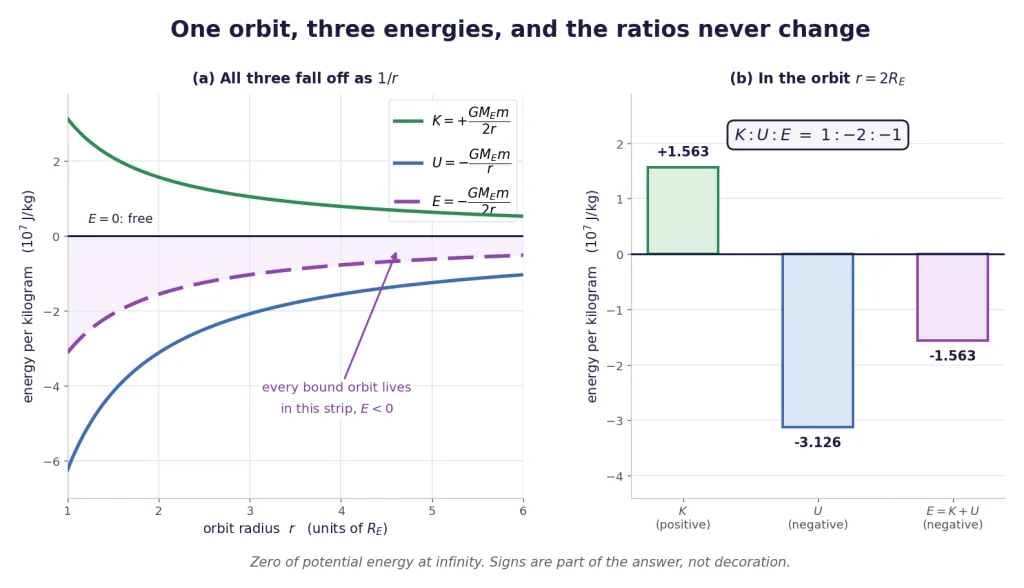
The three relations — pure exam currency
Put the three side by side and the pattern is unmissable:
Every one of them is with a different sign or a factor of two. So:
Key Point — memorise these three relations: Equivalently, . The kinetic energy is half the magnitude of the potential energy, and the total energy has the same magnitude as the kinetic energy but the opposite sign.
These are worth committing to memory exactly as written, signs included. A very large fraction of satellite questions consist of giving you one of , or and asking for another, and if you know the ratios the answer takes one line and no formula sheet.
| Given | |||
|---|---|---|---|
| J | |||
| J | |||
| J |
[NEET Important] The one-liners that get asked verbatim: the kinetic energy of a satellite is positive; its potential energy is negative and twice as large in magnitude; its total energy is negative and equal in magnitude to the kinetic energy.
Why the factor of two is not an accident
The relation for a circular gravitational orbit is a special case of a general result called the virial theorem, which holds for any inverse-square force. You do not need it by name, but it is worth knowing that the same ratio appears for an electron in a Bohr orbit in the atom chapter. When you meet it there, you will already know where it comes from.
[Board Important] A standard three-mark question asks you to derive the total energy of a satellite. Write , substitute , write stating the zero-of-potential convention, add, and conclude . The mark for the convention is real; do not skip it.
Why the Total Energy Must Be Negative
Look again at
Every symbol on the right is positive, and there is a minus sign in front. So the total energy of any circular orbit is negative, no matter the satellite, no matter the height. That is not an accident of the algebra; it is the definition of being trapped.
Bound and unbound, in one line
Section 6 built the whole escape argument on a single inequality. Let us re-read it with the satellite in mind.
At infinity, and , so a body that reaches infinity arrives with . Energy is conserved, so a body that is going to reach infinity must have now. Turn that round:
Key Point — the meaning of the sign of :
With the zero of potential energy at infinity,
- — the body is bound. It can never reach infinity. It is a satellite, on a circle or an ellipse.
- — the borderline. The body just escapes, arriving at infinity with exactly zero speed. Its path is a parabola.
- — the body is free. It escapes and still has speed left over, . Its path is a hyperbola.
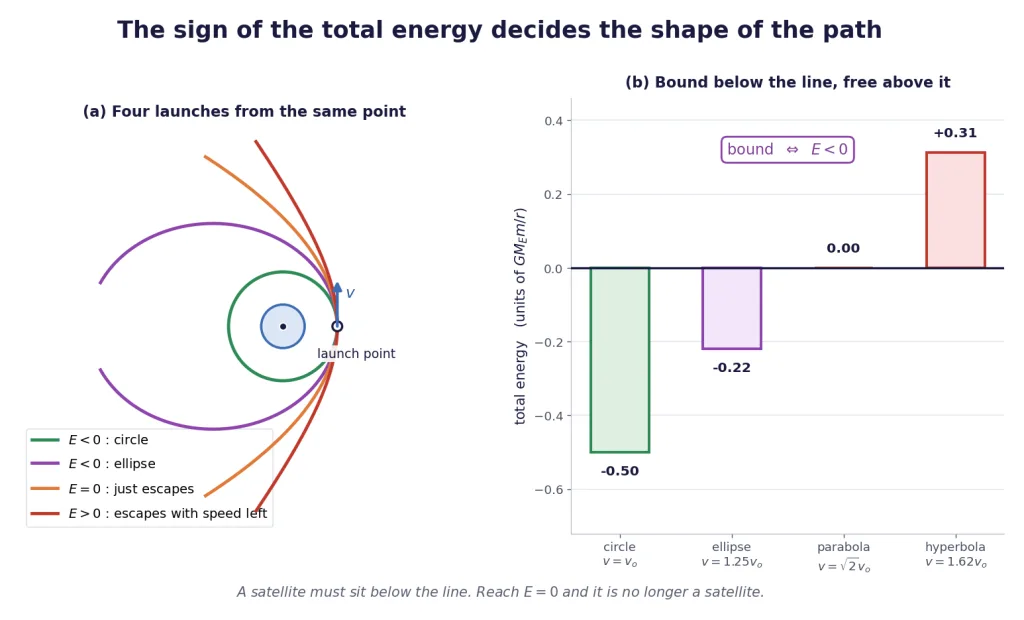
So the negativity of is not a curiosity to be memorised. It is the statement that the satellite is a satellite. If someone hands you an orbit with a positive total energy, they have not handed you an orbit at all.
What about elliptical orbits?
For an ellipse both and change from point to point — fastest and most negative at perigee, slowest and least negative at apogee — but the sum stays constant, and stays negative. The formula generalises in exactly the way Section 7's period formula did: replace by the semi-major axis .
Key Point: For an elliptical orbit of semi-major axis , so two orbits with the same semi-major axis have the same total energy and the same period, however different their shapes.
That is a strikingly useful fact. A nearly circular orbit and a long thin cigar of an orbit, if they have the same , cost exactly the same energy to reach.
A sanity check on the signs
It is easy to write and never look at it again, so let us check it means something.
Take a 1000 kg satellite at 300 km, where m and m/s:
Check the relations: — yes. — yes. And is negative, so the satellite stays. A cross-check on : the orbital speed there is 7727 m/s, and J. The two routes agree exactly, as they must.
[JEE Tip] If a question ever produces a positive total energy for something described as "in orbit", go back and look for a sign error in . Writing is the single commonest slip in this section, and it makes every subsequent line wrong in a way that is hard to spot.
Binding Energy: What It Would Cost to Set It Free
This topic sits outside the rationalised syllabus body text, but Boards, JEE Main, JEE Advanced and NEET ask about it every year, so it is developed here from first principles.
We know the satellite is trapped, because . The obvious next question is: trapped by how much?
The definition
To free the satellite completely means to raise its total energy to zero — to get it infinitely far away with nothing left over. Its total energy now is . So the energy that must be supplied is
Key Point — binding energy of a satellite in orbit: The binding energy is the minimum extra energy that must be given to a satellite in a circular orbit of radius to free it from the planet's gravity altogether. It is positive, it is numerically equal to the kinetic energy the satellite already has, and it is half the magnitude of the potential energy.
Three ways of saying the same thing, all examinable:
Careful: two different "binding energies"
Examiners exploit the following distinction constantly, so get it straight now.
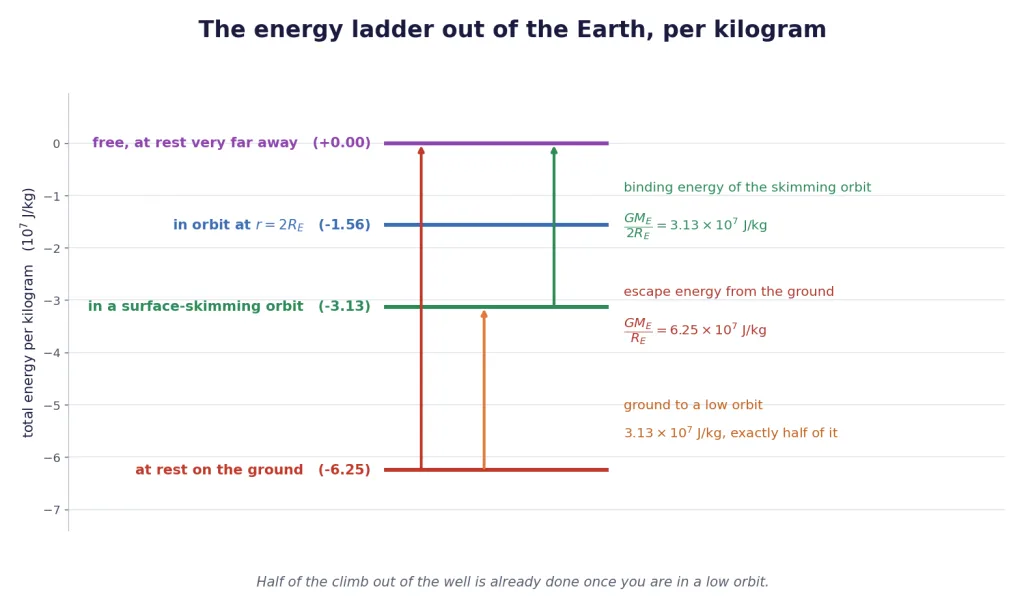
A body at rest on the ground. Its kinetic energy is zero and its potential energy is , so its total energy is . To free it you must supply
which is exactly the escape energy of Section 6 — J for every kilogram.
A satellite already in a surface-skimming orbit. Its total energy is , so to free it you need only
Key Point: A satellite skimming the surface needs only half as much extra energy to escape as a body sitting at rest on the ground at the same place. Being in orbit has already done half the job — which is another way of saying that the orbital speed is of the escape speed, since the energies go as the squares of the speeds.
| Where the body is | Total energy per kg | Binding energy per kg |
|---|---|---|
| at rest on the ground | J | J |
| in a surface-skimming orbit | J | J |
| in orbit at | J | J |
| free, at rest very far away |
Read that table downwards. The higher the orbit, the less tightly the satellite is bound, and the less it would cost to set it free — but the more it cost to put it there in the first place.
Binding energy of the Earth to the Sun, and other big numbers
The same formula applies to any bound pair. The Moon, mass kg, orbits the Earth at m, so its total energy is
and its binding energy to the Earth is J. For scale, the whole world uses about J of energy in a year, so freeing the Moon would take some 60 million years of total human energy consumption. The Moon is going nowhere.
[Board Important] Define binding energy in words as "the minimum energy required to remove a satellite from its orbit to infinity, so that its total energy becomes zero", then quote and note that it equals the satellite's kinetic energy. Those three steps are the full three marks.
Raising an Orbit, and the Paradox That Comes With It
Now the question that separates the students who have understood this section from those who have memorised it.
The cost of moving up
A satellite is in a circular orbit of radius and we want it in a circular orbit of radius . How much energy must be supplied?
Energy in equals the change in total energy:
Key Point — energy to raise a circular orbit: Positive whenever , as it must be: you have to pay to go up.
And now the paradox
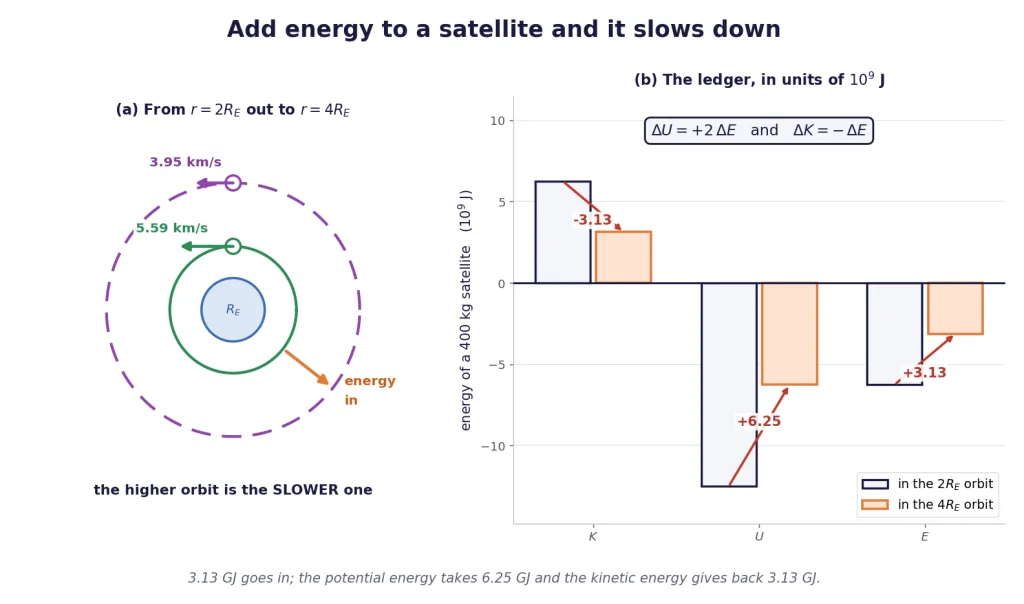
Along with , work out what happens to the two pieces separately. Since and at every radius, the same must be true of the changes:
Key Point — the orbit-raising ledger: The potential energy goes up by twice the energy you supplied. The kinetic energy goes down by exactly the amount you supplied. The satellite ends up moving more slowly than before.
Read that again. You put energy in, and the satellite slowed down.
This looks impossible, and every year it catches people out. So let us take it apart properly, because the explanation is not a trick — it is the physics.
Why adding energy slows a satellite down
Here is the thing. You did not give the satellite energy and let it stay where it was. You gave it energy and it moved outwards, and moving outwards costs potential energy at a rate that outruns what you supplied.
Suppose you supply 1 J. The satellite climbs to a bigger radius. Climbing to that radius costs 2 J of potential energy. Where does the second joule come from? There is only one other account: the kinetic energy. So the kinetic energy pays 1 J, and the satellite is slower.
The bookkeeping is forced by the fact that at every radius. Gravity, so to speak, takes a double share.
Key Point: Adding energy to a satellite raises its orbit and lowers its speed. Removing energy lowers its orbit and raises its speed. The total energy and the speed always move in opposite directions for a circular orbit, because .
The same thing running the other way: atmospheric drag
A satellite in a low orbit brushes the very thin upper atmosphere and loses energy to drag. Drag is a retarding force, so your instinct says it must slow down.
It does the opposite. Losing energy makes more negative, which makes smaller, which makes bigger. A decaying satellite spirals inwards and speeds up the whole way, right until the air gets thick enough to destroy it.
This is not a paradox either, once you see the accounting: as the satellite falls, gravity does positive work on it that is roughly twice what drag takes away, and the surplus becomes speed. It is called the satellite drag paradox precisely because it fools people, and it is a favourite assertion-reason question.
The classic numbers
A 400 kg satellite is moved from a circular orbit of radius to one of radius . With m/s and m:
and therefore
The speed drops from 5.59 km/s to 3.95 km/s, which is of what it was — exactly what doubling the radius should do.
[JEE Tip] Whenever a question asks for "the energy required to shift a satellite from one orbit to another", it wants , and alone. If it then asks for the changes in kinetic and potential energy, write them down instantly as and rather than recomputing. Getting the signs right on those two is usually where the marks are.
Escape, Seen from Orbit
Section 6 derived the escape speed from the ground. The energy picture we now have lets us redo that result as a one-liner, and lets us answer the more practical question: what does it take to escape from an orbit you are already in?
Escape is just
Set the total energy to zero at radius and see what speed that demands:
That is precisely the escape speed of Section 6, now arriving as the boundary case of the energy classification rather than as a separate derivation. Escape speed is simply the speed at which crosses zero.
Compare it with the orbital speed at the same radius:
Key Point: At any radius , the escape speed is times the circular orbital speed at that same radius. Section 6 stated this for the surface; it is in fact true everywhere, provided both speeds are evaluated at the same distance from the centre.
What escaping from orbit actually costs
A satellite in a circular orbit at radius has . To escape it needs , so it needs an extra
which is exactly the binding energy of Section 3 above, and exactly its current kinetic energy. Two neat consequences:
Key Point: To escape from a circular orbit, a satellite must be given
- extra energy equal to its own kinetic energy, ;
- extra speed of , an increase of about 41%.
A 41% increase in speed doubles the kinetic energy, which is precisely what is required. The two statements are the same statement.
The numbers for a low orbit
For a satellite at 300 km, where m/s:
So a probe leaving a low parking orbit for deep space needs a burn of roughly 3.2 km/s. That is a real number used in real mission planning, and it is why interplanetary spacecraft are launched into a parking orbit first and only then given their escape burn.
For a 1000 kg satellite the extra energy needed is J.
Putting the whole ladder together
| Stage | Total energy per kg | What it takes to get to the next rung |
|---|---|---|
| at rest on the ground | J | J to reach a skimming orbit |
| in a surface-skimming orbit | J | J to escape |
| free at infinity | — |
The two steps are equal. Getting into a low orbit is exactly half the energy job of leaving the Earth entirely — the same "half" that keeps appearing, and always for the same reason: because at is half of .
(The energy to actually reach a 300 km orbit from rest on the ground is a touch more, J per kilogram, because you must also climb the extra 300 km. Real rockets need far more again, because of air drag and because they must carry their own fuel — but that is engineering, not gravitation.)
[NEET Important] Two facts, asked in this exact form: the escape speed from a given point is times the orbital speed at that point, and the extra energy needed by an orbiting satellite to escape equals its kinetic energy in orbit.
The Shortlist, and the Traps
Everything worth memorising
| Quantity, circular orbit of radius | Formula | Sign |
|---|---|---|
| Kinetic energy | positive | |
| Potential energy | negative | |
| Total energy | negative | |
| The three relations | , , | — |
| Ratio form | — | |
| Binding energy | positive | |
| Elliptical orbit | , with the semi-major axis | negative |
| Energy to raise the orbit | positive going up | |
| Ledger for the same move | , | — |
| Escape condition | , giving at that radius | — |
| Extra speed to escape from orbit | — | |
| At rest on the ground | , B.E. | — |
Seven traps
Trap 1 — dropping the minus sign on . , always, with the zero at infinity. Every result in this section inherits that sign, and a positive produces a positive , which would mean the satellite is not in orbit at all.
Trap 2 — confusing with . is an energy in joules and belongs to the satellite. is a potential in joules per kilogram and belongs to the field. If a question gives you a value in J/kg, it is , and you must multiply by the mass before adding it to a kinetic energy.
Trap 3 — using for the binding energy of a body on the ground. A body at rest on the surface has no kinetic energy, so its binding energy is , twice the orbital value. The factor of belongs only to something already in orbit.
Trap 4 — thinking that adding energy speeds a satellite up. It slows it down. , so up means down. Say it as higher orbit, higher energy, lower speed.
Trap 5 — answering "the energy required to shift orbits" with . The energy required is . is twice as big, and quoting it is worth zero marks.
Trap 6 — using where the problem gave , or the other way round. Every formula here uses measured from the centre. .
Trap 7 — assuming and are separately constant on an elliptical orbit. They are not; only is. On an ellipse the satellite is fastest and most tightly bound at perigee and slowest at apogee. The formula is the one that survives.
A worked sign check you can do in your head
If someone tells you a satellite has J, you should be able to say, without writing anything: J, J, binding energy J. If you can do that reliably, you have this section.
What comes next
Section 9 takes two particular orbits — the one whose period is exactly 24 hours, and the one that passes over both poles — and asks what they are good for. It also settles the question that this section has been circling: why an astronaut inside an orbiting spacecraft feels no weight at all, even though gravity is precisely what is holding the spacecraft up there.
[Board Important] The most-set long question in this topic is: "Obtain expressions for the kinetic, potential and total energy of a satellite orbiting the Earth at a height . Hence define binding energy and obtain its value." Do it in that order, state the zero-of-potential convention, and finish with .
Solved Examples
Constants used throughout this section, unless a problem states otherwise: N m/kg, kg (so m/s), m and m/s. The zero of potential energy is at infinity throughout, and every energy below is quoted with its sign.
Example 1: The full energy account of a low-orbit satellite
A 1000 kg satellite orbits 300 km above the Earth's surface. Find its kinetic, potential and total energy, and verify the relations and .
Solution:
The orbital radius.
Kinetic energy.
Potential energy.
Total energy.
Check the relations. , and . Both hold.
Independent check on . The orbital speed at this radius is m/s, and J. Agreed.
Final Answer: J, J, J.
Takeaway: Write all three with their signs every time. An answer of " J" for the total energy, without the minus sign, is wrong — it claims the satellite is unbound.
Example 2: One energy given, the other two wanted
The potential energy of a satellite in a circular orbit is J. Find its kinetic energy, its total energy and its binding energy. If its mass is 250 kg, find its orbital speed.
Solution:
Use the ratios. For a circular orbit, and .
Binding energy.
Orbital speed, from .
Final Answer: J, J, B.E. J, km/s.
Takeaway: You never need , or to move between , and . The ratios do it in one line, which is why they are worth memorising.
Example 3: Binding energy of a surface-skimming satellite
Find the binding energy per kilogram of a satellite in a circular orbit just above the Earth's surface, and compare it with the energy per kilogram needed to launch a body from rest on the ground so that it escapes.
Solution:
Binding energy in orbit, with :
Escape energy from rest on the ground. A body at rest on the surface has and , so
The ratio.
Why. The orbiting body already has kinetic energy , which is exactly half the depth of the pit it sits in. That is the energy version of .
Final Answer: J/kg in orbit, against J/kg from rest on the ground — exactly half.
Takeaway: Getting into a low orbit is half the energy job of leaving the Earth. Whenever a question compares "from the ground" with "from orbit", the answer is a factor of two, and it comes from the in .
Example 4: A satellite one Earth radius up
A 500 kg satellite orbits at a height equal to the Earth's radius. Find its kinetic, potential and total energy, and its binding energy.
Solution:
The radius. m.
The common factor.
The three energies.
Binding energy.
Per kilogram, that is J/kg — half the surface-skimming value, because the radius has doubled.
Final Answer: J, J, J, B.E. J.
Takeaway: Compute once and write all four answers off it. Everything in this section is that one number, halved or negated.
Example 5: Moving a satellite to a higher orbit
A 400 kg satellite is in a circular orbit of radius about the Earth. How much energy is required to transfer it to a circular orbit of radius ? What are the changes in its kinetic and potential energies?
Solution:
Initial and final total energies.
The energy required.
Substitute.
The two changes. Since and ,
Check the bookkeeping. J . Consistent.
What happened to the speed. m/s and m/s, a drop of exactly .
Final Answer: J must be supplied; the kinetic energy falls by J and the potential energy rises by J.
Takeaway: The satellite ended up 3.13 GJ richer in total energy and 1.6 km/s slower. The potential energy took twice what you paid, and the kinetic energy made up the difference.
Example 6: The kick that frees a satellite
A satellite is in a circular orbit 300 km above the Earth. (a) By how much must its speed be increased for it to escape? (b) If its mass is 1000 kg, how much extra energy is that?
Solution:
Orbital speed at that radius, with m:
(a) Escape speed at the same radius.
(b) The extra energy is the binding energy, which equals the current kinetic energy:
Cross-check the energy from the speeds. The two agree.
Final Answer: an extra 3.2 km/s, which for 1000 kg is J.
Takeaway: A 41% increase in speed doubles the kinetic energy, and doubling the kinetic energy is exactly what escaping needs. That is why the extra energy required equals the kinetic energy the satellite already has.
Example 7: From the launch pad to a low orbit
How much energy per kilogram is needed to take a body from rest on the Earth's surface and place it in a circular orbit 300 km up? Ignore air resistance and the Earth's rotation.
Solution:
Energy at the start. At rest on the ground, and
Energy at the end, in a circular orbit at m:
The difference.
Split it up, for interest. Of that, J/kg would have been needed even for a skimming orbit; the extra J/kg is the cost of the additional 300 km of climb.
Final Answer: about J for every kilogram placed in that orbit.
Takeaway: Launching is a change in TOTAL energy, from to . Do not compute the kinetic energy needed and stop there; the body also had to climb.
Example 8: The drag paradox, with numbers
A satellite in a low circular orbit loses energy slowly to atmospheric drag. Explain, with the energy relations, why its speed increases. If a 1 kg element of it starts at m and its total energy per kilogram falls by J/kg, find the new radius and the new speed.
Solution:
The argument. For a circular orbit and . If falls (becomes more negative), then must fall, and must rise. Lower orbit, faster satellite.
The starting values, per kilogram.
After the loss.
The new radius. so the satellite has dropped by km.
The new speed. against 7727 m/s before — an increase of 72 m/s.
Final Answer: the orbit shrinks by 123 km and the speed rises by about 72 m/s, even though the satellite has lost energy.
Takeaway: A retarding force makes an orbiting satellite go faster. Gravity does more positive work on the falling satellite than drag takes away, and the surplus becomes kinetic energy — which is exactly what encodes.
Example 9: The Moon's energy account
The Moon, of mass kg, orbits the Earth at a mean radius of m. Find its kinetic, potential and total energy, and its binding energy to the Earth.
Solution:
The common factor.
The three energies.
Binding energy.
A check on . The Moon's orbital speed is m/s, and J. Agreed to three figures.
Final Answer: J, J, J, and the Moon is bound to the Earth by J.
Takeaway: The same three formulas that describe a 400 kg satellite describe the Moon. Only the numbers change, and the ratio does not change at all.
Example 10: Given the total energy, find the orbit
A satellite of mass 200 kg orbits the Earth with a total energy of J. Find the radius of its orbit, its height above the surface, its orbital speed and its period.
Solution:
Radius, from .
Height.
Speed. Since J,
Period.
Final Answer: m, km, km/s, hours.
Takeaway: The total energy fixes the orbit completely. Give me and the satellite's mass and I can tell you its radius, its speed and its period — which is why is the single most useful number to know about an orbit.
Example 11: How the binding energy changes with height
Compare the binding energy of a satellite of mass in a surface-skimming orbit with that of the same satellite in an orbit at a height . Which is more tightly bound, and which cost more to put there?
Solution:
The two binding energies.
The ratio. The higher satellite is less tightly bound: it would take only half as much extra energy to free it.
But which cost more to reach? Compare total energies against a body at rest on the ground, :
Compare. , so the higher orbit cost 50% more to reach.
Final Answer: the higher satellite has half the binding energy but cost one and a half times as much energy to place.
Takeaway: "Less tightly bound" and "cheaper to reach" are opposite things. Going higher costs more and leaves you needing less to escape — which is exactly why deep-space missions leave from high orbits when they can.
Example 12: An orbit change in symbolic form
A satellite of mass orbits a planet of mass at radius . Find, in terms of , (a) the energy needed to move it to a circular orbit of radius , (b) the changes in its kinetic and potential energies, and (c) the fraction of its original kinetic energy that this represents.
Solution:
(a) The two total energies.
(b) The ledger.
(c) The original kinetic energy was , so
Read it back. Supplying two-thirds of the satellite's original kinetic energy triples its orbital radius. The new kinetic energy is , one third of what it was — and indeed means the speed dropped by and the kinetic energy by 3.
Final Answer: (a) ; (b) and ; (c) two thirds of the original kinetic energy.
Takeaway: Symbolic orbit-change questions are always , followed by and . Do the algebra with the terms and substitute numbers only at the very end.