
The Orbit That Stands Still
Geostationary satellites, polar satellites and weightlessness all sit outside the rationalised syllabus body text, but Boards, JEE Main, JEE Advanced and NEET ask about them every year, so all three are developed here from first principles.
Section 7 gave us a rule: pick a radius and the period is fixed. Now run it backwards. Pick a period and the radius is fixed. And there is one period that is more useful than any other.
The idea
A television dish on a roof points at a fixed spot in the sky and never moves again. That only works if the satellite it is pointing at never moves in the sky either — if, seen from the ground, it simply hangs there.
For that to happen, the satellite must go round the Earth in exactly the time the Earth takes to turn once beneath it, and it must go round the right way, and in the right plane.
Key Point — the three conditions for a geostationary satellite:
- Its time period must be exactly 24 hours, matching the Earth's rotation.
- Its orbit must lie in the equatorial plane — directly above the equator.
- It must travel west to east, the same sense in which the Earth turns.
All three are required. Get the period right but the plane wrong and the satellite still drifts north and south in the sky every day; get the direction wrong and it races backwards across the sky twice a day.
A satellite that satisfies only the first condition is called geosynchronous — it returns to the same point once a day but wanders in between. A geostationary satellite is the special case that satisfies all three and truly stands still.
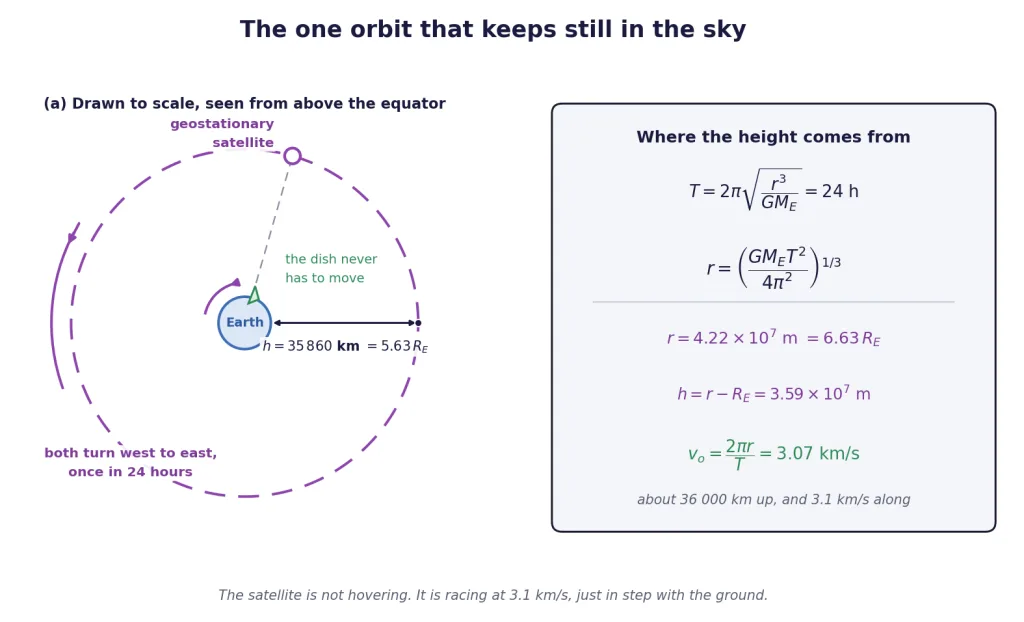
Finding the height
Take the period formula of Section 7 and invert it. From
Put in s and m/s:
and the height above the surface is
Key Point — the geostationary orbit: Every geostationary satellite ever launched, by any country, sits on this one circle. There is no choice about it.
And the speed
or equally from m/s. The two agree, as they must.
Key Point: A geostationary satellite moves at about 3.1 km/s — roughly 11 000 km/h. It is not hovering. It is racing, and only looks stationary because the ground beneath it is racing too, at m/s.
A refinement worth knowing
The Earth actually turns once relative to the distant stars in 23 hours 56 minutes 4 seconds — the sidereal day, s — not in 24 hours. The extra four minutes in the solar day come from the Earth's motion round the Sun. Using the sidereal day gives m and km, about 80 km lower than our figure.
Boards and NEET take hours, and so shall we; but if a problem specifies 23 h 56 min, use it, and expect an answer near 35 800 km.
[Board Important] The standard question is "What is a geostationary satellite? Calculate the height at which it must be placed." State all three conditions, invert , substitute s, and subtract at the end. The subtraction is where marks are lost — m is the radius, not the height.
What the 24-Hour Orbit Is Good For, and What It Cannot Do
Why a dish can be bolted in place
A geostationary satellite sits over a fixed point on the equator forever. From anywhere that can see it, its direction in the sky never changes — not through the day, not through the year.
That single fact is worth an enormous amount. A receiving dish can be aimed once, at installation, and then concreted into position. No tracking motor, no moving parts, no realignment. Every satellite television dish you have ever seen is pointed at a fixed spot in the southern sky (from India) for exactly this reason.
The same logic serves communications relays and weather satellites that need to watch one hemisphere continuously. A geostationary weather satellite returns an image of the same face of the Earth every few minutes, which is what makes an animated cloud-movement forecast possible.
How much can one satellite see?
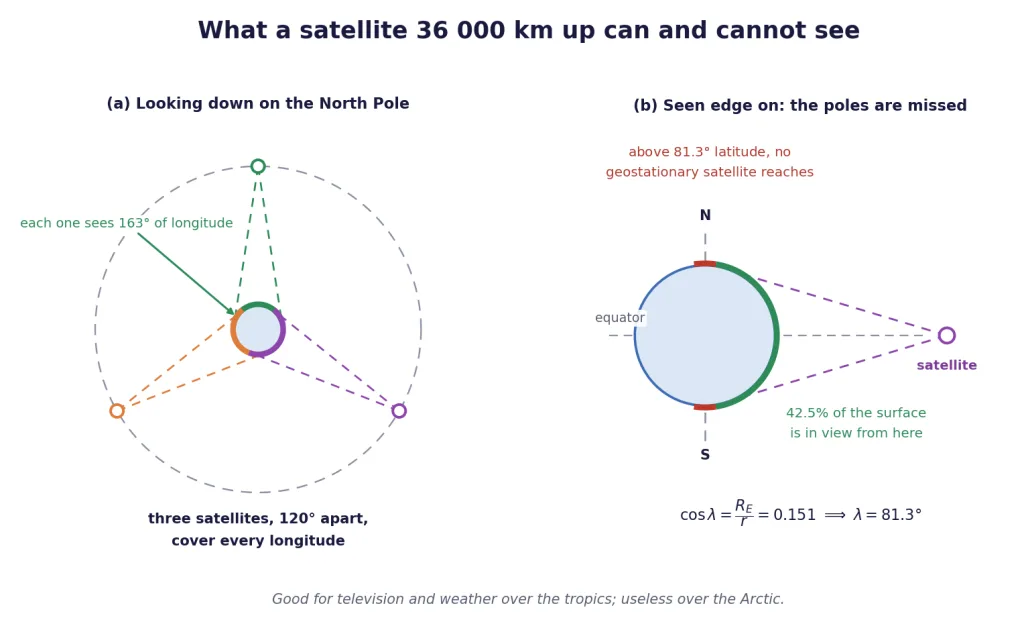
Draw a tangent from the satellite to the Earth's surface. The tangent touches at the point where the satellite is just on the horizon, and a little trigonometry on that right-angled triangle gives the highest latitude in view:
Key Point: One geostationary satellite can see everything within of the point directly below it — about 42.5% of the Earth's surface — and nothing beyond. Three satellites spaced apart in longitude cover every longitude on the planet.
But look at what is missing. Above about of latitude, a geostationary satellite is below the horizon — it never rises. No geostationary satellite, at any longitude, can see either pole. For the Arctic and the Antarctic you need a different kind of orbit entirely, which is the subject of the next block.
The price of being that far away
Two costs come with 36 000 km.
Signal delay. Radio waves travel at m/s, so a signal going up and coming down again covers 71 700 km:
A quarter of a second, each way through the satellite. On a two-way call routed through a geostationary satellite, your words take almost half a second to make the round trip, which is exactly why long-distance satellite phone calls used to have that awkward pause. Undersea cables do not have this problem, which is why they carry most international traffic today.
Signal strength. Intensity falls off as the inverse square of distance, and 36 000 km is a long way. This is why geostationary satellites carry large solar arrays and high-gain antennas, and why the dishes on the ground are as big as they are.
One circle, and everyone wants a spot on it
There is only one geostationary orbit, and satellites on it must be spaced far enough apart that their signals do not interfere. That makes slots on the geostationary ring a genuinely scarce international resource, allocated by treaty. It is a nice illustration of a physical constraint — h fixes uniquely — turning into a political one.
[NEET Important] The facts asked directly: period exactly 24 hours; height about 36 000 km; radius about 42 000 km; speed about 3.1 km/s; orbit in the equatorial plane; direction west to east, the same as the Earth's rotation; used for communication, television and weather watching; cannot cover the polar regions.
Polar Satellites: Let the Earth Do the Work
The geostationary orbit gives you a permanent view of one face of the Earth from very far away. Sometimes you want the exact opposite: a close, detailed look at every part of the Earth, including the poles. That is what a polar satellite is for.
What a polar orbit is
Key Point — a polar satellite:
- orbits at a low height, typically 500 to 900 km, so its period is only about 100 minutes;
- its orbital plane is roughly perpendicular to the equatorial plane, so it passes over or near both poles on every revolution;
- because it is low, it sees the surface in far more detail than a geostationary satellite ever could.
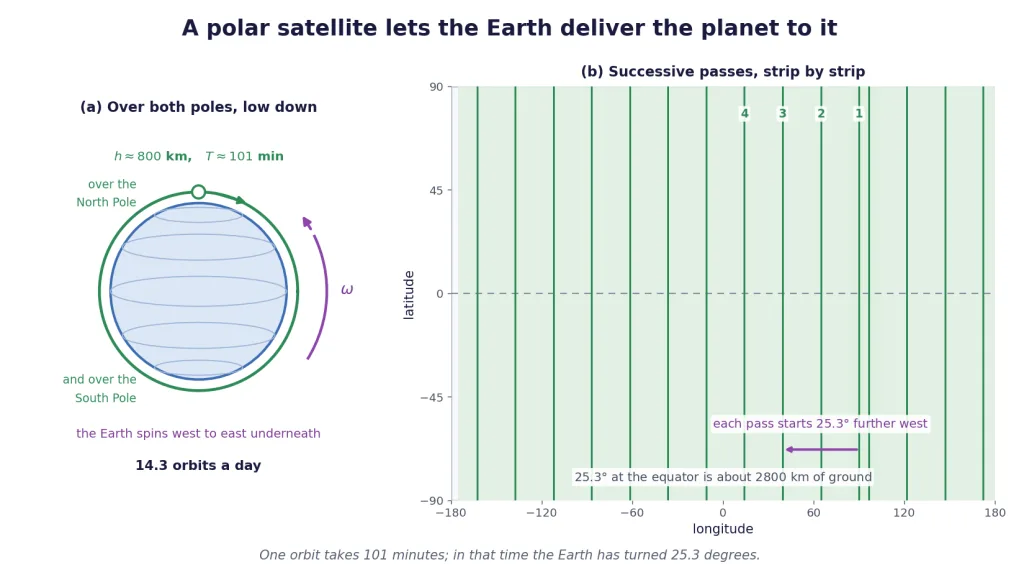
Take a typical example, km, so m:
The trick: the Earth turns underneath
Here is the elegant part, and it is the whole point of the orbit.
The satellite's orbital plane stays put in space. The Earth, meanwhile, keeps turning inside it. So in the 100.8 minutes the satellite takes to complete one pass from pole to pole and back, the Earth has rotated by
which means the satellite's next pass crosses the equator 25.3° further west than the last one. At the equator that is a shift of
Key Point: A polar satellite does not have to fly everywhere. It flies over one strip, and the Earth delivers the next strip to it. With a period of about 100 minutes it makes revolutions a day, each displaced about 25° in longitude, so in a single day it has passed over a strip at every longitude on the planet.
That is why remote sensing and weather monitoring use polar orbits. Every point on the Earth — including both poles, which no geostationary satellite can ever see — gets photographed regularly, from close up.
Notice that this only works because the satellite is low. A low orbit has a short period, so the passes come thick and fast and the strips overlap. A high satellite with a 12-hour period would shift by half the planet each pass and cover almost nothing.
The two orbits side by side
| Geostationary | Polar | |
|---|---|---|
| Height | about 36 000 km | 500 to 900 km |
| Period | exactly 24 h | about 100 min |
| Speed | 3.1 km/s | about 7.5 km/s |
| Orbital plane | equatorial | nearly perpendicular to the equator |
| Seen from the ground | fixed in the sky | crosses the sky in minutes |
| Coverage | 42.5% of the globe, continuously, no poles | the whole globe, strip by strip, including the poles |
| Detail | coarse, it is far away | fine, it is close |
| Typical use | television, communications, whole-disc weather images | remote sensing, mapping, weather sounding, polar monitoring |
[JEE Tip] Questions in this area are almost always Section 7's formulas wearing a costume. "Find the height of a satellite that appears stationary" means solve for with s. "How many times a day does a satellite at 800 km pass overhead" means find and divide 86 400 by it. There is no new physics here at all — only new vocabulary.
Weightlessness: Gravity Is Still There
Now the topic that produces more confused answers than anything else in the chapter.
An astronaut in an orbiting spacecraft floats. Objects released in mid-cabin stay where they are. A spring balance in the cabin, with a mass hanging on it, reads zero. Why?
The wrong answer, and why it is wrong
The popular explanation — "because there is no gravity up there" — is not merely imprecise; it is the exact opposite of the truth.
At the space station's altitude of 400 km, the Earth's gravitational field is
That is 89% of the surface value. Gravity up there is very nearly as strong as it is in your classroom. It has to be — gravity is the only thing holding the station in orbit at all. Take it away and the station would fly off in a straight line.
Key Point: An orbiting astronaut is not beyond gravity. Gravity is exactly what keeps the spacecraft in orbit, and at 400 km it is still about 8.7 m/s. The phrase "zero gravity" is simply wrong; what is zero is not the gravity but the normal reaction.
What "weight" means when you feel it
What you actually feel — what a weighing machine reports, what your feet report — is not gravity. It is the normal reaction from whatever is holding you up. Physicists call it your apparent weight.
Stand on a floor and the floor pushes up with . Newton's second law along the vertical, taking downwards as positive with acceleration :
You feel , not .
The lift, exactly as in the laws-of-motion chapter
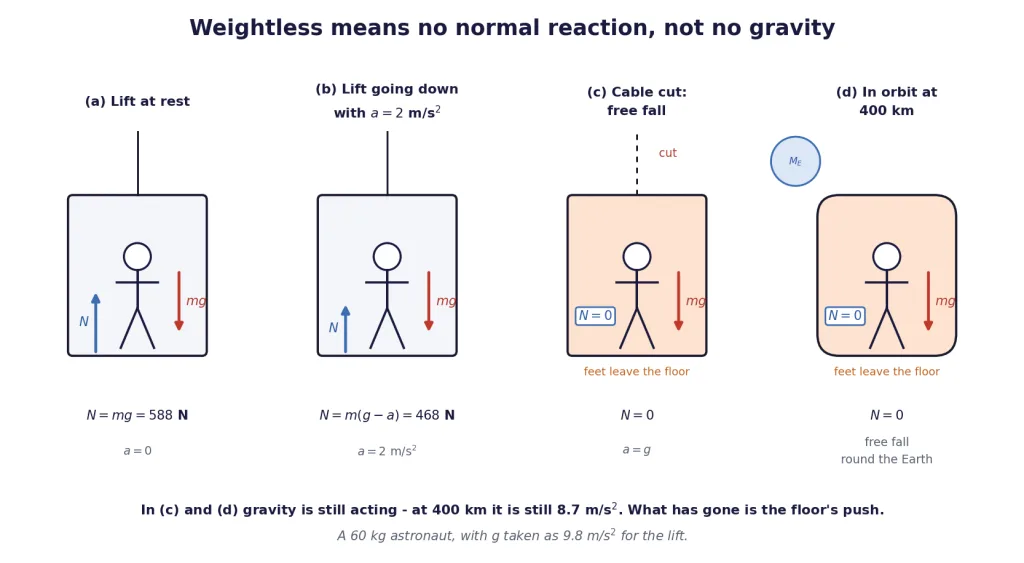
Take a 60 kg passenger and m/s throughout.
| Lift's motion | (downwards positive) | What you feel | |
|---|---|---|---|
| at rest, or moving at constant speed | 0 | 588 N | normal weight |
| accelerating upwards at 2 m/s | 708 N | heavier | |
| accelerating downwards at 2 m/s | 468 N | lighter | |
| cable cut, free fall | 0 | weightless |
The last row is the whole story. When the lift falls freely, , so . The floor has stopped pushing, because the floor is falling away from your feet exactly as fast as you are falling. Your weight has not changed by a whisker. What has vanished is the contact force.
Key Point: Weightlessness is the state in which the normal reaction is zero. It occurs whenever a body and its support are in free fall together, so that the support cannot push on the body at all.
The orbiting spacecraft is a lift with the cable cut, permanently
An astronaut, the spacecraft, and everything loose inside it are all in the same orbit, at the same radius, with the same speed. All of them have the same acceleration — the local , directed at the Earth's centre — because gravity gives every mass the same acceleration regardless of its size.
So nothing inside presses on anything else. The astronaut does not press on the floor and the floor does not press back. . A spring balance in the cabin measures , so it reads zero.
Key Point: An orbiting astronaut is in permanent free fall. The spacecraft is falling towards the Earth continuously, and so is the astronaut, at exactly the same rate — which is why they never meet. The sensation of weightlessness in orbit is the same physical situation as the falling lift, simply prolonged indefinitely by the sideways motion.
This is also why aircraft flying a particular arched path can create 20 seconds of genuine weightlessness for training or for filming: for those 20 seconds the aircraft and everything in it are in free fall together. Nothing about the Earth's gravity changed.
[NEET Important] The exact sentence to write: "An astronaut in an orbiting satellite feels weightless not because gravity is absent, but because the astronaut and the satellite are both in free fall with the same acceleration, so the normal reaction between them is zero."
Two Different Zeros, and the Traps Around Them
Weightless in orbit, weightless at the centre: not the same thing
Here is a comparison that examiners love, because the two cases give the same reading on a spring balance for completely different reasons.
In orbit at 400 km. The gravitational field is m/s, so the astronaut's true weight is N. It is not zero. But the astronaut is in free fall, so and the balance reads zero.
At the centre of the Earth. Section 4 showed, using the shell theorem, that the field inside a uniform Earth is , which is exactly zero at the centre — every shell of matter surrounding you pulls equally in all directions and the pulls cancel. So the true weight is zero. A body there is in equilibrium and needs no supporting force, so again .
Key Point — two zeros, two causes:
- In orbit: the field is large, the true weight is large, but the body is in free fall so the normal reaction vanishes. Apparent weight zero, true weight not zero.
- At the Earth's centre: the field itself is zero, so the true weight is zero. There is no free fall involved at all; the body just sits there. Both zero.
A spring balance reads the same in both places, and the physics could hardly be more different.
| Field | True weight | Acceleration | Normal reaction | Balance reads | |
|---|---|---|---|---|---|
| on the ground | 9.8 m/s | 588 N | 0 | 588 N | 60 kg |
| lift in free fall | 9.8 m/s | 588 N | 9.8 m/s | 0 | 0 |
| in orbit at 400 km | 8.69 m/s | 521 N | 8.69 m/s | 0 | 0 |
| at the Earth's centre | 0 | 0 | 0 | 0 | 0 |
Values for a 60 kg astronaut, with m/s at the surface.
Six traps
Trap 1 — "there is no gravity in space". There is. At 400 km it is 8.7 m/s, and even at the geostationary orbit it is 0.223 m/s, which is small but very far from zero — and it is precisely what holds the satellite there.
Trap 2 — confusing weight with apparent weight. Weight is and does not vanish in orbit. Apparent weight is the normal reaction, and that is what goes to zero. Say which one you mean.
Trap 3 — thinking a geostationary satellite is stationary. It stands still relative to the ground. In the inertial frame it is doing 3.1 km/s. A question asking for "the speed of a geostationary satellite" wants 3.1 km/s, not zero.
Trap 4 — putting a geostationary satellite over Delhi. It cannot be done. A geostationary satellite must be over the equator; if it were over a point at latitude , the plane of its orbit would not pass through the Earth's centre, which no orbit can manage. A satellite can serve Delhi from a slot on the equator, but it cannot hover above it.
Trap 5 — quoting the geostationary radius as the height. m is the radius from the centre. The height is m. Subtract .
Trap 6 — thinking a polar satellite sees everything because it is high. It is the opposite: it is low, which gives it a short period and fine detail, and it sees everything because the Earth rotates underneath it, not because of its vantage point.
The shortlist
| Quantity | Value / formula |
|---|---|
| Geostationary period | exactly 24 h s |
| Geostationary radius | m |
| Geostationary height | m km |
| Geostationary speed | km/s |
| Field at that height | m/s |
| Highest latitude in view | , giving |
| Satellites for full longitude cover | three, apart |
| Polar satellite height, period | 500 to 900 km, about 100 min |
| Polar revolutions per day | about 14 |
| Longitude shift per revolution | , about |
| Apparent weight | , zero when |
| Weightlessness condition | free fall, so , with unchanged |
What comes next
That completes the physics of this chapter. Section 10 is a long set of worked problems spanning everything from Kepler's laws to satellite energetics; the JEE and NEET Corners then take the same material to the level each exam demands.
[Board Important] Two long questions recur almost every year. "What is a geostationary satellite? State its conditions and find its height." And "Explain why an astronaut in an orbiting satellite feels weightless. Is the astronaut beyond the Earth's gravity?" For the second, the answer is: no. The astronaut is in free fall together with the satellite, so the normal reaction is zero, while the gravitational force on the astronaut is very much still there and is exactly what supplies the centripetal acceleration.
Solved Examples
Constants used throughout this section, unless a problem states otherwise: N m/kg, kg (so m/s), m, m/s and the speed of light m/s. No problem mixes with .
Example 1: How high is a geostationary satellite?
Find the radius and the height of the orbit of a satellite that appears stationary from the ground, taking its period as exactly 24 hours.
Solution:
The period in seconds.
Invert the period formula.
Substitute.
Cube root.
Height above the surface.
In Earth radii. , so the satellite sits about above the ground.
Final Answer: m and m, about 36 000 km up.
Takeaway: Subtract at the very end, and say clearly which of the two numbers you are quoting. "42 000 km" and "36 000 km" are both correct answers to different questions.
Example 2: Its speed, and gravity out there
For the geostationary satellite of Example 1, find (a) its orbital speed, (b) its centripetal acceleration, and (c) the value of at that height as a fraction of the surface value.
Solution:
(a) Speed, two ways.
(b) Centripetal acceleration.
(c) The field there. The acceleration of a satellite is the local :
A check on the ratio. . Agreed.
Final Answer: km/s, with a centripetal acceleration of m/s, which is 2.3% of surface gravity.
Takeaway: A satellite's centripetal acceleration is always exactly the local value of — a satellite has no other force acting on it. That single sentence is the whole basis of weightlessness.
Example 3: The sidereal day
The Earth turns once relative to the stars in 23 hours 56 minutes 4 seconds. Find the geostationary radius and height using this period, and compare with the 24-hour answers.
Solution:
The period.
The radius.
The height.
The comparison. The 24-hour figure was 35 860 km, so the sidereal answer is about 80 km lower, a difference of 0.22%.
Final Answer: m and km — about 80 km below the 24-hour result.
Takeaway: Use whichever period the question gives you, and say which one you used. A 0.2% difference will not change a multiple-choice answer, but it will change the last figure of a written one.
Example 4: How much of the Earth can it see?
Find the highest latitude visible from a geostationary satellite, and the fraction of the Earth's surface it can see at one time.
Solution:
The geometry. Draw the line from the satellite tangent to the Earth. It meets the surface at right angles to the radius there, so in the right-angled triangle formed by the Earth's centre, the tangent point and the satellite, where is the angle at the centre between the tangent point and the point directly below the satellite.
Substitute.
The visible cap. The area of a spherical cap of half-angle is , and the whole sphere is , so the fraction is
Read it. 42.5% of the surface, and nothing above latitude in either hemisphere.
Final Answer: everything within of the sub-satellite point, which is 42.5% of the Earth's surface.
Takeaway: Three geostationary satellites apart cover every longitude, and still miss both poles. That gap is precisely the reason polar satellites exist.
Example 5: The delay on a satellite call
A signal is sent from a ground station straight up to a geostationary satellite and relayed straight back down to another station nearby. How long does the round trip take? What about a two-way conversation?
Solution:
The distance. Up and down again, with m:
The time.
A two-way conversation. Your words take 0.239 s to reach the other person; their reply takes another 0.239 s to reach you:
Comment. Nearly half a second of silence before every reply. That is entirely a consequence of the height, and no engineering can remove it — the signal is already travelling at the speed of light.
Final Answer: about s each way, and about s for a full exchange.
Takeaway: The geostationary orbit's great advantage — a fixed spot in the sky — is bought with a quarter of a second of delay. Low-orbit constellations trade the fixed spot back for a much shorter delay.
Example 6: A polar satellite's period and speed
A polar satellite orbits 800 km above the Earth's surface. Find its orbital speed, its period, and the number of revolutions it completes in a day.
Solution:
The orbital radius.
The speed.
The period.
Revolutions per day.
Final Answer: km/s, a period of minutes, and about 14.3 revolutions each day.
Takeaway: A polar satellite is an ordinary low-orbit satellite; only the tilt of its plane is special. Everything numerical about it comes straight from Section 7's formulas.
Example 7: Sweeping the globe strip by strip
For the polar satellite of Example 6, find how far west each successive equator crossing is displaced, in degrees of longitude and in kilometres along the equator. Take the Earth's rotation period as s.
Solution:
How far the Earth turns in one orbit.
Convert to distance at the equator. The equator is m round.
Check the day closes. In 14.3 revolutions the total shift is , so after a day the track has come all the way round the planet and started to repeat. Nothing is missed.
What this means for the instrument. To photograph the whole Earth without gaps, the satellite's camera must be able to see a strip at least 2810 km wide at the equator. Narrower than that and the passes leave gaps that only close over several days.
Final Answer: each pass is further west, a shift of about 2810 km at the equator, and 14.3 passes close the loop in one day.
Takeaway: The satellite provides the north-south motion and the Earth provides the east-west motion. Between them the whole surface is covered without the satellite ever changing its orbital plane.
Example 8: A stationary orbit round Mars
Mars rotates once in 24 hours 37 minutes and has mass kg and radius m. At what height above its surface would a satellite appear stationary, and how fast would it move?
Solution:
The period in seconds.
The gravitational parameter of Mars.
The orbital radius.
The height.
The speed.
Final Answer: about 17 030 km above the Martian surface, moving at 1.45 km/s.
Takeaway: Every rotating planet has its own stationary orbit. Mars's day is almost the same as ours but its mass is only a ninth, so its stationary orbit is much lower — the smaller is what pulls the radius in.
Example 9: A 12-hour satellite is not geostationary
A satellite of the Earth has a period of exactly 12 hours. Find its height. Would it appear stationary from the ground? Explain.
Solution:
The period. s.
The radius.
The height.
Alternatively, by ratio. Halving the period should divide the radius by : m. Agreed.
Does it stand still? No. It completes two orbits while the Earth turns once, so it crosses the sky twice a day. It returns to the same point above the ground once every day — a ground station would see it in the same place at the same hour each day — but between those moments it is moving fast across the sky, so a dish must track it.
Final Answer: about 20 200 km up, and definitely not stationary: it laps the Earth twice a day.
Takeaway: A 24-hour period is required, not a period that divides 24 hours. This is exactly the orbit that satellite navigation systems use, and it is why a navigation receiver needs no dish — it uses a small antenna that listens in every direction.
Example 10: Apparent weight in a lift
A 60 kg person stands on a weighing machine inside a lift. Taking m/s, find the reading of the machine when the lift (a) is at rest, (b) moves up at a steady 3 m/s, (c) accelerates downwards at 4 m/s, and (d) falls freely after the cable snaps.
Solution:
The general equation. Taking downwards as positive with the lift's acceleration , Newton's second law on the person gives The weighing machine reads , the normal reaction.
(a) At rest, :
(b) Steady 3 m/s upward. Constant velocity means again, so Speed is irrelevant; only acceleration matters.
(c) Accelerating downwards at 4 m/s, so : The machine reads the equivalent of 35.5 kg — the passenger feels lighter.
(d) Free fall, :
Final Answer: (a) 588 N, (b) 588 N, (c) 348 N, (d) zero.
Takeaway: Apparent weight depends on acceleration, never on velocity. A lift moving at a steady speed feels exactly like a lift at rest, and only the falling lift makes you weightless.
Example 11: The astronaut's spring balance
An astronaut of mass 60 kg is in a spacecraft in a circular orbit 400 km above the Earth. Find (a) the gravitational field there, (b) the true gravitational force on the astronaut, (c) the astronaut's acceleration, and (d) the reading of a spring balance on which the astronaut stands inside the cabin.
Solution:
(a) The field at that height. That is 89% of the surface value.
(b) The gravitational force on the astronaut. Not small, and not zero.
(c) The acceleration. Gravity is the only force acting, so directed at the Earth's centre. This is exactly the centripetal acceleration the circular orbit requires.
(d) The balance reading. The balance measures the normal reaction . The astronaut's equation of motion along the radius is The cabin, the balance and the astronaut all have the same acceleration , so nothing presses on anything. The balance reads zero.
Final Answer: m/s, a gravitational force of 521 N, an acceleration of 8.69 m/s, and a balance reading of zero.
Takeaway: The astronaut's weight is 521 N and the balance reads nothing. Weight and apparent weight are different quantities, and only the second one goes to zero in orbit.
Example 12: Two ways to weigh nothing
Compare the state of a 60 kg astronaut in orbit at 400 km with the state of a 60 kg body placed at the centre of the Earth. In each case state the gravitational field, the true weight, the normal reaction and the reading of a spring balance, and say what is physically different.
Solution:
In orbit at 400 km (from Example 11): The body is in free fall; the field is large.
At the centre of the Earth. Treating the Earth as uniform, the shell theorem gives , and at the centre , so The body is in equilibrium; the field itself is zero.
The physical difference.
| in orbit at 400 km | at the Earth's centre | |
|---|---|---|
| field | 8.69 m/s | 0 |
| true weight | 521 N | 0 |
| acceleration | 8.69 m/s towards the centre | 0 |
| normal reaction | 0 | 0 |
| why the balance reads zero | free fall: the support falls with the body | there is no gravitational force to support |
- The moral. The same instrument reading arises from two entirely different situations. In orbit gravity is strong and unopposed; at the centre it has cancelled out.
Final Answer: both read zero, but in orbit the astronaut still weighs 521 N and is accelerating at 8.69 m/s, while at the centre the weight and the acceleration are genuinely zero.
Takeaway: "The balance reads zero" is not the same statement as "gravity is zero". Ask which of the two a question means, every single time — it is the difference between full marks and none.