
What JEE Adds to Gravitation
Sections 1 to 10 built this chapter properly, and that build is complete for the Board syllabus. But JEE — Main, and far more so Advanced — asks a family of gravitation questions the core never quite sets up. A rod pulls on a bead lying on its own axis. A stone is dropped down a hole bored clean through the Earth. A satellite is nudged out of one circle and has to arrive on another. Two stars circle a point in empty space between them.
None of it is harder physics. It is the same inverse-square law, asked from a place where you have to build the answer instead of quoting it.
Most of what follows sits outside the rationalised syllabus body text, but JEE Main and JEE Advanced ask it every year, so it is developed here from first principles.
The eight things this section teaches
| # | Skill | Why it earns marks |
|---|---|---|
| 1 | Field and potential of an extended body by integration — rod, ring, disc | The examiner picks a body with no formula. You have to build one |
| 2 | The shell and the solid sphere, inside and out, with BOTH graphs | The single most drawn pair of graphs in the chapter |
| 3 | The tunnel through the Earth and the SHM it produces | One set-up, one period, and a beautiful coincidence |
| 4 | Elliptical orbits with energy AND angular momentum together | Two equations, two unknowns, every time |
| 5 | The vis-viva relation | One line that replaces both of the above |
| 6 | Orbit transfers and the Hohmann manoeuvre | Two burns, and the arithmetic is always the same |
| 7 | Binary stars and the two-body reduction | Both bodies move; the centre of mass never does |
| 8 | Gravitational self-energy, | Assembling a body, not just moving one |
Running underneath all eight is one habit: decide whether you are computing a field or a potential, an energy or an energy per kilogram, and write the sign down before the number. More marks are lost in this chapter to a dropped minus sign than to any integral.
Conventions, fixed now
Constants. Throughout this section N m/kg, kg, m, so m/s. Where a surface value of is needed it is 9.8 m/s. Every problem states which numbers it uses, and no problem mixes 9.8 with 10.
Notation. is the gravitational potential, measured in J/kg; is the gravitational potential energy of a body, measured in J, and . They are never the same object and the paper punishes anyone who treats them as one. is the gravitational field (equivalently the acceleration a free particle would have), in N/kg or m/s. is a semi-major axis, an eccentricity, and the perigee and apogee distances.
The zero of potential is at infinity, always, in every line below. That is why and come out negative everywhere inside the universe of this chapter.
Key Point: Two relations connect everything in this section, and neither is new. Potential is the running total of the field; the field is the slope of the potential. If you can compute either one, you already have the other — and the potential is almost always easier, because potentials add as plain numbers while fields add as vectors.
[Exam Tip] Before writing a single line, ask three questions. Am I inside the body or outside it? Is the quantity asked for a scalar (potential, energy) or a vector (field, force)? Which radius belongs in the formula — the body's , or the point's ? Answer those three and most of these problems are already half solved.
Field and Potential of an Extended Body, by Integration
A point mass has and , and that is the end of it. A rod, a ring or a disc is a continuous smear of point masses, and you have to add up their contributions.
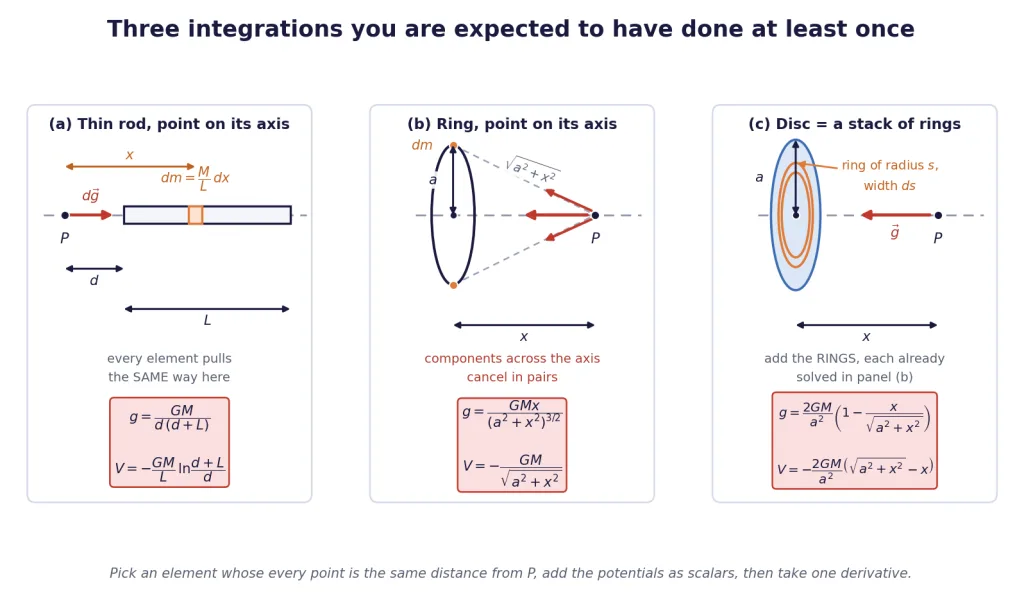
The method, in four lines
- Choose an element every point of which is at the same distance from the field point . Get this right and the integral is easy; get it wrong and it is impossible.
- Express through the density: for a wire, for a lamina, for a solid.
- Integrate the POTENTIAL first, because is a plain number with no direction to keep track of:
- Differentiate once to get the field: along the symmetry axis.
Integrating the field directly is legal, but then you must resolve every into components and argue that the transverse ones cancel. The potential route skips that entirely.
The rod, along its own axis
A thin rod of mass and length lies on a line. is on that same line, a distance from the near end. An element of length at distance from has :
directed towards the rod. Notice that the answer is not and not : the near end pulls harder than the far end, so the effective distance is the geometric mean , not the arithmetic one. Push out to 500 times and sits 0.2% below , which is the point at which a distant rod finally counts as a point mass.
The ring, on its axis
Every point of a ring of radius is the same distance from a point on the axis. So the potential needs no integration at all:
Read off three things at once.
- At the centre, : the field is zero by symmetry, but the potential is , its most negative value. A ring is the cleanest example in the whole chapter of a place where and .
- Far away, : and , as any body must.
- In between, has a maximum. Setting gives
That maximum is asked directly, most years, in one form or another.
The disc, on its axis
A disc of mass and radius is a stack of rings. Take a ring of radius and width ; its share of the mass is , and every point of it is from :
Two limits worth having on tap. Right at the centre of the face, , the field is — finite, not infinite. And writing and letting at fixed ,
independent of . An infinite sheet pulls with the same strength however far away you stand, exactly as a uniformly charged infinite sheet does in electrostatics. That parallel is worth carrying: every result in this block has an electrostatic twin with in place of .
The table, so you never have to rebuild these under time pressure
| Body | Field point | ||
|---|---|---|---|
| Point mass | distance | ||
| Rod, mass , length | on its axis, from the near end | ||
| Ring, mass , radius | on the axis, distance | ||
| Ring | at its centre | ||
| Disc, mass , radius | on the axis, distance | ||
| Infinite sheet, density | anywhere | not defined (no zero at infinity) |
Key Point: In every one of these, came first and came from . Check any result you derive by differentiating your own potential — if the two disagree, you have made an algebra slip, and you will find it in thirty seconds instead of losing the question.
[Advanced] The rod result generalises to a broken rod or a rod with a gap by simple subtraction, because both and are linear in the mass distribution. A rod from to with a piece from to removed has minus the missing piece's contribution, computed with its own limits. The same "add and subtract" trick is what makes the cavity problem in the next block work.
The Shell and the Solid Sphere: Both Graphs, Side by Side
Section 2 stated the two shell theorems and Section 4 drew against . What the paper actually asks for is both curves — the field and the potential — for both bodies, and the differences between them are exactly where the marks sit.
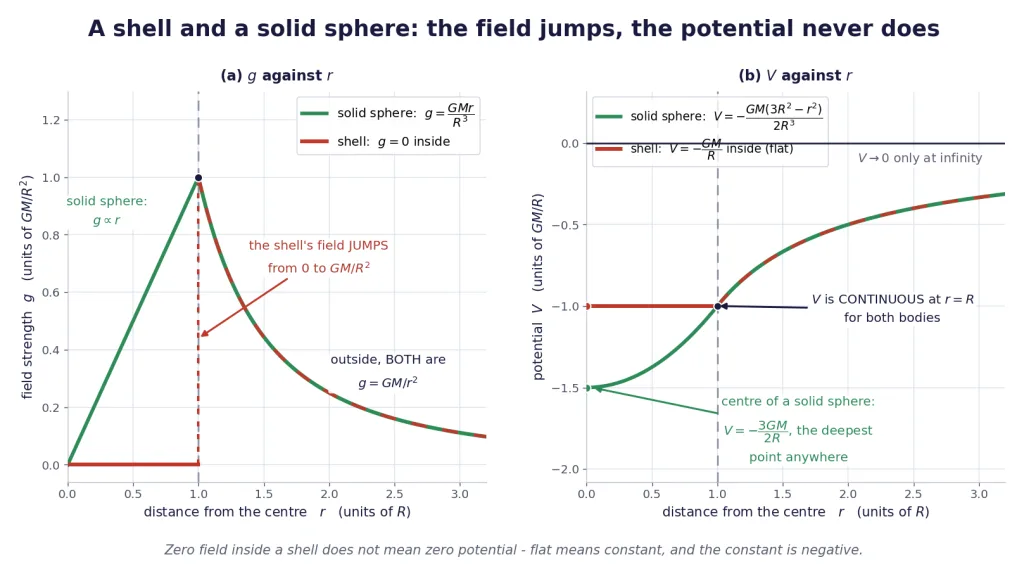
The four results for a uniform shell, mass , radius
Inside a shell the field vanishes but the potential does not. It sits at the constant value , the same as on the surface. That is not a contradiction: a constant potential has zero slope, and zero slope is zero field. Flat means constant, not zero.
The four results for a uniform solid sphere, mass , radius
Inside, only the mass within radius pulls, and that mass is , so the field grows linearly from zero at the centre to at the surface. The potential is a downward parabola, deepest at the centre:
Check the inside potential by differentiating it: , whose magnitude is exactly the inside field. The two halves fit.
The whole thing in one table
| Region | Shell: | Shell: | Solid sphere: | Solid sphere: |
|---|---|---|---|---|
Key Point — read the graphs, do not memorise them.
- is discontinuous for a shell (it leaps from to as you cross the surface) and continuous for a solid sphere.
- is continuous for both. A jump in potential would mean an infinite field, and there is none.
- is maximum at the surface of a solid sphere, never inside it and never outside it.
- is most negative at the centre of a solid sphere and reaches zero only at infinity.
- Both bodies look identical from outside. Nothing measured at can tell a shell from a solid sphere of the same mass.
Superposition: concentric bodies add, cavities subtract
Because both and are linear in mass, a compound body is handled by adding the pieces — being careful that each piece is evaluated at the same field point, with its own inside-or-outside rule.
Worked, in two lines. A solid sphere of mass and radius sits at the centre of a concentric thin shell of mass and radius .
At you are outside the sphere and inside the shell, so
At the centre both fields vanish, but neither potential does:
That second line is the one students get wrong. The shell contributes nothing to and a great deal to .
The cavity. Scoop a sphere of radius out of a uniform sphere of radius , with the hole's centre a distance from the big centre. Treat the hollow body as full sphere plus negative sphere. At any point inside the cavity, with from the big centre and from the hole's centre,
has cancelled. The field everywhere inside the cavity is uniform, of magnitude (with the mass of the original, unhollowed sphere), pointing from the cavity's centre towards the sphere's centre. A genuinely surprising result, and a JEE favourite.
[Exam Tip] The most expensive error in this block is using the wrong radius. In outside, is the distance of the field point. In inside a shell, is the shell's own radius and the field point's distance never appears. Write down which body you are inside before you write the formula, every single time.
The Tunnel Through the Earth
Bore a straight hole from one side of the Earth to the other, through the centre, evacuate it, and drop a stone in. What happens next is one of the most quoted results in the chapter — and, remarkably, one of the easiest to derive.
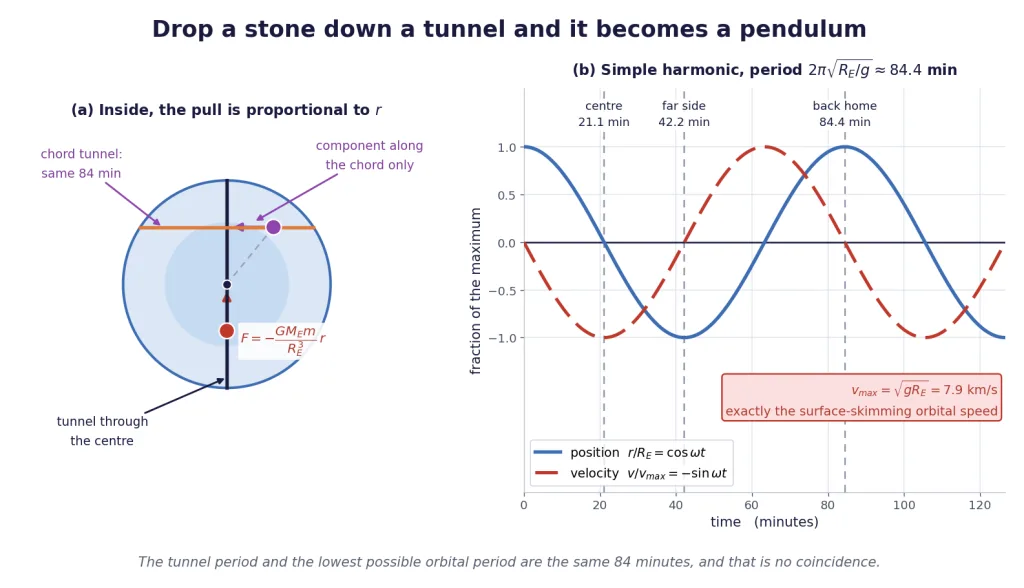
The force inside is proportional to the displacement
Treat the Earth as a uniform sphere of mass and radius . At a distance from the centre, only the mass inside radius pulls, and the field is , directed inwards. So for a stone of mass at position measured from the centre,
That is with : a linear restoring force, and therefore simple harmonic motion about the centre of the Earth.
The numbers
With m and m/s:
| Event | Time |
|---|---|
| dropped at the surface, from rest | |
| passing the centre, at maximum speed | min |
| momentarily at rest at the far surface | min |
| back where it started | min |
The maximum speed, at the centre, is the amplitude times :
The coincidence that is not a coincidence
Look at that number. 7.90 km/s is exactly the orbital speed of a satellite skimming the Earth's surface, and is exactly its orbital period. The stone in the tunnel and the surface-skimming satellite keep the same time.
That is not luck. A circular orbit of radius projected onto any straight line through the centre is simple harmonic motion of amplitude and angular frequency . The satellite's shadow on the tunnel and the stone in the tunnel obey the same equation, so they arrive together.
Key Point: minutes is the shortest period any object can have around the Earth, whether it goes through the planet or skims over it. Every higher orbit is slower. Remember the number: 84 minutes, or 5.07 kiloseconds.
The chord tunnel: the same 84 minutes
Now dig a tunnel that does not pass through the centre — a straight chord whose closest approach to the centre is . Let be the displacement along the tunnel from its midpoint. At that point , the field has magnitude pointing at the centre, and the component along the tunnel is that magnitude times :
The cancels again. Same spring constant, same , same period of 84.4 minutes — for every chord, however short. Only the amplitude changes: it is the half-length of the chord, , so the maximum speed is , smaller for a shorter tunnel.
[Advanced] This is the physics behind the old "gravity train" proposal: a frictionless tunnel between any two points on Earth is a 42-minute one-way journey, whether it links Delhi and Mumbai or Delhi and Buenos Aires. The trip time is the same because the period is the same. If a question tells you the tunnel misses the centre and expects a different period, the question is wrong — but if it asks for the maximum speed, that genuinely does depend on the chord.
[Exam Tip] Two traps. First, depends only on and — not on the mass of the stone, not on the length of the tunnel. Second, the SHM picture uses the uniform-density Earth. The real Earth has a dense core, so the real field does not rise linearly from the centre and the real period would differ; every exam question assumes uniform density, and you should say so in one line if you are writing a full solution.
Elliptical Orbits: Two Conservation Laws, Used Together
A circular orbit has one unknown speed and one equation. An elliptical orbit has two speeds you care about — at perigee and at apogee — and needs two equations. Those two equations are always the same pair.
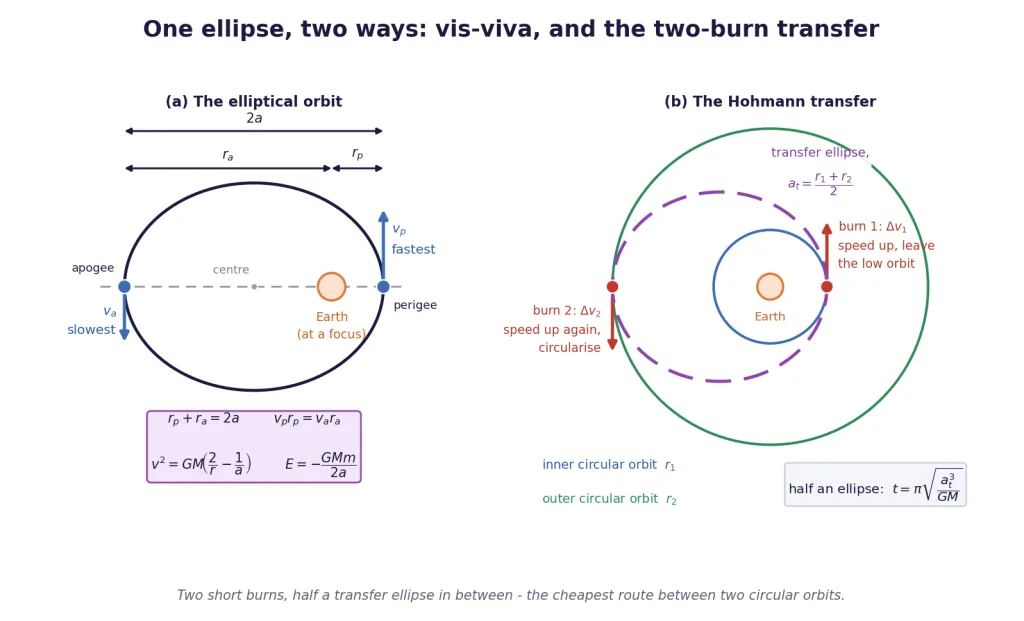
The pair
Angular momentum. Gravity is a central force, so its torque about the focus is zero and is constant. At perigee and apogee the velocity is perpendicular to the radius, so
Energy. Gravity is conservative, so
Two equations, two unknowns. Solving them together, with and :
That last relation is a lovely, and rarely quoted, check: the product of the perigee and apogee speeds equals the circular speed for radius , squared.
The geometry you must be able to write down cold
| Quantity | In terms of and | In terms of and |
|---|---|---|
| perigee distance | — | |
| apogee distance | — | |
| semi-major axis | ||
| eccentricity | ||
| semi-minor axis | ||
| total energy | same, with from the sum | |
| period | same |
Key Point: and depend on alone — not on . Two satellites with the same semi-major axis have the same total energy and the same period, however differently shaped their orbits are. A circle is just the special case , , and every formula above collapses to the circular one when you put .
Vis-viva: the one line that does both jobs
Combine the two conservation laws and eliminate everything but :
This is the vis-viva equation, and it is the single most useful formula in orbital mechanics. It gives the speed at any point of any orbit — circle, ellipse, parabola or hyperbola — from just two numbers.
Feed it the special cases and watch them fall out:
| Put in | You get | Meaning |
|---|---|---|
| the circular orbit speed | ||
| the escape speed — a parabola is an "ellipse" with infinite | ||
| fastest point | ||
| slowest point | ||
| (ends of the minor axis) | the same speed a circular orbit of radius would have |
That last row is worth a moment. At the two points where the satellite is exactly from the focus, it is moving at precisely the circular speed for that distance — but not in a circle, because its velocity is not perpendicular to the radius there.
Areal velocity, in the form that gets asked
Kepler's second law is angular-momentum conservation wearing a hat:
so the time to sweep any region equals its area divided by . Sweeping the whole ellipse takes , and the whole area is , which gives — another route to Kepler's third law if you ever need it.
[Exam Tip] When a problem gives you one speed and one distance on an ellipse and asks for another, do not set up the two conservation laws from scratch. Get from vis-viva at the point you know, then use vis-viva again at the point you want. Two substitutions, no simultaneous equations.
Orbit Transfers, the Hohmann Manoeuvre, and Catching a Satellite
A spacecraft in a circular orbit of radius has to end up in a circular orbit of radius . It cannot simply "move outwards" — every path it takes is itself an orbit. The cheapest route, and the only one you are asked about, is the Hohmann transfer: half an ellipse that touches the inner circle at its perigee and the outer circle at its apogee.
The transfer ellipse
Burn 1, at : speed up from the circular speed to the transfer ellipse's perigee speed.
Coast half an ellipse. That takes half the transfer orbit's period:
Burn 2, at : the craft arrives at apogee moving too slowly to hold a circular orbit there, so it must speed up again.
Key Point: Both burns are prograde — both speed the craft up — yet the craft ends up SLOWER than it started. A low orbit is a fast orbit. The engine adds kinetic energy twice, and the orbit's total energy rises from to , which is less negative; but the speed has fallen. Energy up, speed down. Section 8 called this the orbit-raising paradox; here is the manoeuvre that actually does it.
The ledger, in one worked line
Going from a 7000 km orbit to the geostationary radius of 42 200 km, with :
| Step | Value |
|---|---|
| circular speed at | 7.54 km/s |
| perigee speed on the transfer ellipse | 9.88 km/s |
| 2.34 km/s | |
| apogee arrival speed | 1.64 km/s |
| circular speed at | 3.07 km/s |
| 1.43 km/s | |
| total | 3.77 km/s |
| coast time | 19 200 s = 5.34 h |
Those are real launch numbers: getting a communications satellite from a parking orbit to geostationary really does cost a little under 4 km/s of velocity change and a little over five hours of coasting.
Two satellites in the same orbit: the docking paradox
Here is the set-up that catches everybody. Two satellites are in the same circular orbit, and one is a few degrees behind the other. How does the chaser catch up?
Not by firing its engine forward. Speeding up raises the orbit, which lengthens the period, which makes the chaser fall further behind.
The chaser must fire backwards. That drops it into a slightly smaller ellipse whose period is shorter, so it gains a little angle on every lap. After enough laps the gap is closed, and a second forward burn puts it back on the original circle, now alongside the target. This is called a phasing orbit, and it is exactly how a spacecraft docks with a space station.
where is the angle to be made up and the number of laps you are prepared to spend. Fewer laps means a bigger drop and a bigger ; the manoeuvre is cheap only if you are patient.
Two satellites in different orbits: when do they line up?
If two satellites have periods and , their angular speeds differ by , so they return to the same relative position after
the synodic period. If they orbit in opposite senses, the angular speeds add instead:
[Exam Tip] Read the sense of rotation before you pick a formula. "Same direction" gives a difference, "opposite directions" gives a sum, and swapping them is the single most common slip in this family of questions.
Binary Stars, Self-Energy, and the Traps That Cost Marks
Two bodies, one centre of mass
Everything so far assumed a tiny satellite around a huge fixed planet. Drop that assumption and both bodies move — around their common centre of mass, which stays put because no external force acts.
Two stars of masses and , separated by a distance , in circular orbits. The centre of mass divides the separation in the inverse ratio of the masses:
Both stars sweep the same angle in the same time, so they share one and one period. For star 1, the gravitational pull supplies its centripetal need:
which is Kepler's third law with the total mass in the denominator. Everything else follows:
| Quantity | Result | The sentence that goes with it |
|---|---|---|
| speeds | , | : the heavier star moves slower |
| momenta | equal and opposite; total momentum is zero | |
| total KE | with | one particle again |
| total energy | is the semi-major axis of the relative orbit; if circular |
The reduced mass
The relative position obeys
So the two-body problem is exactly a one-body problem: a single particle of mass orbiting a fixed centre that exerts the same force. Every orbital result you know — vis-viva, , — applies to the relative orbit unchanged.
Two sanity checks on . If then , and the light body orbits a fixed heavy one, which is where we started. If then , and the two stars sit diametrically opposite at each, moving at .
Gravitational self-energy
Everything so far has been the energy of a body in a field. Self-energy is different: it is the work done by gravity in assembling the body from dust scattered at infinity, or equivalently minus the work you must do to pull it apart and scatter it again.
Build a uniform sphere shell by shell. When the sphere already has radius , its mass is , and the next shell of thickness carries . Bringing that shell from infinity onto a sphere of mass releases
Integrate from to :
For a thin shell, where every scrap of mass ends up at the same radius , the same argument gives .
The Earth's number. With kg and m,
so blowing the Earth apart and dispersing it to infinity would cost J — about seven days of the Sun's entire energy output, in every direction at once.
Key Point: Do not confuse the three energies. is the energy of a body in the Earth's field. is the total energy of that body in orbit. is the energy stored in the Earth itself, and it involves , not . Look at which masses appear before you pick a formula.
The seven traps, collected
- Potential is not potential energy. is J/kg, is J. A question asking for "the potential at the centre of the sphere" wants , not .
- Zero field is not zero potential. Inside a shell, at the centre of a ring, at the centre of a two-mass system: and at all three.
- Superposition of fields is a VECTOR sum. Two equal masses on opposite sides of a point give zero field and a doubled (more negative) potential. Adding their magnitudes is the classic sign error.
- The wrong radius. inside a shell uses the shell's radius; outside uses the field point's distance; uses the sum. Three different radii, three different formulas.
- and of an ellipse depend on , not on . Do not put the current distance where the semi-major axis belongs.
- Both Hohmann burns speed you up, and you end up slower. If your working has a retro-burn in a raising manoeuvre, you have the sign backwards.
- Self-energy carries . If your answer to a self-energy question is linear in , it is wrong before you check the number.
[Advanced] One more relation worth carrying. For any bound orbit under an inverse-square force, the time-averaged kinetic and potential energies satisfy , so . That is the virial theorem, and for a circle it is exactly the ratio Section 8 established. For an ellipse the instantaneous values wander, but the averages over one full period obey it exactly.
Solved Examples
Twelve problems at Advanced level. Try each on paper before reading the solution — the value here is in the set-up, not the arithmetic. Where numbers are used, , kg, m and m/s.
Example 1: A ring, on its own axis
A uniform ring of mass and radius lies in the -plane with its centre at the origin. For a point on the -axis a distance from the centre, find (a) the potential , (b) the field , (c) the value of at which is largest and the value of there, and (d) the speed with which a particle released from rest at passes through the centre of the ring.
Solution:
(a) The potential needs no integral. Every element of the ring is the same distance from , so
(b) Differentiate once. The minus sign says the field points back towards the ring. Its magnitude is , which is zero at the centre and zero at infinity.
(c) The maximum. Set the derivative to zero:
(d) Energy conservation, with potentials. At , , so
Final Answer: (a) ; (b) towards the ring; (c) , ; (d) .
Takeaway: Integrate the potential, then differentiate. The ring is the one body where the potential integral is free, and everything else follows from one derivative. And note part (d): the particle speeds up all the way to the centre even though the field is zero there — the field being zero says nothing about the potential.
Example 2: A rod, and the distance that is not the average
A thin uniform rod of mass and length lies along the -axis. A point lies on the same axis, a distance from the nearer end. Find (a) the potential at , (b) the field at , (c) both at , and (d) the percentage by which the exact field differs from the point-mass estimate when .
Solution:
(a) One integral. Take an element at distance from , with . Every point of it is at , so
(b) Differentiate with respect to . so the field has magnitude , directed towards the rod. (Getting the same answer by integrating directly is a useful check: , the same thing.)
(c) Put .
(d) The far-field check. With , The point-mass estimate is 0.2% too big, even at five hundred rod-lengths away.
Final Answer: (a) ; (b) ; (c) and ; (d) 0.2% high.
Takeaway: The effective distance to a rod on its own axis is the geometric mean , not the arithmetic mean . Every extended body approaches a point mass eventually — but "eventually" is further away than students expect.
Example 3: A disc, and the sheet it becomes
A uniform disc of mass and radius has a point on its axis at distance from the centre. (a) Derive and at . (b) Evaluate both at . (c) Show that as at fixed surface density , the field becomes independent of , and state its value.
Solution:
(a) Slice into rings. A ring of radius and width has area and therefore mass Every point of it is from , so it contributes and
(b) At . Then , so
(c) The infinite sheet. Write , so : The has vanished. An infinite sheet pulls equally hard at every distance.
Final Answer: (a) as boxed above; (b) , ; (c) , independent of .
Takeaway: A disc is a stack of rings, and each ring is already solved. Note also what happens at : the field on the face of a disc is a finite , not infinite — the mass right under your feet is spread out, and its contributions cancel sideways.
Solved Examples (continued)
Example 4: The Earth, inside and out, in field and in potential
Model the Earth as a uniform sphere of mass kg and radius m. Find and at (a) the centre, (b) , (c) the surface, and (d) . (e) State where is largest and where is smallest.
Solution:
Set up the two constants once.
(a) At the centre, , use the inside formulas:
(b) At , still inside:
(c) At the surface, both formulas agree:
(d) At , outside:
(e) The extremes. rises linearly to a maximum at the surface and falls as beyond it. is most negative at the centre and climbs monotonically to zero at infinity. The two extremes are at different places, and that catches people.
Final Answer:
| (m/s) | (J/kg) | |
|---|---|---|
Takeaway: peaks at the surface; bottoms out at the centre. Going down a mine weakens the field but deepens the potential well, which is why you must still do work to climb back out. Check every inside-potential answer against .
Example 5: The cavity that holds a uniform field
A uniform solid sphere of mass kg and radius m has a spherical cavity of radius carved out of it, the cavity's centre lying a distance from the sphere's centre. Find (a) the mass of the remaining body, (b) the gravitational field everywhere inside the cavity, and (c) its numerical value.
Solution:
(a) The missing mass. The cavity has half the radius, hence of the volume, so it removes :
(b) Superposition with a negative sphere. Model the hollowed body as a full sphere of density plus a sphere of density filling the cavity. At a point inside the cavity, let run from the big centre to and from the big centre to the cavity's centre, so that runs from the cavity's centre to . Using for each piece: has cancelled. The field is the same vector at every point of the cavity: uniform, and directed from the cavity's centre towards the sphere's centre.
(c) The number. Writing (with the mass of the original, unhollowed sphere) and :
Final Answer: (a) kg; (b) uniform, magnitude , pointing from the cavity's centre towards the sphere's centre; (c) 0.125 m/s.
Takeaway: Negative mass is a legal tool because both and are linear in the mass distribution. And note the trap in the arithmetic: the in is the mass of the sphere before the hole was cut. Using there is the standard wrong answer.
Example 6: The tunnel, straight through and off-centre
A tunnel is bored through the Earth, treated as a uniform sphere with m and surface m/s. A stone is released at the surface with zero speed. Find (a) the period of the resulting motion, (b) the time to reach the centre, (c) the maximum speed, (d) how all three change if the tunnel is a chord whose closest approach to the centre is , and (e) why the answer to (a) equals the period of a surface-skimming satellite.
Solution:
(a) Show it is SHM, then read off . Inside, only the mass within radius acts, giving and hence
(b) Quarter of a period. Released at an extreme, the stone reaches the centre — the equilibrium point — after
(c) Maximum speed, at the centre. Amplitude times :
(d) The chord. Along the tunnel the restoring force is , with measured from the tunnel's midpoint — the geometric factor cancels. So , and therefore min and the 21.1 min to the midpoint, are unchanged. Only the amplitude falls, to the half-chord
(e) The coincidence. A satellite skimming the surface needs , so km/s and — the same expression. The reason is that uniform circular motion projected onto a diameter is simple harmonic motion with the same ; the satellite's shadow on the tunnel and the stone in the tunnel move identically.
Final Answer: (a) 84.4 min; (b) 21.1 min; (c) 7.90 km/s; (d) same period and same time to the midpoint, maximum speed down to 6.84 km/s; (e) circular motion projected on a diameter is SHM with the same .
Takeaway: Every straight tunnel through a uniform Earth has the same 84-minute period, through the centre or not, long or short. What the geometry changes is the amplitude, and therefore the speed — never the clock.
Solved Examples (continued)
Example 7: An elliptical orbit, from the two conservation laws
A satellite orbits the Earth in an ellipse with perigee distance m and apogee distance m, both measured from the Earth's centre. Take m/s. Find (a) the semi-major axis and the eccentricity, (b) the speed at perigee and at apogee, (c) the period, and (d) the total energy per kilogram.
Solution:
(a) Geometry first.
(b) Both laws together. Angular momentum gives , so . Substituting into energy conservation and solving, Cross-check with vis-viva at perigee: . Agreed. A second check: , and . Agreed again.
(c) Period, from alone.
(d) Total energy per kilogram. Check it directly at perigee: . Agreed.
Final Answer: (a) m, ; (b) 8262 m/s and 5508 m/s; (c) s, about 136 min; (d) J/kg.
Takeaway: Two laws, two unknowns, and then three independent checks — vis-viva, , and the direct energy sum. In an ellipse question you should never submit an answer you have not cross-checked; the checks cost fifteen seconds each.
Example 8: Vis-viva, used four times
A spacecraft is in an elliptical orbit about the Earth with m and , so m and m. Using with , find its speed (a) at m, (b) at the two ends of the minor axis, where , (c) what its speed would be in a circular orbit of radius , and (d) the extra speed it would need at perigee to escape the Earth entirely.
Solution:
(a) One substitution.
(b) At . Then :
(c) The circular comparison. A circular orbit of radius has m/s — exactly the same number. But the spacecraft is not moving in a circle at that instant: on the ellipse its velocity is not perpendicular to the radius, so the same speed is being spent partly on moving outwards.
(d) Escape from perigee. Escape needs , that is : The satellite already has 8262 m/s there, so it needs
Final Answer: (a) 7351 m/s; (b) 6746 m/s; (c) the same 6746 m/s; (d) an extra 2404 m/s at perigee.
Takeaway: Vis-viva replaces both conservation laws with one substitution. Learn the four special cases — gives the circle, gives escape, and give the extremes — and most elliptical-orbit questions become a single line of arithmetic. And note (c): equal speed does not mean equal orbit.
Example 9: A Hohmann transfer to geostationary orbit
A satellite is in a circular orbit of radius m and must reach a circular orbit of radius m, the geostationary radius. Using a Hohmann transfer with , find (a) the semi-major axis of the transfer ellipse, (b) both burns, (c) the total velocity change, and (d) the coast time. (e) Comment on the fact that both burns speed the satellite up.
Solution:
(a) The transfer ellipse touches both circles.
(b) Burn 1, at perigee. Burn 2, at apogee.
(c) Total.
(d) Half an ellipse.
(e) Why two prograde burns leave you slower. The satellite starts at 7542 m/s and finishes at 3072 m/s, having been accelerated twice. There is no contradiction: the engine raised the total energy from to , which is less negative, and in a higher orbit the required speed is smaller. Energy went up; speed went down. The difference went into potential energy, and then some.
Final Answer: (a) m; (b) m/s, m/s; (c) 3769 m/s; (d) s, about 5.34 hours; (e) both burns add energy, and a higher orbit is a slower orbit.
Takeaway: The Hohmann recipe never changes: , one vis-viva at each end, subtract, and the coast time is half the transfer period. Memorise that sequence rather than the closed-form expressions, which are easy to mis-copy under pressure.
Solved Examples (continued)
Example 10: A binary star system
Two stars of masses kg and kg move in circular orbits about their common centre of mass, separated by m. Take . Find (a) the distance of each star from the centre of mass, (b) the angular speed and the period, (c) each star's speed, (d) the reduced mass, and (e) the total energy of the system.
Solution:
(a) The centre of mass splits the separation in the inverse mass ratio. The lighter star travels on the bigger circle. Their sum is m, as it must be.
(b) One shared .
(c) Speeds. Note : the heavier star crawls, the lighter one races. Their momenta are equal and opposite, so the centre of mass never moves.
(d) Reduced mass.
(e) Total energy. which matches the general result for a circular relative orbit, and shows the familiar pattern surviving intact.
Final Answer: (a) m and m; (b) rad/s, s (265 days); (c) 36.5 km/s and 18.3 km/s; (d) kg; (e) J.
Takeaway: In a binary, one , one , two radii, two speeds — and the heavier star is always the slower one on the smaller circle. Kepler's third law still holds, with the total mass in the denominator, which is exactly how astronomers weigh stars they have never visited.
Example 11: Taking the Earth apart
(a) Derive the gravitational self-energy of a uniform sphere of mass and radius . (b) Evaluate it for the Earth, with kg and m. (c) How long would the Sun, radiating W, take to supply that much energy? (d) Compare with the energy needed to lift a single 1 kg stone from the surface to infinity.
Solution:
(a) Assemble it shell by shell. Suppose the sphere has already been built out to radius . Its mass so far is and the next shell, of thickness , carries Bringing that shell in from infinity onto a body of mass changes the potential energy by
(b) The Earth's figure. Dispersing the Earth to infinity therefore costs J.
(c) In units of sunshine.
(d) Against one stone. Lifting 1 kg from the surface to infinity costs The ratio is — comparable to, and in fact of, the number of kilograms in the Earth. That is exactly what the factor is telling you: on average, each kilogram of the Earth is bound with of the energy that binds a kilogram sitting on the surface.
Final Answer: (a) ; (b) J; (c) about s, roughly 6.8 days of the Sun's total output; (d) times the cost of freeing one surface kilogram.
Takeaway: Self-energy is about building a body, not moving one, and it always carries . Contrast the three: for a body in a field, for the total energy of an orbit, for the Earth's own binding. A thin shell gives by the same argument, and because a shell's mass sits further from itself.
Example 12: Catching a satellite, and one composite body
Part A. Two satellites are in the same circular orbit of radius m around the Earth, with the chaser behind the target. The chaser will close the gap using a phasing orbit over 3 revolutions. Take . Find (a) the original period, (b) the period and semi-major axis of the phasing orbit, (c) its perigee distance, and (d) the total velocity change required.
Part B. A uniform solid sphere of mass and radius sits at the centre of a concentric thin shell of mass and radius . Find and (e) at and (f) at the centre.
Solution:
(a) The circular period.
(b) Which way to go — and by how much. To catch a target ahead of it, the chaser needs a shorter period, so it must drop into a lower orbit and therefore fire backwards. Over 3 laps it must gain , so each lap must be short by :
(c) The perigee. The burn happens at the original radius, which becomes the apogee of the phasing ellipse, so That is 991 km above the surface — comfortably clear of the Earth, which matters: too big a phase angle in too few laps drives the perigee underground and the manoeuvre becomes impossible.
(d) Two burns, equal and opposite. The first burn slows the chaser onto the ellipse; three laps later, alongside the target, an identical forward burn puts it back on the circle.
(e) At : outside the sphere, inside the shell.
(f) At the centre: both fields vanish, neither potential does.
Final Answer: (a) 6467 s, about 108 min; (b) s, m; (c) m, i.e. 991 km altitude; (d) 34.2 m/s per burn, 68.4 m/s in total; (e) and ; (f) and .
Takeaway: To catch up, slow down. It is the most counter-intuitive sentence in orbital mechanics and it is exactly right. And in Part B, notice that the shell contributes nothing to inside it and a great deal to — zero field never means zero potential.