
How to Use This Section
This is the last section of the chapter, and it is built for one job: to be read the night before the paper, and again in the queue outside the hall.
Nothing new is taught here. Every card below is a compression of something the earlier sections worked through properly, in the same notation and with the same results. So if a line here surprises you, that is not a line to memorise — it is a signal to go back and reread the section that owns it.
Ten formula cards, two graphs, one solar-system table, one mistake checklist, one 60-second panic list and one fast self-test. Screenshot the three figures.
Four notation reminders.
- and are the Earth's mass and radius. Plenty of coaching material writes plain and for exactly the same things. Read both without blinking.
- is gravitational potential ENERGY, in joules; is gravitational POTENTIAL, in J/kg. They are related by and they are not interchangeable. This is the single most examined confusion in the chapter, so the two symbols are kept rigorously apart on every card below.
- is escape speed, is orbital speed, is the semi-major axis, is the eccentricity, and , , are the values of at height , at depth and at latitude .
- Every card that puts a number on the page uses m/s, m and N m/kg. Those choices give km/s exactly. Some worked examples elsewhere use m; the difference is well under 1%, but never mix two values inside one problem.
Four of the topics on these cards — the variation of with latitude, geostationary and polar satellites, weightlessness and binding energy — sit outside the rationalised syllabus body text, and so does the comparison of inertial and gravitational mass. Board papers, JEE Main, JEE Advanced and NEET ask all five every year, so they are on these cards in full.
Card 1 — Kepler's Three Laws
The statements, in the words the paper wants
Key Point — the law of ORBITS (first law): Every planet moves in an ellipse, with the Sun at one of its two foci. Not at the centre, and the other focus is empty. A circle is the special case , where the two foci merge at the centre.
Key Point — the law of AREAS (second law): The line joining a planet to the Sun sweeps out equal areas in equal intervals of time. Equivalently, the areal velocity is constant.
Key Point — the law of PERIODS (third law): where is the semi-major axis — the average of the nearest and farthest distances, not either one of them.
The ellipse, in the four numbers you actually need
| Quantity | In terms of and |
|---|---|
| perihelion (nearest) distance | |
| aphelion (farthest) distance | |
| sum of the two | |
| eccentricity from the two | |
| semi-minor axis |
What the second law really is
The area law is conservation of angular momentum. Gravity is a central force — it acts along the line joining the two bodies — so its torque about the Sun is and cannot change. Two consequences get asked directly:
- Fast when close, slow when far, with at the two apsides, so .
- On any planetary orbit two quantities are conserved: angular momentum and total mechanical energy. Speed, kinetic energy and potential energy are each conserved only for a circle.
Reading the third law
In astronomical units and years the constant becomes 1, so and . The constant depends only on the mass of the central body — the same number for every planet round the Sun, a different number for every moon round the Earth, and never anything to do with the orbiting body's own mass.
[NEET Important] Two eccentric orbits with the same semi-major axis have the same period, however different their shapes. The third law does not see eccentricity at all.
Card 2 — The Universal Law, Superposition and the Two Shell Theorems
The law
Key Point: Always attractive, always along the line joining the two bodies, and always an action-reaction pair of equal magnitude — the Earth pulls the apple exactly as hard as the apple pulls the Earth. N m/kg, with dimensions . The minus sign and together say the force on 1 points back towards 2.
The law as written is for point masses. It applies to real bodies only when they are far apart compared with their sizes, or when they are uniform spheres — for which the shell theorems make it exact.
Superposition
Key Point: The force on one body due to several others is the vector sum of the pairwise forces, each computed as though the others were not there: Gravity cannot be shielded. Placing a lead wall, a planet or a hollow shell between two masses changes the force between them by exactly zero.
The scalar partner is easier and gets used more: potentials simply add, with no directions to worry about,
The two shell theorems
Key Point — theorem 1 (outside): A uniform spherical shell attracts a particle outside it as though the shell's entire mass were concentrated at its centre.
Key Point — theorem 2 (inside): A uniform spherical shell exerts no gravitational force at all on a particle placed anywhere inside it. The force is zero at every interior point, not just at the centre.
The second theorem is why the field inside a solid sphere depends only on the mass beneath you: every shell further out contributes nothing.
Key Point — the trap built on theorem 2: Zero field does not mean zero potential. Inside the shell is a constant everywhere, and precisely because is flat, not because it is zero.
[JEE Tip] The "remove one from a symmetric set" trick: if equal masses spaced round a circle give zero field at the centre, then removing one leaves a field of pointing away from the gap — because the survivors must supply minus whatever the missing one used to. The answer never contains .
Card 3 — at the Surface, and Two Kinds of Mass
Key Point: Use the first when the question gives a mass, the second when it gives a density. depends on the planet alone — never on the mass, shape or material of the falling body, which is why a coin and a feather fall together in a vacuum.
Rearranged, the first form gives kg, which is what "Cavendish weighed the Earth" means: measuring in a laboratory is what turns a known into a known planetary mass. The mean density follows as about 5500 kg/m, roughly twice that of surface rock — the evidence for a dense iron core.
| Body | (m/s) | Compared with Earth |
|---|---|---|
| Moon | 1.6 | about |
| Mercury | 3.7 | about |
| Mars | 3.7 | about |
| Venus | 8.9 | about 0.9 |
| Earth | 9.8 | 1 |
| Saturn | 11.2 | about 1.1 |
| Jupiter | 25.9 | about 2.6 |
| Sun | 274 | about 28 |
Scaling, the way it is asked
so half the radius at fixed mass gives , while half the radius at fixed density gives . Deciding which quantity the question holds fixed is the whole exercise.
Inertial and gravitational mass
Key Point: Inertial mass is defined by — a body's resistance to being accelerated by any force at all. Gravitational mass is defined by — the strength with which a body responds to gravity. They are logically independent definitions, and experiment finds them equal to better than one part in .
That equality is exactly why is the same for every body: . It is the observational foundation of the general theory of relativity.
[Board Important] Mass and weight: mass is the same everywhere, measured in kilograms by a beam balance; weight is , measured in newtons by a spring balance, and it changes from planet to planet, with latitude, with altitude and with depth. A 60 kg astronaut has a mass of 60 kg on the Moon and a weight of only 97 N there.
Card 4 — The Variation of : Altitude, Depth, Latitude and Shape
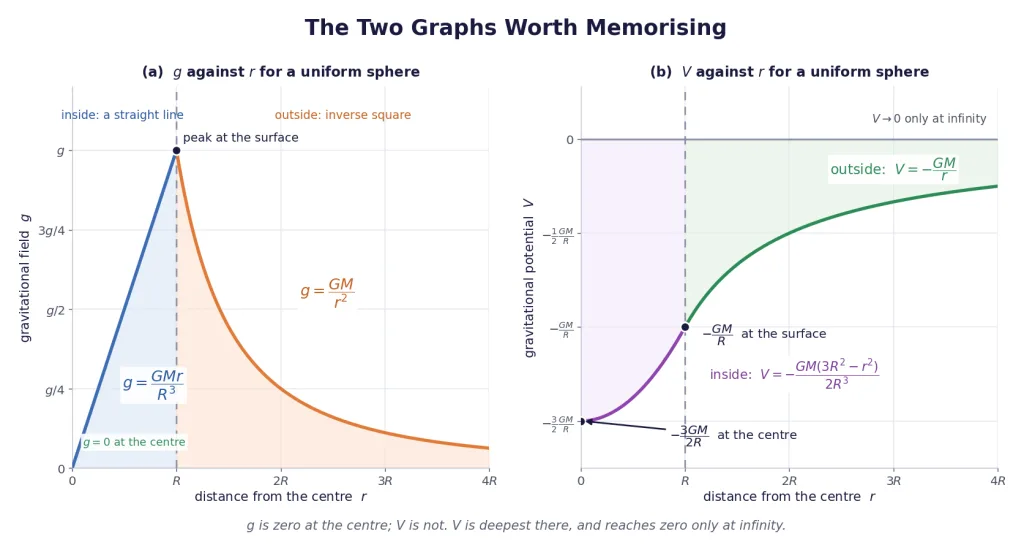
Panel (a) is the -versus- graph this card is about; panel (b) is the -versus- graph, which belongs to the next card. They are drawn together because the paper likes to ask about both at once.
Going up: altitude
Key Point — exact, always valid: Approximate, and only for : The approximation is the first two terms of a binomial expansion. It is within 1% up to about 360 km and 8% low at 1000 km, and at it returns a negative value, which is the algebra telling you it has been pushed far past its range.
| Height | (m/s) | Fraction of |
|---|---|---|
| surface | 9.8 | 1 |
| 32 km | 9.70 | 0.99 |
| 400 km (a space station) | 8.7 | 0.89 |
| 3600 km | 4.01 | 0.41 |
| = 6400 km | 2.45 | |
| = 12 800 km | 1.09 | |
| geostationary, 36 000 km | 0.23 |
Going down: depth
Key Point — exact for a uniform Earth: This is the shell theorem in action: only the sphere of radius beneath you pulls, and everything in the shell above you contributes exactly nothing. falls linearly with depth and reaches zero at the centre of the Earth.
Two comparisons the paper enjoys:
- Near the surface, falls twice as fast going up as going down — against — so for small changes the depth at which matches its value at a height is . That shortcut fails once or is a serious fraction of , where the exact formulae must be used.
- The maximum value of is at the surface. It falls off on both sides.
Rotation: latitude
Key Point: A body at latitude moves in a circle of radius , so part of the gravitational pull is spent supplying its centripetal acceleration and the apparent weight is smaller by .
- At the equator () the correction is largest: m/s, which is 0.35% of .
- At the poles () the correction is zero — a body there sits on the axis, traces no circle, and needs no centripetal force.
- For the equator to become weightless, would have to grow about 17 times, shortening the day to roughly 1.4 hours.
Shape: oblateness
The Earth is not a sphere. Its equatorial radius exceeds its polar radius by about 21 km, so a pole is nearer the centre and is larger there for that reason too. Rotation and shape together give roughly
[NEET Important] Ranking questions recur every year. From largest to smallest: at the poles, then at the equator, then at a modest depth, then at a modest height, and zero at the centre. And a beam balance compares masses, so it reads the same everywhere; only a spring balance notices the change.
Card 5 — Gravitational Potential Energy and Gravitational Potential
The two definitions, kept apart
Key Point — potential ENERGY, in joules: the work done by an external agent in bringing the mass from infinity to a distance from , both at rest. It belongs to the pair of bodies, not to either one of them.
Key Point — POTENTIAL, in J/kg: the potential energy per unit mass at that point. It belongs to the point, and it exists whether or not you put anything there.
| gravitational potential | gravitational potential energy | |
|---|---|---|
| what it belongs to | a point in space | a pair of bodies |
| formula | ||
| SI unit | J/kg | J |
| dimensions | ||
| depends on the test mass? | no | yes, directly proportional |
| link to the field | ||
| scalar or vector | scalar | scalar |
The two-second test: does the question hand you a mass in kilograms? If yes, it wants and an answer in joules. If not, it wants and an answer in J/kg.
The signs, and the zero
Key Point: With the zero taken at infinity — the universal convention — both and are negative everywhere, and both approach zero only as . Moving a body away from the Earth makes less negative, that is, it increases . There is no point in a purely gravitational problem where is positive.
Recovering
For a rise from to ,
is an approximation, valid only near the surface. The exact result for is , whereas would claim — twice too much.
Systems of masses
Three particles give three pairs, four particles give six. For three equal masses at the corners of an equilateral triangle of side , and the work an external agent must do to separate them completely is — positive, because pulling gravitating bodies apart always raises towards zero.
for the standard bodies
| Body | outside, at distance | inside |
|---|---|---|
| point mass | — | |
| uniform shell, mass , radius | , constant | |
| uniform solid sphere, mass , radius | ||
| ring, mass , radius , on its axis at | — |
At the centre of a solid sphere , one and a half times as deep as at the surface. At the centre of a shell , the same as at its surface.
[JEE Tip] Fields cancel; potentials do not. At the null point between two masses the field is zero and the potential is a definite negative number. Inside a shell the field is zero everywhere and everywhere. Any option offering "zero potential because the field is zero" is wrong by construction.
Card 6 — Escape Speed
Key Point: It comes from setting the launch kinetic energy equal to the binding energy at the surface: . The mass cancels from both sides, which is the whole reason for the next box.
Key Point — what escape speed does NOT depend on: the mass of the projected body, its shape, its composition, and the direction of projection. A pebble and a rocket need the same 11.2 km/s. Launching at works exactly as well as launching straight up, because energy is a scalar and the potential depends only on distance. It does depend on the planet's mass and radius, and on the launch height.
The forms worth carrying
Speeds never subtract linearly. Launched at 15 km/s, a body reaches infinity at km/s, not at 3.8 km/s.
Why the Moon has no atmosphere
Gas molecules have a spread of speeds, and any molecule faster than the escape speed simply leaves. The Moon's is only 2.4 km/s, comparable with the thermal speeds of light molecules, so over geological time it has lost everything. The Earth's 11.2 km/s is far above the thermal speed of nitrogen and oxygen, which is why the air is still here — and why hydrogen and helium, being light and therefore fast, have largely escaped even from the Earth.
Card 7 — Orbital Speed and Time Period
Key Point: Gravity supplies the centripetal force, , so with measured from the centre of the planet, never from the ground. Neither expression contains the satellite's mass.
Squaring the period gives — Kepler's third law derived rather than observed, with the constant depending only on the central mass. That is how a planet is weighed from a moon's orbit: .
The scaling family, all for a circular orbit
Higher means slower and longer. A satellite at moves at half the surface-skimming speed and takes eight times as long. Every satellite-scaling question in this chapter is one of those four proportionalities.
The two anchor numbers
| Orbit | |||
|---|---|---|---|
| surface-skimming, | 7.9 km/s | 84.6 minutes — the shortest possible | |
| geostationary | m | 3.1 km/s | 24 hours |
Anchor to those two and any other Earth orbit is one application of away.
For a satellite skimming a planet of density the period contains no radius at all: so two planets of the same density have surface-skimming satellites of identical period, whatever their sizes.
Escape speed against orbital speed
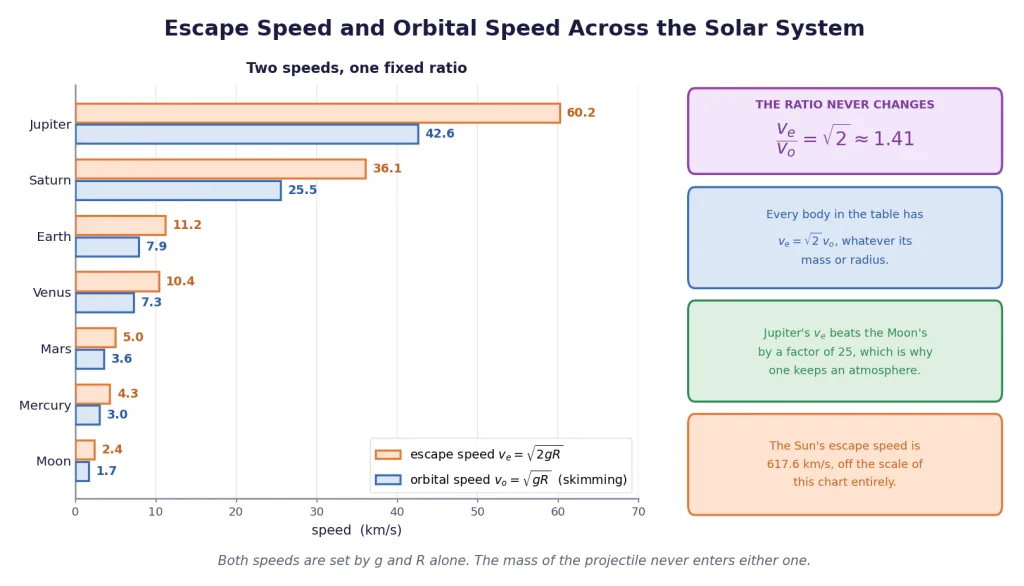
Key Point: At the same radius, always, for every body in the solar system. To turn a circular orbit into an escape you must raise the speed by 41.4%, which costs an extra energy exactly equal to the satellite's present kinetic energy.
| Body | (km/s) | at the surface (km/s) | (m/s) |
|---|---|---|---|
| Moon | 2.4 | 1.7 | 1.6 |
| Mercury | 4.3 | 3.0 | 3.7 |
| Mars | 5.0 | 3.6 | 3.7 |
| Venus | 10.4 | 7.3 | 8.9 |
| Earth | 11.2 | 7.9 | 9.8 |
| Saturn | 36.1 | 25.5 | 11.2 |
| Jupiter | 60.2 | 42.6 | 25.9 |
| Sun | 617.6 | 436.7 | 274 |
[NEET Important] Read the table for the pattern, not the digits: is always times , and both are set by and alone. Notice that Saturn's surface gravity barely exceeds the Earth's while its escape speed is over three times as large — because and Saturn is enormous.
Card 8 — The Energy of an Orbiting Satellite, and Binding Energy
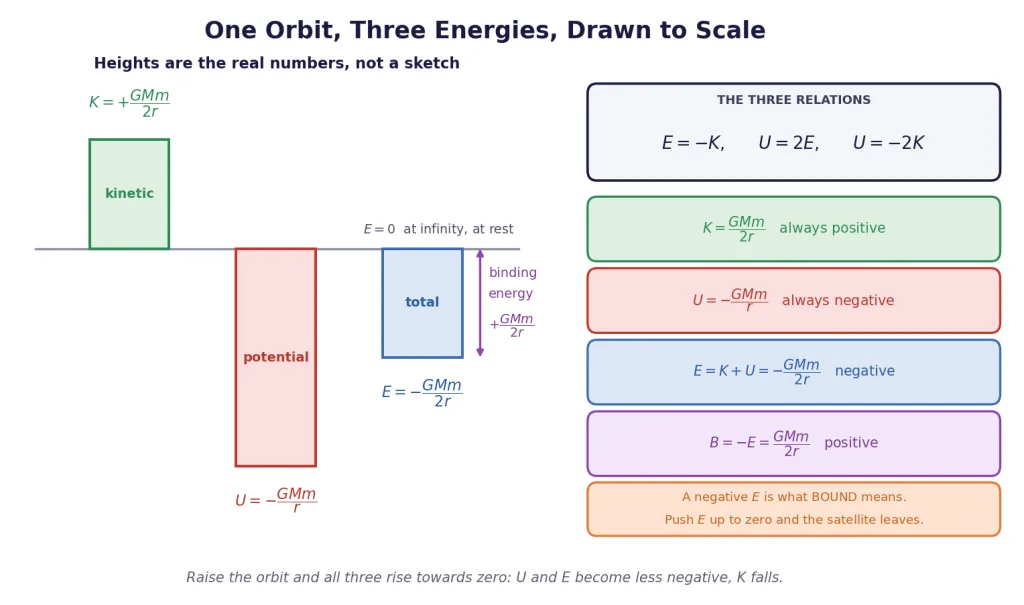
Key Point — the triple, for a circular orbit of radius : and therefore Compute any one and the other two are free. comes from the force balance ; nothing here is a separate thing to memorise.
Key Point — why is negative: a negative total energy is what "bound" means. The satellite has less energy than it would need to sit at rest at infinity, where , so it cannot get there. Raise to zero and it escapes; a positive is an unbound, hyperbolic path.
Binding energy
Key Point: the energy that must be supplied to take the satellite from its orbit to rest at infinity. It is positive, and for a circular orbit it is numerically equal to the kinetic energy.
Two cases with the same name, differing by a factor of two — read which one the question means:
| Situation | Total energy | Binding energy |
|---|---|---|
| body at rest on the surface | ||
| satellite in a surface-skimming orbit | ||
| satellite in a circular orbit of radius | ||
| elliptical orbit of semi-major axis |
So a body on the ground needs 11.2 km/s to leave, while a satellite already circling at 7.9 km/s needs only 3.3 km/s more.
Raising an orbit
Moving from radius to needs
and while that happens rises by twice as much as falls. The satellite in the higher orbit moves more slowly, even though energy was spent putting it there — the tidiest counter-intuitive result in the chapter. Air drag runs the same argument backwards: a satellite losing energy to drag spirals inward and speeds up.
Card 9 — Geostationary Satellites, Polar Satellites and Weightlessness
The geostationary conditions
Key Point: A satellite appears fixed above one point of the ground only if all four conditions hold:
- its period is exactly one sidereal day, 24 hours (23 h 56 min to be precise);
- its orbit lies in the equatorial plane;
- it moves west to east, the same sense as the Earth's rotation;
- the orbit is circular.
Its mass is irrelevant — that is never one of the conditions.
Put h into and the radius follows:
| Quantity | Value |
|---|---|
| orbital radius | m |
| height above the surface | about 35 900 km, quoted as "about 36 000 km" |
| orbital speed | 3.1 km/s |
| at that height | 0.23 m/s |
| one-way signal delay, ground to satellite | about 0.12 s |
Because the orbit must be equatorial, no geostationary satellite can hang over New Delhi — or over any place away from the equator. It can only sit over a point on the equator at the same longitude. Three satellites apart cover essentially the whole globe except the polar caps.
Polar satellites
Key Point: A polar satellite orbits low — typically 500 to 800 km up — in a plane passing close to both poles, with a period of roughly 100 minutes. Each orbit crosses a strip of ground shifted about of longitude west of the previous one, because the Earth turns underneath. After enough orbits it has viewed the whole globe, poles included.
Low means quick and close, so the resolution is high. Polar satellites are used for remote sensing, mapping, resource survey and weather; geostationary satellites are used for communications, broadcasting and continuous weather watch over one region. The two designs are chosen for opposite reasons.
Weightlessness
Key Point: An astronaut in an orbiting spacecraft is not beyond the Earth's gravity. At 400 km the local is still 8.7 m/s, about 89% of its surface value, and it is exactly that gravity which holds the spacecraft in orbit. What has vanished is the contact force: the astronaut, the spacecraft and everything in it fall together with the same acceleration, so nothing presses on anything.
So a spring balance reads zero, a beam balance is useless, a pendulum has no restoring force and does not oscillate at all, and mercury will not stay in a barometer. Mass is entirely unchanged.
[NEET Important] Two situations both give zero reading on a spring balance and they are physically different. At the centre of the Earth the true really is zero. In an orbiting spacecraft is large and the body is in free fall. Options that conflate the two are set every year.
Card 10 — The Mistakes That Cost the Most Marks
Every one of these was flagged somewhere in the earlier sections. They are ordered roughly by how often they actually turn up in answer scripts.
1. Confusing gravitational potential with gravitational potential energy. The one that costs the most, by a distance. is in J/kg and belongs to a point; is in joules and belongs to a pair of bodies; . If the question gives you a mass in kilograms and wants joules, it wants . If it names a point and wants J/kg, it wants . Copying one across as the other loses the whole mark.
2. Losing a sign. With the zero at infinity, and are negative everywhere, the total energy of any bound orbit is negative, and binding energy is positive. Moving a body outward makes less negative, so . If a bound satellite comes out with positive total energy, or the work to separate two masses comes out negative, you have subtracted the wrong way round.
3. Using the wrong radius. is the surface. A point at height is at from the centre; a point at depth is at . The in every orbital formula is measured from the centre of the Earth, never from the ground. "At a height equal to twice the Earth's radius" means , giving — not .
4. Using far from the surface. is the first term of the exact expression and is honest only while . At the true change in potential energy is , while claims — a 100% error. The same warning applies to , which returns a negative at and is 8% low even at 1000 km.
5. Thinking astronauts are beyond gravity. Weightlessness in orbit is free fall, not the absence of gravity. At the height of a space station is about 89% of its surface value. What is zero is the normal reaction, not the gravitational field, and the astronaut's mass is unchanged.
6. Concluding that zero field means zero potential. Inside a uniform shell the field is zero everywhere and everywhere. At the null point between two masses the field cancels and the potential does not — potentials are scalars and both contributions are negative, so they add. measures the slope of , not its value.
7. Mixing up the depth formula with the height formula. Down: , linear, exact for a uniform Earth, zero at the centre. Up: , inverse square, zero only at infinity. They agree only at the surface, where takes its largest value.
8. Getting the backwards. . The correction is largest at the equator, where and , and zero at the poles, where the body sits on the axis and traces no circle. So is greatest at the poles.
9. Losing the factor of two in the energy triple. , , . Quoting when the question asked for the binding energy doubles the answer. And a body at rest on the surface needs to escape, while a satellite already in a surface-skimming orbit needs only half that.
10. Feeding a perigee distance into Kepler's third law. needs the semi-major axis, which is . For a circle they coincide; for an ellipse they do not, and the question that hands you both apsides is testing exactly this.
11. Forgetting that speeds do not subtract. . Launched at 15 km/s a body reaches infinity at 10.0 km/s, not at km/s.
12. Treating gravity as shieldable, or as depending on the falling body. No material blocks gravity, and is the same for a coin and a feather in a vacuum. The escape speed does not depend on the projectile's mass, though the escape energy certainly does.
Key Point: Three more that cost single marks each — using when the question fixed the density rather than the mass, quoting the escape speed where the orbital speed was wanted (they differ by ), and mixing with inside one problem. Pick one value of , write it at the top of your working, and use it everywhere.
The 60-Second Revision
You are in the queue outside the hall. This is the irreducible minimum.
Kepler. Ellipse, Sun at a focus. Equal areas in equal times, which is conserved, so . with the semi-major axis, and , .
The law. , attractive, along the join, action-reaction, . Superposition: add the pairwise vectors for forces, the plain scalars for potentials. Shell theorems: mass at the centre for an outside point, zero force for an inside point.
. m/s. Up: , or for small . Down: , zero at the centre. Latitude: , largest at the poles.
and . in J; in J/kg; ; . Both negative, both zero only at infinity. only near the surface. Inside a shell , constant. At the centre of a solid sphere .
Escape. km/s. Independent of the body's mass, shape and launch direction. .
Orbit. , , . Higher is slower and longer. Floor: 7.9 km/s and 84.6 minutes.
Energy. , , , so and . Binding energy , positive. from the ground, from a skimming orbit.
Satellites. Geostationary: 24 h, equatorial, west to east, circular, m , about 36 000 km up, 3.1 km/s. Polar: low, about 100 minutes, sweeps the globe, used for remote sensing. Weightless means free fall, not zero gravity.
Habits. Name the radius. Decide or . Check the sign. Ask whether the approximation is allowed. Pick one value of and keep it.
The Fast Self-Test
Cover the answers. Fourteen questions, five minutes. Anything you miss tells you which card to reopen tonight.
- Where does the Sun sit in a planet's elliptical orbit?
- Kepler's second law is a statement about the conservation of what?
- Which length does Kepler's third law use — the perihelion distance, the aphelion distance, or the semi-major axis?
- What is the gravitational force on a particle placed anywhere inside a uniform spherical shell?
- Write at the Earth's surface in terms of , and , and again in terms of , and .
- At a height equal to twice the Earth's radius, what fraction of survives?
- At a depth equal to half the Earth's radius, what fraction of survives?
- At which latitude is the rotational reduction in zero, and why?
- State the SI units of and of , and the relation between them.
- Is the gravitational potential inside a uniform shell zero? What is it?
- Write the escape speed in two forms, and name three things it does not depend on.
- A satellite's orbital radius is doubled. What happens to its speed and to its period?
- For a circular orbit, express in terms of , and in terms of .
- Why does an astronaut in an orbiting spacecraft feel weightless?
Answers. 1. At one focus, not the centre. 2. Angular momentum. 3. The semi-major axis . 4. Exactly zero, everywhere inside. 5. . 6. One ninth, since . 7. One half. 8. At the poles, , because a body there lies on the axis of rotation and moves in no circle. 9. J/kg and J, with . 10. No — it is a constant ; the field is zero, which is why is flat. 11. ; it does not depend on the body's mass, its shape, or the direction of projection. 12. Speed falls by ; period grows by . 13. and . 14. Because the astronaut and the spacecraft fall together with the same acceleration, so the normal reaction is zero — gravity there is still about 89% of its surface value.
That is the whole chapter. Go and get the marks.