
Same Chapter, Half the Clock
Section 11 has just taken this chapter apart the JEE way — fields of rods and discs by integration, tunnels through the Earth, vis-viva, Hohmann transfers, binary stars. If you read it, you already know far more than this section will ever ask of you.
So why a separate corner? Because the skill being tested is different.
JEE gives you a hard question and enough time to think. NEET gives you a manageable question and almost no time at all. Physics is 45 questions, and inside a 180-minute paper shared with Chemistry and Biology those 45 deserve roughly 45 minutes. One minute each — and Gravitation reliably supplies two or three of them. Every one has to be finished in well under a minute, correctly, so the time is banked for the questions that genuinely need it.
What is NOT asked from this chapter
This list matters as much as anything else here, because it tells you what to stop worrying about.
Key Point: Gravitation at this level never leaves the core syllabus. No field or potential of a rod, ring or disc by integration. No tunnel through the Earth. No vis-viva. No orbit transfers. No binary stars. No gravitational self-energy. Everything on the paper is a statement you recall, one standard formula you substitute into, a set-up you have drilled, or one of the two special formats.
Every item on that list belongs to Section 11. If you find yourself integrating anything, or writing , you have wandered into the wrong section's version of the question.
The four types, and what each should cost you
| Type | What it looks like | Your budget | The right instinct |
|---|---|---|---|
| 1. Direct recall | "State Kepler's second law." "Escape speed depends on…" "Why does an astronaut feel weightless?" | 15-20 s | You either know it or you do not. Never derive a definition. |
| 2. One-step plug-in | , , , | 25-35 s | Spot the picture, pick the card, substitute once. |
| 3. Standard template | The satellite at a given height, the escape-speed comparison, the -at-height-or-depth ranking | 25-40 s | Recognise the set-up. You should already know the shape of the answer. |
| 4. Assertion-Reason / Column matching | Two special formats, both drilled below | 35-45 s | Judge each statement alone, then judge the link. |
[Important] A diagnostic worth internalising: if a gravitation question needs a fourth line of working, you have misread it. You are handed two of the quantities and asked for a third. If your page is filling up, stop and reread the stem — you have almost certainly imported an assumption that was never made.
The / arithmetic
Four marks for a correct answer, minus one for a wrong one, zero for a blank. On a doubtful item the real question is not "can I get this?" but "can I get this in 40 seconds?" If two options survive elimination and 40 seconds have gone, take the better one and move on — a 50-50 guess is worth marks on average. What you must never do is spend three minutes rescuing one mark's worth of doubt in a chapter where the very next question might be a one-liner about what escape speed does not depend on.
The numbers this section uses, fixed now
Throughout this section m/s and km, the rounded radius exam papers use. That pair is chosen deliberately: it makes come out at exactly 11.2 km/s, and m/s. Where itself is needed it is . No problem here mixes 9.8 with 10.
What this section does, and what it does not repeat
We will not re-derive Kepler's laws (Section 1), re-derive (Section 2), rebuild (Section 3), re-derive the variations of (Section 4), re-derive and (Section 5), re-derive escape speed (Section 6), rebuild orbital speed (Section 7), redo the energy of an orbit (Section 8) or re-explain geostationary satellites (Section 9). What you get instead is the same material reorganised for recognition speed:
- The sentences that come back almost verbatim.
- The formula table as a recognition exercise, with a hook for each.
- The -variation ranking that reappears every year.
- The three standard templates, with clean numbers.
- The two special formats, drilled properly.
- Speed habits and elimination tactics.
The Sentences That Come Back Almost Verbatim
This block is pure recall ammunition. Read it as flashcards, not as prose. Every item here has appeared as a complete question by itself.
Kepler's three laws, word for word
Key Point:
- Law of orbits. Every planet moves in an ellipse with the Sun at one focus — at a focus, not at the centre. Two foci exist; the Sun occupies one and the other is empty.
- Law of areas. The line joining a planet to the Sun sweeps out equal areas in equal intervals of time. Equivalently, the areal velocity is constant. This law is a direct consequence of the conservation of angular momentum, which holds because gravity is a central force and therefore exerts no torque about the Sun.
- Law of periods. , where is the semi-major axis — not the radius, unless the orbit happens to be a circle.
Two consequences that get asked as separate questions: a planet moves fastest at perihelion and slowest at aphelion; and its angular momentum is constant while its linear momentum, kinetic energy and speed are not.
Escape speed: what it does and does not depend on
Key Point:
- Does NOT depend on the mass of the escaping body, the direction of projection, or the shape of the path taken. A stone, a satellite and an atom all need the same 11.2 km/s.
- DOES depend on the mass and radius of the planet — equivalently on and , or on the planet's density through .
- For the Earth km/s; for the Moon, about 2.4 km/s, which is why the Moon has no atmosphere.
Why an astronaut feels weightless
Key Point: Not because gravity is absent. At the height of a typical space station, 400 km up, is still m/s — about 89% of its surface value. The astronaut floats because the station and the astronaut are both in free fall with the same acceleration , so neither presses on the other and the normal force is zero. Apparent weight, which is what a spring balance reads, is the normal force; true weight is very much still there. True weightlessness would require , which happens only infinitely far away.
The same sentence covers a lift whose cable snaps, a projectile at the top of its flight, and a satellite in orbit: all three are in free fall, all three read zero on a spring balance.
What a negative potential energy means
Key Point: The zero of gravitational potential energy is set at infinity. Everything closer than infinity is therefore at a negative , and the magnitude of that negative number is exactly the work you must supply to move the body out to infinity. Negative means bound.
- is measured in joules and belongs to a body of mass .
- is measured in joules per kilogram and belongs to the point in space, not to any body. .
- : bound, an ellipse or circle. : exactly escapes, a parabola. : free, a hyperbola.
The rest of the recall list
Key Point:
- Gravitation is always attractive, acts along the line joining the two bodies, is independent of the medium between them, and obeys the principle of superposition.
- is a universal constant: N m/kg, with dimensions . It is the same everywhere; is not.
- A shell exerts no gravitational force on a body placed anywhere inside it.
- is maximum at the surface, zero at the centre and zero at infinity. It is greater at the poles than at the equator, both because of rotation and because the Earth is flattened.
- Inertial mass and gravitational mass are equal, to within every measurement ever made.
- A geostationary satellite has a period of 24 hours, sits about 36 000 km above the equator, moves west to east, and must orbit in the equatorial plane.
- Total energy of a circular orbit: . Binding energy .
The always-true / never-true table
Speed comes from knowing which sentences are safe.
| Statement | Verdict |
|---|---|
| The Sun is at one focus of a planet's orbit | Always |
| The Sun is at the centre of a planet's orbit | Never |
| A planet's angular momentum about the Sun is constant | Always |
| A planet's speed is constant | Never — fastest at perihelion |
| Escape speed depends on the mass of the projectile | Never |
| Escape speed depends on the direction of projection | Never |
| Escape speed depends on the planet's radius | Always |
| An astronaut in orbit has zero weight | False — zero APPARENT weight; is still there |
| is the same at the poles and the equator | False — larger at the poles |
| Gravitational potential energy is negative near a planet | Always, with the zero taken at infinity |
| and have the same units | False — J/kg and J |
| changes from planet to planet | Never |
| The field inside a uniform shell is zero | Always |
| The potential inside a uniform shell is zero | False — it is , constant |
| Total energy of a bound satellite is negative | Always |
[Important] The four most reused distractors in this chapter are "the Sun is at the centre", "escape speed depends on the mass of the body", "an astronaut is weightless because there is no gravity" and "zero field means zero potential". Each appears somewhere almost every year, and each is worth four marks in under fifteen seconds.
The Recognition Table, With a Hook for Each
Sections 1 to 9 derived all of these. Your job here is different: see the situation, name the formula, substitute. No derivation, ever.
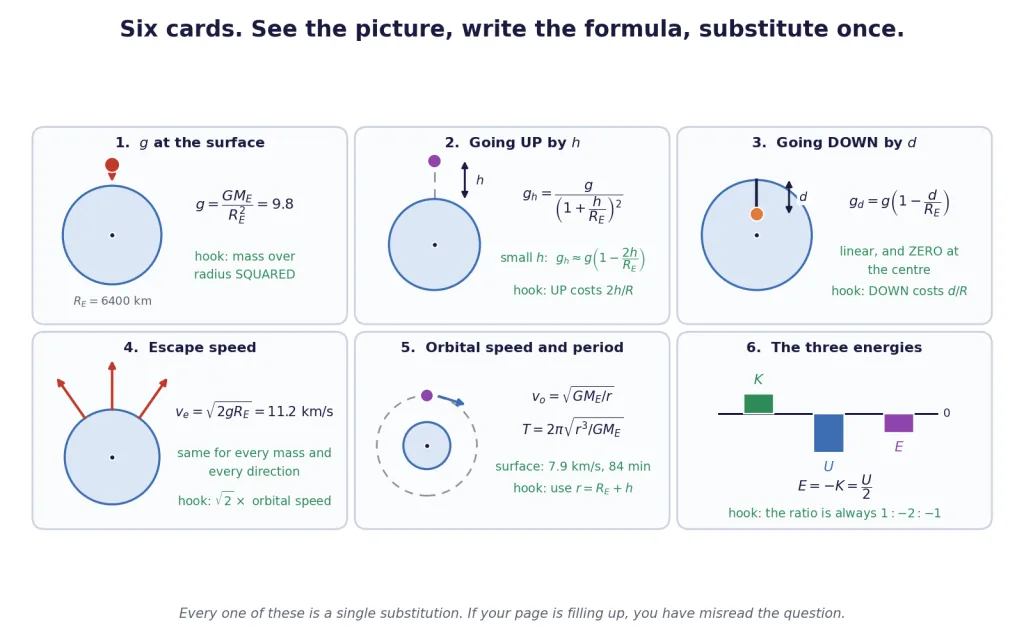
The twelve you must know cold
| # | Situation | Formula | Memory hook |
|---|---|---|---|
| 1 | force between two masses | product over the square | |
| 2 | at the surface | mass over radius SQUARED | |
| 3 | from density | bigger planet, bigger , at fixed density | |
| 4 | at height | UP costs | |
| 5 | at depth | DOWN costs , and hits zero at the centre | |
| 6 | at latitude | maximum at the poles, minimum at the equator | |
| 7 | potential | one over , per kilogram | |
| 8 | potential energy | times the mass, in joules | |
| 9 | escape speed | the surface orbital speed | |
| 10 | orbital speed | , | , never |
| 11 | period | Kepler, with underneath | |
| 12 | the three energies | , , | the ratio is always |
The numbers worth carrying in your head
Using m/s and km throughout:
| Quantity | Value |
|---|---|
| escape speed from the Earth's surface | km/s |
| orbital speed just above the surface | km/s |
| shortest possible orbital period | min |
| escape speed from the Moon | km/s |
| geostationary height above the equator | about km |
| geostationary orbital radius | about m |
| geostationary period | h |
| geostationary speed | about km/s |
| at the height of a low-orbit space station (400 km) | m/s |
| the Earth's mean density | about kg/m |
| at the Earth's surface | J/kg |
| N m/kg |
The ratio shortcuts, which are faster than substituting
Most questions in this chapter compare two situations rather than asking for one absolute number. Learn the proportionalities and you never touch a calculator.
Worked in one line each.
- A planet with twice the Earth's mass and half its radius: scales as , so km/s.
- A planet with the same density but twice the radius: doubles, doubles.
- Move a satellite from radius to : halves, goes up by .
Key Point: The single most examined confusion in this chapter is against . is a property of a point in space and is measured in J/kg. is a property of a body at that point and is measured in J. If a question says "the gravitational potential at the surface of the Earth", the answer has no in it. If it says "the potential energy of a 2 kg body", it does.
[Important] Two more units that get asked directly. The SI unit of gravitational field is N/kg, numerically identical to m/s; both are correct and both appear as options. And has dimensions , which is a stand-alone question in its own right.
The -Variation Questions, Which Recur Every Year
Of all the gravitation items on the paper, the -at-height-or-depth family is the most predictable. One graph and one ranking answer nearly all of them.
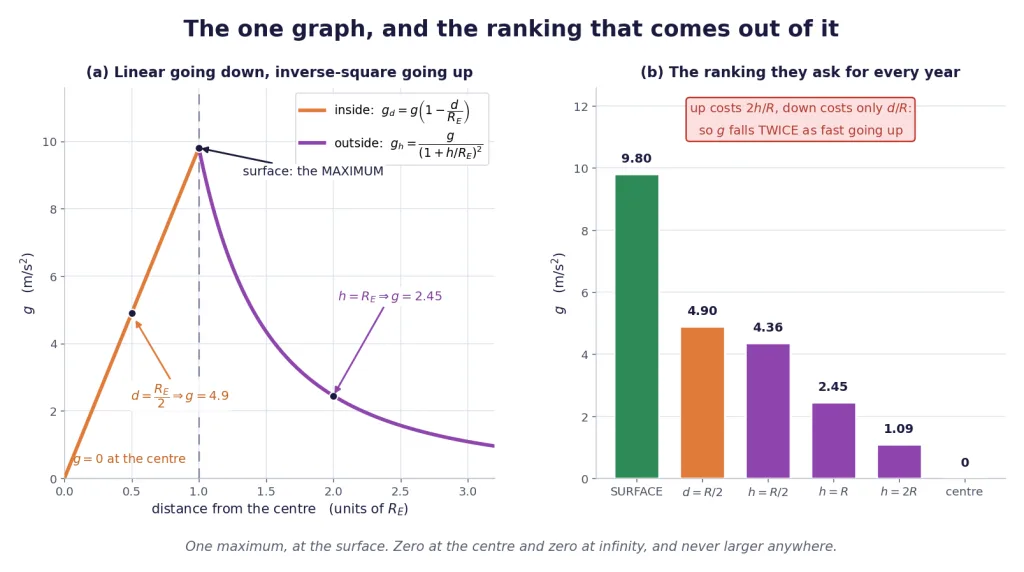
The two branches
Down is linear and reaches zero at the centre. Up is inverse-square and reaches zero only at infinity. Between them sits the surface, where is at its maximum.
For small heights the binomial expansion gives , and that leads to the comparison NEET loves:
Key Point: For small distances, going up costs but going down costs only . So falls twice as fast going up as going down, and at height equals at depth . Rising 10 km weakens gravity as much as descending 20 km.
How far can you trust the binomial? Not as far as you think. Comparing it with the exact formula:
| height | exact | binomial | error |
|---|---|---|---|
| 10 km | |||
| 100 km | |||
| 400 km | |||
| 1000 km |
Use the binomial only when is a few tens of kilometres. Beyond a hundred or so, use the exact form — and if the question says "a satellite at height ", the binomial would give a negative , which should tell you immediately that it does not apply.
The ranking table, ready to read off
| Position | (m/s) | As a fraction of surface |
|---|---|---|
| the surface | ||
| depth | ||
| height | ||
| height | ||
| height | ||
| the centre |
Two clean single-step results that come straight out of this:
- halves at a depth of , that is 3200 km down.
- halves at a height of , that is about 2651 km up. Note it is not ; the height and depth answers are different, and swapping them is the trap.
The rest of the variation list
Latitude and rotation. . At the poles () the correction vanishes and is largest; at the equator () the correction is at its largest and is smallest, reduced by m/s. Add the Earth's flattening and the pole-to-equator difference is about m/s.
Shape. The Earth's equatorial radius exceeds its polar radius by about 21 km, and since , that alone makes larger at the poles.
If the Earth stopped rotating, would increase everywhere except at the poles, where it would not change at all. If instead it spun about 17 times faster, the equatorial would fall to zero and objects there would float.
[Important] Three traps in this one block. (1) The depth formula is linear and the height formula is not — never use one for the other. (2) In the denominator is , so you divide, never multiply. (3) The rotation correction depends on , not ; at the equator gives the maximum reduction, which is the physically correct answer and the way to check you have the right one.
The Three Templates
Three set-ups cover the overwhelming majority of gravitation numericals on this paper. Recognise which one you are looking at, write the boxed line, substitute.
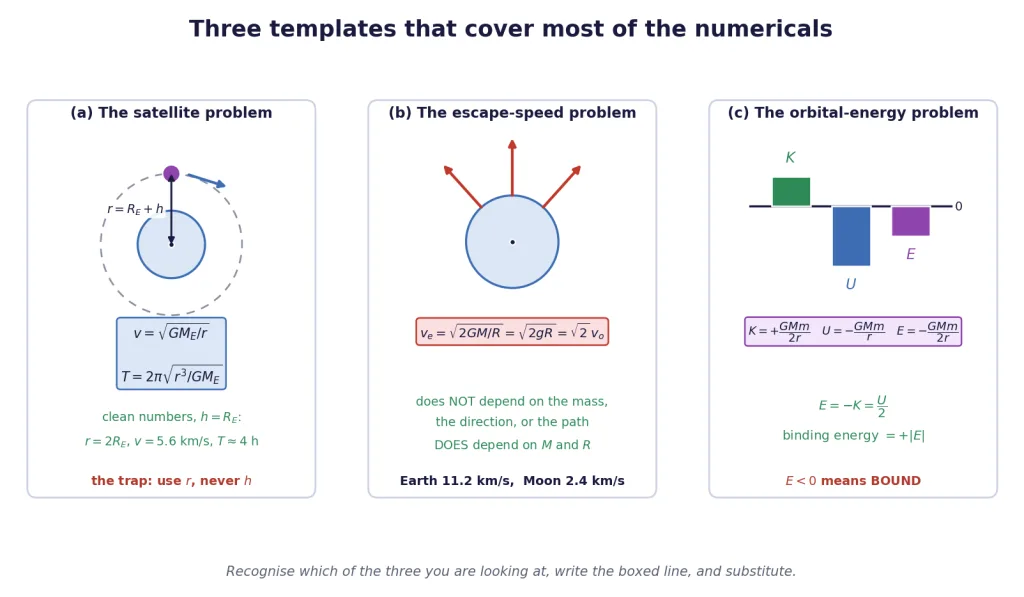
Template 1 — The satellite at a stated height
Everything begins by converting the height into a radius: .
The clean numbers. A satellite at , so m, with :
Both come out clean, which is why turns up so often in question papers.
Key Point: Higher means slower and longer. and . A satellite is never "held up" by its speed; it is falling continuously and missing.
Template 2 — The escape-speed comparison
Almost every escape-speed question is a ratio, not an absolute value, so use the proportionality and never touch .
| The planet, compared with the Earth | |
|---|---|
| same , half the | km/s |
| twice the , half the | km/s |
| twice the , twice the | unchanged, km/s |
| same density, twice the | km/s, since |
| the Moon, and | km/s |
And the fact that this template exists to test: has no in it. Doubling the mass of the projectile changes nothing, because both the kinetic energy you must supply and the potential energy you must overcome scale with .
Template 3 — The energy of an orbit
The clean numbers. A 1000 kg satellite at , with :
so it would take J to set it free. Note the pattern: compute once, and and follow by multiplying by and .
[Important] The single most costly slip in Template 1 is putting the height where the radius belongs. If a question says "a satellite 3600 km above the Earth", the number in the formula is km, not 3600 km. Write as your first line, every time, even when it feels unnecessary.
Assertion-Reason and Column Matching: the Two Special Formats
These two are not harder physics. They are a different reading task, and both are entirely mechanical once you know the drill.
Assertion-Reason: the four codes
You are given an Assertion (A) and a Reason (R), and asked to choose:
| Code | Meaning |
|---|---|
| (a) | Both A and R are true, and R is the correct explanation of A |
| (b) | Both A and R are true, but R is not the correct explanation of A |
| (c) | A is true but R is false |
| (d) | A is false but R is true |
Some papers add "both false". Read the option list before you start — the order of these four is not fixed between papers, and picking "option (a)" from memory when the paper has shuffled them is a self-inflicted wound.
The attack: judge A, then R, then the link
Key Point: Three separate judgements, in this order, and never let one influence the next:
- Cover R. Is A true, on its own?
- Cover A. Is R true, on its own?
- Only if both are true: does R actually explain A, or is it merely another true fact about the same topic?
Step 3 is where the marks are, and it is the step people rush. "Both true" is not enough. Ask yourself: if R were false, would A stop being true? If yes, R explains A. If A would survive without R, the answer is (b).
The trap this format is built around is a true reason attached to a false assertion, which makes the assertion sound plausible. The defence is step 1: judge A with R covered.
Worked, five times
Item 1. A: An astronaut inside an orbiting space station feels weightless. R: The station and the astronaut have the same acceleration towards the Earth, so the floor exerts no normal force. A alone: true. R alone: true. And R is exactly why A holds. So both true, R explains A.
Item 2. A: An astronaut inside an orbiting space station feels weightless. R: There is no gravitational force at the height of the station. A alone: true. R alone: false — at 400 km, is still 8.7 m/s. So A true, R false. This item and the one above are the same assertion with two different reasons, and they have completely different answers. That is precisely how the format is built.
Item 3. A: The escape speed from the Earth is the same for a stone and for a satellite. R: Escape speed is independent of the mass of the escaping body. A alone: true. R alone: true. R explains A directly. Both true, R explains A.
Item 4. A: The gravitational potential inside a uniform spherical shell is zero. R: The gravitational field inside a uniform spherical shell is zero. A alone: false — the potential is a constant , not zero. R alone: true. So A false, R true — and notice how a perfectly correct R makes the false A feel right. This is the sign-and-zero trap in its purest form.
Item 5. A: A planet moves fastest when it is nearest the Sun. R: The angular momentum of a planet about the Sun is conserved. A alone: true. R alone: true. Does R explain A? Yes — constant (at the extremes) forces up when falls. Both true, R explains A.
Column matching: anchor and kill
You are given Column I (four entries, A to D) and Column II (four results, i to iv), and four codes that pair them up.
Key Point: Never work out all four pairings. Find the one you are surest of, use it to eliminate every code that contradicts it, then check whichever single pairing still separates the survivors. Two confident pairings almost always settle a four-option matching question.
The drill:
- Scan Column II for the odd one out — the only entry with a in the denominator, the only one with a minus sign, the only one carrying .
- Anchor on that pairing and strike out every code that disagrees.
- Count the survivors. If one remains, stop. If two remain, find the single letter where they differ and settle just that one.
- Never check a pairing that all the surviving codes agree on. It cannot change the answer.
A worked anchor.
| Column I | Column II |
|---|---|
| (A) at a depth below the surface | (i) |
| (B) escape speed from the surface | (ii) |
| (C) orbital speed at a radius | (iii) |
| (D) total energy of a satellite | (iv) |
Anchor on (D): it is the only entry that is an energy, and (iii) is the only entry with a minus sign and an in it. D-iii is certain, and every code without it dies. Then anchor on (A): it is the only one containing , and (ii) is the only expression with in it. A-ii. Two anchors, and the matching is settled: B-iv and C-i follow without any thought.
A second one, on the laws themselves.
| Column I | Column II |
|---|---|
| (A) Kepler's law of orbits | (i) |
| (B) Kepler's law of areas | (ii) an ellipse with the Sun at one focus |
| (C) Kepler's law of periods | (iii) the normal force falls to zero |
| (D) weightlessness in orbit | (iv) equal areas swept in equal times |
Here the odd one out in Column II is (iii): it is the only entry that is not about orbital geometry at all, so D-iii. The rest read straight off: A-ii, B-iv, C-i.
[Important] Column matching is answered by elimination between the codes, not by solving the physics four times. If you find yourself deriving all four entries, you have already lost thirty seconds you did not have.
Speed Habits: Finishing in Under 45 Seconds
Everything above is content. This block is technique — how to spend the 45 seconds you actually have.
The four-second triage
Read the stem once and put it in a box before writing anything:
| Signal in the stem | Box | First line you write |
|---|---|---|
| "state", "depends on", a unit, "always/never" | recall | the answer |
| a height or a depth is named | -variation | or , and check which |
| "just escapes", "minimum speed to leave" | escape | |
| a satellite with a height, or a period wanted | satellite | |
| "energy required", "binding energy" | orbital energy | |
| two planets compared, or "ratio" | proportionality | the scaling, not the formula |
| Assertion and Reason | AR | judge A alone first |
| two columns and four codes | matching | find the anchor |
Five ways to kill an option without solving anything
- Signs. , and the total energy of a bound orbit are negative. Binding energy and escape speed are positive. Any option with the wrong sign is free to discard, and there is usually one.
- Units. is J/kg, is J, is m/s or N/kg, is N m/kg. An option in the wrong units is dead on sight.
- The mass test. If the question asks for escape speed, orbital speed, period or acceleration, the mass of the small body must not appear in the answer. If three options contain and one does not, you have probably found it.
- Limits. Any expression for must give the surface value at and , must vanish at the centre and at infinity, and must never exceed the surface value.
- Monotonicity. Higher orbit means smaller speed and longer period. Any option going the other way is wrong before you compute.
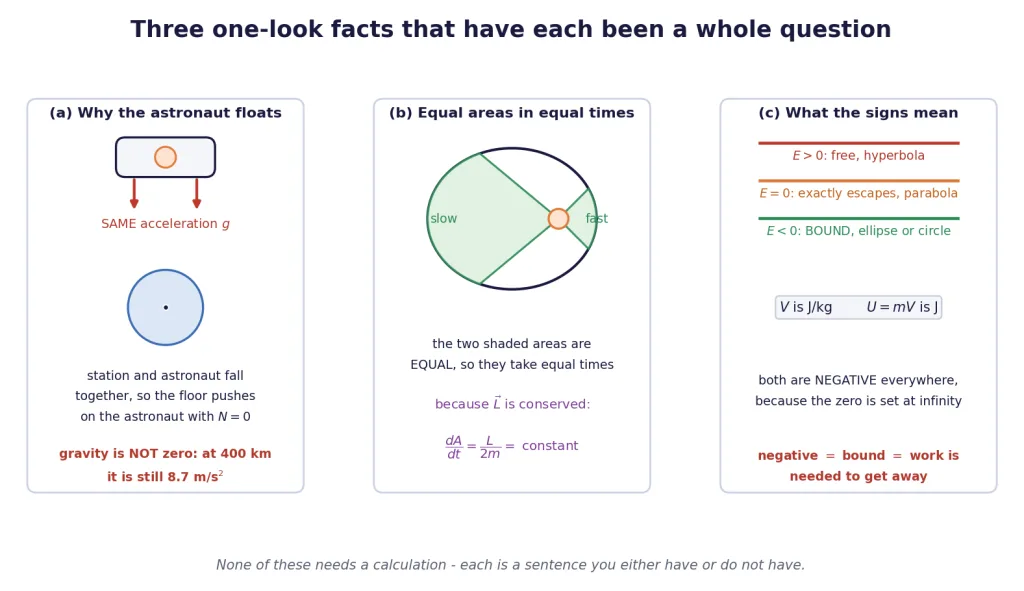
Six one-look facts
These have each been a complete question on their own, and none of them needs a calculation.
- Escape speed does not depend on the mass or the direction of projection, only on the planet.
- at the same radius, so .
- Zero field does not mean zero potential — inside a shell, but .
- An astronaut floats because , not because .
- is maximum at the surface, and falls twice as fast going up as going down.
- A geostationary satellite must orbit above the equator, west to east, with a 24-hour period.
The stopwatch rule
Key Point: Give yourself 45 seconds. At 45 seconds, either you have an answer or you have two surviving options. If it is the second, choose the one your elimination rules favour and move on — the expected value of a 50-50 guess under is , and the two minutes you save are worth more than the mark you are chasing.
The three-question self-test before the exam
If you can answer these three in ten seconds each, this chapter is exam-ready.
- What does escape speed depend on, and what does it not? — on the planet's mass and radius; not on the projectile's mass, direction or path.
- Why does an astronaut in orbit float? — the station and the astronaut fall together with the same , so the normal force is zero. Gravity is still there.
- A satellite is moved to a higher orbit. What happens to , , , and ? — down, up, down, up (less negative), up (less negative).
[Important] If any of those three took you more than ten seconds, go back to the recall block and the recognition table. Those two blocks alone carry most of the marks this chapter is worth on the paper.
Solved Examples
Twelve problems at exam level and exam pace. Give yourself 45 seconds on each before reading the solution. Throughout, m/s, km and m/s.
Example 1: Ten one-liners, from the statements alone
Answer each in a single sentence, with no calculation.
(a) Where is the Sun in a planet's elliptical orbit? (b) Kepler's second law is a consequence of the conservation of what? (c) In , what exactly is ? (d) Name two things escape speed does NOT depend on. (e) Why does an astronaut in a space station float? (f) What is the value of at the centre of the Earth? (g) What does a negative gravitational potential energy tell you? (h) What are the SI units of and of ? (i) Is the gravitational potential inside a uniform shell zero? (j) Which is larger, at the poles or at the equator?
Solution:
(a) At one focus of the ellipse — never at the centre. The other focus is empty.
(b) Angular momentum. Gravity is a central force, so its torque about the Sun is zero.
(c) The semi-major axis of the ellipse. For a circular orbit it is just the radius.
(d) The mass of the escaping body and the direction of projection. (The shape of the path is a third.)
(e) Because the station and the astronaut are in free fall with the same acceleration, so the normal force between them is zero. Not because gravity is absent.
(f) Zero. The mass enclosed by a sphere of zero radius is zero.
(g) That the body is bound, and that the magnitude of is the work needed to take it to infinity, where by convention.
(h) is in J/kg, is in J. They differ by a factor of the mass: .
(i) No. The field is zero there; the potential is a constant .
(j) At the poles, both because the rotational correction vanishes there and because the Earth is flattened.
Final Answer: (a) one focus (b) angular momentum (c) the semi-major axis (d) the body's mass and the direction (e) both in free fall, (f) zero (g) bound; is the work to reach infinity (h) J/kg and J (i) no, it is (j) the poles.
Takeaway: Ten questions, no arithmetic, well under a minute in total. These are the sentences that come back year after year, and every second saved here is a second available for a numerical.
Example 2: The table, as a recognition drill
Without deriving anything, write down: (a) at a height above the surface, exactly. (b) at a depth below the surface. (c) The escape speed in terms of and . (d) The orbital speed of a satellite at height . (e) The total energy of a satellite of mass at radius , and its binding energy. (f) The relation between escape speed and orbital speed at the same radius.
Solution:
(a) . You divide by the square; the binomial form is only for small .
(b) . Linear, and zero at the centre.
(c) , equivalently .
(d) . The denominator is the radius, not the height.
(e) , and the binding energy is — the same size, the opposite sign.
(f) , so about times. At the surface, .
Final Answer: as boxed in each step above.
Takeaway: Every one of these is a lookup. Recognise, do not derive — the derivations belong to Sections 1 to 9 and have no place inside a 45-second window.
Example 3: The -variation set
Find (a) at a height equal to , (b) at a height equal to , (c) at a depth equal to , (d) the depth at which falls to half its surface value, and (e) the height at which falls to half its surface value. Take m/s and km.
Solution:
(a) Height . Then and
(b) Height .
(c) Depth . Linear this time: Compare with (b): the same distance travelled, and going down leaves you with more gravity than going up.
(d) Half by digging. Set :
(e) Half by climbing. Set :
Final Answer: (a) 2.45 m/s; (b) 4.36 m/s; (c) 4.90 m/s; (d) 3200 km down; (e) about 2651 km up.
Takeaway: Down is linear, up is inverse-square, and they give different answers for the same distance. Halving takes 3200 km of digging but only 2651 km of climbing. If a question offers as the answer to the height version, it is testing exactly this.
Solved Examples (continued)
Example 4: Escape speed, five ways
Take km/s for the Earth. Find the escape speed from (a) a planet with twice the Earth's mass and half its radius, (b) a planet of the same density but twice the radius, (c) a planet with twice the mass and twice the radius, (d) the Moon, whose mass is and radius , and (e) a point at a height above the Earth's surface. (f) Does a 1000 kg satellite need more than a 1 kg stone?
Solution:
Use the proportionality, not the formula.
(a) , .
(b) Same density, . With , , so doubling doubles :
(c) , . The ratio is unchanged, so
(d) The Moon. Low enough that the fast tail of any gas escapes, which is why the Moon has no atmosphere.
(e) From a height . Escape from radius needs , and here :
(f) The mass of the body. It does not appear anywhere in . Both need exactly 11.2 km/s.
Final Answer: (a) 22.4 km/s; (b) 22.4 km/s; (c) 11.2 km/s; (d) 2.4 km/s; (e) 7.9 km/s; (f) no, identical.
Takeaway: Escape-speed questions are ratio questions. Use and you will never need , a calculator, or more than one line. And the mass of the escaping body is never in the answer.
Example 5: The satellite template, with clean numbers
A satellite orbits at a height equal to the Earth's radius. Taking km and m/s, find (a) its orbital radius, (b) its orbital speed, (c) its period, and (d) the speed and period of a satellite skimming the surface, for comparison.
Solution:
(a) Radius first, always.
(b) Orbital speed.
(c) Period. Fastest route: circumference over speed.
(d) At the surface, . Doubling the radius has multiplied the period by , exactly as Kepler's third law demands: .
Final Answer: (a) m; (b) 5.6 km/s; (c) about 4 hours; (d) 7.9 km/s and 84.6 minutes.
Takeaway: Write as your first line, then , then . Three lines, always the same three. Higher means slower and longer, and the check takes five seconds.
Example 6: The energy of an orbiting satellite
A 1000 kg satellite orbits at m, with . Find (a) its kinetic energy, (b) its potential energy, (c) its total energy, (d) its binding energy, and (e) the energy needed to lift it from the surface to that orbit, ignoring the Earth's rotation.
Solution:
(a) Compute once.
(b) and (c) The other two come free. The ratio , as it is for every circular orbit.
(d) Binding energy. The energy that must be added to bring up to zero:
(e) Ground to orbit. On the ground the satellite has and (ignoring rotation) no kinetic energy:
Final Answer: (a) J; (b) J; (c) J; (d) J; (e) J.
Takeaway: Compute , then multiply by and . Never compute all three separately — it wastes twenty seconds and doubles your chance of a sign error. And binding energy is always positive; if yours came out negative, you have quoted instead.
Solved Examples (continued)
Example 7: Kepler's third law, three ways
(a) A planet orbits the Sun at 4 AU. What is its period in years? (b) Mars orbits at 1.52 AU. What is its period? (c) A satellite's orbital radius is increased from to . By what factors do its speed and its period change? (d) Two satellites have periods in the ratio . What is the ratio of their orbital radii?
Solution:
(a) , with the Earth as the unit.
(b) Same line. Which is the observed value, to three figures.
(c) Two proportionalities.
(d) Invert the law. so the radii are in the ratio .
Final Answer: (a) 8 years; (b) 1.87 years; (c) speed halves, period goes up eightfold; (d) .
Takeaway: and answer this whole family in one line each. And remember is the semi-major axis — for the circular orbits these questions use, that is just the radius, but the word matters when the orbit is drawn as an ellipse.
Example 8: Weightlessness and apparent weight
(a) A 60 kg astronaut orbits at a height . What is her true weight there, and what does a spring balance she stands on read? (b) What is at 400 km, and what fraction of its surface value is that? (c) A lift's cable snaps. What does a passenger's spring balance read? (d) What would the reading be in a lift accelerating upward at 2 m/s? Take m/s and km.
Solution:
(a) True weight uses the local . At , m/s: The spring balance reads the normal force, and in free fall that is She weighs 147 N and reads zero. Both statements are true at once.
(b) At 400 km, km: which is , about 89% of the surface value. Gravity up there is almost undiminished.
(c) The falling lift. The passenger and the lift both accelerate downward at , so Same physics as the orbiting astronaut, on a much shorter timescale.
(d) Accelerating upward at 2 m/s. compared with a true weight of N on the ground.
Final Answer: (a) 147 N true, zero on the balance; (b) 8.68 m/s, about 89%; (c) zero; (d) 708 N.
Takeaway: Weight is ; apparent weight is the normal force. Free fall makes the second zero and leaves the first completely alone. Any option that says "gravity is zero in orbit" is wrong, and it is offered every single year.
Example 9: Potential against potential energy
Take and m. Find (a) the gravitational potential at the Earth's surface, (b) the potential energy of a 2 kg body sitting there, (c) the work needed to take that body to infinity, (d) the potential at a height , and (e) the work needed to raise the same body from the surface to that height.
Solution:
(a) Potential is per kilogram. Notice there is no mass in the question's answer, because there is no mass in the formula.
(b) Potential energy multiplies by the mass.
(c) To infinity, where . The magnitude of the negative is the work needed. That is the whole meaning of the sign.
(d) At . Half as deep, because .
(e) Surface to that height. Exactly half the cost of going all the way to infinity — the first Earth-radius of climbing is half the total bill.
Final Answer: (a) J/kg; (b) J; (c) J; (d) J/kg; (e) J.
Takeaway: has no in it; does. Read the question for the word "energy" — if it is there, multiply by the mass; if it says "potential", do not. And a positive work with a negative potential energy is not a contradiction, it is the definition.
Solved Examples (continued)
Example 10: An assertion-reason drill
For each pair, choose from: (a) both true and R explains A; (b) both true but R does not explain A; (c) A true, R false; (d) A false, R true.
(i) A: The escape speed from the Earth is 11.2 km/s for every body. R: Escape speed does not depend on the mass of the escaping body. (ii) A: An astronaut in an orbiting station is weightless. R: Gravity does not act at the height of the station. (iii) A: The gravitational field inside a uniform shell is zero. R: The gravitational potential inside a uniform shell is constant. (iv) A: A satellite in a higher orbit has a larger total energy. R: A satellite in a higher orbit moves faster. (v) A: The value of is greater at the poles than at the equator. R: The Earth rotates about its polar axis.
Solution:
(i) A alone: true. R alone: true. And R is precisely why A holds — the mass cancels from the energy equation. Answer (a).
(ii) A alone: true, she does float. R alone: false — at 400 km, is still 8.7 m/s. Answer (c).
(iii) A alone: true. R alone: true, the potential is a constant . Does R explain A? Yes, and rather elegantly: a constant potential has zero gradient, and , so zero gradient is zero field. Answer (a). Many students choose (b) here by treating the two as unrelated facts.
(iv) A alone: true — becomes less negative as grows, so it increases. R alone: false — a higher satellite moves slower, since . Answer (c). This is the orbit-raising paradox in assertion-reason clothing.
(v) A alone: true. R alone: true. Does the rotation explain it? Yes — the term subtracts nothing at the poles and the full amount at the equator. (Flattening contributes too, but rotation is a genuine cause.) Answer (a).
Final Answer: (i) a; (ii) c; (iii) a; (iv) c; (v) a.
Takeaway: Items (i) and (ii) share an assertion and differ only in the reason, and their answers differ completely. Judge A alone first, then R alone, then the link — and never let a plausible R talk you into a false A.
Example 11: Two column-matching drills
Drill 1.
| Column I | Column II |
|---|---|
| (A) Escape speed from the surface | (i) |
| (B) Orbital speed at radius | (ii) |
| (C) at depth | (iii) |
| (D) Total energy of a satellite | (iv) |
Drill 2.
| Column I | Column II |
|---|---|
| (A) Kepler's law of areas | (i) |
| (B) Kepler's law of periods | (ii) in free fall |
| (C) Weightlessness | (iii) angular momentum is conserved |
| (D) Binding energy of a satellite | (iv) |
Solution:
Drill 1, anchor first. Scan Column II for the odd one out: (ii) is the only entry with a minus sign and an , so it must be the energy. D-ii.
Second anchor. (i) is the only entry containing , so it must be the depth formula. C-i.
The rest follow. Of the two speeds left, carries the factor 2 that marks escape, and carries the orbital radius. A-iii, B-iv.
Drill 2, anchor first. (iv) is the only formula in Column II, so it pairs with the only entry that is a quantity rather than a statement: D-iv.
Second anchor. (ii) mentions the normal force, which appears nowhere in Kepler's laws: C-ii.
The last two are the definitions themselves. The law of areas is the angular-momentum statement, the law of periods is :
Final Answer: Drill 1: A-iii, B-iv, C-i, D-ii. Drill 2: A-iii, B-i, C-ii, D-iv.
Takeaway: Find the entry that cannot possibly belong to anything else, and anchor on it. A minus sign, a lone , the only formula among four sentences — one distinctive feature usually kills three of the four codes at once.
Example 12: The forty-five second round
Answer these ten with at most one line of working each.
(a) A satellite is at a height . What fraction of surface acts on it? (b) What is the ratio at the same radius? (c) A body weighs 100 N on the Earth. What does it weigh on a planet with the same density and twice the radius? (d) By what factor does the period change if the orbital radius is doubled? (e) What is the total energy of a satellite whose kinetic energy is J? (f) Two point masses and are 6 m apart. How far from is the resultant gravitational field zero? (g) In which direction does a geostationary satellite move? (h) A planet is at aphelion. Is its speed maximum or minimum? (i) Does depend on the medium between two masses? (j) What is the SI unit of gravitational field?
Solution:
(a) , so — one sixteenth.
(b) , that is about .
(c) Same density, gives , so the weight doubles to 200 N.
(d) , so by .
(e) J.
(f) Set , so and m from the smaller mass — always nearer the lighter body.
(g) West to east, the same sense as the Earth's rotation, and in the equatorial plane.
(h) Minimum. Aphelion is the farthest point, and is constant at the extremes.
(i) No. is a universal constant; gravitation cannot be screened.
(j) N/kg, numerically the same as m/s. Both appear as options and both are correct.
Final Answer: (a) (b) (c) 200 N (d) 2.83 (e) J (f) 2 m from (g) west to east (h) minimum (i) no (j) N/kg.
Takeaway: Ten questions, no calculator, under five minutes in total — and that is the pace this chapter has to run at. If any of them took you longer than thirty seconds, that is the one to revise tonight.