
What JEE Adds to Laws of Motion
Sections 1 to 8 stayed inside the Board syllabus, and they covered it honestly: the three laws, momentum and impulse, the common forces, free-body diagrams, friction, circular motion, connected bodies and lifts. Section 9 worked forty-two problems on top of that. If the Board paper were the only thing on your calendar, you could stop reading here.
JEE will not let you stop. Not because the physics changes — there is not one new law anywhere in this section — but because JEE asks those same three laws through set-ups the Board course never draws. A block whose acceleration is twice another block's. A lift problem solved from inside the lift. A block sitting on a wedge that is itself being pushed. A stone on a string going right over the top of a vertical circle. A rocket whose mass is dropping while you watch.
The one genuinely new idea: constraints
Here is the thing. Every problem in Section 8 had one hidden gift: the connected bodies all had the same acceleration magnitude. Two blocks on a string, an Atwood machine, a block dragging another over a table edge — in every one of them , and you never had to justify it.
That gift is withdrawn now. The moment a movable pulley appears, or a rope pulls at an angle, or a block slides on a wedge that is itself moving, the accelerations are different, and you have to work out the relation between them before you write a single force equation. That relation is called a constraint relation, and getting it is the skill that separates a JEE-level solution from a Board-level one.
Key Point: A constraint relation carries no physics at all — no forces, no masses, no . It is pure geometry: a statement that a string cannot stretch, or that a block cannot leave a surface. You get it before you draw a single force arrow, and it supplies exactly the extra equation that makes the system solvable.
What this section covers, in order
| # | Topic | Why JEE needs it |
|---|---|---|
| 1 | Constraint relations — length method and virtual work | The extra equation when accelerations differ |
| 2 | Movable pulleys, multi-pulley systems | Mechanical advantage, , three-block set-ups |
| 3 | Pseudo forces in accelerating frames | Lifts, cars, wedges solved from the inside |
| 4 | Centrifugal force in a rotating frame | And why it is not the reaction to the centripetal force |
| 5 | Blocks on blocks, two friction surfaces | The "do they move together?" test |
| 6 | Minimum-force problems, by minimisation | derived, not asserted |
| 7 | The vertical circle | The single most-asked JEE circular-motion set-up |
| 8 | Variable mass and the rocket equation | used properly |
| 9 | Springs versus strings on a sudden cut | The "just after" question |
Two conventions before we start
We use m/s^2 throughout this section unless a problem says otherwise, because JEE arithmetic is designed to land on clean numbers with that value. Never mix 9.8 and 10 inside one problem.
Sign conventions are chosen once per problem and then obeyed. Almost every wrong answer in connected-body work comes from writing the constraint with one sign convention and the force equations with another. Pick a positive direction for each body, write it down on the page, and do not change your mind halfway.
[Exam Tip] Nothing in this section replaces Sections 1 to 8. Every topic below is a standard result you already own, asked a harder question. If a step feels unfamiliar, the fix is almost always to go back to the corresponding basic section, not to memorise a new formula.
Constraint Relations: the Skill That Unlocks Everything
An inextensible string has a fixed total length. That single sentence, differentiated twice, is the whole topic.
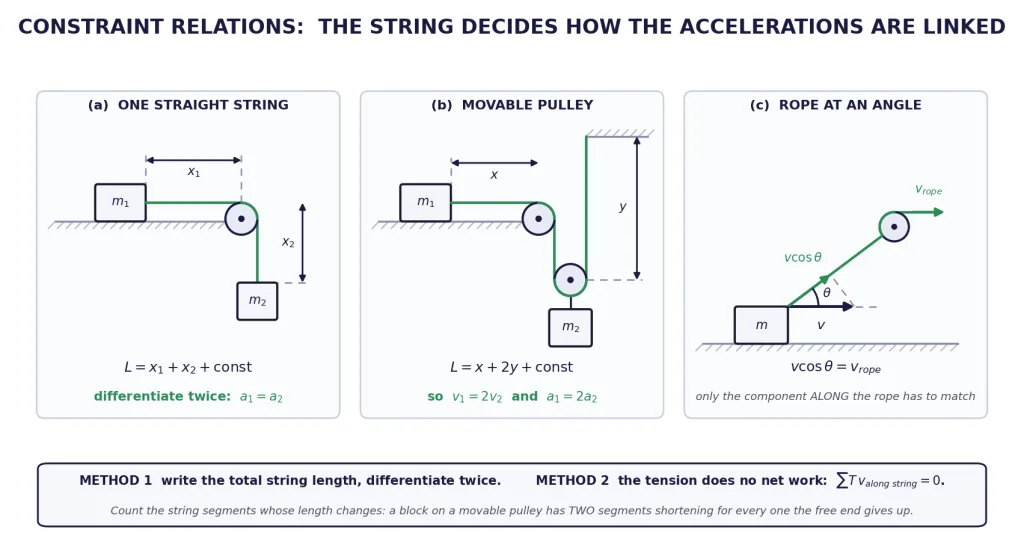
Method 1: write the length, then differentiate
The recipe never changes:
- Fix an origin that does not move — a pulley axle, a ceiling, a wall.
- Measure the position of every body from that origin, using symbols.
- Write the total string length as a sum of those distances plus constants (the bits wrapped around pulleys never change and go into the constant).
- Differentiate once with respect to time for the velocity relation, twice for the acceleration relation.
The simple case. Panel (a) of the figure: a block on a table joined over a fixed pulley to a hanging block. With measured from the pulley to the block and from the pulley down to the hanging mass,
is constant, so differentiating gives and . The minus sign only says that as one distance grows the other shrinks; in magnitudes,
which is exactly the assumption Section 8 made without proof. Good — the method reproduces what you already believe.
Method 2: the virtual-work shortcut
There is a faster route, and once you trust it you will rarely go back.
Key Point: An ideal string is massless, so the net work done by the tension on the whole string must be zero at every instant. Writing for each end, where is the component of each body's velocity along the string at that end. Since is the same throughout one continuous light string, it cancels, and you are left with a pure velocity relation.
The rule in words: add up the rates at which the string is being paid out at every end, and the total must be zero. For a movable pulley, the string is being pulled in at two points on the same body, so that body counts twice.
The movable pulley:
This is the single most-asked constraint in JEE. Panel (b) of the figure: a string leaves block on a table, goes over a fixed pulley at the edge, down and under a movable pulley that carries , and its far end is tied to the ceiling.
By Method 1. Let be the block's distance from the fixed pulley and the movable pulley's depth below the ceiling. The two vertical segments each have length , so
By Method 2. The tension pulls the block with speed along the string, and pulls the movable pulley at two points, each with speed . Zero net work needs , giving again in one line.
In words, which is what you should actually carry: for every metre the block moves, two metres of string have to be freed up around the movable pulley, so the pulley only rises half a metre. The body carrying the movable pulley is the slow one.
Key Point: Count the string segments attached to the moving pulley. Two segments the load moves at half the speed of the free end and carries twice the tension. Three segments one third the speed, three times the force. Speed down, force up, always in the same ratio — that ratio is the mechanical advantage.
A rope at an angle: only the component along it matters
Panel (c). A block on the ground is dragged by a rope that runs up over a pulley, so the rope makes an angle with the horizontal at the block. If the free end is reeled in at , the block does not move at .
The rope's length only changes at the rate at which the block moves along the rope's direction, so
The block moves faster than the rope is pulled, and faster still as grows. That surprises people every time; the fix is to remember that the perpendicular component of the block's velocity does nothing to the rope's length.
[Exam Tip] Differentiate that relation again and you get — the angle is changing too, so the acceleration relation has a second term. JEE Main almost always asks only the velocity version. If a question asks for the acceleration at an angle, expect the extra term.
The wedge constraint: the block stays on the face
The third standard constraint, and the one people invent wrongly. A block slides on the smooth inclined face of a wedge, and the wedge itself is moving horizontally with acceleration .
The block does not move along the incline as seen from the ground. What is true is:
Key Point: The block's acceleration relative to the wedge is directed along the wedge's face. So if the wedge has acceleration (horizontal) and the block has acceleration down the face relative to the wedge, the block's ground-frame acceleration is the vector sum with components and (taking the face descending towards ).
That is the constraint. It is what guarantees the block neither sinks into the wedge nor flies off it. Equivalently, the components of the two accelerations perpendicular to the face must be equal — write it that way if you prefer:
Example 4 solves a wedge that is free to slide on a smooth floor using exactly this, and gets a clean m/s^2 out of it.
The three mistakes that cost the most marks
- Assuming out of habit. The instant a movable pulley or an angled rope appears, that is false. Write the constraint.
- Mixing sign conventions. If you called "down" positive for one block in the constraint, keep "down" positive for that block in its force equation too.
- Counting wrapped string. The length of string in contact with a pulley never changes, so it goes into the constant and never appears in the differentiated relation. Do not try to include it.
Movable Pulleys and Multi-Pulley Systems
Constraints tell you how the accelerations are related. Now we need the matching statement about the forces, and then a recipe that turns any pulley system into equations.
The two tension facts
Key Point: For an ideal string (massless, inextensible) running over ideal pulleys (massless, frictionless):
- The tension is the same at every point of one continuous string, including on the two sides of every pulley it passes over.
- A different string has a different tension. A system with two separate strings has two unknown tensions, and you may not assume they are equal.
And the fact that makes movable pulleys work:
Key Point: A massless movable pulley has zero net force on it, whatever it is doing. If one continuous string of tension wraps around it, the two segments pull with each, so the hook below it feels A massless pulley cannot "absorb" any force: because , even when .
Mechanical advantage: force up, distance down
Put those two facts together with the constraint and you get the whole point of a pulley block. To hold a load hanging from a movable pulley you need to pull with only — but you must pull two metres of rope for every metre the load rises. The work you do is the same either way; the pulley trades distance for force.
| Arrangement | Segments supporting the load | Force needed | Load speed |
|---|---|---|---|
| Single fixed pulley | 1 | ||
| One movable pulley | 2 | ||
| Two movable pulleys | 4 | ||
| supporting segments |
[Exam Tip] Read the diagram, do not recall the table. Count how many string segments actually pull upward on the load's pulley. That count is your mechanical advantage, and it is also the factor in the constraint relation. One count, two uses.
The recipe for any pulley system
- Name the strings. Different strings get different tension symbols: , , .
- Name the pulleys. Mark which are fixed and which are movable.
- Write the constraint(s) — one per independent string — before touching forces.
- Free-body diagram for every block, and for every movable pulley (its equation is simply "net force = 0" if it is massless).
- Solve. The count works out: with bodies and strings you get force equations plus constraints for accelerations plus tensions.
The three-block set-up: a double Atwood machine
The archetype JEE returns to. A block hangs from one end of a string over a fixed pulley. The other end of that string carries a movable pulley, and over that movable pulley runs a second string carrying and .
Two strings, so two tensions: in the upper string and in the lower one. The massless movable pulley gives immediately
For the constraint, take "downward" as positive for every body and let be the movable pulley's downward acceleration. The upper string forces . The lower string, measured from the movable pulley, gives the standard result that the two masses' accelerations relative to the pulley are equal and opposite, so their ground accelerations satisfy
That is the whole trick. Learn it as a sentence: the average of the two lower accelerations equals the pulley's acceleration.
Now write , , , feed in and the constraint, and you have four equations in four unknowns. Example 3 does exactly this and comes out at m/s^2, N, N with beautifully clean numbers.
The relative-acceleration shortcut
There is a faster way to set up the same system, and it is worth having. Let be the acceleration of relative to the movable pulley, downwards. Then 's acceleration relative to the pulley is upwards, and in the ground frame
Adding these two recovers the constraint automatically — which is the point. You have swapped two unknowns (, ) for two others (, ), but the constraint is now built in and cannot be forgotten.
[Advanced] A satisfying special case: if , the movable pulley acts exactly like a single mass of hanging on the upper string, and the whole thing collapses to an ordinary Atwood machine. If as well, nothing moves at all — check that against the equations, because it is a favourite one-line question.
The mistakes
- Assuming the same tension in two different strings. The upper and lower strings in a double Atwood are different strings. , not .
- Giving a massless pulley a force equation with in it. Its mass is zero, so its net force is zero — even though it is accelerating.
- Forgetting that a movable pulley's acceleration is not the same as the load's when the load hangs from a further string.
Non-Inertial Frames, Pseudo Forces and the Centrifugal Force
Section 1 told you that Newton's first law defines which frames you are allowed to use: an inertial frame is one in which a body with no net force on it stays at rest or moves uniformly. Every frame accelerating relative to an inertial one is non-inertial, and in it Newton's laws are simply false as written.
This block shows you how to use a non-inertial frame anyway — legally, and with a correction term.
Why the laws fail
Stand on the ground and watch a ball resting on the smooth floor of a truck. The truck accelerates forward at . Nothing horizontal touches the ball (the floor is smooth), so the ball stays put — first law, perfectly obeyed.
Now sit inside the truck. From that seat the ball accelerates backwards at , and there is no force on it at all. has just failed: the left side is zero and the right side is not.
The fix
Key Point: In a frame accelerating with relative to an inertial frame, add to every body an extra force of magnitude , directed opposite to the frame's acceleration, and proportional to that body's own mass. With that one arrow added to the free-body diagram, works again exactly as usual, where is the acceleration measured in the accelerating frame.
Check it on the truck: the pseudo force backwards is now the only horizontal force on the ball, so the ball accelerates backwards at — which is what the passenger sees. Consistent.
Three things to be clear about:
- A pseudo force has no agent. Nothing exerts it, so it has no third-law partner. It is a bookkeeping term, not an interaction.
- It is proportional to the body's mass, exactly like gravity. That is not a coincidence, and it is the seed of Einstein's equivalence principle.
- Using it is optional. Any problem solvable with pseudo forces is solvable in the ground frame. You use the accelerating frame when it makes the algebra shorter — usually when the body is at rest in that frame, because then and you are back to a simple equilibrium problem.
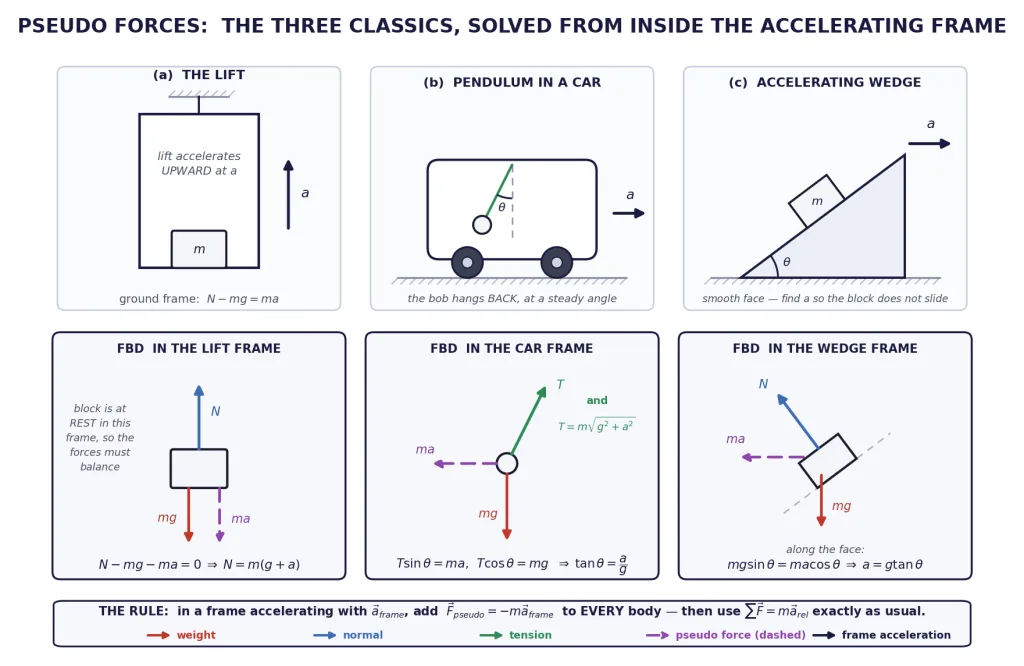
Classic 1: the lift, from the inside
A block of mass on the floor of a lift that accelerates upward at .
Ground frame: , so .
Lift frame: the block is at rest, so the forces must balance. The forces are up, down, and the pseudo force downward (opposite to the lift's upward acceleration):
Same answer, and now it is an equilibrium problem. The useful way to read it: inside an accelerating lift, everything behaves as though gravity had been changed to an effective gravity
Every result you know — the time for a dropped ball to reach the floor, the period of a pendulum, the reading of a spring balance — carries straight over with replaced by . In free fall , so : that is weightlessness, and it is why nothing inside a freely falling lift falls relative to the lift.
Classic 2: the pendulum in an accelerating car
A bob hangs from the roof of a car accelerating forward at . It settles at a steady angle behind the vertical.
In the car's frame the bob is at rest, so the three forces balance: tension along the string, weight down, pseudo force backwards. Resolving,
Divide, and the tension disappears:
Notice : the string works harder than it would at rest, and the "effective gravity" points along the string. This is a genuinely useful instrument — a pendulum in a vehicle is an accelerometer.
Classic 3: the accelerating wedge
A block sits on the smooth face of a wedge of angle . How hard must the wedge be pushed horizontally so the block does not slide relative to it?
In the wedge frame the block is at rest, and the forces are perpendicular to the face, down and backwards. Resolve along the face, because has no component there:
and perpendicular to the face, .
Three readings worth having. The required is independent of the mass — the pseudo force scales with exactly as the weight does. Push harder than and the block rides up the face; push more gently and it slides down. And a steeper wedge needs a larger , going to infinity as , which is the sensible answer for a vertical wall.
The centrifugal force: the pseudo force of a rotating frame
A rotating frame is non-inertial too — a point fixed in it has centripetal acceleration towards the axis. So a body at rest in that frame needs a pseudo force opposite to that, meaning outward:
Key Point: In a frame rotating with angular speed , every body of mass at distance from the axis feels an outward centrifugal force directed radially outward, away from the axis.
That is genuinely useful. A coin on a turntable, a person in a rotor, a passenger in a turning car — analyse each in the rotating frame and the problem becomes a static balance: friction inward versus centrifugal outward.
The two things everybody gets wrong
Mistake 1: drawing it in the ground frame. There is no outward force on a car going round a bend when you watch from the roadside. The only horizontal force is friction, pointing inward. The passenger's feeling of being flung outward is inertia — their body continuing straight while the car curves under them. Draw a centrifugal arrow on a ground-frame free-body diagram and the diagram is simply wrong.
Mistake 2: calling it the reaction to the centripetal force. This is the single most common misconception in the chapter, and it is worth being precise about why it is wrong.
Key Point: The centrifugal force is not the third-law partner of the centripetal force. Two reasons, either one fatal:
- Both act on the same body, and a third-law pair must act on two different bodies.
- The centripetal force is a real force with an agent; the centrifugal force has no agent at all, and pseudo forces never have partners.
So what IS the partner? Take a car of mass rounding a level bend of radius at speed . The centripetal force is the friction the road exerts on the tyres, inward, of magnitude . Its genuine third-law partner is the friction the tyres exert on the road, outward, also — acting on the road, not on the car. Both are real, both are friction, they act on different bodies, and neither of them is the centrifugal force.
Same structure for a stone whirled on a string: the string pulls the stone inward, and the stone pulls the string outward. That outward pull on the string is the partner. The "centrifugal force on the stone" appears only if you deliberately move into the stone's rotating frame.
[Exam Tip] A three-word test for a suspected third-law pair: swap the two nouns. "Road pulls tyres inward" swaps to "tyres pull road outward" — a genuine pair. "Road pulls car inward" cannot swap into "car flung outward", because both of those sentences are about forces on the car.
Friction at JEE Level: Blocks on Blocks, and Minimum-Force Problems
Section 6 gave you the laws of friction and Section 9 drilled them. JEE adds two set-ups that need genuinely more care.
Blocks on blocks: two surfaces, two frictions
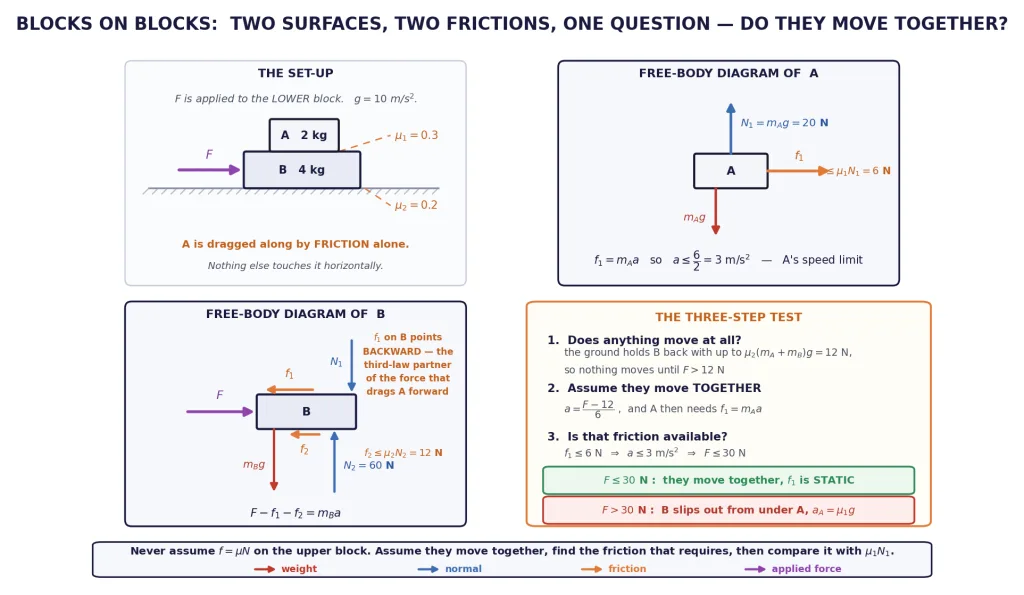
Block A (2 kg) sits on block B (4 kg), which sits on the ground. The coefficient between A and B is ; between B and the ground it is . A horizontal force is applied to the lower block. Take m/s^2.
The whole problem turns on one observation:
Key Point: Nothing touches block A horizontally except friction. So friction from B is the only force that can accelerate A, and A's acceleration is capped at Notice the mass cancels: the top block can never accelerate faster than , whatever it weighs. Here that is m/s^2.
Step 1: does anything move at all? The ground can hold the pair back with a static friction up to
so for N nothing moves, and the friction at both surfaces is zero. (Zero, not — A needs no friction at all when it is not accelerating.) This is the step people skip, and it is the classic silent error: applying to a stationary block.
Step 2: assume they move together. Treat the 6 kg as one body:
Step 3: test the assumption. For A to have that acceleration, B must supply friction . That is available only while N, i.e. while m/s^2, i.e. while
Step 4: past the limit they slide. For N, A is left behind and kinetic friction acts:
At N, for instance, m/s^2 and m/s^2. A slides backwards relative to B, which is what "B slips out from under A" means.
Does the ground friction matter?
Yes, but only through the total weight. Two points examiners test:
- The normal force on the ground is , not . A presses on B, and B passes that on. Forget this and comes out too small.
- If the ground were smooth, step 1 disappears and the numbers change: , and becomes N. The ground friction shifts the threshold but never changes A's ceiling of .
Push the top block instead, and the answer flips
Same stack, same coefficients, but now is applied to A. Now A drives B through friction, so it is B's requirement that binds:
On a smooth floor that reads , so m/s^2 and N — only half the 18 N you get pushing the bottom block on the same smooth floor. The heavier the block being dragged by friction, the smaller the force you may apply.
On our rough floor the answer is sharper still: the most friction A can hand to B is 6 N, while the ground can resist up to 12 N, so B never moves at all — push A hard enough and it simply slides across a stationary B.
Key Point: Never write at an internal surface on sight. Assume they move together, compute the friction that requires, and only then compare it with . Static friction is whatever it needs to be, up to the limit — and it is only at the limit that .
Minimum-force problems, done by minimisation
A block of mass rests on a rough floor with coefficient . It is to be dragged by a force at angle above the horizontal. What angle costs the least force?
Pulling upwards has two competing effects: less of goes into pulling horizontally ( falls), but the block is lightened, so friction falls too (). There must be a best compromise.
On the verge of moving, , so
Minimise by maximising the denominator :
and the second derivative confirms it is a maximum of , hence a minimum of . At that angle and , so and
Three things to notice about that result
1. The best angle is the angle of friction. , exactly the angle Section 6 defined. Pull along the direction of the total contact force at the point of slipping, and you waste nothing.
2. It can be written as . Since , the minimum force is the weight times the sine of the angle of friction — a one-line form worth memorising.
3. The saving is real but modest. With the horizontal pull is while : a saving of 20%. For small the saving is tiny (it goes as ), which is why nobody bothers tilting a rope on ice.
[Advanced] The same minimisation with the block on a rough incline gives the least force to drag it up the slope as , applied at angle to the incline surface, with . Setting the incline angle to zero recovers the flat-floor result above. If you remember one of the two, remember this one.
The Vertical Circle
Section 7 did circular motion at constant speed — level roads, banked roads, the conical pendulum. In a vertical circle gravity has a component along the path, so the speed changes continuously. That one difference generates the richest set-up in the chapter.
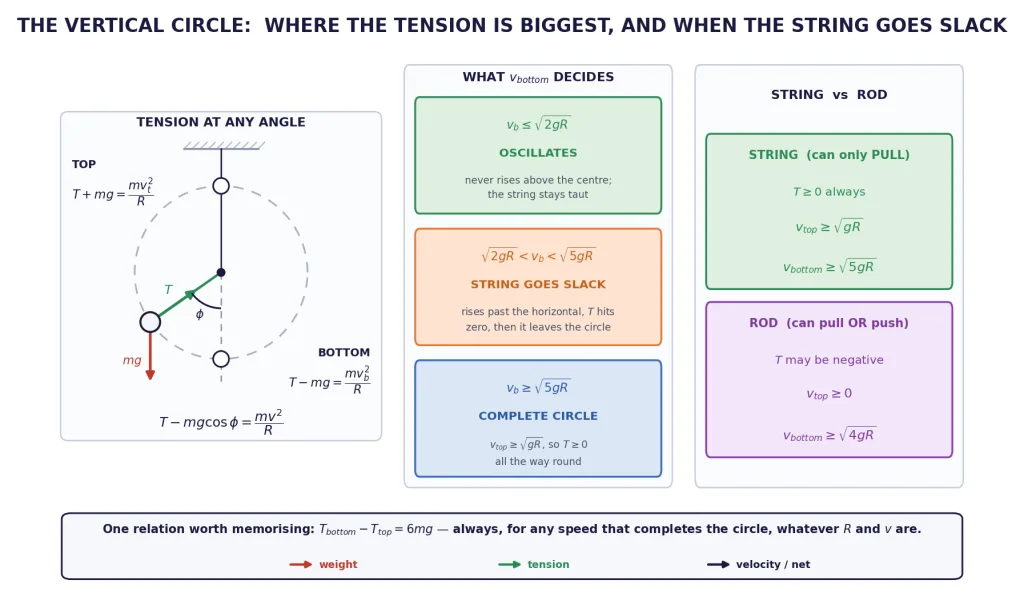
Tension at any angle
A bob of mass on a string of length swings in a vertical circle. Let be measured from the lowest point. Resolve along the string, towards the centre — that is the direction the net force must have magnitude :
Two special cases fall straight out:
- Bottom (, ): — tension is largest here, and bigger than .
- Top (, ): — tension is smallest here, and gravity is now helping to supply the centripetal force.
[Exam Tip] The tangential component does not appear in that equation at all. It changes the speed, not the tension. Two perpendicular directions, two separate jobs — resolve along the string for tension, along the tangent for the rate of change of speed.
Bringing in energy
The string is always perpendicular to the motion, so it does no work, and mechanical energy is conserved. Between the bottom and a general angle , the height risen is , so
Substitute into the tension equation and everything collapses into one formula in terms of the bottom speed alone:
That is the master result. Set and and subtract:
Always. Independent of , independent of , valid for any motion that gets all the way round. It is asked directly almost every year, and it is a free check on any vertical-circle answer you compute.
The condition for a complete circle
A string can only pull, never push, so it needs everywhere. The tension is smallest at the top, so the whole question is decided there:
At exactly the string is limp and gravity alone supplies the whole centripetal force — the bob is momentarily in free fall along a circular path. Translate that to the bottom with energy ():
And at that critical speed, exactly, since .
The three zones — this is where the marks are
Take a bob released from the bottom with speed :
| Range of | What happens | Where it ends up |
|---|---|---|
| Oscillates like a pendulum | Rises to at most the level of the centre; stays positive throughout | |
| String goes slack | Rises past the horizontal, reaches zero somewhere above the centre, then it becomes a projectile | |
| Complete circle | all the way round |
The middle zone is the one examiners live in. To find where the string goes slack, set in the master formula:
For between and this is negative, i.e. the bob is above the centre — which is why the slack point is always in the upper half. Example 11 works a case with m and m/s and finds the string going slack above the horizontal.
Key Point: Below the string never goes slack because the bob never rises above the centre, where the string could not support even a stationary bob. Between and it does. Those two thresholds, and the fact that the second is and not , are the whole examinable content of this table.
A rod is a different animal
Replace the string with a light rigid rod. A rod can push as well as pull, so a negative is perfectly legal — it just means the rod is holding the bob up rather than pulling it in. The condition vanishes, and all that is left is the requirement that the bob actually reaches the top with :
| String | Rod | |
|---|---|---|
| Can it push? | No, | Yes, may be negative |
| Minimum at the top | ||
| Minimum at the bottom | ||
| at the top when critical | (rod pushes up) |
The same distinction applies to a bead threaded on a circular wire, a ball inside a hollow tube, or a car on the inside of a loop with a roof: if the constraint can push, use ; if it can only pull, use . Read the set-up, then choose.
And a ball on the OUTSIDE of a sphere
The mirror-image problem, and a JEE Advanced regular. A ball slides from rest down the outside of a smooth sphere of radius . Here the normal force replaces the tension and points outward, so
with measured from the top. It leaves the surface when ; energy gives , and putting the two together,
Notice that neither the mass nor survives: every ball leaves every smooth sphere after dropping one third of the radius. That is worth memorising.
Variable Mass, the Rocket Equation, and Springs versus Strings
Two last JEE staples, both of which look like new physics and are actually just the second law read carefully.
is the special case; is the law
Section 2 said this and moved on. Now we need it. When the mass of the system you are watching is changing,
and that second term is the whole subject. Two warnings before any algebra:
- You must be careful about which system you are following. The relation above is only correct if the mass entering or leaving does so with zero velocity relative to the ground. That is true for a conveyor being loaded from rest, and false for a rocket.
- The safe method every time is to take a small time , write the total momentum of everything at and at (the same particles in both), and equate the change to . No formula to misremember.
The rocket
A rocket ejects burnt gas backwards at speed relative to the rocket, at a mass rate . Doing the momentum bookkeeping properly gives the propulsive force, called the thrust:
directed forwards, opposite to the exhaust. So a rocket climbing vertically near the ground obeys
Three things JEE tests on this equation:
- The thrust is set by the exhaust speed and the burn rate, not by the rocket's mass. It is essentially constant during a burn.
- The acceleration is not. As fuel burns, falls while the thrust stays put, so the acceleration rises through the flight — which is why astronauts feel the heaviest just before burnout.
- A rocket does not lift off at all unless at ignition. That comparison is a standard one-liner: compute the thrust, compute the initial weight, subtract.
Integrating the equation with neglected gives Tsiolkovsky's rocket equation, — worth recognising, though JEE Main sticks to the thrust and the initial acceleration.
The falling chain, and the conveyor belt
The other side of the same coin: mass being added to a system, not lost.
A uniform chain of linear density is held vertically just above a table and released. When a length has landed, the table feels two separate things:
- The weight of the part already lying on it, .
- The impact force needed to stop the arriving links. In time a mass arrives at speed and is brought to rest, so
Adding them:
That factor of three is the memorable result, and it is asked directly. At the instant the last link lands, the reading is three times the chain's full weight; a moment later it drops to the ordinary weight.
The same logic handles a belt being loaded with sand, water striking a wall, or a hose filling a bucket on a balance. Section 9 worked the conveyor version; this is its vertical twin.
Springs versus strings: the "just after" question
Now the most elegant trick in the section, and a JEE Advanced favourite.
Key Point: A string's tension can change instantaneously, because a string is inextensible — cut it, and its tension is zero the same instant.
A spring's force cannot, because a spring's force is and its length cannot change in zero time. Immediately after any sudden change, a spring is still exerting exactly the force it was exerting before.
That single sentence answers the whole family of "find the acceleration just after the string is cut" questions.
The worked archetype. A block A of mass 2 kg hangs from the ceiling by a spring. A block B of mass 3 kg hangs from A by a string. Everything is at rest. The string is now cut. Find both accelerations just after the cut. Take m/s^2.
Before the cut, the spring holds up both blocks, so its force is
Just after the cut:
- B has nothing left holding it, so m/s^2 downward. Easy.
- A still feels the unchanged 50 N up from the spring, and its own weight 20 N down. Net 30 N upward, so
A accelerates upward at 1.5 g, which is the answer that surprises people. Over the following moments the spring shortens, its force falls, and A eventually oscillates about a new equilibrium — but at the instant , the spring force is still 50 N.
Now cut the SPRING instead. The spring's force vanishes with it, and A and B become a single freely falling object: m/s^2 downward, and the string between them goes slack with zero tension. Completely different answer, from the same picture.
| What is cut | Force that survives the instant | just after | just after |
|---|---|---|---|
| The string below A | spring, still 50 N | m/s^2 up | m/s^2 down |
| The spring above A | none | m/s^2 down | m/s^2 down |
[Advanced] The same logic settles a related favourite: two blocks joined by a spring and dragged by a force, where the force is suddenly removed. The spring force is unchanged for that instant, so the block not being pulled keeps exactly the acceleration it had, while the block that was being pulled changes at once. Ask yourself only one question — is the force in question elastic or inextensible? — and the rest follows.
Where this goes next
- Section 11 (JEE Main Pattern Practice) drills all of this at exam pace with a marking scheme.
- Section 12 (NEET Corner) covers the same chapter for a paper that asks none of this, and needs speed instead.
- Section 14 compresses the whole chapter, including these JEE extensions, into revision cards.
Solved Examples
Twelve problems at genuine JEE level. Work each one on paper before reading the solution — the value is entirely in the attempt. Unless stated otherwise, m/s^2 and all strings and pulleys are ideal.
Example 1: The movable pulley, by both methods
A block of mass 2 kg rests on a smooth horizontal table. A light string is tied to it, runs horizontally to a fixed pulley at the table edge, goes down and under a light movable pulley, and its far end is tied to the ceiling. A block of mass 8 kg hangs from the movable pulley. Find (a) the constraint relation, (b) the tension in the string, and (c) the acceleration of each block.
Solution:
(a) The constraint, by the length method. Let be the 2 kg block's distance from the fixed pulley and the movable pulley's depth below the ceiling. The two vertical segments are each of length , so By virtual work, as a check: the tension does work on the 2 kg block at rate and on the movable pulley at rate (two segments). Setting the total to zero gives immediately.
(b) and (c): the force equations. For the 2 kg block on the smooth table, the only horizontal force is the tension: The movable pulley is massless, so the 8 kg block plus pulley feels upward and down:
Substitute the constraint , so :
Check every line. The 8 kg block: N net, and m/s^2. Correct. The 2 kg block: m/s^2. Correct. And the hanging block accelerates at , as it must, since the string is holding some of its weight.
Final Answer: ; N; the 2 kg block accelerates at 10 m/s^2 and the 8 kg block at 5 m/s^2.
Takeaway: Notice how badly a "same acceleration" assumption would have failed here — the two blocks differ by a factor of two, and the pulley feels , not . Both errors come from the same place: not writing the constraint first.
Example 2: The rope over a pulley, and a speed that surprises people
A boat is being pulled towards a jetty by a rope that runs from the boat up over a bollard 3 m above the water. At the moment when the rope makes with the horizontal (), the rope is being hauled in at 5 m/s. Find the boat's speed at that instant. Is the boat moving faster or slower than the rope is being pulled?
Solution:
Set up the geometry. Let be the boat's horizontal distance from the point below the bollard and the length of rope from the boat to the bollard. With the bollard at height m,
Differentiate with respect to time: because is precisely .
Read off the answer. The rope is shortening at 5 m/s, so
Faster, and here is why. Only the component of the boat's velocity along the rope shortens the rope. The perpendicular component does nothing to the length. So the boat must move faster than 5 m/s to deliver 5 m/s along the rope — and as the boat gets closer, grows, shrinks, and the boat speeds up further even at a constant haul rate.
Final Answer: 6.25 m/s, which is faster than the 5 m/s haul rate.
Takeaway: , never . The same relation, run backwards, is how a man walking away from a pulley raises a load: the load rises at , slower than he walks.
Example 3: A three-block double Atwood machine [Advanced]
A block of mass 4 kg hangs from one end of a light string passing over a fixed pulley. The other end of that string carries a light movable pulley. Over the movable pulley runs a second light string carrying 2 kg on one side and 1 kg on the other. The system is released from rest. Find the acceleration of each block and the tension in each string.
Solution:
Name the unknowns. Two strings, two tensions: in the upper, in the lower. Because the movable pulley is massless, the net force on it must be zero:
The constraint. Take downward as positive for every body. If the 4 kg block accelerates down at , the movable pulley accelerates up at , i.e. its downward acceleration is . The lower string then forces
Three force equations, all with down positive:
Solve. From the last two, and . From the first with , . Substituting into the constraint:
Back-substitute:
Check all four bodies independently.
- 4 kg: N down, m/s^2 down. Correct.
- 2 kg: N down, m/s^2 down. Correct.
- 1 kg: N, so 6 m/s^2 up. Correct.
- Constraint: . Correct.
Final Answer: 4 kg: 2 m/s^2 down. 2 kg: 2 m/s^2 down. 1 kg: 6 m/s^2 up. N, N.
Takeaway: Four unknowns, four equations — three from Newton and one from geometry. Note that the movable pulley itself never got an equation, because its mass is zero; it contributed instead.
Solved Examples (continued)
Example 4: A block on a wedge that is free to slide [Advanced]
A wedge of mass 4 kg with a smooth face rests on a smooth horizontal floor. A block of mass 2 kg is released on the face. Find the acceleration of the wedge and the acceleration of the block relative to the wedge.
Solution:
What can move, and how. The wedge can only slide horizontally; call its acceleration in the direction (the direction the block pushes it). The block slides down the face with acceleration relative to the wedge, along the face. Only two unknowns of motion, plus the normal force .
The constraint — the block stays on the face, so its ground-frame acceleration is . With the face descending towards ,
Newton for the block, using . The forces are perpendicular to the face and down:
Newton for the wedge. The block pushes back on the face with , whose horizontal component drives the wedge:
Solve the three equations. Adding the wedge equation to (x) eliminates : Substituting into (y) with and grinding through gives the standard pair
Put the numbers in with , , , : and N.
Check with momentum. No horizontal external force acts on the wedge-plus-block system, so the total horizontal momentum must stay zero. The block's horizontal acceleration is m/s^2, so Exactly zero, as required. That is a check worth doing every time.
Final Answer: The wedge accelerates at 2 m/s^2, and the block slides down the face at 8.49 m/s^2 relative to the wedge.
Takeaway: Three equations, three unknowns, and the constraint is what supplied the link between and the block's acceleration. The horizontal-momentum check is free and catches sign errors instantly.
Example 5: Two rides, one pseudo force — the lift and the car
(a) A lift is descending with a downward acceleration of 2 m/s^2. A ball is released from rest at a height of 4 m above the lift floor. How long does it take to reach the floor?
(b) A pendulum bob of mass 0.5 kg hangs from the roof of a car that accelerates horizontally at 5 m/s^2. Find the angle the string makes with the vertical and the tension in it.
Solution:
(a) In the lift's frame, the pseudo force is upward (opposite to the lift's downward acceleration), so the ball's effective weight is and The ball starts at rest relative to the lift, so from ,
Confirm in the ground frame, with no pseudo forces at all. The ball falls with m/s^2 and the floor accelerates down at m/s^2, so the gap closes with a relative acceleration of m/s^2. Same s. The two frames must agree, and they do.
(b) In the car's frame the bob is at rest, so three forces balance: tension along the string, weight down, and the pseudo force backwards. Resolving,
Divide to kill :
And the tension, by Pythagoras on the two components: Note N — the string works harder than it would at rest.
Final Answer: (a) 1 s. (b) from the vertical, with N.
Takeaway: Both parts were solved by making the body stationary in the chosen frame, which turns a dynamics problem into an equilibrium problem. Part (a) also shows the standard cross-check: if the ground frame and the accelerating frame disagree, one of them has a sign error.
Example 6: How fast must the wedge be pushed? [Advanced]
A block of mass 2 kg rests on the smooth face of a wedge of angle (). The wedge is pushed horizontally along a smooth floor. (a) What acceleration must the wedge have so that the block does not slide relative to it? (b) What is the normal force on the block then? (c) What happens if the wedge is pushed harder than that?
Solution:
(a) In the wedge's frame the block is at rest, so its three forces balance: perpendicular to the face, down, and the pseudo force pointing backwards (away from the push). Resolve along the face, where contributes nothing:
Notice what is missing. The mass cancelled. Any block, of any mass, stays put on this wedge at this acceleration — because both the weight and the pseudo force scale with .
(b) Resolve perpendicular to the face, where the two components add: With and : Cross-check with the compact form N. Agreed. And note N: the block presses harder into a wedge that is accelerating.
Ground-frame confirmation. Only two forces act in the ground frame, and , and the block's acceleration is purely horizontal at . So (vertical) and (horizontal). Dividing gives again, and N again. Both routes, same answer.
(c) Push harder and the required exceeds what the block's own inertia demands, so the block slides up the face. Push more gently and it slides down. is a knife-edge, not a range — which is exactly why the same problem with a rough face and a range of allowed accelerations is the natural JEE Advanced follow-up.
Final Answer: (a) 7.5 m/s^2. (b) 25 N. (c) The block slides up the incline.
Takeaway: The wedge-frame route took one line because the block was at rest in it. The ground-frame route took two. Both are correct; choose the frame in which something is not moving.
Solved Examples (continued)
Example 7: The rotor, and what the centrifugal force is not [Advanced]
In a fairground "rotor", people stand against the inside wall of a vertical cylinder of radius 2.5 m. The cylinder spins about its vertical axis and the floor is then dropped away, leaving the riders pinned to the wall. The coefficient of static friction between clothing and wall is . (a) Find the minimum angular speed for a rider not to slip down. (b) Does a heavier rider need a faster spin? (c) Name the third-law partner of the centripetal force on the rider.
Solution:
(a) Work in the rotating frame, where the rider is at rest. Three forces act: the wall's normal force pointing inward (towards the axis), the weight down, and the centrifugal pseudo force outward. Friction from the wall acts upward, holding the rider up.
Horizontally, the rider is at rest in this frame, so the normal force balances the centrifugal force:
Vertically, friction must carry the whole weight, and it cannot exceed its limit:
Solve for : which is a wall speed of m/s, or about 30 revolutions per minute.
(b) No. The mass cancelled in step 3 — it appears on both sides. A 90 kg rider and a 40 kg rider need exactly the same minimum spin. (Verified numerically: all three masses give rad/s.)
(c) The partner. The centripetal force on the rider is the normal force from the wall on the rider, pointing inward. Its third-law partner is the normal force from the rider on the wall, pointing outward, acting on the wall. That outward push is real and it is what makes the drum flex. The centrifugal force is not the partner: it acts on the rider (the same body), it has no agent, and it exists only because we chose to work in the spinning frame.
Final Answer: (a) rad/s. (b) No — the mass cancels. (c) The outward normal force exerted by the rider on the wall.
Takeaway: In the rotating frame this was a static problem: outward centrifugal force sets , and friction from carries the weight. In the ground frame you would say the same thing differently — the wall supplies the centripetal force — and get the identical answer. What you may never do is draw an outward force on the rider in the ground frame.
Example 8: Blocks on blocks, both regimes [Advanced]
Block A of mass 2 kg rests on block B of mass 4 kg, which rests on the ground. The coefficient of friction between A and B is 0.3 and between B and the ground is 0.2. A horizontal force is applied to B. Find (a) the value of below which nothing moves, (b) the largest for which A and B move together, and (c) both accelerations when N.
Solution:
The two friction limits first. With A pressing on B and both pressing on the ground: Note the second one uses the total weight, 60 N, not B's 40 N.
(a) Does it move? The whole stack starts moving only when beats the ground's static friction: For N nothing moves and both frictions are less than their maxima — in particular the friction on A is exactly zero, not 6 N.
(b) Assume they move together and treat the 6 kg as one body: For A, the only horizontal force is friction from B, so it needs , and that is available only while , i.e. m/s^2: At exactly N, m/s^2 and the friction on A is 6 N — right at its limit.
(c) At N the assumption fails, so they slide. A is now driven by kinetic friction at its maximum value: For B, friction from A acts backwards (6 N, third-law partner) and ground friction acts backwards (12 N):
Check. N, and the net external horizontal force on the system is N. They match, so the internal 6 N friction pair has cancelled correctly.
Final Answer: (a) nothing moves for N; (b) they move together up to N; (c) at 42 N, m/s^2 and m/s^2.
Takeaway: Three regimes, three different frictions: zero below 12 N, static and self-adjusting between 12 N and 30 N, and kinetic at above 30 N. Writing at the start would have got two of the three wrong.
Example 9: The cheapest angle to pull
A 10 kg block rests on a floor with . Show by minimisation that the least force needed to just move it is applied at , and find that force. Compare it with a horizontal pull.
Solution:
Set up the general case with the force at above the horizontal. The upward component lightens the block: and on the verge of moving,
Solve for :
Minimise properly. is least when is greatest, so set the derivative to zero: The second derivative is , confirming a maximum of and therefore a minimum of .
Evaluate at that angle. With we get , , , and
Compare with a horizontal pull (): so tilting the rope saves N, a 20% reduction. At the optimum the normal force has fallen to N, and the friction being overcome is N — which is exactly N, as it must be.
The elegant form. Since , the result can be written Here N. Same number, one line.
Final Answer: The optimum angle is above the horizontal, with N, against 75 N for a horizontal pull.
Takeaway: Two competing effects — a smaller horizontal component but a smaller normal force — and calculus finds the balance point exactly at the angle of friction. That coincidence is not an accident: pulling along the direction of the limiting contact force is the efficient thing to do.
Solved Examples (continued)
Example 10: A full vertical circle, top to bottom [Advanced]
A stone of mass 0.5 kg is tied to a string of length 1 m and whirled in a vertical circle. At the lowest point its speed is 8 m/s. Find (a) the tension at the lowest point, (b) the speed at the highest point, (c) the tension there, and (d) verify that . Does it complete the circle?
Solution:
(a) At the bottom, the tension pulls up and the weight pulls down, and the net force must be centripetal (upward, towards the centre):
(b) At the top, use energy. The string does no work, so with a rise of m,
Does it complete the circle? The condition is m/s. Here , so yes. Equivalently, exceeds m/s.
(c) At the top, both the tension and the weight point downwards, towards the centre: Positive, so the string is genuinely taut at the top — consistent with step 3.
(d) The check: They agree, as they must for any speed that completes the circle.
A harder variant, worth the extra minute. Suppose the stone had started at only m/s. Then , so it is in the middle zone: it rises past the horizontal and the string goes slack. Setting in the master formula : which is above the horizontal. The speed there is m/s, and from that instant the stone is a projectile.
Final Answer: (a) 37 N (b) 4.90 m/s (c) 7 N (d) . Yes, it completes the circle.
Takeaway: Three tools, used in order: Newton along the string for the tension, energy to move between points, and the relation as a free check. Never try to get from the bottom to the top with Newton alone — the tangential force is changing all the way.
Example 11: The rod that beats the string [Advanced]
A small ball is attached to the end of a light rigid rod of length 0.9 m, pivoted at its other end so that the ball can move in a vertical circle. (a) What is the minimum speed at the lowest point for the ball to complete a full circle? (b) What would the answer be if the rod were replaced by a string of the same length? (c) In the rod case, what force does the rod exert on the ball at the top when it just barely gets round, if the ball has mass 0.2 kg?
Solution:
(a) A rod can push. There is no requirement that the constraint force be inward-only, so the ball merely has to arrive at the top, with any speed down to zero. By energy conservation over a rise of m,
(b) A string can only pull, so it needs at the top, which forces : The string demands about 12% more speed — and about 25% more kinetic energy — for the same circle.
(c) At the top in the rod case with , the required centripetal force is . But the weight N is pulling the ball down towards the centre. Something must cancel it exactly, so the rod must push up on the ball with In the sign convention where positive means "pulling inward", this is N. That negative tension is precisely what a string cannot deliver.
Sanity check on the ordering. , so the rod is always the easier case — which fits, since a rod can do everything a string can and more.
Final Answer: (a) 6 m/s (b) 6.71 m/s (c) the rod pushes the ball outward (upward) with 2 N.
Takeaway: Ask one question before starting any vertical-circle problem: can the constraint push? String, chain, thread, or the outer wall of a loop no, use . Rod, groove, tube, or a bead on a wire yes, use .
Example 12: A rocket, a chain, and a cut string [Advanced]
(a) A rocket of total initial mass 20000 kg burns fuel at 150 kg/s and ejects it at 2000 m/s relative to the rocket. Find the thrust and the initial acceleration at lift-off.
(b) A uniform chain of mass 4 kg and length 2 m is held vertically with its lower end just touching a table, and released. What force does the chain exert on the table when 1 m of it has landed?
(c) A block A of mass 2 kg hangs from the ceiling by a spring; a block B of mass 3 kg hangs from A by a string. The string is cut. Find both accelerations just after the cut.
Solution:
(a) The thrust is the exhaust speed times the burn rate: The initial weight is N, which is smaller — so it does lift off, with Note this is the acceleration at that instant only: as fuel burns, falls, the thrust stays put, and the acceleration climbs.
(b) The chain, in two parts. Linear density kg/m. When 1 m has landed:
- The weight of the landed part: N.
- The impact force. The arriving links are moving at m/s, and mass arrives at rate . Stopping it dead needs
Add them: Three times the weight of the part already lying there — the general rule.
(c) The key idea: a spring's force cannot change instantaneously, but a string's can. Before the cut, the spring holds both blocks:
Just after the cut:
- B has no force on it but gravity: m/s^2 downward.
- A still feels 50 N up from the unchanged spring and 20 N down from its weight:
- The contrast. Cut the spring instead and its force disappears with it, so A and B fall together at 10 m/s^2 with no tension in the string between them. Same picture, entirely different answers.
Final Answer: (a) thrust N, initial acceleration 5 m/s^2. (b) 60 N. (c) A: 15 m/s^2 upward; B: 10 m/s^2 downward.
Takeaway: All three parts are the second law read carefully. (a) and (b) are with mass changing; (c) is the observation that needs to change, and cannot change in zero time. No new law anywhere.