
How to Use This Section
Sections 1 to 8 taught you the physics. This section is where you find out whether you actually own it.
What follows is 42 fresh worked problems — new numbers, new framings, and combinations the theory sections deliberately did not attempt. They are ordered roughly easy to hard, and they are grouped by idea so you can attack a weak area directly:
| Examples | Topic | Sections to revise if you get stuck |
|---|---|---|
| 1 to 4 | First law, inertia, inertial frames | Section 1 |
| 5 to 13 | Second law, impulse, force-time graphs, variable force | Section 2 |
| 14 to 19 | Third law, recoil, collisions, explosions, mass flow | Section 3 |
| 20 to 23 | Equilibrium, Lami's theorem, multi-string FBDs | Sections 4 and 5 |
| 24 to 29 | Friction, angle of repose, inclines, stopping distances | Section 6 |
| 30 to 34 | Circular dynamics — level road, banked road, conical pendulum | Section 7 |
| 35 to 39 | Connected bodies, pulleys, Atwood, lifts, ropes with mass | Section 8 |
| 40 to 42 | Genuinely hard, two or three skills chained together | everything |
How to work them
Read the problem, close the page, and solve it yourself. Then compare. Reading a worked solution feels like learning and is not; the only thing that transfers to an exam hall is having done it with your own pen.
Key Point: Three habits appear in nearly every solution below, and they are worth more than any formula in this chapter. (1) Draw the free-body diagram before writing a single equation. (2) For any friction problem, test whether the body moves — compare the driving force with — before you decide whether to use or . (3) After you get an answer, check it against an equation you did not use.
[Board Important] Every example states the value of it uses. Some problems say "take m/s^2", while others use 9.8. Both appear below, always stated, and never mixed inside one problem. In an exam, use whatever the question says; if it says nothing, say what you assumed.
Right. Pen, paper, and let's go.
Solved Examples
Example 1: The pebble thrown upwards
A pebble of mass 0.05 kg is thrown vertically upwards. Take m/s^2 and ignore air resistance. Give the magnitude and direction of the net force on the pebble (a) during its upward motion, (b) during its downward motion, (c) at the highest point, where it is momentarily at rest. Do the answers change if it is thrown at to the horizontal instead?
Solution:
List the forces, not the motions. Once the pebble has left the hand, only one force acts on it: gravity. There is no "force of throw" travelling with it — that force stopped existing the moment contact ended. Air resistance is ignored by instruction.
So in every one of the three cases:
(a) Going up. The velocity is upward, the force is downward. Nothing wrong with that — a force opposite to the velocity is what slows a body. N down.
(b) Coming down. Velocity down, force down, so it speeds up. N down.
(c) At the top. Here , and this is where students go wrong. Zero velocity does not mean zero force. If the force were zero at the top, the first law says the pebble would stay there forever. It does not. N down.
Thrown at ? Gravity does not know or care about the launch angle. The path becomes a parabola, the horizontal velocity stays constant throughout, but the net force is still N vertically down at every instant, including the top of the flight (where the velocity is not zero now — it is horizontal).
Final Answer: 0.5 N vertically downward in all three cases, and unchanged for a launch.
Takeaway: The single most examined confusion in this whole chapter is between velocity and force. They are independent: a body can have zero velocity and a huge force (the pebble at the top), or a huge velocity and zero force (a spacecraft coasting). The first law connects force to change of velocity, never to velocity itself.
Example 2: Where the string is cut
A bob of mass 0.1 kg hangs from the ceiling by a string 2 m long and is set oscillating. Its speed at the mean (lowest) position is 1 m/s. Take m/s^2. What is the trajectory of the bob if the string is cut (a) at an extreme position, (b) at the mean position?
Solution:
The principle. The instant the string is cut, tension vanishes. Only gravity remains, so the bob becomes a projectile with whatever velocity it happened to have at that instant. The whole question is therefore: what is the velocity vector at the moment of cutting?
(a) At an extreme position. At the extremes, the bob is momentarily at rest — . A projectile launched with zero velocity simply falls. Trajectory: a vertical straight line, straight down.
(b) At the mean position. Here the speed is 1 m/s and the velocity is horizontal (the string is vertical, and the velocity of a pendulum bob is always perpendicular to the string). A projectile launched horizontally under gravity follows a parabola. Trajectory: a parabolic arc.
Putting a number on (b). Suppose the bob is 1.8 m above the floor when the string is cut at the mean position. The fall time is and in that time it travels horizontally
A bonus check on the tension just before the cut. At the lowest point the bob is moving on a circle of radius 2 m, so the net upward force must supply :
Final Answer: (a) a vertical straight line; (b) a parabola — landing 0.6 m away if cut 1.8 m above the floor.
Takeaway: "Cut the string" problems are always answered the same way: find the velocity at that instant, then treat it as a projectile. The bob does not fly outward along the string, and it does not stop — inertia carries it off along the tangent. [NEET Important] Notice how part (a) and part (b) differ only in when you cut, and give completely different paths.
Example 3: The braking bus, and the box that keeps going
A bus travelling at 15 m/s brakes uniformly and comes to rest in 5 s. A smooth (effectively frictionless) box sits on the floor of the bus, 2.0 m behind the partition at the front. Does it hit the partition? If so, when, and at what relative speed?
Solution:
The bus first.
Now the box — and here is the whole point. The floor is frictionless, so there is no horizontal force on the box at all. By the first law it keeps moving at a constant 15 m/s. The bus slows; the box does not.
Work in the ground frame (an inertial frame, so Newton's laws are valid there without corrections). Measuring both from the same starting line, so the box gains on the front of the bus by
It hits when m: The bus is still moving at m/s at that moment, so this happens early in the braking.
Relative speed at impact:
Final Answer: Yes — it strikes the partition after 1.15 s, at a relative speed of 3.46 m/s.
Takeaway: Notice what we did not say: we never claimed a force threw the box forward. Nothing pushed it. The bus was taken out from under it. [JEE Tip] If you insist on working in the bus's frame, you must add a pseudo-force of N forward, because the bus frame is non-inertial — that machinery is Section 10's job. The ground frame needs no such thing, which is exactly why it is the safer choice in an exam.
Example 4: Four forces and a constant velocity
A body moves with constant velocity while four coplanar forces act on it. Three of them are Find the fourth force, its magnitude and its direction.
Solution:
Read "constant velocity" correctly. Constant velocity means zero acceleration, which by the second law means zero net force. It does not mean zero force on the body — it means the forces cancel.
Add the three known forces component by component:
The fourth force must cancel that:
Magnitude and direction: Both components are negative, so it points into the third quadrant, at below the negative -axis.
Check: . Clean.
Final Answer: N, magnitude 3.16 N, at below the negative -axis.
Takeaway: The whole problem is one line of physics — "constant velocity " — and three lines of arithmetic. [JEE Tip] Also note what is not needed: the mass of the body, the actual value of the velocity, and the direction of motion. If a question hands you numbers you never use, that is often deliberate.
Example 5: Two quick second-law drills
(a) A constant retarding force of 50 N acts on a 20 kg body moving initially at 15 m/s. How long does it take to stop, and how far does it travel? (b) A constant force acting on a 3.0 kg body changes its speed from 2.0 m/s to 3.5 m/s in 25 s, without changing direction. Find the magnitude and direction of the force.
Solution:
(a) Acceleration first:
Time to stop, from with :
Distance, from :
(b) Acceleration from the speed change:
Force: The speed increased along an unchanged direction, so the force is along the direction of motion.
Final Answer: (a) 6.0 s, travelling 45 m; (b) 0.18 N, in the direction of motion.
Takeaway: Part (b) is a useful reality check on how small forces can be. A force of 0.18 N — about the weight of a 18 g biscuit — is enough to change a 3 kg body's speed by 1.5 m/s, provided you give it 25 seconds. Force sets the rate of change of momentum, not the change itself; a long enough time turns any force into a large impulse.
Example 6: Two perpendicular forces
A body of mass 5 kg is acted upon by two perpendicular forces of 8 N and 6 N. Find the magnitude and direction of its acceleration.
Solution:
Set up axes along the forces. Put the 8 N force along and the 6 N force along (they are perpendicular, so this is allowed and it makes the arithmetic trivial):
Resultant magnitude — the familiar 3-4-5 triangle, scaled:
Acceleration:
Direction. The acceleration is parallel to the net force (the second law is a vector equation, so and always point the same way):
Component check: m/s^2 and m/s^2, and m/s^2. Consistent.
Final Answer: m/s^2, at from the 8 N force (that is, from the 6 N force).
Takeaway: Two things worth locking in. First, add the forces as vectors, then divide by — never add magnitudes ( N is wrong and gives 2.8 m/s^2). Second, always state the direction relative to something named, because "" on its own means nothing to an examiner.
Example 7: The three-wheeler and the child
The driver of a three-wheeler moving at 36 km/h sees a child in the road and brings the vehicle to rest in 4.0 s, just in time. The three-wheeler has mass 400 kg and the driver 65 kg. What is the average retarding force on the vehicle?
Solution:
Convert to SI first, every time:
Retardation:
What mass is being retarded? The driver is decelerating too, and the force that does it comes from the vehicle. So the retarding force from the road must slow both:
Second law: The minus sign says "opposite to the motion". Magnitude 1162.5 N.
Cross-check by impulse. kg m/s, delivered in 4.0 s, so N. Same.
Final Answer: 1162.5 N, directed opposite to the motion.
Takeaway: The driver's 65 kg is not decoration — leaving it out gives 1000 N and loses the mark. Ask yourself every time: what exactly is the system this force is accelerating? Also note the word average: the real braking force varies from instant to instant, and gives you its time-average, which is all the data allows.
Example 8: The rocket's initial thrust
A rocket with a lift-off mass of 20,000 kg is blasted upwards with an initial acceleration of 5.0 m/s^2. Take m/s^2. Calculate the initial thrust of the blast.
Solution:
Free-body diagram of the rocket at lift-off. Two vertical forces: the thrust upward from the exhaust gases, and the weight downward.
Weight:
Second law, taking up as positive:
Sanity check. The thrust must exceed the weight, or the rocket would not leave the pad — and indeed . The surplus, N, is the net force, and m/s^2 as required.
Final Answer: N.
Takeaway: The pattern is the same one you meet in the lift (Example 37) and in every "lifting something with acceleration" problem. [NEET Important] The commonest error is writing N and forgetting that the thrust also has to hold up the weight. If a body accelerates upward, the upward force is always bigger than .
Example 9: A force with an expiry date
A body of mass 0.40 kg is moving at a constant 10 m/s to the north. From it is subject to a constant force of 8.0 N directed south, for 30 s. Take at . Predict its position at s, s and s.
Solution:
Set up. Take north as positive . While the force acts,
At s the force has not started yet. The body has been coasting at a constant 10 m/s, so That is, 50 m south of the origin — which makes sense: five seconds before it reached the origin, it was 50 m short of it.
At s the force is still acting (it runs from 0 to 30 s), so use the uniform-acceleration formula: The body reversed long ago — it turned around at s — and is now 6 km south.
At s. Here is the trap. The force stops at s. After that the body coasts. So do it in two stages. From s to s (70 s) there is no force, so the velocity stays at m/s:
Final Answer: m at s; m ( km) at s; m ( km) at s.
Takeaway: Two lessons in one problem. (1) Kinematic formulas only apply over intervals in which the acceleration is actually constant — the moment the force switches off, you start a new stage with the old stage's final velocity as the new initial velocity. (2) Applying blindly all the way to s gives m, and it is wrong by almost a factor of two.
Example 10: Dropped from an accelerating truck
A truck starts from rest and accelerates uniformly at 2.0 m/s^2. At s, a person standing on top of the truck, 6 m above the ground, drops a stone. Take m/s^2 and neglect air resistance. Find (a) the velocity and (b) the acceleration of the stone at s.
Solution:
The truck at the instant of release. The stone was travelling with the truck, so at the moment it is released it has a horizontal velocity of 20 m/s.
What forces act on the stone after release? Only gravity — vertical, downward. There is no horizontal force, so the stone's horizontal velocity stays at 20 m/s for ever after. The truck keeps accelerating; the stone does not. (You met exactly this point in Section 1, in a new coat.)
One second after release ( s):
Combine: at an angle below the horizontal of
Check it is still in the air. Falling 6 m takes s, and s, so at s the stone has not landed. Good — the question is answerable.
(b) The acceleration is just : 10 m/s^2, vertically downward. The truck's 2.0 m/s^2 is irrelevant to the stone the moment contact ends.
Final Answer: (a) 22.4 m/s at below the horizontal; (b) 10 m/s^2 vertically downward.
Takeaway: Step 5 is the habit to steal from this problem. Before you compute a projectile's state at some time, check it is still in flight. And note the split personality of the answer: the velocity remembers the truck (through ), while the acceleration has forgotten it completely.
Example 11: Force and impulse from a position-time graph
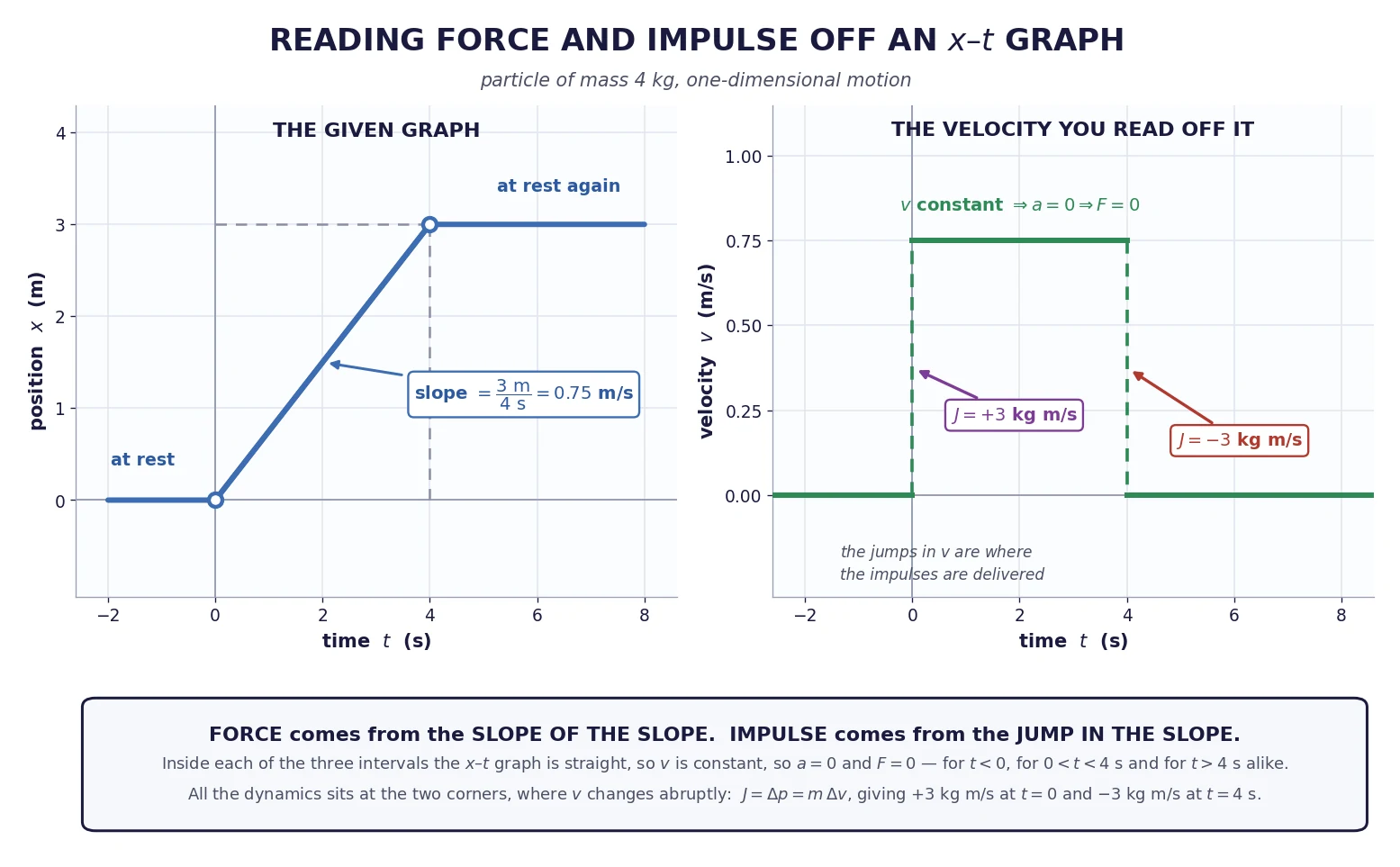
The graph shows the position-time record of a particle of mass 4 kg: it sits at for all , moves along a straight line reaching m at s, and then stays at m. Find (a) the force on the particle for , for s and for s; (b) the impulse at and at s.
Solution:
- Turn the - graph into velocities. Velocity is the slope.
- For : the graph is flat, so .
- For s: a straight line from to , so m/s, constant.
- For s: flat again, so .
(a) The force. In each of the three intervals the velocity is constant, so , so Yes — zero force even while it is moving at 0.75 m/s. That is the first law, and it is exactly the point of the question.
(b) The impulse at . The velocity jumps from 0 to 0.75 m/s:
The impulse at s. The velocity jumps from 0.75 m/s back to 0:
Why "impulse" and not "force" at the corners? At a sharp corner of the - graph, the velocity changes in zero time, so the force is infinite for an instant. The force is unanswerable; the impulse — force integrated over time — is perfectly finite and equals the momentum change. That is precisely when the impulse-momentum theorem earns its keep.
Final Answer: (a) in all three intervals; (b) kg m/s at and kg m/s at s.
Takeaway: Read graphs in this order: position slope gives velocity slope of that gives acceleration multiply by for force. A straight - segment always means zero force, however steep it is. And a kink in the - graph always means an impulse. The two impulses here are equal and opposite, so the total momentum change over the whole record is zero — which it must be, since the particle starts and ends at rest.
Example 12: A force-time pulse, and the area under it
A 4 kg block rests on a frictionless horizontal surface. A horizontal force is applied: it grows linearly from 0 to 8 N over the first 2 s, stays at 8 N from s to s, then falls linearly back to zero by s. Find (a) the total impulse, (b) the final speed, (c) the maximum acceleration, and (d) the average force over the 6 s.
Solution:
The shape is a trapezium, so the impulse — which is the area under the - graph — is best found piece by piece.
(a) Piecewise areas:
(b) Final speed. By the impulse-momentum theorem, and since the surface is frictionless so no other horizontal force acts,
(c) Maximum acceleration happens when the force is largest, at 8 N:
(d) Average force over the whole 6 s: Check: a constant 6 N for 6 s would also produce m/s. That is what "average force" means.
Intermediate speeds, for practice. Up to s the impulse is 8 N s, so m/s; up to s it is 32 N s, so m/s. The last second adds only 1 m/s, because the force is dying away.
Final Answer: (a) 36 N s; (b) 9.0 m/s; (c) 2.0 m/s^2; (d) 6.0 N.
Takeaway: When a force varies with time, stop looking for and start looking for area. Impulse handles any shape of — triangles, trapezia, curves — with no calculus beyond finding an area, and it delivers the velocity change directly. [JEE Tip] Whenever a graph of force against time appears in a paper, the question is almost certainly about impulse.
Example 13: A force that dies away
A 2 kg body at rest on a frictionless surface is acted on by a horizontal force N, where is in seconds. Find (a) the initial acceleration, (b) the instant the force vanishes, (c) the speed at that instant, and (d) the speed at s.
Solution:
(a) Initial acceleration. At , N, so This is an instantaneous value — the second law is a relation between force and acceleration at the same moment, and both are changing here.
(b) The force vanishes when : After that, becomes negative — the force reverses and starts retarding the body.
(c) Speed at s. The force is not constant, so use impulse (the area under the - line, which is a triangle of base 4 s and height 12 N): That is the maximum speed, because the force turns negative afterwards.
(d) Speed at s. From 4 s to 8 s the force is negative, and by symmetry that second triangle has exactly the same area, N s. So The body accelerates for 4 s, decelerates for 4 s, and ends at rest — but far from where it started: 32 m by the time it reaches top speed, and 64 m by the time it stops.
A speed on the way up, for practice. At s, N s, so m/s.
Final Answer: (a) 6.0 m/s^2; (b) s; (c) 12 m/s; (d) 0.
Takeaway: A force of zero at s does not mean the body is at rest there — it means the body has stopped changing its velocity, so that is where the speed peaks. [JEE Tip] "Maximum velocity" almost always means "where the acceleration crosses zero", and finding that instant is usually the first line of the solution.
Example 14: The recoil of the gun
A shell of mass 0.020 kg is fired from a gun of mass 100 kg. If the muzzle speed of the shell is 80 m/s, what is the recoil speed of the gun?
Solution:
Choose the system: gun + shell together. The explosion forces are internal to that system, and the external forces (gravity, the normal reaction from the ground) are vertical, so horizontal momentum is conserved.
Before firing, everything is at rest:
After firing, taking the shell's direction as positive:
Set them equal:
Check the vector sum. Shell: kg m/s. Gun: kg m/s backwards, so . Total zero, as required. The speed ratio is 5000 to 1, the exact inverse of the mass ratio.
Final Answer: The gun recoils at 0.016 m/s, that is 1.6 cm/s, opposite to the shell.
Takeaway: Both objects receive the same magnitude of momentum (1.6 kg m/s), because they push each other with equal and opposite forces for the same length of time. It is the speeds that differ wildly, and only because the masses do. [NEET Important] In every recoil problem the pattern is — a lighter body always ends up faster.
Example 15: The impulse each billiard ball receives
Two billiard balls, each of mass 0.05 kg, move towards each other at 6 m/s and rebound with the same speed. What impulse does each ball receive from the other?
Solution:
Take a direction. Let ball A move along at 6 m/s and ball B along at 6 m/s.
Momenta before: Total: 0.
Momenta after (each rebounds, so each reverses): Total: 0. Momentum is conserved, as it must be.
Impulse on A (impulse-momentum theorem):
Impulse on B:
Third-law check: . The two impulses are equal in magnitude and opposite in direction, exactly as Newton's third law requires — the two balls push each other with equal and opposite forces for the identical contact time.
Final Answer: Each ball receives an impulse of magnitude 0.6 kg m/s, directed opposite to its own original motion.
Takeaway: The magnitude is , not — a reversal changes momentum by twice the original amount. Students routinely halve this answer. [JEE/NEET] And note that the total momentum was zero both before and after: conservation of momentum is satisfied trivially here, which is why the interesting quantity is the impulse on each ball individually.
Example 16: The batsman's deflection
A batsman deflects a ball by an angle of without changing its speed, which is 54 km/h. The ball has mass 0.15 kg. What impulse is imparted to the ball?
Solution:
Convert: So kg m/s.
Get the geometry right — this is the whole problem. The ball arrives at the bat and is deflected, meaning it is sent back on the other side, making with the line it came in on. So the incoming and outgoing velocity vectors are at to each other, not .
Set it up in components. Let the incoming velocity be along ; the outgoing velocity is then at :
Impulse:
The one-line version. When the speed is unchanged and the two vectors are at angle to each other, Equivalently, in terms of the stated deflection : kg m/s.
Direction. points along the bisector of the reversed incoming and the outgoing directions — that is, straight out from the bat face, which is exactly where you would expect the bat to push.
Final Answer: kg m/s, that is about 4.2 kg m/s, directed along the bisector of the two paths.
Takeaway: Everything hinges on step 2. If you had read "deflected by " as "the two velocity vectors are apart", you would have got kg m/s — a completely different answer for the same words. [JEE Tip] In any change-of-direction impulse problem, draw the two momentum vectors from a common point and measure the angle between them. Never work from a description alone, and remember that the reversal case () gives the maximum possible, .
Example 17: Why the fragments must fly apart back to back
A nucleus is at rest in the laboratory frame. Show that if it disintegrates into two smaller nuclei, the products must move in opposite directions.
Solution:
The system is isolated. Nuclear forces are internal to the parent nucleus, and during the split no external force acts. Therefore the total linear momentum is conserved as a vector.
Before: the nucleus is at rest, so
After: two fragments of masses and with velocities and :
Rearrange: Masses are positive scalars, so and must be antiparallel — exactly opposite in direction. That is the proof, and it is three lines long.
The speeds are not equal, though. Taking magnitudes, The lighter fragment goes faster, in exact inverse proportion.
A number, to make it concrete. A nucleus of mass number 220 at rest emits an alpha particle (mass number 4), leaving a daughter of mass number 216. If the alpha leaves at speed , the daughter recoils at in the opposite direction, and the two momenta are identical in magnitude.
Final Answer: The two fragments must move in exactly opposite directions, with speeds inversely proportional to their masses.
Takeaway: This is the recoil of a gun (Example 14), the explosion of a bomb, and a person stepping off a boat — the same one-line argument every time. [JEE/NEET] And note carefully what makes it work: the total momentum before was zero, so the total after must also be zero, and the only way two vectors add to zero is by being antiparallel. If the parent nucleus had been moving, the fragments would in general not be back to back in the lab frame.
Example 18: Sand onto a moving conveyor belt
Sand drops vertically at a steady rate of 5 kg/s onto a horizontal conveyor belt that is moving at a constant 2 m/s. What extra horizontal force must the belt motor supply to keep the belt moving at that speed, and what extra power does it need?
Solution:
What is the physics? The sand lands with zero horizontal velocity. The belt has to drag it up to 2 m/s. That change of horizontal momentum needs a horizontal force, and it is friction between the sand and the belt that provides it.
Momentum given to the sand per second. In one second, 5 kg of sand goes from 0 to 2 m/s horizontally:
By the second law in its momentum form, that rate of change of momentum is the force on the sand: By the third law, the sand drags backwards on the belt with 10 N, so the motor must supply an extra 10 N to hold the speed steady.
Extra power:
Cross-check by impulse over 4 s. In 4 s, 20 kg of sand is loaded and each kilogram ends at 2 m/s, so the momentum delivered is kg m/s. The impulse from a steady 10 N over 4 s is N s. Identical, as they must be.
Final Answer: An extra force of 10 N and an extra power of 20 W.
Takeaway: This is used in the form the shortcut cannot handle: the mass is changing, not the velocity. The same formula governs a water jet hitting a wall, a rocket burning fuel, and a hose filling a bucket. [JEE Tip] Whenever a problem gives you a rate in kg/s, reach for , never for .
Example 19: Four "explain why" questions
Explain why (a) a horse cannot pull a cart and run in empty space, (b) passengers are thrown forward from their seats when a speeding bus stops suddenly, (c) it is easier to pull a lawn mower than to push it, (d) a cricketer moves his hands backwards while holding a catch.
Solution:
(a) The horse in empty space. The horse pushes backwards on the ground; by the third law the ground pushes forwards on the horse, and that reaction is the force which drives horse and cart forward. In empty space there is no ground to push against, so no reaction is generated, and the horse's legs thrash uselessly. The tension in the traces is internal to the horse-plus-cart system and can never move it as a whole.
(b) Passengers thrown forward. They are not thrown — nothing pushes them. The seat and the floor decelerate with the bus; the passenger's upper body has no such force acting on it and, by the first law, keeps moving forward at the original speed. Relative to the bus, that looks like being flung forward. This is exactly Example 3, with a person instead of a box.
(c) Pull versus push, with numbers. Take a 20 kg mower, , a handle at to the horizontal, and m/s^2. The vertical component of the applied force changes the normal reaction, and friction follows . Pulling (force at above the horizontal): , and to just move it, . Solving the pair, with N. Pushing (force at below the horizontal): now , so with N. Pushing needs 1.6 times as much force.
(d) The cricketer's hands. The catch must destroy the same momentum either way, so Drawing the hands back stretches — the only quantity he can control. Triple the stopping time and the average force on his hands falls to a third. The impulse is fixed; the force is negotiable.
Final Answer: (a) no ground means no reaction force; (b) inertia of the passenger, not a forward force; (c) pulling reduces , so 75.0 N instead of 120.1 N; (d) a longer means a smaller for the same .
Takeaway: These four look like essay questions and are actually four different laws in disguise: (a) the third law, (b) the first law, (c) friction with a variable normal reaction, (d) the impulse-momentum theorem. In a board exam, name the law you are using in the first sentence of each answer — that sentence usually carries the mark.
Example 20: A lamp on two chains
A lamp of mass 12 kg hangs from a hook in the ceiling. Two chains run from the hook to the ceiling, one making with the ceiling and the other , on opposite sides. Take m/s^2. Find the tension in each chain.
Solution:
Isolate the hook — the point where the three forces meet. The lamp's weight pulls straight down on it with N, and the two chains pull along their own lengths, up and outwards.
Choose axes and resolve. Let be the tension in the chain (up and to the left) and in the chain (up and to the right). Angles are measured from the horizontal ceiling.
From the first equation:
Substitute into the second:
Cross-check with Lami's theorem. Draw the three forces from the hook: at , at , at . The angles between successive pairs are (between the chains), ( to ) and ( to ), which sum to as they must. Then giving N and N. The two methods agree exactly.
Final Answer: N in the chain; N in the chain.
Takeaway: The steeper chain always carries the larger tension, because it is doing more of the vertical lifting — a two-second sanity check you can run on any answer of this type. [JEE Tip] Also notice that N, far more than the 120 N being supported. Tensions do not add up to the weight unless both strings are vertical.
Example 21: A sphere against a smooth wall — Lami in two lines
A sphere of mass 10 kg rests against a smooth vertical wall. It is held by a light string attached to the wall above, and the string makes with the wall. Take m/s^2. Find the tension in the string and the reaction of the wall.
Solution:
Three forces act on the sphere, and they are concurrent (all lines pass through the centre): the weight N vertically down; the normal reaction from the wall, horizontal (the wall is smooth, so there is no friction and the reaction is perpendicular to the wall); and the tension along the string, at to the vertical.
By components. Taking horizontal (away from the wall) and vertical:
From the vertical equation:
From the horizontal equation: Equivalently, N.
Lami's theorem as a check. The angle between and is ; between and is ; between and is . So
Final Answer: N and N.
Takeaway: Two standard results worth memorising for this configuration: and , with measured from the wall. Both grow without limit as the string is made more horizontal (), which is why a sphere resting against a wall is always hung from well above it. [NEET Important] is always greater than here — if your answer for a slanted supporting string comes out less than the weight, you have made a sign or angle error.
Example 22: Two masses balanced across a double incline
A wedge has two smooth faces sloping at and , meeting at an apex where a light frictionless pulley is mounted. A 10 kg block on the face is joined by a light string over the pulley to a block of mass on the face. Take m/s^2. Find for equilibrium, the tension, and the normal reaction on each face.
Solution:
Two free-body diagrams, two sets of axes. For each block choose axes along and perpendicular to its own face — the two blocks get different axes, and that is fine, because they are separate bodies.
The 10 kg block on the face. Along its slope, at rest:
The block of mass on the face. Same string, so the same tension (light string, frictionless pulley):
Normal reactions, from the perpendicular equations:
The elegant form of the condition. Setting the two along-slope equations equal: Check: . Consistent.
Final Answer: kg, N, N and N.
Takeaway: The balancing condition is , and it says something you can see: the steeper face needs the lighter block, because a steeper slope makes a larger fraction of the weight act along the string. The normal reactions never enter the balance at all — they are perpendicular to the string and do no competing.
Example 23: Held aside by a horizontal force
An 8 kg block hangs from the ceiling on a light string. A horizontal force pushes it sideways until the string makes with the vertical, and holds it there. Take m/s^2, , . (a) Find and the tension . (b) What is the smallest force that could hold the block at that same , and in what direction must it act?
Solution:
(a) FBD of the block: weight N down; tension along the string, at to the vertical; applied force horizontal. Three forces, in equilibrium.
From the vertical equation:
From the horizontal equation: or in one step, N.
(b) The minimum force. Here is the trick: whatever is, the tension can only act along the string, so must cancel the component of the weight perpendicular to the string. The most efficient way to do that is to make itself perpendicular to the string, so that none of it is wasted along the string direction. Resolving perpendicular to the string: and resolving along the string,
Check part (b): the three forces N, N and N form a right-angled triangle, and . It closes.
Final Answer: (a) N and N; (b) N applied perpendicular to the string, with then only 64 N.
Takeaway: The horizontal force is not the cheapest way to hold the block aside — 60 N horizontal against 48 N perpendicular to the string, a 20% saving. [JEE Tip] The general rule: to hold a body displaced against a string, the minimum force is always , applied at right angles to the string. Notice too that the horizontal push increases the tension to 100 N, while the minimum force decreases it to 64 N.
Example 24: The does-it-move test, four ways
A 25 kg crate sits on a horizontal floor with and . Take m/s^2. Find the friction force and the acceleration when the applied horizontal force is (a) 80 N, (b) 98 N, (c) 120 N. (d) Once it is sliding, what force keeps it moving at constant speed?
Solution:
Do the set-up once. Vertically there is no acceleration, so Those two numbers now decide everything.
(a) N. Test: , so the crate does not move. Static friction is self-adjusting and takes exactly the value needed for equilibrium:
(b) N. Test: — it is exactly on the verge. Static friction is at its ceiling, and motion is impending but has not begun:
(c) N. Test: , so it breaks free and slides. Only now may you use the kinetic formula:
(d) Constant speed once sliding. Constant velocity means , so the applied force must exactly balance kinetic friction:
Final Answer: (a) N, ; (b) N, ; (c) N, m/s^2; (d) 73.5 N.
Takeaway: Part (d) contains the sentence that catches people out. It takes 98 N to start the crate and only 73.5 N to keep it going, because . So a crate that has just been set moving will accelerate if you keep pushing with the 98 N that started it. [NEET Important] And burn in the sequence: compute , compute , compare, and only then choose your formula. Applying to a stationary block is the single most common silent error in this chapter.
Example 25: From the angle of repose to a real slide
A block placed on a plank just begins to slide when the plank is tilted to . The plank is then raised to , where the coefficient of kinetic friction is 0.35. Take m/s^2. Find (a) , (b) the acceleration of the block down the slope, (c) its speed after sliding 2.0 m from rest.
Solution:
(a) The angle of repose. At the angle at which sliding just begins, the down-slope weight component exactly equals the maximum static friction: The mass cancels, which is why this is such a good way to measure — no force meter and no balance needed, just a protractor.
(b) First, the does-it-move test at . Compare the driving force with the maximum static friction, per kilogram: Since — equivalently — the block slides, and kinetic friction applies.
Now the second law along the slope, taking down-slope as positive:
(c) Speed after 2.0 m from rest, using : (It takes s to cover that distance.)
Final Answer: (a) ; (b) m/s^2 down the slope; (c) m/s.
Takeaway: The angle-of-repose test is the fastest experiment in the whole chapter. [JEE/NEET] Note the shortcut you now own for any slope: if the block slides; if it stays put, regardless of its mass. Compare the tangent of the angle with and you have answered "does it move" in one line.
Example 26: Braking downhill, on the level, and uphill
A car travelling at 20 m/s brakes so hard that its wheels lock and it skids to a stop. The coefficient of kinetic friction is 0.6 and m/s^2. Find the stopping distance (a) going down a slope, (b) on level ground, (c) going up a slope.
Solution:
Common set-up. Once the wheels lock, the car is a sliding block. On a slope of angle , , so friction is , always opposing the motion — that is, up the slope while the car moves down it. Gravity contributes down the slope in every case. The mass will cancel throughout.
(a) Going downhill. Friction acts up the slope, gravity's component acts down it, so they fight:
(b) On the level. No slope component at all:
(c) Going uphill. Now friction acts down the slope (opposing the upward motion) and gravity's component also acts down the slope, so they cooperate:
Read the three numbers together: 47.9 m, 33.3 m, 26.2 m. The downhill stopping distance is 1.8 times the uphill one, from a slope of just .
Final Answer: (a) 47.9 m; (b) 33.3 m; (c) 26.2 m.
Takeaway: Slope changes stopping distance far more than most people expect, and always in the dangerous direction going down. Note also that on the level has no mass in it — a loaded lorry and an empty car with the same tyres stop in the same distance — but it does have , so doubling the speed quadruples the distance. [JEE Tip] Watch the sign of the term: it subtracts from the retardation downhill and adds to it uphill. Getting that backwards is worth a wrong answer every time.
Example 27: The cheapest way to drag a crate
A 40 kg crate rests on a floor with . Take m/s^2. It is to be dragged by a rope pulling at an angle above the horizontal. (a) What force is needed if you pull horizontally? (b) What angle needs the least force, and how much is it? (c) Compare with pulling at .
Solution:
Set up the general case. With the rope at above the horizontal, the upward component lightens the crate: and on the verge of moving, the horizontal component equals the maximum static friction:
Solve for :
(a) Horizontal pull, :
(b) The best angle. is smallest when the denominator is largest, and that expression peaks at which is the angle of friction. At that angle the denominator equals , so
(c) At : Worse than , better than horizontal.
The saving: N is a reduction of 10.6%. Modest, but free.
Final Answer: (a) 200 N; (b) needing 178.9 N; (c) 188.6 N at .
Takeaway: The optimum angle is , the angle of friction — the same angle that turns up as the angle of repose. That is not a coincidence: both mark the point where the total contact force (normal plus friction) is tilted as far from the vertical as the surfaces allow. [JEE Tip] The two results and are worth memorising outright; they are asked directly and they save a differentiation under exam pressure.
Example 28: Pinned to a vertical wall
A 2 kg block is held against a vertical wall by a horizontal force pressing it into the wall. The coefficients are and , and m/s^2. (a) What is the smallest that stops it sliding down? (b) If N, what friction force acts on the block? (c) If N, what happens, and with what acceleration?
Solution:
Get the geometry of the forces right. The wall is vertical, so its normal reaction is horizontal and equals the applied force: . Friction acts vertically, along the wall face, and it is the only thing that can hold the block up. The weight is N down.
(a) Minimum force. For the block not to slide, friction must supply the full 20 N, and the most it can supply is :
(b) N — run the test. Friction needed for equilibrium is N. Friction available is N. Since , the block stays put and static friction takes only what is required:
(c) N — run the test again. Needed: 20 N. Available: N. Since , the block slides down. Now, and only now, kinetic friction applies:
Final Answer: (a) N; (b) N upward, and the block stays; (c) it slides down at 4.0 m/s^2.
Takeaway: Part (b) is the whole lesson. is a ceiling, not a value. Writing N would give a block with a net upward force of 12 N, accelerating up a wall for no reason — an answer that fails the smell test instantly. [NEET Important] Note also that here is horizontal and does not have to beat the weight; it only has to press hard enough that friction can. That is why appears divided by , not compared with directly.
Example 29: How hard must you push, and how hard may you?
A 10 kg block sits on a incline with and . Take m/s^2. A force is applied up the slope, parallel to it. (a) Left alone, does the block stay? (b) What is the smallest that holds it? (c) What is the largest that still leaves it stationary? (d) With N, what is the acceleration?
Solution:
The three standing quantities:
(a) Does it stay on its own? The driving force down the slope is 50 N, and friction can supply at most 25.98 N. Since — equivalently — the block slides down by itself. So some force is definitely needed.
(b) The smallest . With the block on the verge of slipping down, friction acts up the slope at its maximum, and makes up the rest:
(c) The largest . Now the block is on the verge of being pushed up, so friction flips and acts down the slope at its maximum: Any between 24.0 N and 76.0 N leaves the block sitting still — a window 52 N wide, and friction quietly adjusts itself across the whole of it.
(d) N. That is above 76.0 N, so the block moves up the slope, and kinetic friction now acts down it:
Final Answer: (a) no, it slides; (b) 24.0 N; (c) 76.0 N; (d) 1.83 m/s^2 up the slope.
Takeaway: Friction is a two-sided force on an incline: it points up the slope when the block tends to slide down, and down the slope when it tends to be pushed up. That is why there is a range of holding forces, , rather than a single value. [JEE Tip] Whenever a question says "find the range of for which the block remains at rest", these two expressions are the answer — write both down before touching a calculator.
Example 30: The whirling stone
A stone of mass 0.25 kg tied to a string is whirled in a horizontal circle of radius 1.5 m at 40 revolutions per minute. (a) What is the tension in the string? (b) If the string can withstand 200 N, what is the maximum speed? (c) If the speed is pushed past that and the string snaps, which way does the stone go?
Solution:
(a) Convert the rate to an angular speed: (and for reference m/s).
The string supplies the centripetal force, so Cross-check with the other form: N. Same.
(b) Maximum speed at N. From , which corresponds to rad/s, or about 220 rpm.
(c) When the string breaks — the correct alternative is (b): the stone flies off tangentially from the point where the break occurred. The instant the tension disappears there is no horizontal force at all, so by the first law the stone continues in a straight line, along the direction it was already moving, which is the tangent. It does not fly radially outward: nothing ever pushed it outward.
A note on the idealisation. Here the circle is treated as horizontal and the string as horizontal too. Strictly, gravity would tilt the string slightly, making this a conical pendulum (Example 34). Neglecting that is what lets us write directly.
Final Answer: (a) 6.58 N (about 6.6 N); (b) 34.6 m/s; (c) tangentially — alternative (b).
Takeaway: Part (c) is the highest-yield idea in circular motion. There is no outward force. The feeling of being flung outwards is the sensation of your own inertia resisting an inward pull, and the moment the inward pull vanishes, inertia wins and you go straight. [NEET Important] Note also that the tension in (a) is only 6.6 N — you can whirl a stone gently — but that it grows as , so reaching 34.6 m/s needs 200 N, roughly the weight of a 20 kg mass.
Example 31: Naming the centripetal force
One end of a string of length is tied to a particle of mass and the other to a small peg on a smooth horizontal table. The particle moves in a circle with speed . The net force on the particle, directed towards the centre, is: (i) , (ii) , (iii) , (iv) — where is the tension. Choose the correct alternative.
Solution:
List the forces on the particle. Three of them: the weight down, the normal reaction up from the table, and the tension along the string towards the peg.
The vertical pair cancels. The particle has no vertical acceleration, so and the two forces cancel exactly. Neither has any horizontal component.
So the only horizontal force is the tension. The net force directed towards the centre is therefore and the answer is (i).
Why (ii) and (iii) are traps. The quantity is not a separate force — it is what the net centripetal force equals, from the second law: Adding or subtracting it from is counting the same thing twice. And (iv) would mean no force at all, which cannot be right for a body that is continuously changing direction.
A number, to make it concrete. For kg, m and m/s, the required centripetal force is N, so the tension is 2.5 N and the net inward force is 2.5 N. One number, two names.
Final Answer: (i) .
Takeaway: Centripetal force is a job description, not a new force. Never add "" to a free-body diagram alongside the real forces — it belongs on the other side of the equation, as the thing the real forces must add up to. [NEET Important] This exact confusion, in this exact wording, is a standard multiple-choice question, which tells you how much it matters.
Example 32: Designing a level curve
A highway engineer must build an unbanked curve on which cars can safely travel at 90 km/h. When wet, the road gives . Take m/s^2. (a) What is the minimum radius? (b) If site constraints force a radius of only 150 m, what is the safe speed? (c) An 1100 kg car takes that 150 m curve at 20 m/s. What friction force actually acts, and is it safe?
Solution:
The physics. On a level road the only horizontal force available is friction between the tyres and the road, so friction must supply the entire centripetal force. The condition for not skidding is Notice cancels: a lorry and a scooter with the same tyres have the same limit.
(a) Convert: m/s. Rearranging for :
(b) With m: So the curve would need a posted limit of about 80 km/h, or it would need banking (Example 33).
(c) Test before you use a formula. The friction required to hold the car on the 150 m curve at 20 m/s is The friction available is Since , the car holds the curve, and static friction takes exactly the value needed: 2933 N, directed towards the centre.
Final Answer: (a) 178.6 m; (b) 22.9 m/s (82.5 km/h); (c) 2933 N inward, and yes, it is safe with about 24% margin.
Takeaway: Part (c) is the friction lesson from Section 6, now wearing a circular-motion costume: is the maximum, not the actual value. Writing N here would say the car is skidding when it plainly is not. [JEE Tip] And note the design consequence of : since falls by roughly half when the road is wet, the safe speed falls by a factor of — about 30%. That is why speed limits on curves are set for wet conditions.
Example 33: A banked curve with friction — the full speed window
A curve of radius 120 m is banked at . The coefficient of static friction between tyres and road is 0.25 and m/s^2. Find (a) the optimum speed, (b) the maximum safe speed, (c) the minimum safe speed, and (d) say whether a car can be parked on this bank.
Solution:
(a) The optimum (friction-free) speed is the one at which the normal reaction alone does the whole job: which is 64.6 km/h. At exactly this speed the tyres need no sideways grip at all.
(b) Maximum speed. Go faster and the car tends to slide outwards and up the bank, so friction acts down the slope, adding to the inward force:
(c) Minimum speed. Go slower and the car tends to slide inwards and down the bank, so friction flips and acts up the slope: That is 16.2 km/h — a genuine floor, not a formality.
(d) Can you park? Parking means , which requires , which requires . Here and , so no — a stationary car on this bank would slowly slide down it. It must keep moving at 4.49 m/s or more.
A consistency check. Solving the two FBD equations at for a 1000 kg car gives N and N, and exactly, as it must be when friction is at its limit. At the same solve gives : friction of the same size, pointing the other way.
Final Answer: (a) 17.9 m/s; (b) 25.8 m/s; (c) 4.49 m/s; (d) no — , so it cannot be parked.
Takeaway: A banked road gives you a band of safe speeds, , with sitting inside it. [JEE Tip] Two boundary cases are worth carrying: if then and parking is safe; and if the denominator in goes to zero, meaning a steeply banked, high-grip track has no upper speed limit at all — which is exactly how a velodrome works.
Example 34: A conical pendulum, from the angle up
A bob of mass 0.4 kg on a string 0.8 m long is whirled so that it moves in a horizontal circle with the string making with the vertical. Take m/s^2, , . Find the radius, the tension, the speed, the angular speed, the period, and the rate in rpm.
Solution:
Geometry first.
The vertical equation. The bob stays at the same height, so there is no vertical acceleration, and the vertical component of the tension carries the whole weight: Sanity check: N, and as it must be, since the tension also has to spare a horizontal component.
The horizontal equation. The horizontal component of the tension is the centripetal force: Cross-check by dividing the two equations: , so . It agrees.
Angular speed and period: Cross-check with the standard result:
In revolutions per minute:
Final Answer: m, N, m/s, rad/s, period 1.59 s, about 37.7 rpm.
Takeaway: The conical pendulum is always the same two equations — vertical: ; horizontal: — and dividing one by the other kills and gives the master relation . [JEE/NEET] That relation is identical to the banked-road formula , and for exactly the same reason: in both cases a single slanted force is being split into "hold up the weight" and "turn the corner".
Example 35: 600 N, and which end you pull
Two bodies of masses 10 kg (A) and 20 kg (B) rest on a smooth horizontal surface, tied together by a light string. A horizontal force N is applied along the direction of the string, to (i) A, and (ii) B. Find the tension in each case.
Solution:
Whole system first, both cases. The string tension is internal to the pair, so it never appears: The acceleration is the same whichever end you pull — that is the first thing to notice.
(i) Force applied to A. Then the string has to drag B, and B's only horizontal force is the tension. Isolate B: Cross-check on A: , so . Correct.
(ii) Force applied to B. Now the string drags A, so isolate A: Cross-check on B: . Correct.
The rule behind both. In each case, . Since B is twice A, dragging B needs twice the tension.
Final Answer: (i) N; (ii) N.
Takeaway: Same force, same acceleration, and the tension halves depending on which end you pull. The string only has to accelerate whatever lies beyond it, so pulling from the heavy end puts the lighter mass beyond the string and needs less tension. [JEE Tip] In a rope-and-blocks chain, the tension at any joint equals times all the mass still ahead of that joint — a rule that scales to any number of blocks.
Example 36: The 8 kg and 12 kg Atwood machine
Two masses of 8 kg and 12 kg hang from the ends of a light inextensible string over a frictionless pulley. Take m/s^2. Find the acceleration of the masses and the tension in the string when they are released.
Solution:
Decide the direction first. 12 kg beats 8 kg, so the 12 kg block descends and the 8 kg block rises. The string is inextensible, so both have the same magnitude of acceleration, .
Two free-body diagrams, each with its own positive direction (for each block, take "the way it actually moves" as positive):
Add the two equations — the tension cancels, which is the whole trick:
Substitute back for the tension: Check with the other equation: . Consistent, and both string segments carry the same 96 N, as an ideal pulley requires.
Two standard-form cross-checks:
The force on the pulley's support is the two string segments pulling down: N, which is less than the combined weight of 200 N — precisely because the system is accelerating downward on balance.
Final Answer: m/s^2 and N.
Takeaway: Run the range check every time: . The tension always lies strictly between the two weights while the system accelerates — greater than the lighter weight (or that block could not rise), less than the heavier one (or that block could not fall). If your tension escapes that window, you have a sign error, and you know it before the marker does.
Example 37: The man on the weighing scale
A man of mass 70 kg stands on a weighing scale in a lift. Take m/s^2. What does the scale read when the lift is (a) moving up at a uniform 10 m/s, (b) accelerating downward at 5 m/s^2, (c) accelerating upward at 5 m/s^2, and (d) in free fall after the mechanism fails?
Solution:
One free-body diagram serves all four parts. The man has exactly two forces on him: his weight N down, and the normal reaction up from the scale platform. The scale reads , never . Taking up as positive,
(a) Uniform 10 m/s upward. Uniform speed means — the 10 m/s is a distractor.
(b) Downward acceleration of 5 m/s^2, so :
(c) Upward acceleration of 5 m/s^2, so :
(d) Free fall, : The man and the scale fall together, so the platform exerts no force on him. He is weightless in the apparent sense only — gravity is still pulling on him with the full 700 N, which is precisely why he is falling.
Final Answer: (a) 700 N (70 kg); (b) 350 N (35 kg); (c) 1050 N (105 kg); (d) zero.
Takeaway: His weight was 700 N in every single case. What changed was the normal reaction, and a weighing machine reads the normal reaction and divides by . [NEET Important] Part (a) is the standard trap — uniform velocity, however large, means zero acceleration and a completely normal reading. And note the direction test: reading above normal means the lift accelerates up; below normal means it accelerates down; that says nothing about which way it is travelling.
Example 38: A rope that has mass
A 5 kg block lies on a smooth horizontal floor. It is pulled by a uniform rope of mass 2 kg and length 4 m, with a horizontal force of 35 N applied at the free end of the rope. Find (a) the acceleration, (b) the tension where the rope meets the block, (c) the tension at a point 1 m from the free end.
Solution:
(a) Whole system first. Block plus rope is 7 kg, and the only horizontal external force is the 35 N:
(b) Isolate the block. The only horizontal force on the block is the pull of the rope at the junction, which is the tension there: Note this is not 35 N. The rope is not massless, so 10 N of the applied force is spent accelerating the rope itself.
(c) A point 1 m from the free end. Cut the rope there and ask what lies ahead of the cut: the block (5 kg) plus the 3 m of rope between the cut and the block. The rope is uniform, so 3 m of it has mass Total mass ahead: kg. So
The general profile. Measuring from the block end, the mass ahead of is , so which gives 25 N at the block, 30 N at the rope's midpoint, and 35 N at the free end — exactly the applied force, as it must be.
Final Answer: (a) 5.0 m/s^2; (b) 25 N; (c) 32.5 N.
Takeaway: In a massless rope the tension is the same everywhere — that is the whole content of the ideal-string assumption from Section 4. Give the rope mass and the tension varies continuously along it, largest where you pull and smallest at the far end. [JEE Tip] The universal rule: the tension at any cross-section equals times all the mass still ahead of that cross-section. Everything above is one application of that sentence.
Example 39: Rough incline plus pulley — test before you solve
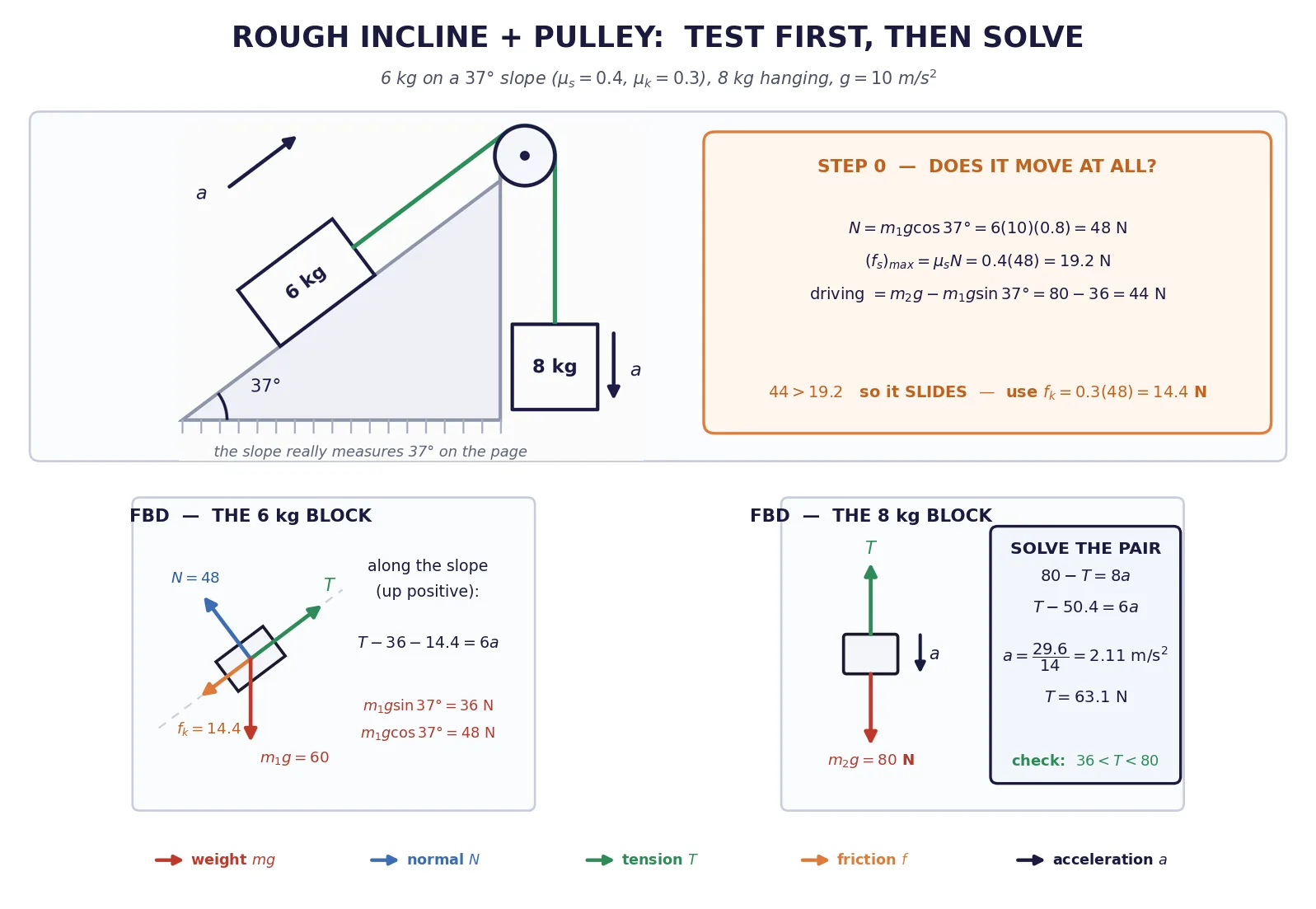
A 6 kg block rests on a incline with and . A light string from it passes over a frictionless pulley at the top and carries an 8 kg block hanging vertically. Take m/s^2, , . Does the system move, and if so with what acceleration and tension?
Solution:
Step 0 — the test. Never assume motion. Compute the three deciding quantities: The two competing pulls along the string are N (hanging block, pulling the system one way) against N (the incline block's weight component, pulling the other way). The net driving force is
Compare. , so static friction cannot hold it. The system moves: the 8 kg block descends and the 6 kg block is dragged up the slope. Kinetic friction now applies, acting down the slope (opposing the block's motion):
Two free-body diagrams. For the 6 kg block, axes along the slope with up-slope positive; for the 8 kg block, vertical with down positive:
Add them to eliminate :
Substitute back: Checks. From the other equation: and . Consistent. And the range test: — the tension lies between the two competing pulls, as it always does. After 2 s the blocks are moving at m/s.
Final Answer: Yes, it moves; m/s^2 and N.
Takeaway: Step 1 is not optional and it is not a formality. Had the hanging block been 5 kg instead of 8 kg, the driving force would have been N, which is less than 19.2 N — nothing would move, would be zero, the tension would be exactly 50 N, and friction would sit at a self-adjusted 14 N. Same diagram, completely different answer, and only the test tells you which world you are in. [JEE Tip] Compute before you write , every single time.
The last three are harder
Each of the next three chains at least two separate skills. Give each one a proper attempt before reading on — these are the level at which JEE Main and the tougher NEET questions actually sit.
Example 40: The bullet, the block and the rough floor
A bullet of mass 10 g moving horizontally at 400 m/s strikes a 1.99 kg wooden block resting on a rough horizontal floor, and embeds itself in it. The coefficient of kinetic friction between block and floor is 0.25. Take m/s^2. Find (a) the speed of the block just after the bullet embeds, (b) how far it slides, and (c) how long it takes to stop.
Solution:
Split the problem in two. This is the key move. The embedding is a collision — very fast, so friction has no time to matter, and momentum is conserved. The sliding afterwards is a friction problem. Do them in order and never mix them.
(a) Stage 1: momentum conservation. During the embedding, the only significant horizontal forces are the internal ones between bullet and block: Vector check: 4.0 kg m/s before, kg m/s after. Conserved.
(b) Stage 2: the friction phase. The combined 2.00 kg body is already moving, so there is no does-it-move test to run — kinetic friction applies from the first instant: Distance, from with final speed zero:
(c) Time:
A word on energy, for later. The kinetic energy before impact is J; just after, it is J. 796 J vanished into deforming and heating the wood. Momentum is conserved in this collision; kinetic energy emphatically is not. (Chapter 6 makes that formal — the collision is perfectly inelastic.)
Final Answer: (a) 2.0 m/s; (b) 0.80 m; (c) 0.80 s.
Takeaway: Momentum for the collision, Newton's second law for what happens next. Trying to apply conservation of momentum to the sliding phase would be wrong (friction is an external force), and trying to use during the embedding is hopeless (you do not know the force or the contact time). Recognising where one stage ends and the next begins is most of the skill. [JEE Tip] This experiment run backwards — measure , deduce — is the ballistic pendulum, a genuine method for measuring bullet speeds.
Example 41: For which hanging masses does nothing move?
A 5 kg block rests on a incline with . A light string from it passes over a frictionless pulley at the top and carries a hanging mass . Take m/s^2. Find the complete range of for which the system stays at rest.
Solution:
The three deciding quantities, exactly as in Example 39:
Realise there are two limits, not one. Friction on the incline block can point either way depending on which way the block tends to move, and the block's tendency depends on how heavy is. So there is a smallest and a largest .
The lower limit — too light, block tends to slide DOWN. Friction then acts up the slope, at its maximum, and helps the string:
The upper limit — too heavy, block tends to be dragged UP. Friction flips and acts down the slope, at its maximum, joining forces with the weight component:
The answer, and a spot check. The system is at rest for Test kg: the tension would be 20 N, so the friction required is N up the slope, comfortably under the 21.65 N available. Static, as predicted. Test kg: the string would pull with 60 N against N of resistance, so it moves. Also as predicted.
Final Answer: kg — a range more than thirteen times wide.
Takeaway: Without friction, exactly one mass balances the system ( kg — note it sits neatly in the middle of our range). Friction turns that single point into a band of half-width N in tension, that is kg about the frictionless value of 2.5 kg. [JEE Tip] Any question phrased "find the range of masses / forces for which the system remains at rest" is asking you to flip the direction of and solve twice. Solve it once and you will get half the marks at best.
Example 42: Two blocks with different friction, sliding down together
Block A (2 kg, ) rests in contact with and directly above block B (3 kg, ) on a incline. They are released from rest. Take m/s^2. Find their common acceleration and the contact force between them. Would anything change if their positions were swapped?
Solution:
First check that each would slide on its own. , which exceeds both 0.2 and 0.4, so neither block could rest on this slope unaided. Both slide, and kinetic friction acts up the slope on each.
Ask which one is "faster". Alone, each would accelerate at : A is the slippier block and wants to go faster. Since A is above B, A runs into B, they push on each other, and they must move together with a common acceleration.
Whole system first. Total mass 5 kg; total down-slope driving force minus total friction: Sanity check: . The common acceleration lies between the two solo values, exactly as it must — B slows A down, A speeds B up.
Now isolate A to get the contact force (B pushes back up the slope on A):
Cross-check on B, where the contact force acts down the slope by the third law: Consistent to the last digit.
Swap them? Put A (the slippier one) below B. A still wants to accelerate faster, so it runs away from B, and the gap opens. Contact would require a force that pulls the blocks together, and two blocks merely touching cannot pull. So they separate, and each moves with its own acceleration: A at 3.27 m/s^2, B at 1.54 m/s^2. Solving the equations for that arrangement gives a negative contact force, which is the algebra's way of telling you the same thing.
Final Answer: m/s^2 with a contact force of 2.08 N; swapped, they separate and travel at 3.27 and 1.54 m/s^2 respectively.
Takeaway: Part 6 is the examinable subtlety. A contact force can only push, never pull, so if your algebra returns a negative normal force, the correct physical answer is "they come apart" — not a negative number. [JEE Tip] The quick rule for two blocks on a rough incline: they stay together only if the upper block is the one with the smaller . Check that first, and you know whether to write one equation or two before you start.